
The short answer
The autonomous mobile robot cost for commercial laundry facilities depends on how many heavy cart moves the plant runs each shift, how far apart the washers, dryers and folding areas sit, how many shifts the robot covers, and how much mapping, integration and service the site needs. No list figure fits every plant, so a lease quote is built after a free site assessment measures those conditions on your floor. The labor saved comes from the repeated cart pushing the robot takes over, while staff keep loading, unloading and exception work.
Key takeaways
- Cart volume and route length set most of the cost for an autonomous mobile robot in a commercial laundry.
- Mapping, integration and service are the hidden costs that early budgets most often leave out.
- Repeated pushing of heavy linen carts is the injury pattern that route automation targets.
- A lease quote follows a free site assessment, so the numbers reflect your floor and your shifts.
- Start with one unit on the busiest cart route, then add units once your logs confirm the savings.
What does the autonomous mobile robot cost for commercial laundry facilities depend on?
The autonomous mobile robot cost for commercial laundry facilities depends on the cart work on your floor, not on a catalog figure. A plant that moves a few carts an hour between two machines has a very different case from one that runs carts between a wash row, a dryer bank and several folding lines through a full shift. Every lease quote we issue starts from those measured conditions.
Commercial laundry is a small slice of its category. According to First Research, linen and uniform supply has about 2,400 establishments, an analyst estimate rather than a federal count, and commercial laundry is under 5% of that category. Most plants are single sites, so each plant's floor, cart counts and shift pattern carry its own cost.
A third-party aggregator, Wagedex, citing BLS projections, reports 198,040 US workers in laundry and dry-cleaning work and 5.4% growth from 2023 to 2033. We did not verify that figure against the BLS site, so treat it as secondary. For a plant manager, the number is mainly context: laundry work is a large occupation, and cart labor is a line item most plants can measure directly.
Why do heavy cart moves matter so much?
Cart pushing is where laundry labor and injury risk overlap. According to TRSA, strains are described as the leading cause of injury in laundries, often tied to incorrect handling of large delivery carts. OSHA lists excessive reaching, pushing and lifting during laundry cleaning and transport among the causes of work-related musculoskeletal disorders.
A 2025 report from Network CSC summarizes BLS injury data, though we have not checked it against the BLS tables. For linen supply it lists 5,500 musculoskeletal disorder cases over 12 years, the most frequent category in that group, and 1,700 struck-by-cart incidents, or 8%. For industrial launderers it reports 4,540 sprains, strains and tears, or 29%, and 980 struck-by-cart incidents, or 6%.
The pattern is easy to see on a floor. The same loaded cart travels the same route many times a shift, and each stop adds reaching, turning and pushing against a heavy load. OSHA's recommended controls include cart handles, pushing rather than pulling, and mechanical aids such as auto-dumping washers. A robot on a set route removes the repeated pushing while staff keep loading, unloading and handling exceptions.
What moves the cost up or down at a commercial laundry?
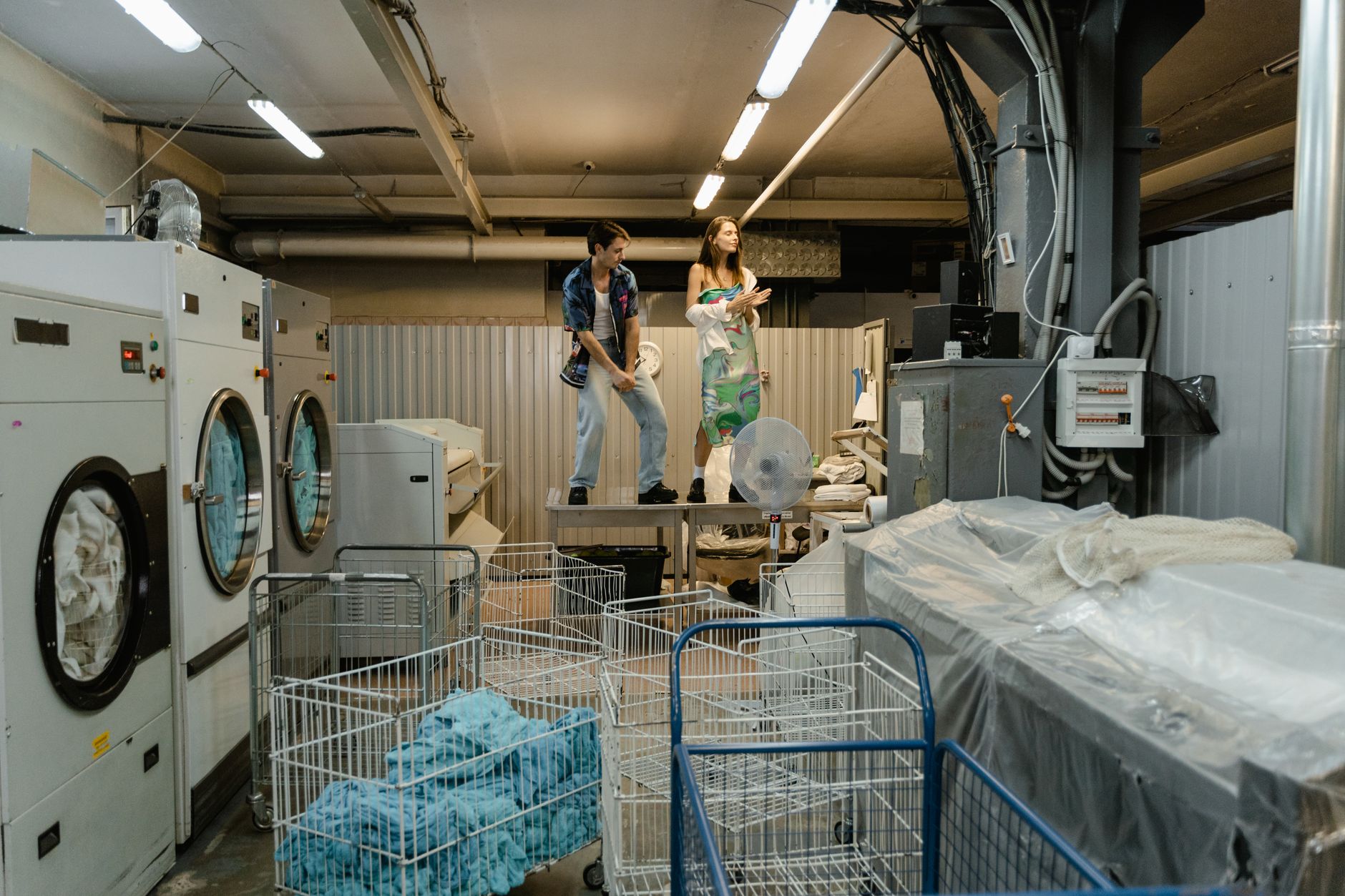
Route length and cart volume set most of the cost. Each cart move is a trip the robot must map, run and clear, so a plant with many carts on long routes needs more capacity than one with short runs between adjacent machines. Count moves per shift first, because that count shapes how many units the site needs.
Floor surfaces and transitions come next. Thresholds, ramps between building sections, wet areas near washers and staff traffic all affect how the route is set and how often the robot stops. A route through a clear, level corridor is simpler to set up than one that crosses a loading door, a drain grate and a busy aisle.
Shift count changes the work load. A robot that runs one shift and a robot that runs through the night carry different hours of use, and the plan must match that. Plants with weekend or holiday volume peaks need the route plan to allow for the extra cart moves those peaks bring.
Integration and service are the parts people underestimate. Integration means the robot's stops line up with your washers, dryers and folding stations and that each handoff is clear. Service depends on how far the plant is from our technicians and how quickly a fault needs a response. Floor area and cart counts are not published for this sector, so the site assessment measures them rather than relying on a sector average.
How many labor hours does cart work take, and how is it measured?
Labor hours in a laundry are usually measured in pounds, not in cart trips. TRSA defines pounds per operator hour as pounds delivered divided by total production hours. It also notes that operators use soil pounds, clean pounds or calculated wash weight, so comparisons only hold when the method matches.
Published productivity figures for this sector are thin. A 2026 vendor blog from Linenplus reports 55 to 65 pounds of laundry per operator hour, but it does not state its method. A before-and-after example from American Laundry News, undated, shows pounds per operator hour rising from 42 to 57. Use both as ranges to test against your own logs, not as targets.
We did not find a verified hours-per-shift figure for pushing carts, so the table below describes the work by task rather than by hour count. Cart logs from your own shifts, plus a timing study in the site assessment, set the real numbers. Those are the figures a finance team should check before comparing options.
What can the robot not do, and what do plant teams worry about?
The robot follows its routes. It does not sort mixed linen, decide that a cart is overloaded, fix a jammed dryer door, or open a machine to clear a fault. Staff still do those jobs, and the plan should say which tasks stay with people.
It also depends on a clear path. Blocked aisles, carts left in the route and floor changes that the mapping did not capture will stop runs. Plants that keep routes clear and set a simple rule for staging carts usually get steadier results than plants that leave the route to chance.
Common worries are fair. Teams ask whether the robot could collide with staff, whether it can handle the mix of carts they use, and what happens when it stops. The answers depend on the site. The myth and fact list below sets out how we handle the most common ones.
Where does the robot work inside the plant?
The robot works between the points where linen changes state. Most plants have a collection area for soiled linen, a wash row, a dryer bank, a folding area, clean storage and a dock or staging point. Each of those is a stop on a route, and the cost depends on how many stops the robot must serve and how far apart they sit.
The zones below show what the robot covers in a typical layout. Your layout may vary, and the site assessment maps your version of it before any route is set.
How does leasing through financing work, and what does the quote include?
We lease the robot through financing programs. The plant makes a fixed robot lease payment over the term rather than covering the full equipment cost at once. That payment is not a catalog figure. It comes in the written quote after the site assessment, which sets the robot count, the routes, the integration work and the service level.
A quote should list the lease term, the fixed payment, the deployment and integration work, staff training, go-live support, and the maintenance and service coverage. It should also say what happens when a unit fails, including whether a spare unit is part of the agreement. We put these terms in writing so the person who signs off can check them against the site plan.
Leasing keeps capital free for other work and lets a plant start with one unit on its busiest route before adding more. Set that against the labor hours the route takes over, which the assessment measures on your floor. A lease makes the most sense when the measured hours and the lease terms point the same way.
How do I get a quote for an autonomous mobile robot?
Start with a free site assessment. We walk the plant, record the cart moves and routes, check floor conditions and shift patterns, and map the stops. That record is the basis for the quote, and nothing is estimated from a sector average.
After the assessment, you receive a written quote with the lease terms, the included work and service, and the expected timeline. Deployment follows once the terms are signed. Integration, training and go-live support happen on site, and the first routes run under observation before the fleet takes its regular schedule.
Frequently asked questions
Want a warehouse robot at your commercial laundry facility?
Tell us about your site. We will recommend the robot, quote the lease, and keep it serviced.