
The short answer
The cobot cost for sign and display fabrication shops depends on how many stations the arm covers, how often job sizes and materials change, how much integration the tools and fixtures need, and which service terms sit in the lease. Shops that run many short jobs with frequent changeovers need more setup and fixture work than shops running long identical runs. A lease quote is set after a free site assessment, so the number reflects your floor and your jobs.
Key takeaways
- Station count and changeover frequency move the cost more than the arm itself.
- Setup, fixtures and integration are often the largest part of the scope.
- Shops in this field are numerous and skilled labor is hard to fill, so repeat finishing is a staffing question.
- Hours should come from a time study on your own runs, not from averages.
- A lease quote should list what it covers: the arm, integration, training and service.
What does a cobot cost for sign and display fabrication shops?
A cobot cost for sign and display fabrication shops is set by the work the arm takes on, the floor it has to fit, and the service the owner needs through a busy production week. Two shops with the same number of arms can get widely varying quotes. One runs long repeat cuts on a single panel size. The other runs many one-off sign faces and changes fixtures between most jobs.
Cutting and finishing are where a cobot earns its place. Trimming edges, scuffing substrate, applying protective film, handling sheets at a station and stacking finished pieces are repetitive and physical. They take staff time that could go to setup, color checks and proofing. The arm repeats the motion. People set the fixture, load the job and decide whether the finish passes.
The useful question is not only what the arm costs to lease. It is what it takes to get the arm doing productive work on your floor, and what it takes to keep it running when a rush order lands in the middle of a shift.
What moves the cost in a sign and display shop?
The biggest driver is scope: how many stations the arm will cover and whether it works one bench or moves between a cutting table and a finishing bench. Each added station brings more fixtures, sensors, guarding and integration time. A single bench doing one repeat task is a much smaller job than a line that touches several operations.
Job variety is the second driver. A shop that runs the same panel size all week needs few fixture changes. A shop that switches sizes several times a day needs new fixture positions, new paths and a check that the first piece is right after each change. Ask how often the job changes, not only how large the average run is.
Materials matter too. Glossy vinyl, acrylic, aluminum composite and painted substrates each respond to a tool or a scuffing pad in their own way. Surface finish, edge quality and coating thickness shape the tool path and the end effector, and some surfaces need tighter inspection.
Floor space, power access and traffic complete the picture. A station beside a cart route or a forklift lane needs more guarding and layout work than a station in a cordoned bay. The shift pattern matters as well. An arm that runs one day shift is scoped another way than one that supports a second shift with a smaller crew.
How many sign and display shops are there, and is labor hard to find?
IBISWorld reports 5,702 businesses in NAICS 33995, Billboard and Sign Manufacturing, for 2026, down 0.2% from 5,715 in 2025. That industry scope includes billboards, scoreboards and transit displays, so it is wider than the walk-in sign shop. IBISWorld's counts for sign and banner shops also vary between its own pages, so treat exact shop counts as approximate.
Employment has moved slowly. According to IBISWorld, US billboard and sign manufacturing employment fell 0.1% a year from 2020 to 2025. The Bureau of Labor Statistics employment index for the same code, published through FRED, was 98.190 in 2024 and 102.036 in 2025, on a 2017 base of 100. That is an index, not a headcount. The two sources cover separate periods and measures, so read them as direction, not as one trend.
The most recent headcount in this review is older. The EEOC EEO-1 aggregate for the same code reported 16,771 employees in 2006, but it covers filers only and is dated. A current count needs the newest BLS tables.
Labor is the constraint most owners describe. The International Sign Association's education director, Matt Rumbaugh, warned of a skilled labor shortage in the sign industry, saying 'There is a tsunami coming, if it isn't already here.' EBSCO, a secondary reference without a stated projection period, reports 3% projected growth for sign painters and letterers. Slow growth and a skills gap mean shops compete for the same people and should not plan on easy hiring.
Adoption is growing across automation. According to Association for Advancing Automation data, as summarized by M4S News, cobots were 18% of total North American robot unit sales. That figure covers all sectors, not sign shops, but it shows the arm is no longer a niche choice. The same summary names metal fabrication among the adoption leaders.
Where do the hours go in cutting and finishing, and what is the injury risk?
The hours a cobot can take over sit in the repeat steps, not the judgment steps. Repeat cutting, edge trimming, scuffing, film application, sheet handling and stacking are the candidates. Before asking any vendor what the arm will do, count how long each step takes per job and per shift.
No verified hour figures for sign shops turned up in this review, so the table below describes the work and the staff time in general terms, not measured hours. Measure your own runs for a week. Note how many jobs change size, how many fixture changes happen, and how much staff attention each step takes.
Repetitive cutting and handling carry injury risk. A BLS result reported in a search snippet, covering all manufacturing and not sign shops, says cuts, lacerations or punctures accounted for 15,380 manufacturing days-away cases in 2019, or 13.3% of such cases. The exact table could not be confirmed, so use it as direction. The sign-shop rate sits in the BLS injury and illness tables by industry and should be pulled there.
The savings come from hours that return to setup, color checks and quality review. The arm does not remove the need for a skilled person at the bench. It removes the repeat motion, so skilled people spend more of the shift on work that needs them.
Is a cobot worth it, and what can it not do?
Whether it is worth it depends on the hours recovered and on what the saved time is spent on. A shop that moves recovered time into setup, checks and rush work gets more from the arm than one that expects the shift to simply end earlier.
Work out the return from your own time study, the lease quote and the uptime you expect. Do not use an industry average. Compare the scope in each quote line by line, since two quotes for the same arm can cover very different work.
The arm cannot judge finish quality, read a customer's proof or decide whether a substrate is good enough. It cannot run a station without a fixture, and it cannot handle a part it has not been programmed for. It will not replace a skilled sign maker on custom work with many variables. Keep people on exceptions, quality decisions and design changes.
How does leasing through financing work, and what does the quote include?
We lease the robot through financing, so the shop does not have to tie up its own capital in the arm. The quote sets a fixed robot lease payment for the term, with the scope written out. Robots are only leased, and the payment comes in the quote after a free site assessment.
A quote should name the arm, the integration work, the training sessions, the service plan and the response times. It should say what happens during a repair and whether a spare or loaner unit is included. Ask for the scope in writing and compare scopes side by side, not just the payment line.
Our role is integrator. We pick the arm for the site, lease it through financing, deploy and integrate it, train your staff and service it nationwide. One partner handles the whole path, so there is one number to call when a station stops.
Check the term length, the options at the end of it, and what happens if the job mix changes before the term ends. Those points matter more in a shop where the work keeps shifting.
How do you get a quote after a free site assessment?
Start with the list of stations, the typical job sizes, the surfaces you finish and the shift pattern. Bring a time study if you have one. We do not quote from a brochure. The free site assessment lets us measure the floor, map each station, check power and traffic, and confirm which steps the arm should take.
The quote follows the assessment. It sets the fixed robot lease payment, the financing term, the integration scope, the training plan and the service terms. Compare it with the staff time you expect to recover and the time you still need on setup and checks.
If the scope is uncertain, start small. A single leased station with a clear repeat task is an easier first step than a full line, and it gives measured results before you commit to a second station.
Where in the shop does a cobot work?
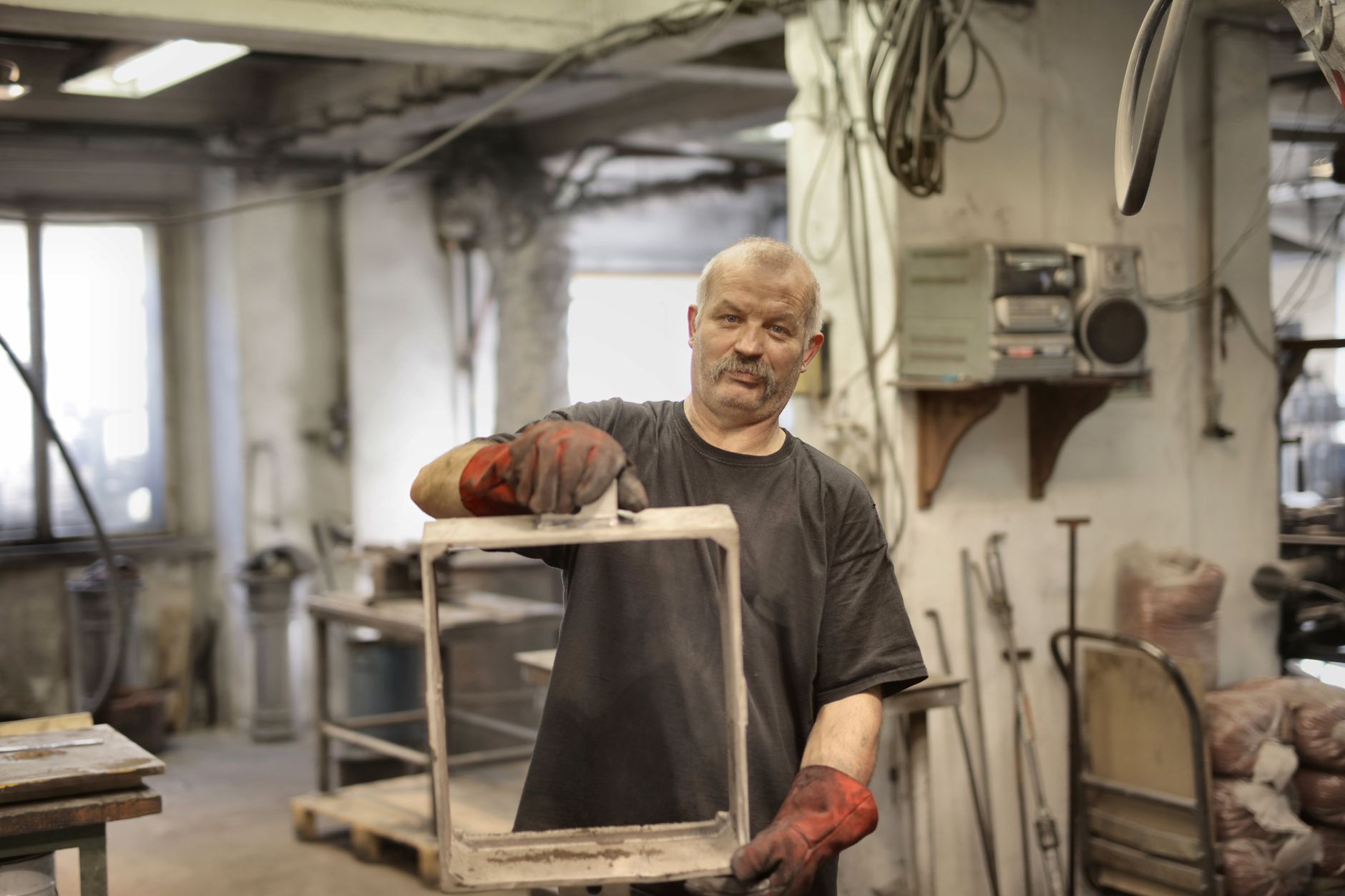
The arm works at a fixed station, not across the floor. The zones below show where the repeat work tends to sit in a sign and display shop. Each zone has its own fixture, reach and layout, and the site assessment settles which zones are in scope.
Place the arm where the repeat step happens and close to material supply and the finish check. A station far from supply tends to need a second person to move sheets, which erases part of the saving.
Frequently asked questions
Want a cobot at your sign and display fabrication shop?
Tell us about your site. We will recommend the robot, quote the lease, and keep it serviced.
Sources
- IBISWorld, Billboard and Sign Manufacturing number of businesses
- IBISWorld, Billboard and Sign Manufacturing employment
- FRED, BLS employment index for NAICS 33995
- EEOC EEO-1 2006 aggregate report, NAICS 33995
- BLS news release table osh.t03a (search snippet, not confirmed)
- EBSCO Research Starters, sign painter and letterer
- International Sign Association, skilled labor shortage
- M4S News, cobots share of North American robot sales