
The short answer
Cobot cost in Fresno, CA is set by the job the cell has to do, not by the arm alone. The main drivers are the task and cycle time, the reach and payload the arm needs, how much the cell must connect to existing equipment, the shift pattern, and the service terms, and a lease quote for a Fresno site is written only after a free site assessment.
Key takeaways
- The task and cycle time set the base, and integration with the existing line usually moves the quote most.
- Safety guarding and risk review are real cost lines, even on a collaborative arm.
- Fresno heat, with about 36 days a year at 100 degrees Fahrenheit or higher, affects enclosure and install choices.
- Hours saved are measured per cell on your line, not assumed from the job title.
- A lease quote arrives after a free site assessment, with the lease payment, term and service terms written out.
Cobot cost in Fresno starts with the task
A cobot does not have one price tag in Fresno. The figure that reaches your desk is the cost of a finished cell: the arm, the end effector, the controller, guarding as the risk review requires, installation, integration, training and the service plan. Two cells built on the same arm model can land far apart once their jobs differ.
The question to ask is what the cell costs to lease, run and keep working on your floor, not what the arm costs on its own. That is why a page like this one can only give drivers. The actual figure comes from a site assessment that measures your cycle, your line and your building.
The task and cycle time set the base. Reach and payload, integration, safety design, shift count, number of units and service level then move the figure up or down. Each one is covered below.
Why Fresno's labor data matters for the decision
Fresno County's unemployment rate was 8.2 percent, according to the California Employment Development Department release dated May 22, 2026. Nonfarm employment rose by 7,400 jobs, or 1.7 percent, between April 2025 and April 2026, according to the same release.
Food manufacturing has its own published series for the Fresno metro area. According to the Federal Reserve Bank of St. Louis (FRED), food manufacturing employment there was 15.4 thousand in September 2025 and 14.3 thousand in December 2025. FRED reports that series not seasonally adjusted, so part of that drop is the normal seasonal pattern and should not be read as a trend.
Seasonal swings like this make a repetitive shift harder to staff on a steady basis. A cell does not solve that by itself, but it gives a plant a fixed set of hours it can plan around, which is easier to budget than a shift that depends on who is available in December.
Nationally, the International Federation of Robotics says new collaborative robot installations reached 66,000 units globally in 2025, or 11 percent of all industrial robot installations, according to its president's report. According to The Robot Report's summary of IFR data, U.S. industrial robot installations rose 11 percent year over year to 38,000 units in 2025.
What moves the cost up or down at a Fresno site
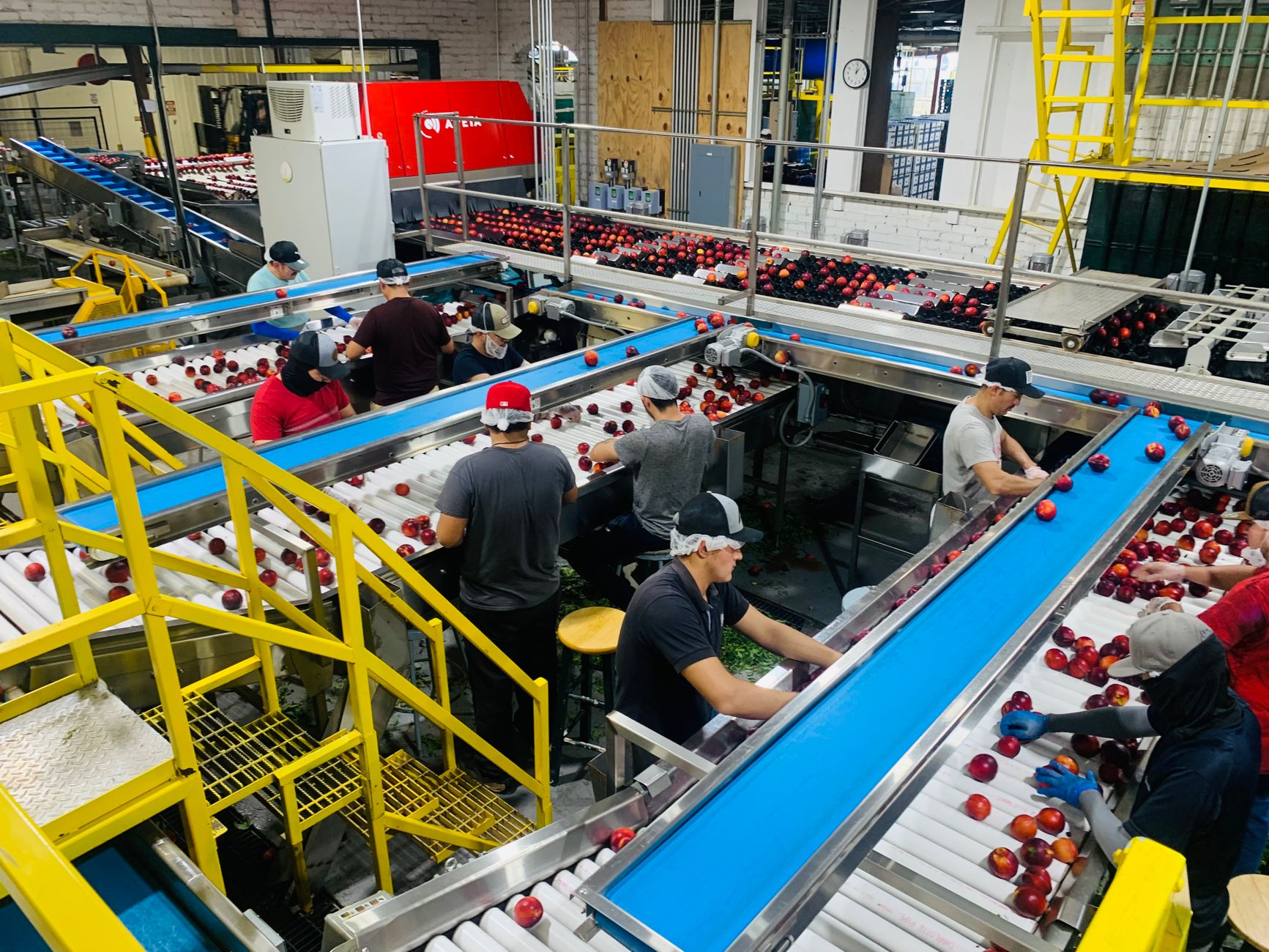
The task sets the base. Palletizing needs reach and payload sized to the case weight and stack pattern. Machine tending needs a fixture, a clean interface to the machine and a review of the machine's own hazards. Packing at the end of a line may need a sensor or camera to find product orientation, which adds hardware and programming time.
Integration with what is already on the floor is usually the largest swing. A cell that takes signals from an older controller on a packaging line, or must match conveyor speed, needs more engineering than a stand-alone cell with its own pallet station. Ask which machine controls the cell has to talk to before anyone agrees to a number.
Safety design is a cost line plants underestimate. A collaborative arm can work near people at lower speeds and forces, but the cell still needs a risk assessment, and depending on speed and task it may need guarding, scanners or light curtains. That work belongs in the quote, not added later.
Shifts and uptime change the service design. A cell on one shift can tolerate a next-day visit for some faults. A cell on two or three shifts, or one feeding a line that cannot stop, needs faster on-site dispatch and a spare unit or backup plan.
Number of units spreads fixed work. Programming, training and spare parts are largely the same for two cells on one line as for one, so the cost per cell often falls as the count rises. A single pilot cell carries all of that setup on its own.
Product changes add programming time. Each new pack size or SKU can mean a new program, a new fixture or a changed gripper. Plants that change packs every week should count that time when they compare options.
How Fresno heat and building stock affect the install
The National Weather Service Hanford office puts Fresno at about 36 days a year at 100 degrees Fahrenheit or higher, as quoted in a local news report. The same report cites a low of 15 such days in 1956 and a high of 63 in 1984.
For a cell, heat matters most in two places: the controller and any enclosure, and the building itself. An older metal building with no mechanical cooling can push a cell past the temperature range in its specification on the hottest afternoons. Check the rated operating range for each component, then ask how the install handles it: a cooled or shaded enclosure, a location away from the hottest wall, or a schedule that moves the heaviest work to cooler hours.
Food and packing areas add washdown and dust requirements. Those set the enclosure rating and cleaning schedule for the cell, and they can change the cost of the guarding and cabinet. Tell the assessor which areas get hosed down and how often.
How leasing through financing works and what the quote includes
The business leases the cell through a financing program. The lease carries a fixed robot lease payment for the term written in the quote, so the budget line is known before the cell goes in. Financing is the reason a plant can start with one cell instead of committing its own capital to the whole line.
A lease quote is issued only after a free site assessment. Before that visit, any figure you hear is a range, because the arm, guarding, integration and service plan all depend on your floor.
The quote lists the arm and configuration, the controller and end effector, guarding as the risk review sets it, installation and integration, operator and maintenance training, go-live support, the service plan terms, the lease term, the lease payment, end-of-term options and anything excluded. Read the exclusions first.
How many labor hours a cobot takes over
Labor hours depend on cycle time and shift length, so the table below is a method, not a set of typical hours. Time the task on your line across a full shift before you ask for a quote. The assessor will take the same measurement during the visit.
Hours taken over are not the same as heads removed. A cell on a shift still needs a person to load and check parts, clear faults, swap bins and sign off quality. The staffing change is the slice of hours that moves from a person to the arm. Injury data gives another reason to look at repetitive handling: the BLS chart lists manufacturing at 2.7 cases per 100 full-time workers, and the version reviewed does not state the year.
Hard-to-fill repetitive work is not limited to factories. Nationally, the BLS Occupational Outlook Handbook counts 2,447,700 janitors and building cleaners in 2024 and projects 2 percent growth from 2024 to 2034, which it describes as slower than average. Where a repetitive task is hard to staff, the value of an arm often lies in holding those hours steady.
What a cobot cannot do
A cobot repeats a defined motion well. It does not judge a product it has not been taught to see, unless vision and the program cover that case. Once the program is set, a change in part shape or position usually means a reprogram or a new fixture.
It is fixed to a base or a station. It does not move between buildings or across a plant floor on its own, so it does not replace a forklift or a mobile robot for moving pallets between zones. It cannot repair an upstream jam, a bad fixture or a poorly fed conveyor, and it stops when its safety system sees a person in the zone.
It is a poor fit for heavy loads beyond its rating, for work that needs fast hand finishing, and for lines that change products several times a shift without programming time set aside. Being direct about those limits is the fastest route to a decision that holds up.
How to get a quote after a free site assessment
Start with the numbers that drive the quote: cycle time, shifts per day, product changes per week, and the bottleneck the cell would relieve. Add photos of the work area and of each machine interface the cell would touch.
The site assessment measures floor space, power and network, the safety zone, heat and dust exposure, and the integration points. From that we select the arm and configuration for the site and write the quote.
When the quote arrives, check the term, the fixed robot lease payment, the service plan terms, on-site dispatch, spare unit coverage, and what happens if your line cannot stop. A quote that answers those questions can be compared on the same basis as any other option.
Frequently asked questions
Put a robot to work in Fresno.
We walk your site, learn the job, and recommend the unit that fits. Then we quote the lease, deploy it, and keep it serviced.
Sources
- California Employment Development Department, Fresno County labor market release
- FRED, Federal Reserve Bank of St. Louis, Fresno food manufacturing employment
- U.S. Bureau of Labor Statistics, injuries and illnesses by industry chart
- U.S. Bureau of Labor Statistics, Occupational Outlook Handbook, janitors and building cleaners
- International Federation of Robotics, President's report
- The Robot Report, summary of IFR U.S. figures
- National Weather Service Hanford office, days at 100 degrees Fahrenheit