
The short answer
Cleaning robot ROI for data centers comes from scheduled floor scrubbing of large, flat, low-traffic hard floors during quiet hours, which takes repetitive janitor-type work off staff without pulling them away from critical systems. The savings range depends on how many hours of that work the robot takes over, what share of it the robot realistically handles on a given floor, and the lease cost quoted after a free site assessment. Treat any range as an estimate until the floor has been measured.
Key takeaways
- The return comes from janitor-type floor hours moved into quiet windows, not from cutting operations staff.
- Usable floor area, obstructions and traffic set how much of the work a robot realistically takes.
- Measure current cleaning hours and floor area before trusting any savings range.
- The lease cost is quoted after a free site assessment, so the range firms up only with site data.
- Expect a phased start with one or a few units in a single hall before scaling.
Run the numbers for your site
Pick your city or state for a real regional number - we use the real BLS wage there. (On the live site this auto-detects from your location.)
What do you want to automate?
The robot runs the open floor overnight; your crew keeps detail and edges.
What is cleaning robot ROI for data centers?
Cleaning robot ROI for data centers is the balance between the labor hours a robot takes over and the lease cost of running it, measured across the scheduled floor work at one site. The setting is unusual. A data center holds few people relative to its size and a lot of raised floor, cabinets and cooling equipment, so the floor work is large, repetitive and largely predictable.
The number of these sites is large. ABI Research counts 2,396 operational US data centers in 2025, with 17.2 GW of active IT load, and notes that its figure may exclude smaller sites. Any count of that size means floor plans differ widely, which is why the savings range on this page depends on a site survey rather than a national average.
The return is not a story about cutting operations staff. Critical facilities need trained people on site, and a robot does not replace them. It takes the floor scrubbing that would otherwise be squeezed into short gaps by whoever is free, or into blocks that pull people away from their own duties.
How much floor does a cleaning robot actually cover?
Typical white space, the room that holds the servers, runs from a few hundred square feet to about 100,000 square feet, according to a data center glossary. Support areas, corridors, electrical rooms and staging space often add to that. The usable hard floor is what matters, and it has to be measured because the glossary range is wide.
Not all of that floor suits a scrubber. Raised floor tiles, cable trays, cabinet bases and tight cold aisles limit where a machine can run. A useful assessment maps the open, flat, continuous hard floor separately from the areas that need hand work, and the zones below show the usual split.
Median hourly wage, Janitors and Building Cleaners
$4,041
Monthly cost of one full-time worker, at the median wage plus payroll costs (an estimate, not a quote).
Who works in a data center, and who does the floor cleaning?
Staffing varies widely. Data Center Knowledge gives a guide estimate that a small critical facility runs one to two qualified operators on site around the clock, though that is not an audit. Larger sites carry more people. The same source reports that one large site in Washington state reportedly employs 50 full-time staff, and a site in Nevada reportedly had 73 permanent employees.
One analysis cited by the same source says about half of the on-site workforce is often contract staff. That matters for cleaning, because contract crews may not be on site during the quiet window. The research for this page did not find a published janitorial headcount for data centers, so the typical headcount shown with this page uses the one to two operator figure as a floor, not a measured crew size. Confirm the real crew at the site.
On the government side, the BLS Occupational Outlook Handbook reports 2,447,700 janitors and building cleaners employed in 2024, with employment projected to grow 2 percent from 2024 to 2034. The government wage data for this job sits in the panel beside this text, and the labor side of any savings range is priced on it. Operators and other data center staff are not priced here, because the robot takes janitor and building cleaner work off their plate, not their own jobs.
How does the savings math work?
The return has three inputs. The first is the hours of janitor and building cleaner work the robot takes over each week, meaning the scheduled, repeatable floor work. The second is the share of that work the robot realistically handles on the surveyed floor, since some areas still need hand work. The third is the lease cost, which is quoted after a free site assessment and is not stated on this page.
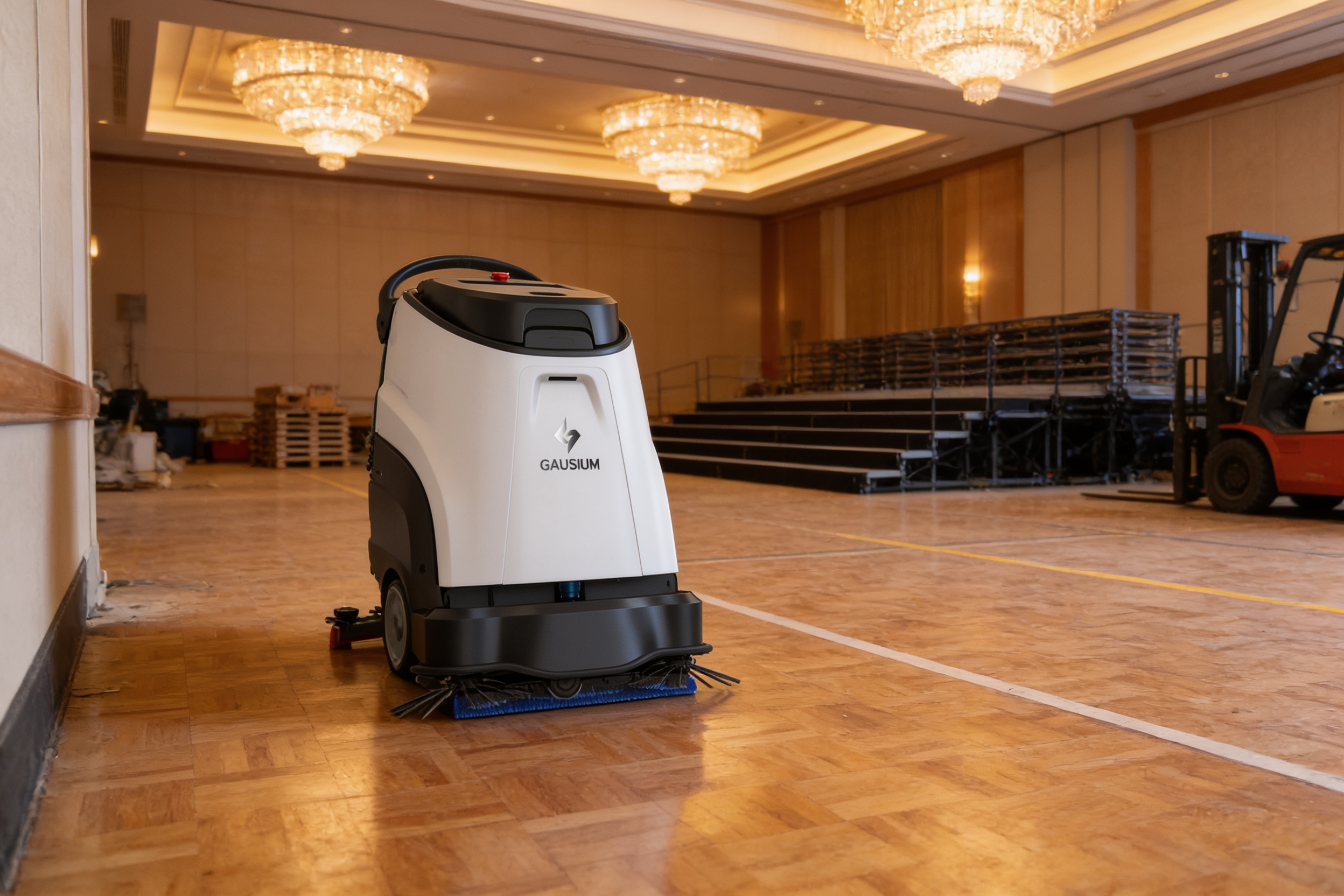
Coverage rates set the first input. A retailer listing gives roughly 17,000 to 22,000 square feet per hour for 18 to 20 inch walk-behind scrubbers. Listed and manufacturer figures are theoretical maximums under ideal conditions. A vendor listing for a comparable 30 inch machine reports a practical productivity of 31,485 square feet per hour against a 47,500 square foot cleaning rate, so the practical figure runs about two thirds of the rated one on that machine.
Worked through for a hypothetical 20,000 square foot hard floor, the practical figure gives about 38 minutes of machine time per pass, before setup, turns and any hand work. Obstructed floors take longer, which is why the survey measures usable area rather than the floor plan. The staff hours that the machine time replaces are then priced on the government wage data for the job, and the quoted lease cost is subtracted to give a range.
What changes the number up or down?
A few site facts move the range. Clear, flat, continuous hard floor raises the share of work the robot takes, while obstructions, frequent cable crossings and tight cabinet rows lower it. A long, steady quiet window helps, and short or broken windows reduce the hours that can be scheduled.
Current hours matter more than most people expect. If floor cleaning is done in small pieces by staff who are otherwise busy, the saving is harder to pin down than when there is a clear weekly block. The checklist below lists what to confirm before deciding.
Is a cleaning robot or a person better for this work?
A robot does not replace the judgment a person brings. It runs the same scheduled pass at the same speed, in hours that would otherwise need staff, and it is not pulled into other tasks. People still win on spills near equipment, unusual debris, access decisions and anything that needs a hand tool.
The robot earns its place on the repeatable pass, and people keep the exceptions. The site assessment should confirm that split before any lease is signed.
- Night coverage
Cleaning Robot
Runs the scheduled pass in quiet hours without fatigue
Staff
Available only if the shift has time for it
- Consistency per pass
Cleaning Robot
Same route and speed on every run
Staff
Varies with the person and the day
- Tight spaces and cable trays
Cleaning Robot
Limited by machine footprint and mapped exclusions
Staff
Can work into tight spots with hand tools
- Spills and unusual debris
Cleaning Robot
Needs a person to clear and reset
Staff
Handles it on the spot
- Judgment near live equipment
Cleaning Robot
Follows mapped rules only
Staff
Can stop and decide
- Adding more coverage
Cleaning Robot
Repeats the same route across the same hours
Staff
Each added hour needs another person's time
What are the risks to the return, and how do you avoid them?
The biggest risk is counting hours that were never spent on the floor. If the staff time the robot is meant to replace was scattered or already allocated elsewhere, the payback slips. The second risk is an obstructed floor that needs more hand work than the survey assumed. The third is downtime with no fallback, which leaves the scheduled pass undone on the nights it matters.
Safety is the other side of the ledger. The BLS Survey of Occupational Injuries and Illnesses reports 2.3 cases per 100 full-time equivalent workers across all private industry in 2024. A scheduled machine running during quiet hours keeps cleaning out of the way of people in active work areas, but the machine and the people who check it still need clear procedures and training.
Adoption is still early. An AACEM and ISSA survey fielded in winter 2019 described adoption as being at an infant stage, with about one-third of non-adopters somewhat likely to adopt within a year. That survey is older than most current fleets, so treat it as context rather than a current rate. To avoid the main risks, measure first, start with one or a few units in a single hall, and set service and spare unit coverage in the lease quote before go live.
What is the timeline from assessment to payback?
A realistic path runs in phases. The first step is the free site assessment, which maps the usable floor, measures current hours and sets the zones. The second is the lease quote and the financing decision. The third is deployment, integration and staff training, followed by a go live period in which the schedule is checked against real runs.
Payback depends on how quickly the machine takes over a steady share of the work. This page does not state a payback period, because it depends on the surveyed hours and the quoted lease cost. Plan for the go live period to review the first runs and tune the schedule before the savings range is treated as settled.
Once in service, the work runs on a set schedule during quiet hours, with staff checking each run at start and end. Compare the hours taken over against the survey at regular intervals, and update the zone map when the floor changes, such as when new equipment goes in.
How do you get a precise figure from a free site assessment?
A precise figure comes from the site, not from national averages. Our team starts with a free site assessment that maps the hard floor, flags obstructions and access rules, and measures the hours the work takes now. We pick the right robot for the floor, lease it through financing, deploy and integrate it, train the staff and service it nationwide.
The lease payment is quoted after that assessment, so it is not shown on this page. The right unit and terms depend on the floor. Bring floor drawings, the current cleaning schedule, the length of the quiet window, and the names of the staff and contract crews who work the floor. With those, the range on this page can be replaced with a figure for your own site.
Frequently asked questions
Want a cleaning robot at your data center?
Tell us about your site. We will recommend the robot, quote the lease, and keep it serviced.
Sources
- US Bureau of Labor Statistics, Occupational Employment and Wage Statistics (OEWS May 2024)
- ABI Research, top data center companies in the United States
- Data Center Knowledge, data center staffing and on-site headcount
- BLS Occupational Outlook Handbook, Janitors and Building Cleaners
- BLS Survey of Occupational Injuries and Illnesses, 2024 release
- ISSA, AACEM autonomous cleaning survey
- Quill, floor scrubber listings
- Elite Metal Tools, automatic scrubbers listing
- Sunbird DCIM glossary, data center white space