
The short answer
For a business in Cleveland, OH, cleaning robot ROI comes from the janitor and building cleaner hours the robot takes over, priced at the local wage for that job, minus the fixed lease payment and any staff time the robot still needs. The savings range on this page is a computed estimate, not a promise, and it moves with how much of the floor a robot can cover, how many shifts run, and how many hours are already lost to overtime or open shifts. A free site assessment turns those inputs into a quoted lease and a tighter range.
Key takeaways
- The return is janitor and building cleaner hours the robot takes off the schedule, priced at the local wage for that job.
- Only the share of floor a robot can cover on its own counts, so the savings figure is always a range.
- Overtime and open shifts create the most value, but only when those hours are real and recurring.
- The lease payment is quoted after a free site assessment, and payback timing follows from that quote.
Run the numbers for your site
Auto-detected from your location - we use the real BLS wage here. Not right? Pick your city or state above.
What do you want to automate?
The robot runs the open floor overnight; your crew keeps detail and edges.
How much can a cleaning robot save in Cleveland, OH?
A cleaning robot in Cleveland, OH pays back by taking floor work off a payroll that is hard to fill. The savings range on this page is computed from the hours the robot can realistically take over, priced at the government wage data for janitors and building cleaners in the Cleveland metro, then reduced by the fixed lease payment and any staff time the robot still needs. It is a range, not a promise, because the number depends on your floor, your schedule and your existing staffing gaps.
Read the range as the case for hours a robot can own. A site with open overnight shifts, heavy overtime or a large hard floor will usually sit higher in the range than a site where a steady day crew already covers the scrubbing. The page does not assume a headcount cut. It assumes the robot does part of the work your staff now do, or part of the work you cannot staff at all.
Most of the value comes from consistency. A scheduled route runs the same way every night, which makes the hours easy to count. The harder part is the share of the floor the robot can take, which is why the free assessment matters more than any general estimate.
Where does the return come from in this setting?
The return comes from the hours of janitor and building cleaner work a robot takes over. According to the Bureau of Labor Statistics Occupational Outlook Handbook, janitors and building cleaners held about 2.4 million jobs in 2024. The same source projects growth of 2 percent from 2024 to 2034, which is slower than average, and about 351,300 openings a year, including openings from workers who leave the occupation and must be replaced. For an operator in Cleveland, that points to steady hiring need even though the occupation itself is not growing fast.
The local side of the math comes from the Bureau of Labor Statistics May 2024 Occupational Employment and Wage Statistics release for the Cleveland metro. The wage for this job is shown in the panel beside this text, and the calculator applies it to the hours in scope. We did not confirm a typical headcount for one Cleveland site of this kind, so staffing is treated as an input you verify during the assessment.
Two kinds of hours carry the value: the ones you already pay for through overtime, and the ones that go undone when a shift is not filled. Both are real costs, even when they hide inside other budget lines.
Median hourly wage, Janitors and Building Cleaners
$3,955
Monthly cost of one full-time worker in Cleveland, OH, at the median wage plus payroll costs (an estimate, not a quote).
How is the savings math worked out?
The calculator starts with the hours of floor work in scope. A JLL-linked productivity study uses 5,000 square feet per janitor per eight-hour day as a baseline, with a median of 4,939 across the sites it surveyed. A consultant estimate for large Class A and B metro offices puts productivity at 4,500 to 6,000 square feet per hour per worker. These use other units, and neither is a standard, so use them to size the work, not to promise hours.
Take a hypothetical 40,000 square foot hard floor. At the JLL baseline, one full cleaning cycle is about eight eight-hour days of janitor time, and that covers all cleaning tasks, not only scrubbing. The robot takes only the share of that area it can cover on its own, so the first step is sorting the floor into what a robot can run and what stays with people.
The formula is simple. Hours the robot takes over, multiplied by the local wage for the job, gives the labor value. Subtract the fixed lease payment, plus any supervision time the robot still needs from your staff, and the remainder sets the savings range. The range narrows as the assessment replaces these planning anchors with measured area and measured schedule hours.
What changes the number up or down?
Four things move the range most: how much floor a robot can cover without help, how many hours crews already lose to overtime or open shifts, the shift windows the robot can run in, and the lease term. A site with clear, wide aisles and few obstacles can route the robot over more of the floor. A site with heavy furniture, loading dock transitions or frequent spills keeps more work with people, and that shrinks the share the robot takes over.
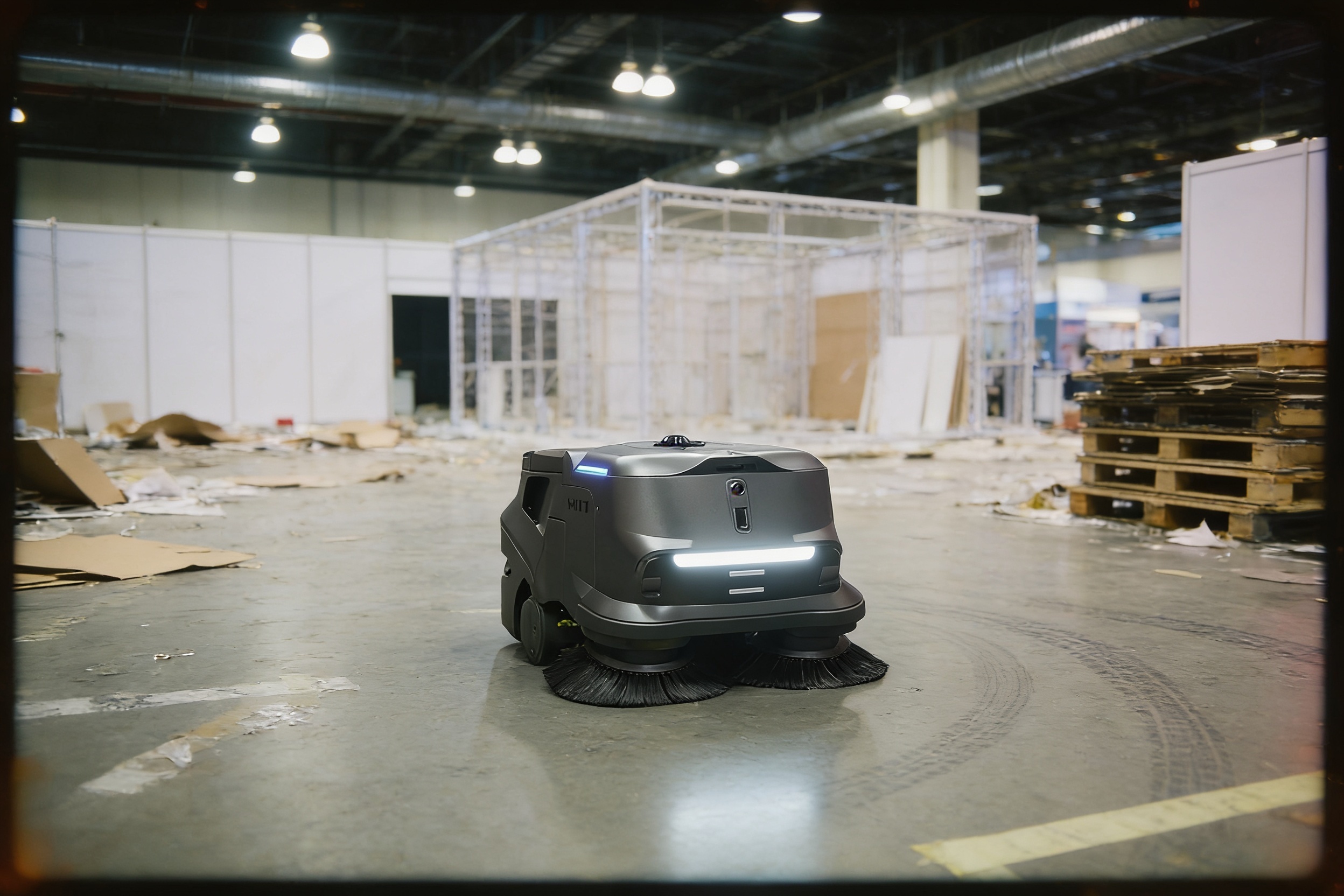
Shift windows matter more than many operators expect. A robot that runs overnight takes hours outside the day crew's schedule, which is valuable when those hours would otherwise be paid as overtime or left undone. A robot that only runs during the day competes with staff for the same hours and offers a smaller offset.
How does a cleaning robot compare with a person on this work?
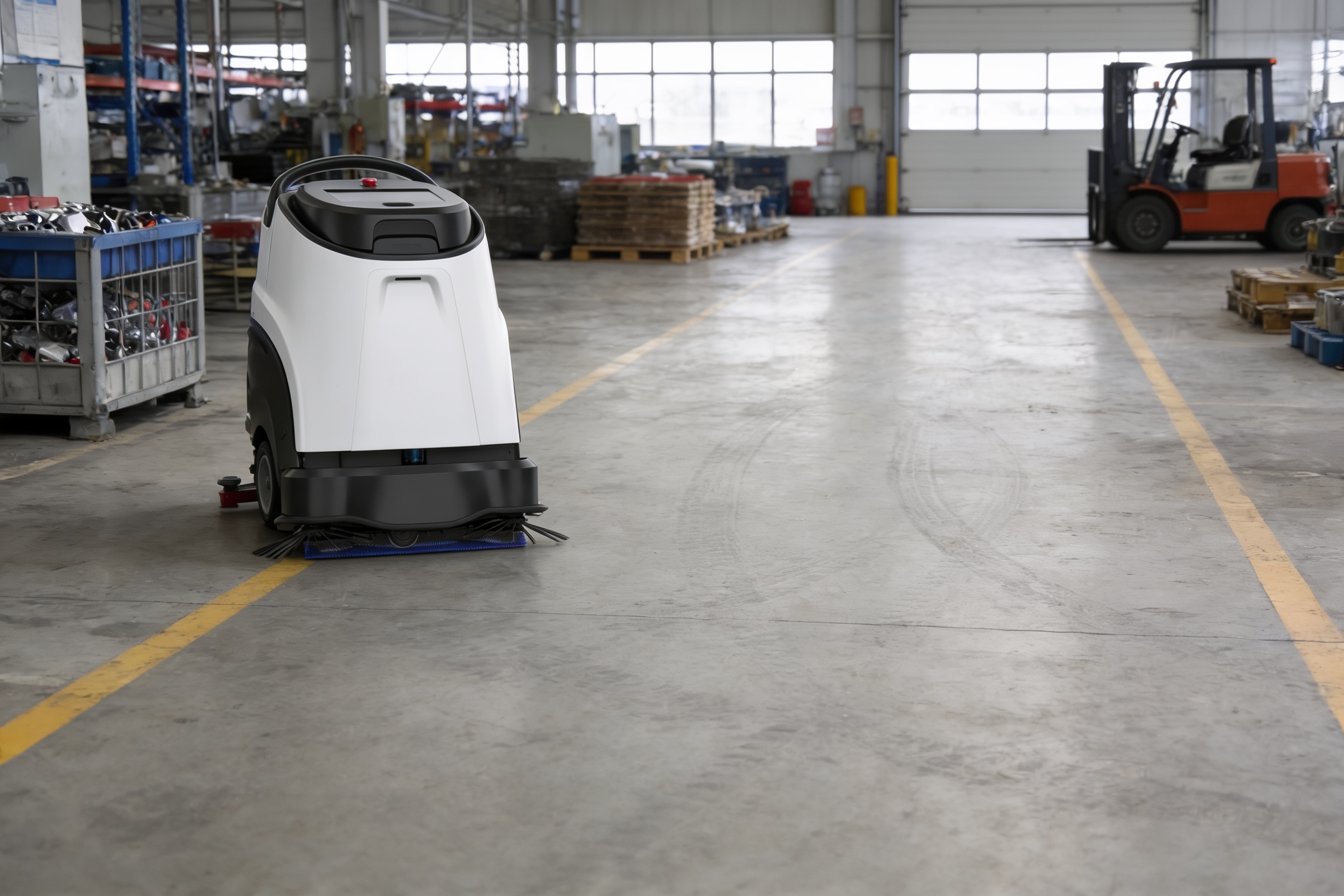
The robot does not do everything a person does, and this comparison is meant to be direct. A robot is strongest where the work is repetitive, large and scheduled, such as a long hard floor pass at night. A person is stronger where the work needs hands, judgment or a fast response to something unexpected.
Most sites that succeed with a robot keep their staff. The people shift toward restrooms, detail work, trash, spills and exceptions, while the robot covers the floor pass. That split is what keeps the savings range honest.
- Night coverage
Cleaning Robot
Runs the scheduled route with no operator once mapped
Staff
Needs a paid shift, a supervisor and breaks
- Consistency on a long route
Cleaning Robot
Follows the same path and pressure on each pass
Staff
Varies with fatigue, pace and crew size
- Detail and hand work
Cleaning Robot
Does not clean restrooms, detail edges or handle trash
Staff
Handles restrooms, fixtures, spills and trash well
- Unexpected obstacles
Cleaning Robot
Stops or reroutes, and a person must clear the obstacle
Staff
Adapts on the spot
- Hiring and turnover
Cleaning Robot
Does not turn over, but needs a trained operator for checks and exceptions
Staff
Requires steady recruiting, since openings recur each year nationally
What risks can weaken the return, and how do you avoid them?
The biggest risk is overestimating the scrubbable share. If the floor is more cluttered, more broken up or more often changed than the plan assumed, the robot runs fewer hours and the range falls. Avoid this by mapping the site and testing the route before the quote is final, and by treating the first stretch of operation as measurement rather than proof.
The second risk is idle time. A robot that waits in a closet during open shifts earns nothing. Plan the schedule around the hours you are actually short of, and confirm that the route matches the shift windows you pay for. Ask how the robot handles stairs, thresholds and elevators, since any area it cannot reach stays with staff.
The third risk is safety and exposure. A third-party summary of Bureau of Labor Statistics injury data reports 2.5 recordable injuries and illnesses per 100 full-time workers in janitorial services in 2024. That is a secondary figure, so check it against the BLS table before you rely on it. Fewer hours of manual scrubbing may reduce exposure, but this page does not claim a measured reduction.
The fourth risk is downtime. A single unit out for repair means a lost shift of floor coverage, so ask how fast a failed unit is replaced and whether loaner coverage is part of the lease. Service and replacement terms belong in the written quote, not in a footnote.
How long does it take to reach payback?

Payback depends on how fast the robot is deployed and how steady the hours are. After a site assessment, the usual path runs through a written quote, a floor map, route testing, staff training and a go live period in which the route is tuned. The first weeks are for measurement, and the savings range narrows as real run hours replace estimates. The exact timing depends on your site and deployment plan, and the quote sets the schedule.
Service Robot Co. selects the robot for the site, leases it through financing, deploys and integrates it, trains your staff and services it nationwide. One team handling selection, deployment and service keeps the go live plan simple. A common approach is to start with one unit on one floor, measure the hours it actually runs, then decide on a wider rollout. That keeps the payback question grounded in measured results.
Expect the payback calculation to be revisited at least once after go live. Early run hours may differ from the plan, and the range should be updated with real numbers rather than the original estimate.
What is happening with adoption and staffing across the trade?
Building service contractors are moving toward robotic floor equipment, though not all at once. A 2026 Building Service Contractor Market Study, as reported in a Nassco press release, found about 32 percent of contractors plan to adopt robotic floor equipment within 12 months, roughly double the 2025 share. The same release says 44.6 percent expect labor challenges to grow. That source is vendor issued and self reported, and the 2025 and 2026 samples and questions differ, so read the trend as direction rather than precise change.
A separate CMM 2026 benchmarking survey reports that 85 percent of contractors plan to add staff in 2026, while 23 percent have no plans to adopt new technology within the next year. Those two findings show the trade hiring and automating at the same time. That combination fits a robot that covers hours staff cannot fill, rather than a plan to replace a whole crew.
An older AACEM and ISSA autonomous cleaning survey, from 2019 and sent to nearly 23,000 contractors and facility managers, described adoption as early stage. About one third of non-adopters said they were open to adopting within a year. Newer surveys are more useful for planning, so weight the 2026 figures above it.
How do I get a precise figure from a free site assessment?
A free site assessment replaces the planning anchors on this page with your numbers. Bring the floor plan or square footage for each area, the cleaning schedule, the hours your crews work, and the overtime and open shift hours you carry. Note the floor surfaces and any thresholds, ramps or elevator stops the route would need to cross.
The assessment maps the floor, measures the scrubbable share and confirms which areas stay with staff. The output is a written quote with the fixed lease payment, a route plan, a training outline and a savings range built from your hours and the local wage data. Ask for the range to show the low case as well as the midpoint, and ask what happens when a unit is down.
Service Robot Co. quotes the lease after the assessment, not before, because the right robot, route and term depend on the floor. Bring your list of questions, and expect the quote to name the assumptions it uses so you can check each one against your own records.
Frequently asked questions
Put a robot to work in Cleveland.
We walk your site, learn the job, and recommend the unit that fits. Then we quote the lease, deploy it, and keep it serviced.
Sources
- US Bureau of Labor Statistics, Occupational Employment and Wage Statistics (OEWS May 2024)
- BLS Occupational Outlook Handbook: Janitors and Building Cleaners
- BLS Midwest regional release: Occupational Employment and Wages, Cleveland metro, May 2024
- Nassco 2026 Building Service Contractor Market Study (press release, via Webull)
- CMM 2026 Building Service Contractor Benchmarking Survey Report
- FMLink: AACEM/ISSA autonomous cleaning survey (2019)
- CMM: What does cleaning cost (consultant productivity estimate)
- Clean India Journal: JLL-linked janitorial productivity study