
Key takeaways
- Autonomous mobile robots for lumber yards take over the repeat carries between saws, racks, staging and loading bays.
- Labor shortages ranked second for U.S. softwood lumber producers, named by 43 percent of respondents.
- Savings come from hours counted in your own yard, not from a headline figure from another site.
- The model is a robot working with a smaller team, never zero staff, and the robot cannot grade boards.
- Start with a free site assessment, then receive a lease quote through financing.
See what a autonomous mobile robot costsRun the numbers in the ROI calculator
What can autonomous mobile robots for lumber yards do?
Autonomous mobile robots for lumber yards take over the repeat carries that people make all shift: stacked boards and bundles moved from the saw outfeed to sorting racks, from racks to staging, and from staging to the loading bays. Each robot follows a mapped route, picks up a load at a defined point, and sets it down at the next one.
For the operator, the gain is a steadier flow between zones more than any single fast trip. Fewer manual lifts and fewer waits at the handoffs keep the saw line and the trucks supplied. The job fits this kind of robot when the same moves happen every shift between areas that stay in place.
We are a US commercial robot integrator. We pick the robot that fits your site, lease it through financing, deploy and integrate it, train your staff and service it nationwide. The rest of this page covers where the robot earns its place in a yard, what it cannot do, and how to start with a free site assessment.
What problem does this solve at a lumber yard today?
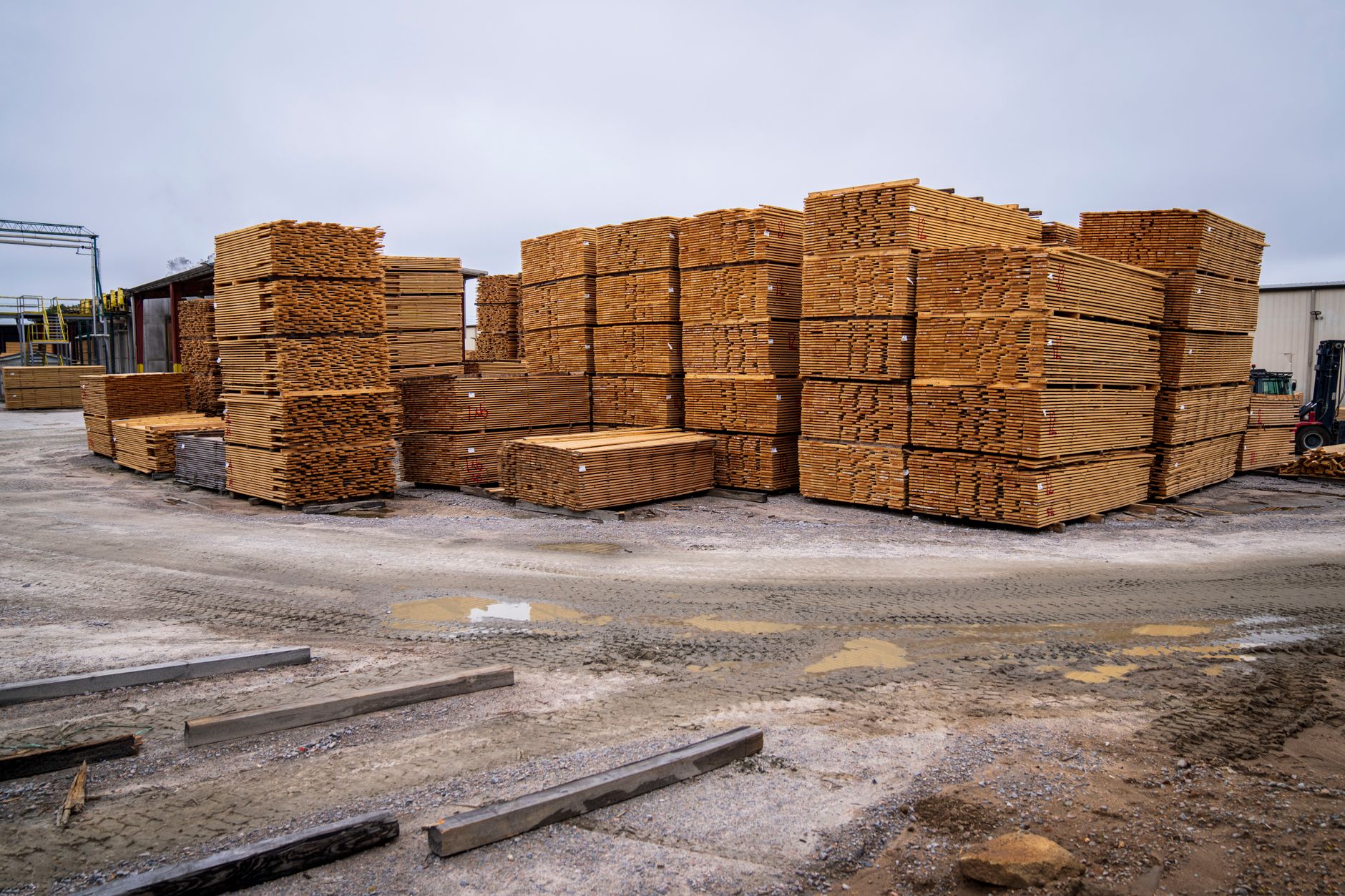
At most yards, stacked boards and bundles still move by hand or on a forklift with a crew, between the saws, the sorting racks and the loading bays. Each handoff means a lift, a walk and a wait for the next free person. These moves add nothing to the wood itself, yet they pull people away from grading, stacking and loading.
Operators of this kind of place form a large group. According to a third-party market research estimate, there were 34,448 lumber and building material stores in 2026, a decrease of 1.1 percent from 2025. Any yard that stacks and moves material every day faces the same handoff problem.
Staffing makes the problem harder. In a 2026 outlook survey of about 130 U.S. softwood lumber producers, labor shortages ranked second, named by 43 percent of respondents, behind flat lumber markets at 53 percent. Respondents also said finding skilled staff gets harder as equipment becomes more automated and complex. That survey covered sawmills rather than retail yards, but the squeeze on hands for material handling is close to what a yard faces.
What are the main benefits for a lumber yard?
The first benefit is fewer manual handoffs between defined zones. Each load runs on a route the robot knows, so the saw outfeed, the racks, the staging area and the bays get a steady supply instead of a stop and go crew.
The second is less strain on people. A vendor case study from a factory, which published no figures, reported that robots carrying heavy material on fixed routes reduced worker strain and fatigue. A yard that lifts heavy bundles all shift has the same exposure, and every carry the robot takes is one fewer lift for a person.
The third is consistency at the edges of the shift. The robot runs the same route at the end of a shift as at the start, so loading bays do not go short when a crew is pulled to another job. Staff time goes to the stacking, grading and checks that need a person.
How does the robot work there day to day?
A typical day starts with the robot at its charging point and a load list set by a supervisor. The robot takes the first pickup, carries it along its marked route, drops it at the next zone, and returns for the next job. Routes come from the site survey, so the robot follows the same mapped lanes every shift.
Crews and forklifts still operate in the yard, so the site plan separates robot lanes from manual traffic and marks where people and robots cross. A 2022 research review of autonomous machines in mill yards of the forest industry described the environment as dynamic and complex, with processes that are partly unstructured. That is why the route plan and the crossing rules get so much attention before go live.
Supervisors watch the robot's status, clear a blocked route and call for help when a unit stops. The robot becomes part of the daily flow rather than a separate project.
Which areas of the yard does the robot work in?
The robot works wherever material moves on repeat routes between defined zones. Six areas are common in a lumber yard, and each has a clear start point and end point, which keeps the route simple. The zones below are the usual candidates.
Areas that change layout often, or that mix loose material with heavy equipment, need more planning before a route is set. During the site assessment we map each zone, mark the crossings, and decide which zone makes a good first route. Starting with one zone and one route is the safer way to learn the yard, and a second zone can be added once the first runs cleanly through a few shifts.
How does the robot work alongside existing staff?
The robot does not replace the crew. It takes the repeat carries, and people keep the work that needs judgment: grading boards, stacking to plan, checking loads against tickets and loading trucks. The model is a robot working with a smaller team, never zero staff.
Training is part of the deal. Staff learn how to clear a blocked route, what the robot's status signals mean, and when to call for service. We train your staff and set up the handoff points during go live support, so the first shifts run smoothly.
Recruiting is often the reason operators look at this. A New Zealand forest industry wages survey for 2025 found 36 percent of respondents reported difficulty recruiting, down from 58 percent in 2024 and 65 percent in 2023. That survey covered New Zealand firms, so read it as a trend rather than a U.S. benchmark. It also noted high staff turnover at some firms, which makes steady handoffs more valuable.
What drives the savings?
Savings come from hours people no longer spend on manual carries, and from fewer stops that interrupt the saw line or the loading bays. The clearest way to measure them is in your own yard. Count the hours each shift spends on repeat moves, then compare that with the route a robot would run. We do not quote hour savings before that count exists.
The pool of this kind of work is large. According to the U.S. Bureau of Labor Statistics, about 6.95 million people worked as hand laborers and material movers in 2024, and employment in that group is projected to grow 4 percent from 2024 to 2034, about as fast as the average for all occupations. That covers the broad occupation rather than lumber yards alone, but the repeat carries sit inside it.
A vendor-reported case gives a ceiling check, not a promise. At one site, with a fleet of 50 robots, manual material handling fell by 91 percent and the reported payback was 14 months. Your yard will differ, which is exactly why the site assessment counts your hours first.
What can the robot not do?
The robot does not handle every task in the yard. It moves loads along mapped routes, so it does not grade boards, judge quality, or decide which pile to pull. It does not stack, and it cannot clear a route on its own when a forklift has left a load in the lane.
It depends on the site too. Charging points and clear route width take space, and a robot that stops in a crowded aisle needs a plan for the people nearby. Mixed traffic needs marked lanes and a clear rule for who yields. Without those, the robot adds delay instead of removing it.
Outdoor yards deserve a closer look than covered bays. Surface condition, slope and weather exposure all matter, and the site assessment checks them before a route is set.
How do you get started?
Start with a free site assessment. We walk the yard, map the zones, list the repeat moves and count the hours per shift that go to them. Then we recommend the robot that fits the floor and the route, and you see the plan before anything is installed.
The robot is leased through financing. The payment comes in the quote, which we send after the site assessment, so the terms are clear before you commit. Lease options and lease financing programs are walked through at that stage.
After you accept the quote, we deploy and integrate the robot, train your staff, provide go live support and service the unit nationwide, with on-site dispatch when it is needed. Starting with one robot on one zone lets the team learn the route before it grows.
Frequently asked questions
Want a warehouse robot at your lumber yard?
Tell us about your site. We will recommend the robot, quote the lease, and keep it serviced.
Sources
- 2022 research review on autonomous vehicles and machinery in mill yards
- Vendor case study on AMRs delivering heavy material in a factory
- U.S. Bureau of Labor Statistics, hand laborers and material movers
- 2026 outlook survey of U.S. softwood lumber producers
- New Zealand forest industry wages survey 2025
- Third-party lumber and building material store count estimate
- Vendor case study with 50 AMRs in intralogistics