Key takeaways
- Empty pallets in travel aisles steal forklift minutes and can violate clear-aisle rules, so recovery belongs on a schedule, not when someone finally notices.
- Tug-style AMRs, fork-equipped units, and dedicated pallet movers each fit different dock layouts, stack heights, and damage rates.
- Predictable consolidation zones plus exception rules for cracked boards and random pickup points keep a pallet AMR loop stable through peak season.
Why do empty pallets clog warehouses faster than teams expect?
Empty pallet recovery is the quiet bottleneck in many distribution centers. Every inbound trailer, case pick, and repack station spits out wood or plastic platforms that have to go somewhere before the next wave arrives. When no one owns that return loop, stacks appear at the end of pick aisles, against rack uprights, and in front of fire equipment.
Federal material-handling rules require aisles and passageways to stay clear, with no obstruction that creates a hazard, according to 41 CFR 50-204.3. OSHA's broader warehouse guidance treats routine pallet storage in permanent aisles as an operating defect, not planned capacity. Forklift drivers then reroute, loaders wait, and the building feels full long before rack slots are actually gone.
Autonomous mobile robots fit here because empty pallet moves are repetitive, heavy, and easy to define. The job is not creative problem solving. It is visit a pickup queue, secure a stack or single unit, drive to a consolidation lane, and repeat on a timer that matches your shift rhythm.
What does an AMR empty-pallet loop actually do on the floor?
Think of the loop in three jobs: detect work, move safely, and deposit in a controlled stack lane. Pickup points might be label printers at pack stations, stripper tables at inbound, or marked floor tiles at the end of pick modules. The robot either collects singles until it hits a weight limit or grabs a pre-stacked bundle your team already built.
Consolidation happens in a dedicated empty-pallet zone, not in a travel aisle. Good layouts keep that zone on the same side of the building as your primary dock returns so forklift drivers are not crossing live pick traffic. The AMR becomes the steady background hauler while lift trucks stay on full loads and rack putaway.
Software matters as much as hardware. Fleet rules need priorities so a robot clearing a narrow pick aisle wins over a run from a low-traffic overflow corner. Exception flags let a supervisor mark a pickup as skipped when the stack is unstable or when human crews are doing a one-off rebuild.
- Timed sweeps of high-spill pack lines during peak outbound
- On-demand calls from a tablet when a dock door stack hits a height threshold
- End-of-shift pulls that empty floor staging so night cleaning can run
How do tug, fork, and pallet-moving AMR designs compare?
Tug-style units excel when you already move wheeled carts or captive pallet jacks between zones. They pull a train of empty platforms along a wide main aisle and drop the whole group at consolidation. They need generous turning radius and smooth floor transitions, but they keep upfront payload cost lower when loads stay on trailers or dollies.
Fork-equipped AMRs behave like unmanned lift trucks at miniature scale. They pick true floor stacks, including uneven partial piles at dock doors. They shine when pickup points vary in height or when you must place empties directly into rack-facing lanes. Validation on your actual floor plates and dock levelers is non-negotiable before you commit.
Dedicated pallet-moving AMRs use custom top modules: clamping forks, wide platforms, or low-profile lifters meant for empty GMA-style units only. They often handle singles and doubles in tight aisles where a full forklift would over-travel. Compare rated payload to real empty weight plus moisture soaked into wood during rainy seasons.
How should you handle damaged pallets and messy pickup points?
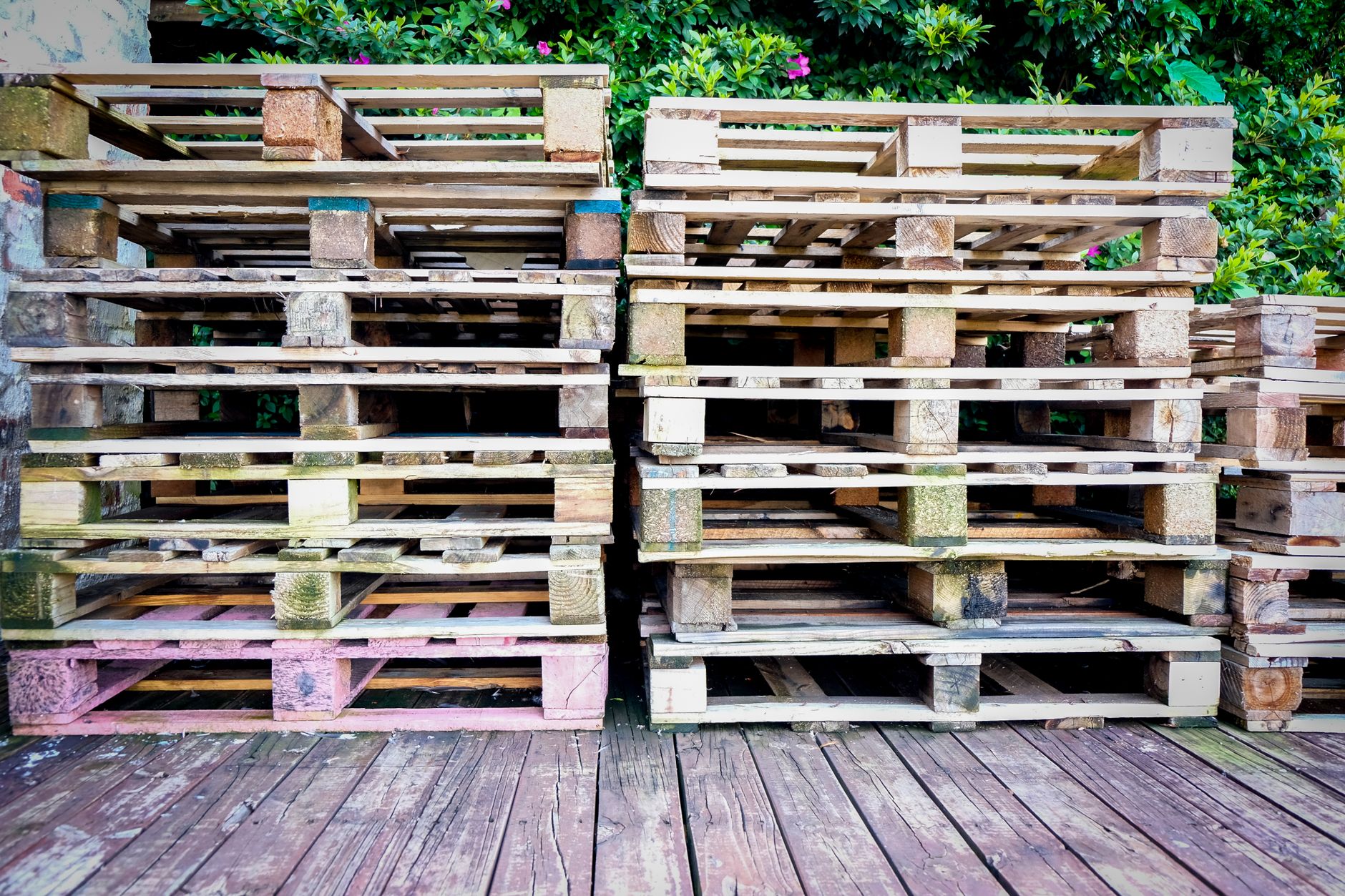
Damaged boards are the fastest way to corrupt an automated loop. Splintered stringers hang up on fork heels, skew stacks, and leave debris that confuses vision systems. Your standard operating procedure should require humans to pull bad units to a scrap cage before the robot visits. The AMR should never be the first inspector.
Unpredictable pickup points appear when teams drop empties wherever the last forklift stopped. Fix that with painted boxes, light towers, or RFID tags that tell the robot a zone is full. Without physical discipline, you will burn autonomy hours wandering partial stacks.
Fire and sprinkler rules still apply in consolidation areas. NFPA 1 limits idle pallet stack height and footprint in many jurisdictions, and sprinkler clearances commonly require at least 18 inches below heads, per OSHA sprinkler guidance cited in industry summaries. Automated stacking must respect those caps even if the robot could physically build higher.
Where does a full-service integrator shorten the pilot?
Service Robot Co. approaches empty-pallet AMRs as one lane in a wider intralogistics program: select the right form factor across OEM-neutral options, finance the fleet, map routes with your WMS or warehouse execution data, train shift leads on exceptions, and keep units running through a nationwide field service network.
A useful pilot starts with one spill-heavy zone, not the entire campus. Measure minutes forklift operators spend shuffling empties today, then run the robot on that same cadence for four to six weeks. Interact Analysis noted in 2025 that only about 13 percent of warehouses may deploy even one fulfillment AMR by 2030, which means early movers still have time to tune flows before competitors catch up.
Monthly robot programs can cover the loop while you prove dock layout changes. When the math holds, expand pickup points rather than buying duplicate hardware that fights for the same aisle windows.
What should operations leaders measure in the first 90 days?
Track aisle clearance incidents, not just robot utilization. If pick aisles stay open through peak, the project is working even when the fleet looks idle between waves.
Log manual overrides. Frequent skips at one pickup point usually mean layout trouble, not robot failure.
Compare consolidation lane inventory to outbound ship schedule. Empty pallets should leave the building on return trucks or pooling programs before they become a storage department of their own.
Grand View Research estimated the global autonomous mobile robot market at about $5.49 billion in 2026 with continued double-digit growth through the decade, which reflects how many facilities are still adding first fleets. Your metrics should beat your own baseline, not a glossy market average.
When is manual forklift haul still the better call?
Ultra-short peak seasons, heavy outdoor yard transitions, or buildings with constant layout churn may not justify fixed routes yet. Likewise, if every empty pallet is immediately reused at the same dock door, a dedicated loop adds handoffs without saving travel.
Hybrid plans work: AMRs cover interior pick modules and pack lines on a clock, while lift trucks handle trailer pulls and damaged stack rebuilds. The goal is to keep autonomous units in the boring middle mile where repetition is highest.