Key takeaways
- Finished-goods AMRs earn their keep on fixed post-pack routes, not on the oven line itself.
- Separate zone maps for allergen areas, washdown corridors, and dry shipping docks keep FDA-style controls intact.
- Surge weeks need mission priorities and buffer racks so robots do not starve the cooler or the dock.
- Top modules and dock interfaces must match real rack bases, not ideal CAD sketches.
Why put AMRs on bakery outbound logistics?
Autonomous mobile robots fit commercial bakeries after product is wrapped, cased, or palletized and must reach cooling racks, blast chillers, cold storage, or shipping without piling walk time on a crew that already runs packaging and sanitation. The robot handles the repeat leg while people stay at checkweighers, metal detection, and label verification.
That outbound loop is where labor math gets tight. The U.S. Bureau of Labor Statistics counted about 165,800 employees in commercial bakeries and frozen cake and pastry manufacturing in December 2024 on its Current Employment Statistics table, and packaging and filling machine operators alone numbered about 383,860 nationally in May 2024 wage tables. None of those headcounts spare two walkers every hour during a holiday surge.
An AMR fleet on finished goods is not a replacement for bakers at the divider. It is material handling for standardized loads on mapped aisles, with rules that respect washdown schedules, floor moisture, and allergen boundaries spelled out in your food safety plan.
Which loads should robots carry first?
Start with loads that are stable, labeled, and already on a standard base: wrapped rack frames, full case stacks on slip sheets, or CHEP-style pallets with known dimensions. These moves repeat dozens of times per shift between the same packaging outfeed, cooler airlock, and staging lane.
Defer odd shapes, partial racks, and rework totes until the fleet proves stopping distance on your actual floor. Finished bread lines often emit tall rack loads with uneven top profiles after manual adjustment. Vision or height checks at the pickup station prevent the robot from committing to a top-heavy move.
Match the top module to the interface, not the other way around. Roller conveyors, low-profile lifters, and tug hooks each assume a fixed pickup height and latch point. Document the rack foot print and caster type before you quote hardware.
- Wrapped rack moves from bagger outfeed to cooler queue
- Full case stacks from case erector to cold storage airlock
- Pallet moves from stretch wrapper to shipping lane staging
How should cooling and cold storage handoffs work?
Cooling is time sensitive. AMR missions should carry a timestamp and priority flag so a rack headed to a blast chiller jumps ahead of a pallet bound for ambient staging. Fleet software needs a rule for when a cooler door is busy: hold in a buffer lane rather than blocking the packaging line.
Cold storage airlocks punish condensation. Robots that just crossed a washdown zone need a dry path or a timed wait before entering a low-temperature room, or wheels will slip and labels will fog. Map those transitions explicitly in the digital twin before go-live.
Return trips matter. Empty racks and collapsed cases should ride on dedicated return missions so robots do not carry cardboard dust back into packaging. That separation supports allergen and sanitation controls under 21 CFR 117, which requires procedures to prevent allergen cross-contact during storage and handling.
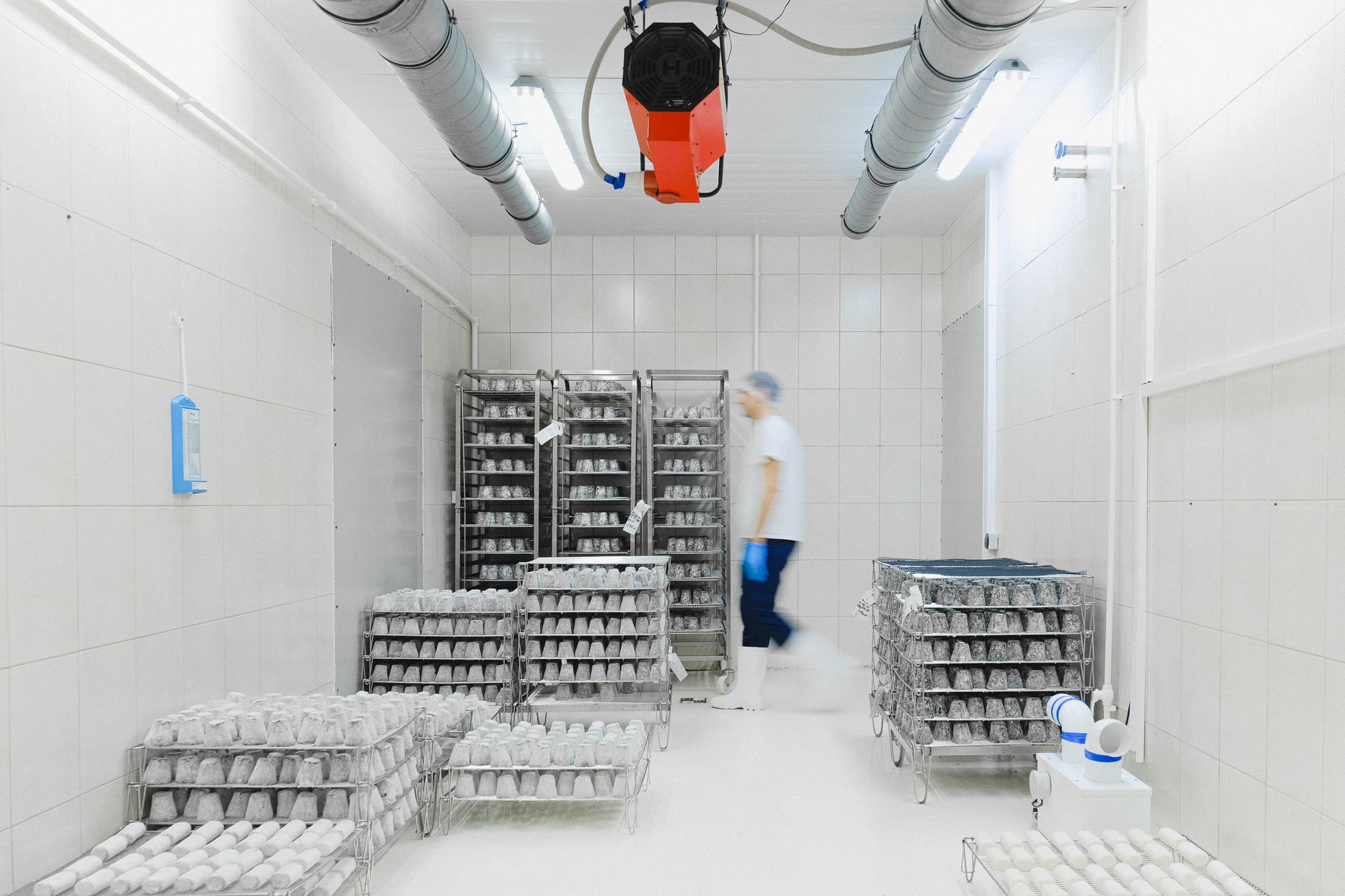
What changes in washdown zones and on wet floors?
Bakeries run foam, caustic, and sanitizer cycles that leave slopes, drains, and occasional puddles. AMRs need IP-rated components where spray hits daily, and wheels rated for wet epoxy or quarry tile. Ramp traction testing on a soapy sample beat a glossy demo on a dry showroom slab.
Schedule robot blackouts when crews foam a whole aisle. Trying to share a lane during active washdown invites slip incidents and voids validation data. Tie the fleet calendar to sanitation standard operating procedures so planners see the same windows maintenance uses.
Floor joints and drain grates are trip points for small casters. Walk the route with a maintenance lead and mark no-go polygons around problem grates until they are rebuilt flush.
How do you plan for production surges?
Promotional weeks and holiday SKUs can double outbound moves without adding square footage. Buffer racks at packaging and at the cooler let AMRs batch trips instead of ping-ponging one rack at a time. Size buffers from logged move counts during last year's peak, not from average Tuesday volume.
When surge hits, humans override. The fleet needs a visible priority channel so a supervisor can flush cooler backlog before ambient staging. Without that, robots keep serving the nearest mission while product age clocks run in the rack queue.
Labor data explain why surges hurt. BLS industry figures for bakeries and tortilla manufacturing show about 72,650 bakers in May 2023 occupational estimates, with mean pay near $17.19 per hour in that NAICS group. Packaging staff sit in the same wage band. You cannot hire your way through every spike, but you can schedule robot hours like you schedule oven bands.
Which load interfaces fail most often in pilots?
Misaligned conveyor heights cause half the failed pickups in bakery pilots. The fix is mechanical: shim the outfeed or add a short gravity section so the rack lands in the same plane every cycle.
Pallet loads need stretch-wrap integrity checks before the robot hooks in. A dragging film tail wraps around a drive wheel and stops the whole lane. A simple photo eye at the wrapper exit catches tails before dispatch.
Weight matters for acceleration. An AMR rated for 1,000 kg that routinely runs at 900 kg on a wet floor needs a longer stopping distance validation than the vendor chart shows. Re-test after you change rack suppliers.
How do allergen boundaries affect robot routes?
FDA preventive controls treat allergen cross-contact as a hazard you must control in storage and handling, not only at the mixer. That means robot routes crossing from a nut-free line to a shared cooler need either physical separation or validated cleaning between zones.
Digital geofences are the operating mirror of those physical lines. A robot should not enter a dedicated allergen storage polygon unless the load, the cart, and the shift schedule all match that zone's profile. Violations should log to the same record you use for manual audits.
Changeovers are the hard case. When a line switches from sesame rolls to plain buns, routes that touched sesame packaging must stay out of allergen-free storage until equipment and carts pass inspection. Fleet software should accept a manual allergen hold that blocks missions until QA clears it.
What should a first pilot measure?
Scope one packaging outfeed, one cooler destination, and one return path for empties. Run four to six weeks including at least one busy retail promo if possible. Count manual walks eliminated, cooler age at handoff, and mission success rate without human rescue.
Track downtime reasons in plain language: slip, blocked door, bad pickup, software fault. Those buckets tell you whether to fix floor, doors, mechanical interface, or IT before you add robots two and three.
Global AMR spending is climbing fast. MarketsandMarkets projected the autonomous mobile robot market at about $2.75 billion in 2026 in a February 2026 release, with a 14.4 percent compound annual growth rate through 2032. Bakery outbound is a narrow slice of that total, but the same fleet tools apply once routes are mapped.
Where does a full-service integrator fit?
Vendor-neutral integrators select AMRs, top modules, and charging layouts against your rack standards, then finance, deploy, train, and service the fleet through one contract. That matters in food plants where downtime during sanitation windows is expensive and OEM finger-pointing wastes hours.
Service Robot Co. runs site assessment, mapping, integration with warehouse or manufacturing execution signals, and nationwide field service on the units it places. Monthly payment programs and pilot structures let you prove cooler handoff times before you scale to every packaging line.
The goal is finished goods flowing to cold storage and shipping with fewer ad hoc walks, while allergen maps and washdown calendars stay aligned with the same preventive controls your QA team already documents.
Frequently asked questions
Sources
- BLS CES Table B-1b December 2024 commercial bakeries employment
- BLS OEWS May 2024 featured data packaging operators and bakers
- BLS OEWS NAICS 311800 May 2023 industry employment
- eCFR 21 CFR 117.135 preventive controls allergen and sanitation
- MarketsandMarkets AMR market February 2026 projection
- BLS Occupational Outlook Handbook bakers May 2024 wages