Key takeaways
- Yes. AMRs can handle dirty-tray return loops in hotels when routes, elevator access, and receiving points are tightly defined.
- The strongest fit is back-of-house movement between guest floors, service pantries, and dish areas, not guest interaction.
- Hallway tray clutter is not just ugly. It collides with labor shortages, egress discipline, and guest perception.
- Hotels should judge the use case by repeatable daily volume, elevator reliability, pantry layout, and dish-room handoff, not by novelty.
Can AMRs really handle hotel tray-return work?
Yes, in the right hotel they can. Dirty-tray returns are one of the more automatable transport loops in lodging because the route pattern is repetitive, the payload is predictable, and the handoffs usually happen at known points: outside guest rooms or at floor pantries, then down to a dish or stewarding area.
That matters because tray returns sit in an awkward gap between departments. The labor often lands partly on room service, partly on housekeeping, and partly on stewarding. The task keeps happening, but it rarely has one owner pushing to redesign it. An autonomous mobile robot rental or a hotel delivery robot rental program can make sense here precisely because the work is dull, frequent, and easy to standardize.
This is not the same thing as a guest-facing amenity delivery robot. The tray-return loop is a back-of-house transport job. The robot does not need charm. It needs reliable navigation, elevator coordination, spill-tolerant containment, and a clean handoff into dish operations.
Why is this loop worth attention now?
Hotels are still operating under labor pressure. According to the American Hotel and Lodging Association, 65 percent of surveyed hotels reported staffing shortages in February 2025, and 38 percent specifically cited housekeeping shortages. More than seven in ten said they had open jobs they could not fill despite active recruiting.
Those shortages land directly on messy edge work like tray pickup. A hotel may keep room service because the guest experience still matters, then struggle with the after-part: collecting carts, plates, glassware, and leftovers quickly enough to keep corridors clear. According to the Bureau of Labor Statistics, the U.S. accommodation sector employed 420,800 maids and housekeeping cleaners in 2025, with a median hourly wage of $16.78 in that industry. Even before overtime and supervisory overhead, that is not labor you want burning on repeated elevator trips.
Meanwhile, food and beverage is still operationally important. CBRE reported that food and beverage revenue per occupied room rose 3.8 percent in the first half of 2025 across a sample of 866 hotels, outpacing total hotel revenue growth. If in-room dining and pantry service remain revenue and satisfaction drivers, the return loop deserves the same operational scrutiny as the delivery loop.
What problem does the robot actually solve?
The first win is labor recapture. Staff stop making low-value walks from guest floors to service elevators, from service elevators to stewarding, and back again. The human work shifts toward guest contact, exception handling, and faster room turns.
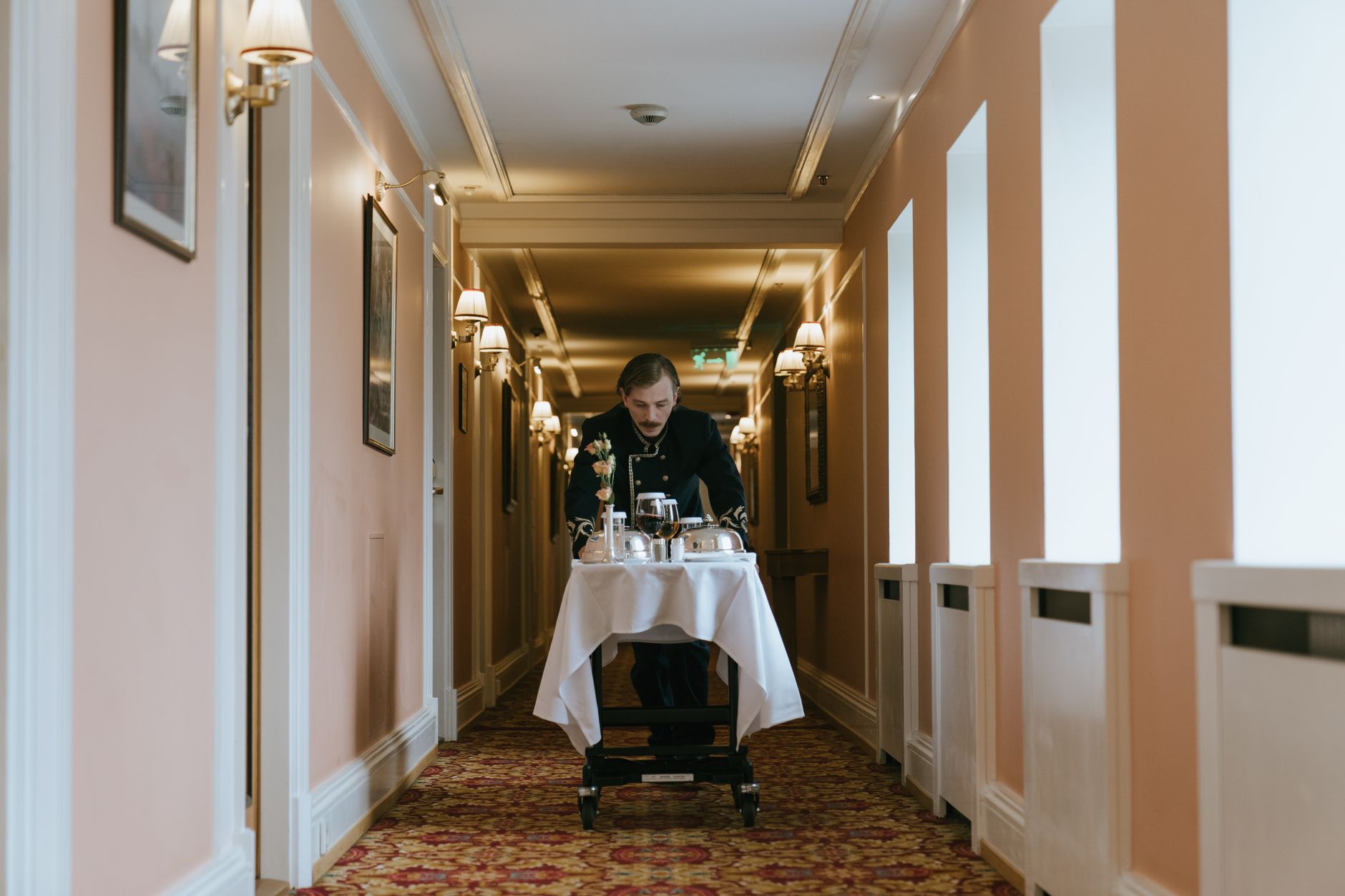
The second win is corridor control. Trays and carts left outside doors tend to accumulate in bursts: after breakfast, after late arrivals, after event nights, and after a rainy evening when more guests order in. That clutter is not merely cosmetic. OSHA says exit routes must be free of obstructions and that objects projecting into an exit route must not reduce the route below minimum width requirements. In a hotel environment, that makes lingering trays a housekeeping issue and an egress discipline issue.
The third win is rhythm. A robot can run scheduled sweeps at 7:00 a.m., 9:30 a.m., 1:30 p.m., and 10:00 p.m., plus on-demand dispatches from a pantry or service phone. That turns tray return from a reactive scavenger hunt into a managed transport loop.

Where does tray-return automation fit best inside a hotel?
The best fit is a full-service, resort, or convention property with enough in-room dining, club-level service, or pantry circulation to keep the route busy. It also fits hotels where guest floors stack cleanly over a central dish room and the service elevator path is consistent.
It is especially attractive where room service is offered during compressed peaks. Breakfast is the obvious one, but banquet spillover matters too. A property that gets a morning wave of trays from business travelers and a second late-night wave from event guests often has exactly the kind of repetitive transport automation that AMRs handle well.
By contrast, a low-volume select-service hotel may not have enough tray density to justify a dedicated room service robot loop. If staff only collect a handful of trays per day, the better automation target may be a different hotel workflow entirely. The route needs enough repetition to matter.
- Strong candidates: full-service hotels, resorts, convention hotels, club-floor operations, high breakfast room-service volume, late-night pantry traffic
- Weak candidates: low-volume select-service properties, buildings with unreliable elevator access, dish rooms with no defined robot receiving point
- Operational sweet spot: multi floor delivery robot routes that stay mostly on service corridors and use the same elevator bank each cycle
What has to be true on day one?
The route has to be tighter than many operators expect. A successful tray-return program needs defined pickup behavior, not vague hopes that staff will place trays in roughly the right place. Some hotels use pantry staging points. Others authorize robot stops at specific door clusters during low-traffic windows. Either way, the loop needs discipline.
Payload handling matters too. Dirty china, stemware, coffee pots, and half-finished food are harder than boxed amenities. The robot needs enclosed or well-contained transport so a sharp turn or threshold bump does not create a new cleanup event. Dish-room staff also need a fast unload method, because a robot waiting five minutes for someone to notice it is not moving labor, it is relocating delay.
Elevator behavior is often the real gate. A delivery robot for elevators is only useful if call, ride, and exit behavior are dependable. Some hotels can integrate directly with access and elevator systems. Others use a human trigger at peak periods. Both can work, but the operating model has to be decided upfront.
What should operators watch before buying or renting?
Start with counts. How many trays, carts, or bussing loads move from guest floors to stewarding on a typical breakfast day, a slow Tuesday, and a group-heavy Saturday? How many minutes does each run consume door to dish room to return? If the hotel cannot answer that, it is not ready to size the fleet.
Then inspect the physical path. Door thresholds, carpet transitions, service elevator dwell times, pantry congestion, and dish-room traffic all shape uptime more than a spec sheet does. Hotels often discover that the real constraint is not navigation. It is the last twenty feet at either end of the trip.
Finally, decide commercial structure. Some operators prefer robot as a service, service robot rental, or robot leasing for business because occupancy and event calendars swing by season. Others want lease rental or sale options for a longer planning horizon. The right structure depends on operational confidence, internal capital rules, and how quickly the property expects to expand from one loop to several.
How does Service Robot Co. fit this kind of project?
This is exactly where an OEM-neutral integrator earns its keep. Hotels rarely need a generic robot pitch. They need the robot that fits their floor, their elevator stack, their pantry geometry, and their service standards. Service Robot Co. works as a vendor neutral robot integrator for U.S. businesses, selecting across manufacturers instead of forcing a single brand onto every building.
That matters even more in hospitality because one property may need a compact unit for tight service corridors while another needs more enclosed payload capacity and stronger multi-floor behavior. Service Robot Co. can finance, deploy, integrate, train, and service the fleet through a nationwide U.S. engineer network, which is a cleaner operating model than juggling hardware, software, and field support across multiple parties.
For hotels evaluating a pilot, the practical question is not just which machine can move trays. It is who will map the site, integrate the workflow, train staff, support go-live, and handle service after launch. One partner for the whole lifecycle is often the difference between a pilot that sticks and one that becomes hallway furniture.
What does a sensible pilot look like?
A good pilot is narrow. One tower. One elevator bank. One dish drop. One or two peak windows. The goal is not to automate all room service on day one. The goal is to prove that tray-return frequency, staff compliance, elevator reliability, and dish-room handoff are stable enough for daily use.
Measure four things from the first week: completed runs per shift, average cycle time, staff minutes recaptured, and corridor dwell time for dirty trays. If those numbers improve without creating new exceptions, expand gradually to more floors or longer service windows.
Hotels should also write the human SOP early. Who loads the robot. Who clears blocked paths. Who handles glass breakage. Who responds if an elevator is tied up. The best AMR deployments in hospitality are not magical. They are operationally crisp.
The real case is operational, not theatrical
A lot of hotel robot discussion still circles guest-facing novelty. That is understandable, but it misses the harder and more durable use case. Tray returns are repetitive, unglamorous, and expensive in staff time. That is exactly why they belong on the automation shortlist.
According to AHLA's 2026 state-of-industry release, hotel operating profit per available room remained around 90 percent of 2019 levels because rising expenses kept squeezing margins. In that environment, hotels do not need more gadget theater. They need quieter fixes for stubborn labor drag.
For the right property, AMR rental or a longer-term deployment can reduce hallway clutter, stabilize a messy interdepartmental task, and free people for work that guests actually notice. That is a better use of a room service robot than making a cameo with toothpaste.