Key takeaways
- AMRs fit fixed loops between sort tables, soil separation, and route staging, not the garment inspection itself.
- Hanging loads and narrow aisles demand low speed, side retention, and aisle maps built for peak dispatch waves.
- RFID and WMS handoffs only work when the robot mission ID matches the cart or bag ID at pickup and drop.
- BLS counts thousands of hand material mover jobs inside laundry services, the labor AMRs can offset on cart runs.
- A vendor-neutral integrator aligns top modules, software, financing, and nationwide service on one rollout.
Do AMRs belong inside a uniform rental plant?
Yes, when the pain is cart and rack travel, not garment skill. Industrial uniform facilities already split clean soil, sort by customer route, and push waves to the dock on a clock. Workers spend much of their shift walking hung garments, bagged bundles, and wheeled route carts between those zones.
Autonomous mobile robots fit the middle miles: sort exit to inspection hold, clean storage to dispatch lane, soil return to wash alley. They do not replace spotters, menders, or route auditors. They cut repeated pushes through the same narrow aisles so those roles stay at the tables where judgment matters.
If your plant runs two or three dispatch waves before sunrise, AMRs pay when each wave repeats the same cart types on the same paths. Random one-off moves still belong on manual equipment.
What moves should you automate first?
Start with clean-route carts after sort is closed. The payload is predictable, the path is wide enough for a tug, and timing ties to truck departures you can see on a schedule.
Soil-side moves come next when bags ride standard bins and floors stay clear of loose linen. Keep biohazard or specialty soil on separate manual rules until your SOP defines robot exclusion zones.
Hanging garment racks need dedicated top modules and slower cornering. Pilot one aisle with the lightest racks before you commit a fleet to full double-rail storage.
- Closed-loop clean cart from sort buffer to dispatch lane.
- Soil bin shuttle from drop station to wash feed when bins are standardized.
- Empty rack return from dock to sort only after hang stability testing.
How do RFID and WMS handoffs stay honest?
Uniform plants live on account, route, and garment ID data. An AMR mission should inherit the same identifiers the sorter scanned at the table. Pickup confirmation should log cart ID, route code, and timestamp before the unit leaves the aisle.
Drop at dispatch should reconcile against the wave manifest. If the reader misses a tag, the robot holds or diverts to exception lane instead of blending loads on the truck side.
According to May 2023 BLS industry data, drycleaning and laundry services employed about 3,840 hand material movers alongside roughly 89,670 laundry and dry-cleaning workers. That mix shows how much floor time still sits in manual cart work that software-linked AMRs can absorb without touching washer controls.
What changes with hanging loads and narrow aisles?
Garment racks raise the center of gravity. Side sway on a tight turn can clip an adjacent bay or walk garments into the floor. Map corners for reduced speed and require anti-sway arms or rack cradles rated for your rail height.
Narrow aisles punish over-wide top modules. Measure clear width at the pinch points near fire doors and wash alley entries, not just the main trunk aisle.
Floor joints and drain grates matter when racks roll on casters while the AMR provides motive power. Test stopping distance with a loaded rack, not an empty cart.
How do soil separation rules affect robot zones?
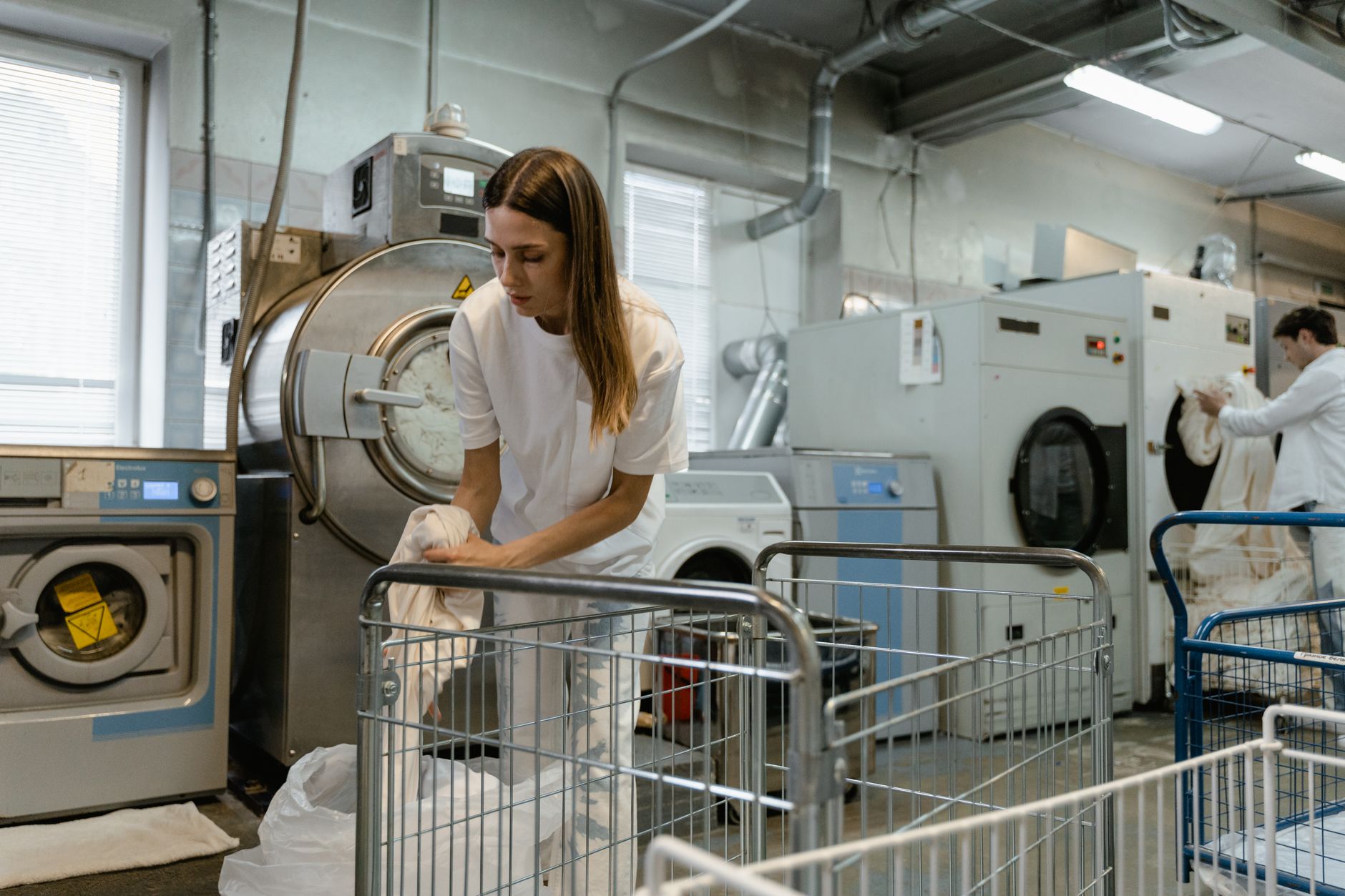
Clean and soil must never share a cart without a defined washdown boundary. Paint floor zones and configure geofences so soil AMRs cannot enter clean storage without an explicit maintenance unlock.
Bag leaks are the common failure mode. Route soil robots over washable concrete with drains, and keep absorbents staged where the map shows recurring drips.
Cross-contamination audits should include robot tooling. Hangers and bin hooks need the same laundry protocol as manual carts when they touch both sides of the house.
How do dispatch waves stress the fleet?
Peak waves stack missions in a short window. Size the fleet for concurrent cart pulls, not average hourly volume. One robot per active dispatch lane is a common starting assumption until data proves otherwise.
Charging strategy must survive the gap between night sort and first truck. Opportunity charging at sort tables beats a single midnight dock session when waves run past dawn.
When a truck is late, staging lanes fill and aisles clog. Build overflow holds into the map so AMRs have a second drop point without blocking fork paths.
What labor data supports the business case?
National May 2023 OEWS figures show about 185,000 laundry and dry-cleaning workers with a mean wage near $15.33 per hour. Inside the laundry services industry alone, hand material movers averaged about $16.72 per hour on roughly 3,840 jobs.
Those numbers frame cart automation as partial relief on a large manual transport layer, not a headcount elimination claim. Gains show up as fewer missed waves and less overtime on walk-heavy shifts.
Injury risk follows repetition. BLS groups hand laborers and material movers among physically demanding roles in warehousing and laundry settings, which is why fixed AMR loops with clear right-of-way rules matter as much as speed.
Where does Service Robot Co. fit?
Uniform plants fail when the tug vendor, RFID integrator, and finance desk do not share one timeline. Service Robot Co. compares AMR form factors for racks, bins, and carts, then structures monthly programs if capex is tied up in wash equipment.
Site assessment covers aisle pinch points, soil geofences, and wave schedules with your dispatch lead. Nationwide field service keeps a down unit from becoming a missed truck on Friday morning.
Pilot one closed loop, measure minutes saved per wave, then scale modules and fleet size with real stopwatch data instead of brochure specs.