Key takeaways
- Yes. Robots can improve visible cleanliness at car wash sites, but only when the work is mapped to the right zones and routines.
- The best fit is usually a mix: autonomous floor care indoors, inspection loops around customer-facing exterior areas, and staff for detail work and exceptions.
- Appearance matters commercially. According to the International Carwash Association, nearly 80% of U.S. drivers now most often use a professional car wash.
- Safety and presentability overlap. OSHA requires walking-working surfaces to be clean, orderly, sanitary, and dry where feasible.
- A full-service integrator matters because car wash sites need financing, deployment, training, service, and fast support, not just a machine drop-off.
Yes, but the win comes from targeted tasks, not a magic machine
Robots can help self-serve and express car wash sites stay presentable, especially in the repetitive, highly visible work that gets skipped during busy hours. That includes lobby floor care, payment-area checks, vacuum-lane sweeps, mat-station inspection, and after-hours reset work. The payoff is not that a robot replaces every porter task. It is that the site looks cared for more consistently, even when staffing is thin and the operating day runs long.
The practical model is narrow and disciplined. Use robotic floor care where the surface, route, and cleaning objective are stable. Use patrol and inspection where the real problem is not scrubbing every square foot, but finding the small failures that drag down the customer impression: litter by vacuums, pooled water near pay points, full trash, crooked cones, or a mat station that looks neglected by midafternoon.
That distinction matters. A car wash is not a generic retail box. It has wet concrete, hoses, tight turns, changing traffic, and weather. A robot program works when it is designed around those realities, not when someone tries to force a warehouse playbook onto an outdoor service property.
Why does this niche feel harder to keep sharp than it looks?
The operating context is tougher than the footprint suggests. According to the International Carwash Association, the U.S. had 17,584 car washes with paid employees in the 2020 Census, plus an estimated 16,250 self-service car washes. The same ICA industry page says the sector employs more than 220,000 full-time and part-time workers at retail stores, and that new store construction is estimated to exceed 500 units per year.
That growth raises the standard for presentation. ICA also reports that the share of U.S. drivers who most frequently wash at a professional car wash has climbed from about 48% in 1994 to nearly 80% today. Customers are not just buying a clean vehicle. They are buying speed, convenience, and the feeling that the site is orderly enough to trust with a repeat visit.
Membership economics reinforce that pressure. In a January 28, 2026 industry update published by the International Carwash Association, aggregated data from more than 3,000 car wash locations showed 2025 fourth-quarter same-store sales up 4.8% year over year, while membership revenue rose 11.3%. If recurring revenue depends on habit and trust, then the condition of the lobby, kiosk, vacuum apron, and mat area is not cosmetic fluff. It is part of retention.
Which areas are the best candidates for robotic help?
Indoor customer spaces are usually the cleanest starting point. Small lobbies, vestibules, and payment waiting areas often have predictable routes, flat flooring, and a simple standard of clean. That makes them good candidates for a commercial cleaning robot rental or a robot floor cleaner rental program, especially if the site wants overnight cleaning with no operator standing over the machine.
Exterior customer zones are different, but still promising. Vacuum lanes, mat stations, kiosk aprons, and trash islands often need less deep cleaning than they need frequent attention. An inspection robot rental or autonomous patrol robot can run a recurring route, document exceptions, and direct staff to the exact places that need touch-up work. Instead of walking the property on instinct, a manager gets a timestamped queue of issues.
Payment areas deserve special attention. They are often where a customer slows down, reads signage, touches a screen, and notices the site condition. A grimy kiosk surround, wet pad, or windblown trash nearby creates a bigger impression than operators sometimes expect. If a robot program improves any one zone first, that is often the one to test.

How do floor care and safety connect at a car wash?
Presentability and risk control overlap more than they appear to. OSHA standard 29 CFR 1910.22 requires walking-working surfaces to be kept in a clean, orderly, and sanitary condition. It also says floors must be maintained in a clean and, to the extent feasible, dry condition, and kept free of hazards such as leaks and spills.
That matters because wet, cluttered surfaces are not a theoretical problem. The U.S. Bureau of Labor Statistics reports 479,480 days-away-from-work cases involving falls, slips, and trips in 2024, with a median of 8 days away from work. OSHA, in its walking-working-surfaces guidance, describes slip, trip, and fall hazards as a leading cause of worker deaths and lost-workday injuries, and estimates that its final rule will prevent 5,842 lost-workday injuries each year.
At a car wash, the lesson is simple. Robots are useful when they support a cleaner and drier customer path, catch standing-water trouble early, and make inspection more regular. They are not useful if operators expect them to drive through active wash-bay chaos without site prep, drainage discipline, or clear lane rules. The machine helps enforce the standard. It does not erase the need for one.
Can robots really help the outdoor zones, or is that overstated?
They can help, but the job is usually inspection first and heavy cleaning second. Outdoor vac areas and mat stations change by the hour. Customers leave wipes, receipt scraps, mud, puddles, and hose tangles in patterns that are irregular but familiar. A patrol or inspection workflow can make those conditions visible early enough to fix before the whole area looks tired.
This is where operators should think in loops, not heroics. A robot that checks the site every 30 or 60 minutes can surface the small defects that erode the brand over the course of the day. That is especially useful for lean properties where attendants are splitting time across tunnel loading, member questions, light maintenance, and closeout tasks.
The limits are just as important. Windblown debris, saturated concrete, hose placement, and customer unpredictability mean some exterior lanes will never be a pure autonomous-cleaning environment. For many car washes, the right answer is not a fully autonomous exterior scrub. It is a lighter inspection layer paired with a fast human response.
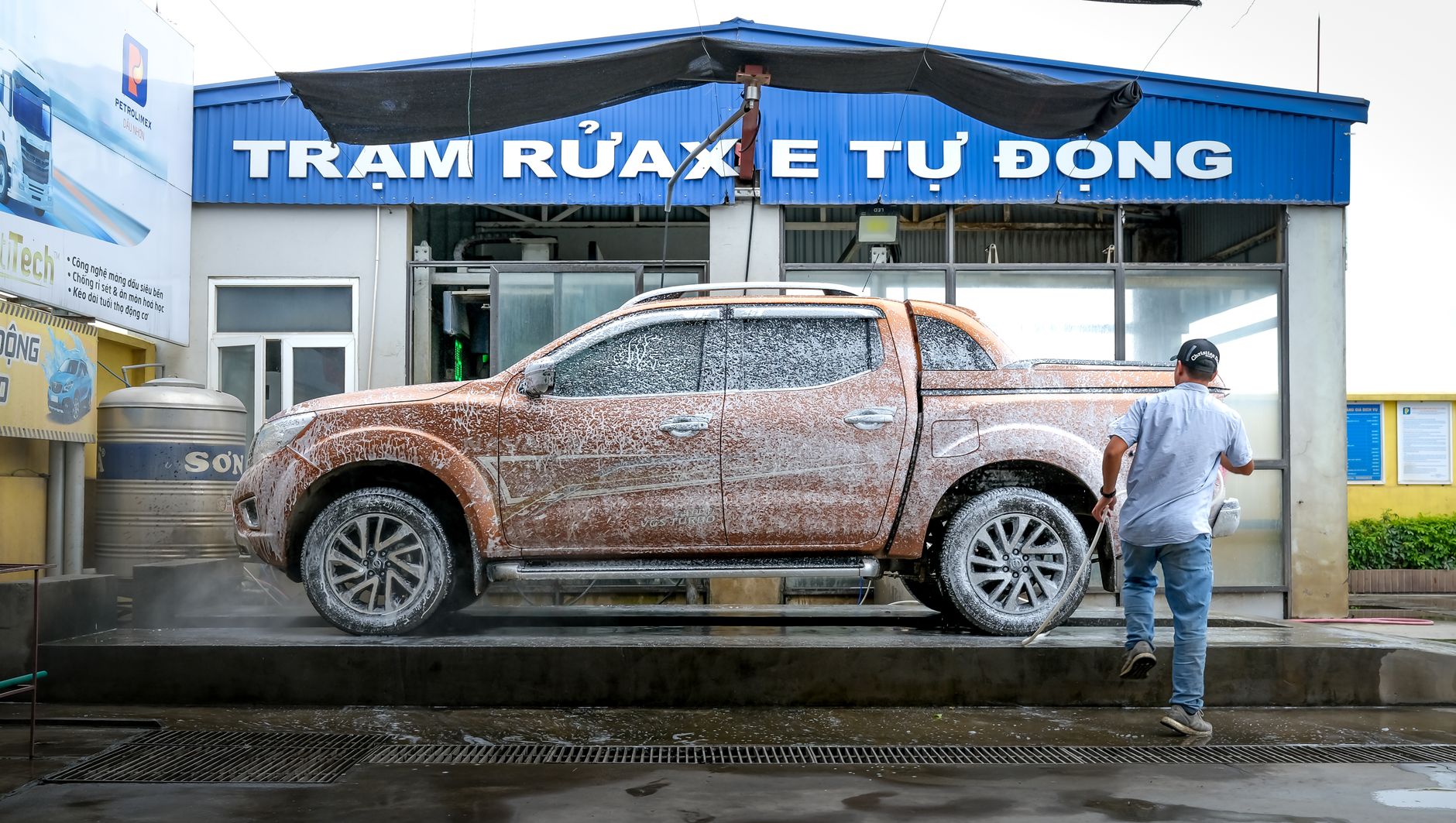
What does the labor case look like without wishful math?
The labor argument is real, but it needs adult arithmetic. The Bureau of Labor Statistics lists the May 2025 mean hourly wage for janitors and cleaners, except maids and housekeeping cleaners, at $18.64. Its Occupational Outlook Handbook also projects about 351,300 openings for janitors and building cleaners each year, on average, from 2024 through 2034. In other words, routine cleaning work is not disappearing, and keeping every repetitive task reliably staffed is still hard.
For a car wash, that does not automatically mean a robot is cheaper than a person. It means repetitive appearance work has a measurable cost, a scheduling problem, and a consistency problem. A robot as a service model, robot leasing for business arrangement, or month-to-month style service robot rental can make sense when the site needs coverage during awkward hours, wants maintenance included, and values documented inspection rather than informal walk-throughs.
The honest ROI questions are operational. How many manager minutes disappear into site checks each day? How often do vac zones degrade between rounds? How much of the complaint load starts with presentability rather than wash quality? If those numbers are high, a robot program has something to attack. If the site is tiny, cluttered, and already well staffed, it may not.
Where does Service Robot Co. fit in a car wash rollout?
This is exactly the kind of narrow property-ops use case where an OEM-neutral integrator earns its keep. Car washes do not need a generic pitch. They need the right robot for the floor, the traffic pattern, the drainage reality, and the support expectation. Service Robot Co. works as a full-service commercial robot integrator for U.S. businesses, selecting the right system across manufacturers and handling financing, deployment, integration, training, and service through a nationwide engineer network.
That matters because most operators do not want four separate relationships for hardware, software, field service, and staff training. They want one partner, one number, and a clear answer when a unit needs help. For car wash operators exploring a commercial cleaning robot rental, inspection robot rental, or broader robot as a service approach, the real product is not just the machine. It is the operating model behind it.
It also matters because car wash sites vary widely. One site may need autonomous floor care in a lobby and payment room. Another may need an outdoor inspection route plus exception alerts. A third may be better served by waiting. Vendor neutral robot integrator is not a slogan in this context. It is the difference between fitting the site and forcing the site to fit the robot.
How should a car wash operator pilot this without wasting six months?
Start with one site and one visible problem. Choose the zone customers see first, or the zone managers repeatedly struggle to keep sharp. Map the route, define what good looks like, and run the pilot long enough to include weekends, weather changes, and staff handoffs. A clean Tuesday morning tells you very little.
Measure a small set of practical signals. Track exception counts in vacuum and mat areas, standing-water dwell time near customer paths, trash overflow incidents, manual inspection time, and the number of site-condition complaints. Take before-and-after photos at the same times of day. Car wash operations are visual. The proof should be visual too.
Then be strict about the decision. If the robot reduces inspection labor, improves consistency, and holds up operationally, expand to the next zone. If it struggles with route chaos, drainage, or customer interference, redesign the scope or stop. Good pilots are supposed to answer hard questions quickly, not protect a pet project.
Frequently asked questions
Sources
- International Carwash Association Industry Information
- ICA report on 2025 Q4 car wash performance
- BLS Occupational Outlook Handbook for janitors and building cleaners
- BLS 2025 national wage table by occupation
- BLS Injuries, Illnesses, and Fatalities overview
- OSHA walking-working surfaces FAQ
- OSHA slip, trip, and fall hazard guidance
- OSHA standard 29 CFR 1910.22 general requirements