
Key takeaways
- Wind and sand set the cutting window on a links course, so schedule passes around verified readings rather than the clock alone.
- No public source checked here gives a robot fairway mower a wind shutdown limit, so the manual for your exact model sets the rule.
- Hold the pass whenever blown sand sits on the surface, and log the hold with the conditions that caused it.
- A held pass is data: the log shows which hours keep producing holds, and that pattern should move the first pass.
How wind and sand change the cutting window
On a links course the cutting window is not a fixed block on the calendar. Onshore breezes often build as the day warms, and blown sand can settle across fairway edges faster than a crew can walk them. A superintendent who schedules autonomous passes by the clock alone will eventually send a machine into conditions the turf should never have faced.
The practical answer is to treat wind and sand as gates. A pass starts only when the surface and the weather both pass a short check, and it holds when either one drifts. The gate is set by the model manual first, then by the superintendent's judgment and what the crew can see on the turf.
This article covers the timing judgment and the log that backs it. It does not claim any robot can handle any wind speed, because the public record does not support that claim.
What the public record says about wind limits
A search of public sources turned up no published wind speed at which a robotic fairway mower must stop. Treat any number you hear on a sales call as something to confirm in writing against the spec sheet for the exact model.
Wind does appear in the engineering record, though for a different job. A Gill Instruments case study, hosted by Agriculture Xprt, describes an ultrasonic WindSonic sensor fitted to a robotic greens mower to keep positioning accurate in windy conditions. The case study is vendor reported and does not describe a shutdown threshold.
A US patent application describes an autonomous ground maintenance vehicle that adjusts operating parameters for rain, soil moisture and slope. Wind is not among the inputs it lists, which is one more reason not to assume a machine reads gusts the way a superintendent does.
Reading sand and sea breeze before the first pass
Crews should walk the first holes before the mower leaves the shed. Look for sand lying in a thin film on the turf, drifts against the collar, and fresh deposits on any walking surface. Visible sand is a reason to hold, not a cue to run the pass and clean up afterward.
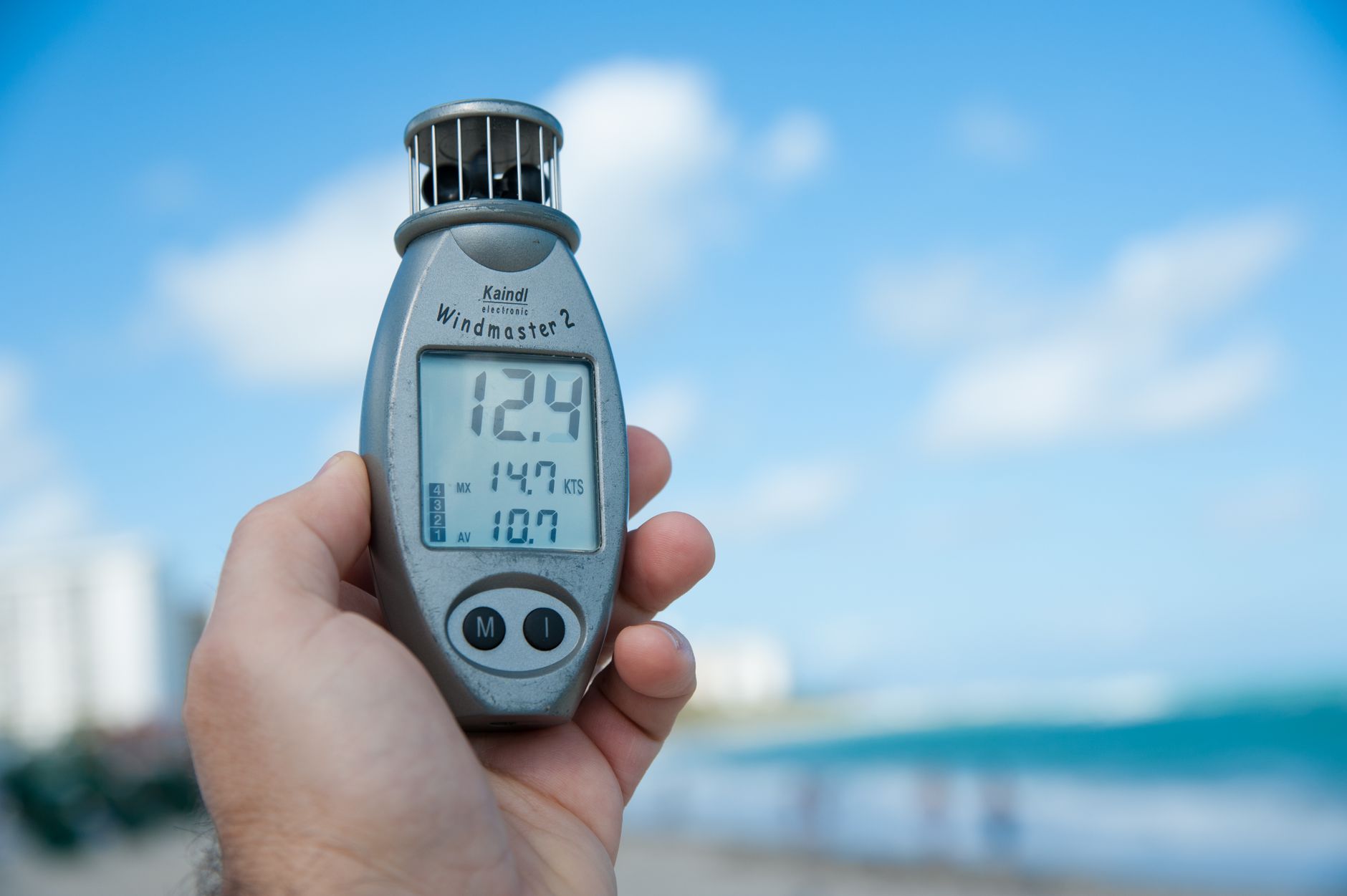
Sea breeze deserves its own reading. A morning that feels calm at the clubhouse door can be stronger on an exposed hole. Record wind at two or three points across the course, not one, and note the direction relative to the mowing corridor.
Public sand guidance from vendors is thin. Husqvarna lists fairway mowers for golf courses, with its CEORA line described for large, open areas, and as of November 2026 that page gives no wind rating and no sand guidance.

Scheduling passes around the wind window
Schedule the first pass for the calmest, most settled hours you can verify on your own course, and set a hold rule before the day starts. A hold rule names the condition, the action, and the person who decides, so no one improvises at six in the morning.
Build the window from three checks: a morning reading, a mid-morning reading, and a sand check at the course edge. If any check fails, the pass waits. If the wind eases, the pass resumes only after the crew confirms the surface again.
Other vendors show the same gap. Turflynx introduced a robotic electric fairway mower pitched on reducing fairway mowing costs, but the coverage found gives no operating conditions. Belrobotics' Bigmow is being piloted as a fairway mower at Flanders Nippon in Hasselt, Belgium, according to a March 2026 report, and no specifications appear in that result. A pilot tells you a machine is being tested, not how it handles a coastal afternoon.
What to log when a pass is held

A held pass is the most useful record a coastal course can keep. Without it, next season's scheduling rests on memory. Each hold should leave one line with these fields.
- Date, planned start time, and the times the hold began and ended
- Wind direction and speed at each check point, with the point named
- Sand observation: where it lay and how thick the film looked
- The rule from the hold sheet that triggered the stop
- Who made the call, and whether the pass resumed, moved, or was cancelled
- Any surface change noticed at the resume check
Reviewing the hold log to move the first pass
Review the log weekly. If holds cluster in the same hours, move the first pass later or start it from the sheltered side of the course. The pattern will tell you more than any single bad morning.
Keep the check points identical from day to day. Changing where the readings are taken makes two weeks of logs impossible to compare, and the comparison is the whole point.
Questions to settle with a vendor before the season
Ask for any wind operating limit in writing, tied to the exact model and its manual. Ask how the machine responds to sand on the walking surface, what a hold looks like on the operator screen, and what the vendor's engineer does after a held pass.
Ask for sensor placement details as well. A wind sensor used for positioning is a different question from a wind rule that stops a pass, and the two should never be treated as the same spec.
Where Service Robot Co. fits a coastal calendar
Service Robot Co. is an OEM neutral integrator, so the first question we ask is which robot fits the turf, not which brand we happen to offer. We lease robots through financing on a three year lease, with one fixed lease payment quoted after a site assessment, and we deploy, integrate, and train the crew on hold rules like the ones described here.
Every unit we place runs under RoboCare, our service plan, backed by regional service engineers in each state we service. On a coastal course, that means wind and sand questions go to a regional service engineer before the season opens, not after the first missed morning. Learn more at servicerobotco.com.
Frequently asked questions
Want a robot working for you?
Tell us the job and the site. We will recommend the robot, quote the lease, and keep it serviced.