Key takeaways
- Stone countertop shops are a strong cobot fit when the work is repetitive, dusty, and hard to staff, but still changes from job to job.
- The best first uses are machine tending, part handoff, edge finishing support, and repeatable polishing or adhesive steps around existing CNC flow.
- Silica control is not a side issue. In stone fabrication, the automation plan has to be built around wet methods, local exhaust, and housekeeping from day one.
- Most small and mid-sized shops do not need a lights-out cell. They need one well-placed cobot that removes the ugliest repetition without disrupting veteran fabricators.
- An OEM-neutral integrator matters here because the robot, gripper, stand, dust controls, training, financing, and service plan have to work as one operating system.
Do cobots make sense for stone countertop shops?
Yes, in the right slice of the process. Small and mid-sized stone shops rarely need a fully automated plant, and many would be poorly served by one. Their work mix changes, their slab flow is uneven, and the best people in the shop still make judgment calls on seams, edge quality, veining, and install readiness. But that does not mean automation is a mismatch. It means the right target is a practical cobot cell, not a moonshot.
The strongest fit is repetitive work that sits beside skilled craft rather than replacing it. Think machine tending on a saw or CNC, material handoff between stations, repeatable polishing passes, adhesive or sealant dispensing, and finishing tasks that chew up labor without adding much artistry. In those pockets, a collaborative robot arm can hold consistency through the shift, keep people out of the dustiest repeat motions, and free veteran fabricators for the work that still needs eyes and hands.
The timing is real. According to the U.S. Bureau of Labor Statistics, manufacturing still had 481,000 job openings in June 2026, including 345,000 in durable goods. Stone fabrication feels that labor pressure sharply because it is specialized work, physically demanding, and often hard to backfill fast.
Why is this niche a better cobot candidate than it first appears?
At first glance, countertop fabrication looks too custom for automation. Every kitchen is different. Every slab has its own pattern, break risk, and finishing quirks. That is true at the job level, but less true at the task level. Inside a typical shop, the same handful of motions happen over and over: load, present, hold, polish, clean, flip, hand off, and tend a machine while the spindle runs.
That is exactly where cobots have gained ground. According to the International Federation of Robotics, cobots accounted for 10.5 percent of the 541,302 industrial robots installed worldwide in 2023. According to the Association for Advancing Automation, North American companies ordered 36,766 robots in 2025, up 6.6 percent from 2024, with demand led by general industry rather than only automotive. That matters for stone shops. It means collaborative automation is no longer reserved for giant plants with long, frozen production runs.
The industry itself is also large enough to matter and fragmented enough to reward practical deployments. The U.S. Census Bureau counts 2,163 employer establishments in cut stone and stone product manufacturing in 2023. This is not a tiny artisan corner. It is a substantial base of mostly small and mid-sized operations that often share the same staffing pain, the same wet and dusty environment, and the same need to get more output from the crew they already have.
Which tasks are the best first targets?
The first rule is simple. Start where the task is repetitive, the part presentation can be controlled, and the quality standard is teachable. Do not start with the most artistic work in the building. Start with the most repeatable annoyance.
In many shops, the best first move is a machine tending robot beside an existing CNC, saw, router, or edge machine. The robot is not there to run the whole shop. It is there to keep a predictable station fed, unload finished pieces, or move a part to the next table without tying up a skilled fabricator on dead time.
A second good target is repetitive finishing support. Edge prep, surface touch-up on standardized profiles, adhesive dispensing, and repeat polishing passes on common shapes can all fit if the shop is willing to fixture the work properly. Material handoff is another strong candidate, especially where people are spending hours repositioning smaller pieces, backsplashes, sink cutout remnants, and finished components between benches and carts.
- Machine tending around saws, routers, and CNC centers
- Part presentation and handoff between wet stations and finishing benches
- Repeatable polishing on standard edge profiles and similar part families
- Adhesive, resin, or sealant dispensing where bead consistency matters
- Deburring, cleaning, and repetitive finishing steps that do not justify a full fenced cell
Where do cobots struggle in a stone shop?
They struggle where weight, part variability, and uncontrolled surfaces all collide at once. Full slab handling is usually the wrong opening move. So is any task that depends on split-second judgment about fissures, chips, or pattern matching on every cycle. A cobot can support that environment, but it should not be asked to solve the whole thing on day one.
Cycle time is another limit. Collaborative robots trade raw speed for easier deployment near people. If the job demands very high throughput, very heavy payloads, or aggressive motion envelopes, a conventional industrial cell may be the better answer. Some shops discover that a lift assist, a vacuum manipulator, or a better table layout fixes the bottleneck more cheaply than a cobot does.
This is why honest application selection matters more than robot enthusiasm. The wrong first cell creates two bad outcomes at once. It disappoints the owner and it teaches the crew that automation is a headache. The right first cell does the opposite. It removes a hated repeat task and proves the shop can automate without turning itself upside down.
Dust and water controls have to shape the cell
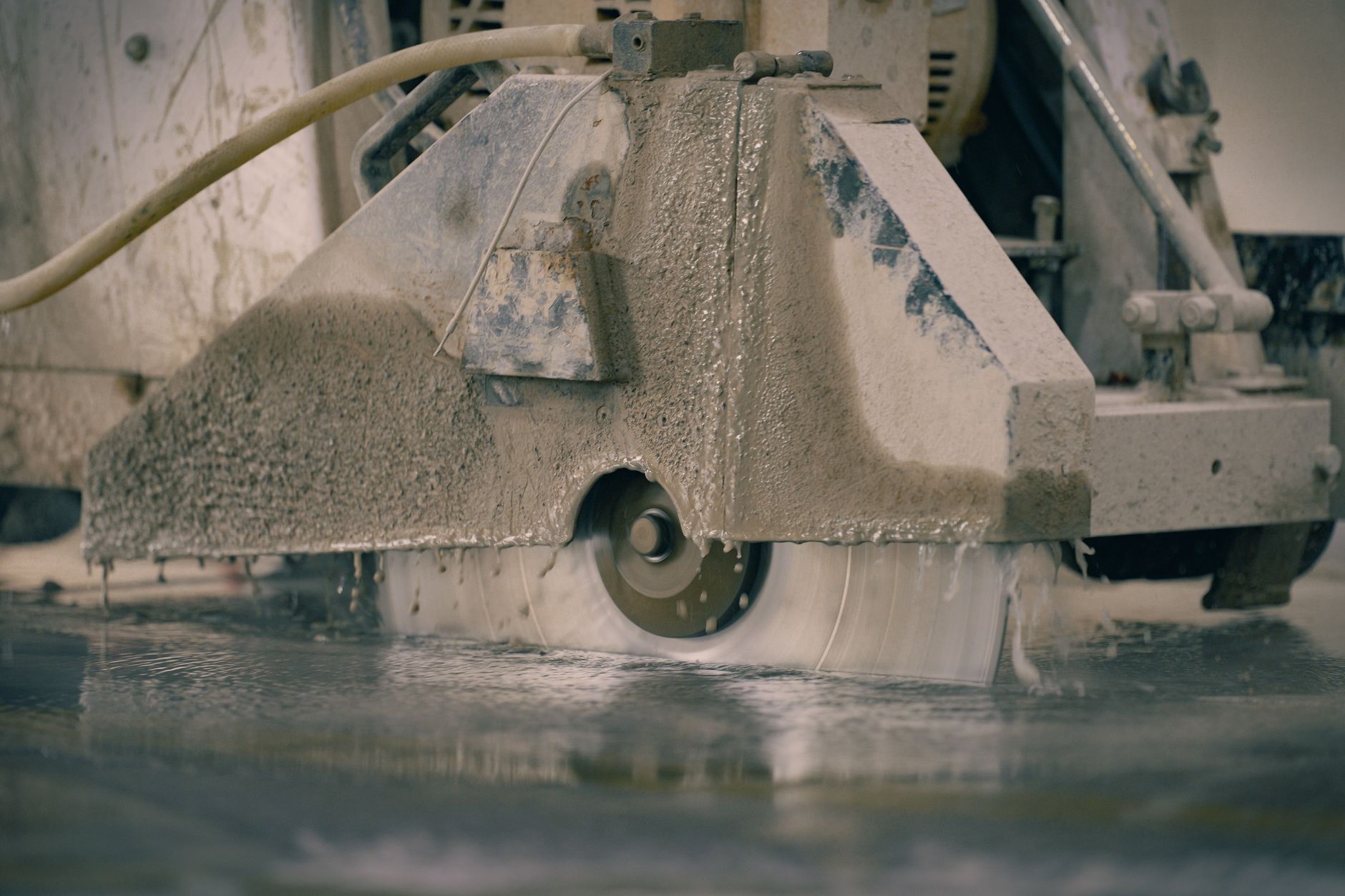
Stone fabrication is not a generic manufacturing environment. The automation design has to start with silica, slurry, and cleanup discipline. OSHA says about 2.3 million people in the United States are exposed to silica at work. Its current silica guidance explicitly calls out stone countertop manufacturing, finishing, and installation as high-risk activities.
The risk is especially acute in engineered stone. A CDC and NIOSH bulletin notes that engineered stone can contain more than 90 percent crystalline silica, compared with less than 45 percent in granite. The same bulletin reported 18 silicosis cases, including two fatalities, among stone fabrication workers in four states, and cited nearly 9,000 establishments with 96,000 employees in the broader stone fabrication industry in 2018.
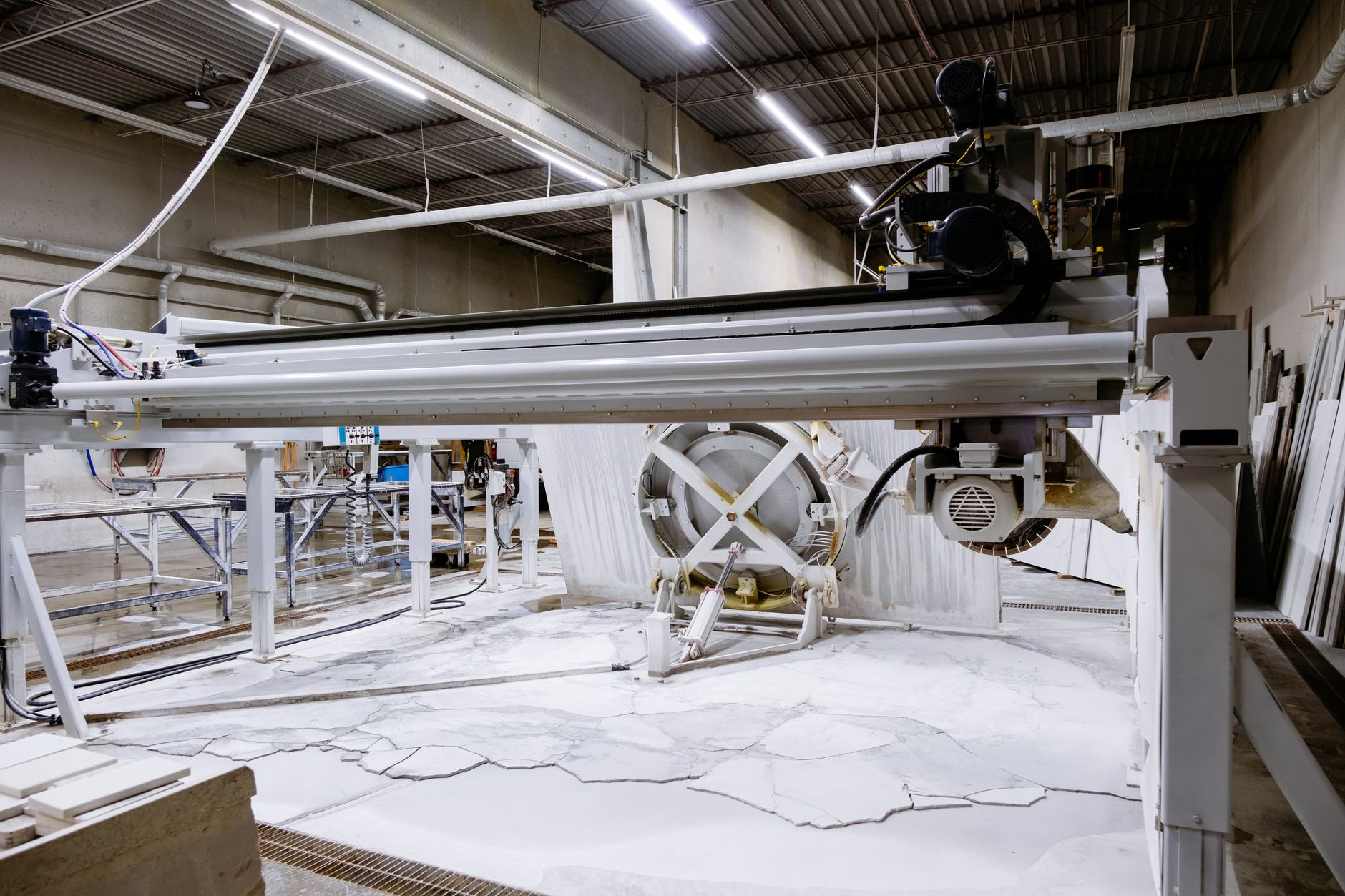
The operational point is straightforward. A cobot cell cannot just be bolted to the floor and left to fend for itself in a cloud of dust. OSHA's focused inspection guidance for engineered stone emphasizes water spraying systems, remote-controlled tools, wet-edge milling, local exhaust ventilation, HEPA-filtered cleanup, and strict housekeeping. That guidance lines up with how a good stone-shop cell should be built anyway.
The exposure numbers underline why. In a NIOSH field survey of countertop fabrication, short-term respirable crystalline silica exposures ranged from 27.1 to 142.6 micrograms per cubic meter for polishers and 57.8 to 450.8 for grinders, with higher spikes tied to cleaning and compressed-air practices. If you automate polishing or finishing, dust control is part of the machine design, not an afterthought.
How should a small shop start without disrupting production?
Start beside the flow you already trust. In most shops, that means adding one cobot at an existing CNC or finishing bottleneck instead of rebuilding the building around automation. Keep the first deployment narrow. One station. One part family. One success metric that everyone in the shop understands.
That metric should be operational, not theatrical. More spindle uptime. Fewer manual transfers per shift. Less operator waiting. Better consistency on a standard edge. Lower time spent on repetitive polishing. Cleaner handoff between wet work and final finishing. When the first cell earns its place on one of those measures, the second one becomes much easier to justify.
This is also the stage where training matters more than most owners expect. Veteran fabricators do not need a lecture on robotics. They need a cell that respects the way stone work is really done, plus enough hands-on coaching to recover gracefully from a fault, change a part setup, and keep production moving when the day gets messy.
What does a practical buy or rent path look like?
For many shops, the right commercial question is not simply buy versus do nothing. It is buy, finance, or start with a cobot rental style program if the workload is seasonal or the owner wants proof before committing to a broader rollout. Search demand reflects that shift. Buyers increasingly look for terms like cobot rental, machine tending robot, robot financing for small business, and robot leasing for business because they want automation to match cash flow, not break it.
This is where Service Robot Co. fits naturally. The company is an OEM-neutral robot integrator for U.S. businesses, which matters in stone work because the right answer depends on payload, reach, washdown tolerance, end-of-arm tooling, fixturing, safety layout, and service coverage, not on forcing one catalog into every shop. Service Robot Co. can finance, deploy, integrate, train, and service the system through a nationwide U.S. engineer network, which is a better fit for a stone fabricator that wants one partner for the whole lifecycle.
That model also lowers a real operational risk. In a dusty shop, downtime is never just a software problem. It can be a gripper issue, a hose issue, a guarding issue, a vacuum issue, or a process drift issue. Having one vendor for robot deployment and integration, service, and follow-up support is often more valuable than squeezing the initial hardware quote.
What does success actually look like six months later?
Success is usually quieter than the sales pitch. The shop has not become lights-out. It has become less fragile. One station no longer depends on a single tired operator. The CNC sits idle less often. Finishing output is steadier. The crew spends fewer hours on the most repetitive and dusty motions, and more time on layout, quality, install prep, and the judgment-heavy work that keeps callbacks down.
That is the real promise of cobots in stone fabrication. Not factory theater. Better use of scarce skilled labor. According to OSHA, the safest shops are already pushing work into controlled manufacturing conditions instead of doing more dusty cutting and grinding in uncontrolled spaces. A well-planned cobot cell supports that same logic. It keeps repeat work controlled, teachable, and measurable.
For small and mid-sized countertop shops, that is enough. It is often more than enough. One good cell, placed in the right bottleneck, can do more for throughput and crew stability than a grand automation plan that never survives contact with stone dust, custom jobs, and a real production calendar.