Key takeaways
- A scrubber rides an elevator through an interface to the elevator controller, either a software API or a hardware gateway wired in by your elevator service team.
- Otis, KONE, Schindler, TK Elevator and Aethon each publish a robot integration, so ask your elevator provider which one your building supports.
- Otis says its API works with most Otis elevators made since 2000, and Aethon says its interface works with nearly every elevator make and model.
- Plan the water and charging for each floor. A dock, a battery swap or a return trip to a home floor all work, but each one shapes the schedule.
- Roll out in order: confirm the elevator, map one floor, place the dock, test with the elevator provider, then add floors.
How do autonomous floor scrubbers handle elevators and multiple floors?
An autonomous floor scrubber handles elevators through an interface that lets it call the car, ride to a mapped floor and carry on cleaning, usually from a separate map for each floor. Which interface works depends on your elevator maker. Service Robot Co. checks that before we pick a machine, then leases, deploys and services it.
A multi-floor job has four parts. The robot needs a map and cleaning plan for every floor, a way to talk to the elevator, a plan for water and charging on each level, and rules for sharing the car with people. Miss one and the robot stops at the lift door.
The elevator is the part that cannot be improvised. A scrubber is heavy and wet, and the car belongs to your building, so the first conversation is with your elevator service provider, not the robot maker.
How does a robot talk to an elevator?
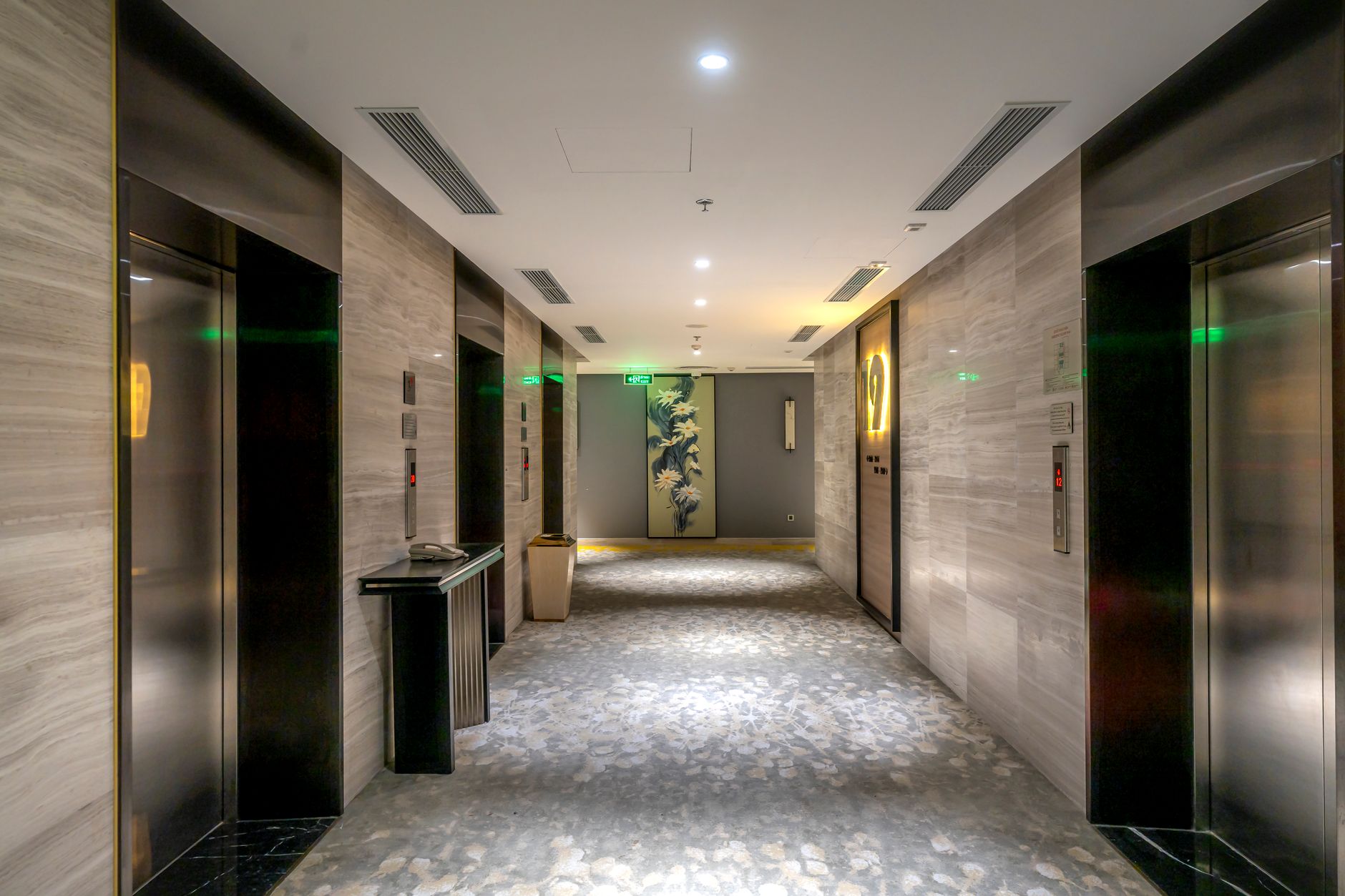
Two approaches dominate. One is a software API from the elevator maker. The other is a hardware interface wired to the elevator controller. Otis describes its Integrated Dispatch as a cloud-based or on-premise API that offers more flexibility and elevator data than traditional hard-wired integrations, and says it works with most Otis elevators made since 2000.
KONE says its Service Robot API uses IoT technology to connect robots to its elevator control system so they can call elevators and move between floors, and that real-time data on position, direction and status helps them navigate. Schindler's BuilT-In connects the elevators' network switch to the building network or a gateway box, and a robot places its call over WiFi, 4G or 5G. TK Elevator offers MAX Robot Calls as an API add-on that gives real-time elevator status and remote elevator control, and names cleaning robots among its uses.
Aethon takes the third path, a brand-neutral ReadyElevator interface wired to the controller by your elevator service team. Aethon says it uses the controller's existing capabilities without altering them, accepts fire and safety signals, works with single-entry or pass-through cabins, and that it has integrated more than 1,000 elevators. Gausium says its Phantas, Vacuum 40 and Scrubber 50 robots integrate with smart elevator systems through IoT hardware or an open API.
In practice the sequence is short. Schindler describes it in four steps: the robot receives a task for a floor, places an elevator call over the network, is assigned a dedicated or dynamically chosen car, and returns to its dock when the task is done. While it travels, the robot also asks the elevator for its position and door status. Whatever the brand, ask for the same sequence in writing for your building, including what happens at each step if the signal drops.
Who has to approve and install the elevator link?
Your elevator service provider sits at the center. Otis says its field engineers install a small amount of hardware in the building and coordinate with local safety inspectors. Aethon says your elevator service team wires its interface to the controller. Schindler points to a cloud-based environment where operators simulate scenarios before deployment, including a check that robot-elevator communication is not interrupted.
Several makers offer tools for testing before anyone rides the lift. Otis describes online simulation environments for robot developers to test against its APIs before on-site deployment, and Aethon says it certifies each robot vendor for safe use of the elevator system. Ask your provider which of these steps apply to your building and who signs off at the end.
Door timing and car choice matter in a busy tower. Otis says door open and close times can be adjusted to a robot's travel speed and that robots can use all the elevators in a bank, with the best car assigned for travel time. Ask what the robot does during a fire alarm or when a door sticks, and get those behaviors in writing for your building.
How does the scrubber keep a map for every floor?
Each floor gets its own mapping pass. Gausium says its robots build a map on first deployment and that no location tag, laptop connection or professional engineer is needed. Avidbots says that when a Neo is deployed the facility is mapped and a cleaning plan generated. Tennant's spec sheet lists Teach and Repeat and Area Fill as learning types, and a Tennant blog post says mapping can take several weeks before a machine can run.
Public pages describe the elevator call far better than the map handoff. Ask any maker how the robot knows it has arrived on the fourth floor and how it loads that floor's map and plan. It is a fair question, and a good answer will be specific.
The goal is a plan that covers the whole building without anyone escorting the machine. Gausium says elevator integration removes the need for staff to move robots between floors by hand, and that its cloud platform offers 24/7 remote diagnostics. Treat that as the maker's claim and ask to see it run on a trial in a building like yours.

How do water, charging and weight work across floors?
Water and power are a floor-by-floor plan. Gausium sells a workstation for its Scrubber 50 and 75 series that charges, refills and drains the robot. Kärcher's KIRA B 200 has an optional dock for refill, drain and charge, and Avidbots offers swappable batteries. Schindler notes that after a task its robot returns to the docking station to wait for the next order.
Decide where the dock lives. One dock on a home floor means a ride down for every refill. A dock on each floor needs more plumbing and electrical work but keeps each level self-contained. The public pages we reviewed do not say how many floors one dock should serve, so the answer comes from your tank life and your floor area.
Weight is the physical limit. Tennant lists the T380AMR at 850 lb and the T7AMR at 1,085 lb with tanks empty and batteries fitted, and a full tank adds more. Give your elevator provider the weight, width and length of each shortlisted machine and ask for the rated capacity and car dimensions before you compare models.
What about network and cybersecurity for the elevator link?
The link between a robot and an elevator is a connection into a building system, so your IT team will ask about it. The makers answer in different ways. Otis says all communication between its elevators and service robots is encrypted. KONE says its API service is certified to ISO 27001:2022 for information security management. Aethon says its interface meets the UL 2900 cybersecurity standard and uses fully authenticated, on-premise communication with no cloud or external servers required.
Schindler's page describes the connection method, a link from the elevator network switch to the building network or a gateway box, but does not describe security measures. That gap is not a flaw in the product, only a question to put to the maker. Ask who manages the network path, what is encrypted, who can see the robot's position data, and what the robot does if the connection fails.
Bring the elevator provider, your IT lead and the cleaning robot supplier into one conversation early. Each knows a third of the answer, and a multi-floor plan stalls when they learn about each other late.
How should you roll out a multi-floor cleaning robot?
Go in order and keep the elevator out of the first night. Prove the robot on one floor with your crew, then bring in the elevator link once the cleaning plan is solid. This is how we sequence a multi-floor job, and the list below shows the steps.
Expect preparation work on every floor. Tennant's blog says staff must move mats, signs and carts before mapping, and that robots need retraining when furniture or fixtures change. A tenant floor that gets rearranged monthly needs a standing plan for updating its map.
How does Service Robot Co. handle a multi-story building?
We start by asking your elevator provider which robot interface your cars support, and we measure the car, the doors and the weight limits. Then we compare robots across manufacturers, pick the one that fits the building, lease it on a 3-year lease with a $1 buyout at the end, deploy it, train your crew and service it.
We do not promise a brand before we know the elevator. A building with a modern connected elevator and a building with a decades-old controller are different jobs, and we say so up front.
Want help picking the right robot? Talk to us
Book a free site assessment with Service Robot Co. Tell us how many floors you clean, who services your elevators and what hours the building is quiet, and we will map out what a multi-floor robot plan looks like.
Every robot we lease comes with 24/7 support with 10-minute specialist triage, regional service engineers in every serviced state, three check visits a year and a 12-month warranty.
Frequently asked questions
Want a robot working for you?
Tell us the job and the site. We will recommend the robot, quote the lease, and keep it serviced.
Sources
- Otis Integrated Dispatch
- KONE: Service Robot API press release
- Schindler: robot service connection (BuilT-In)
- TK Elevator: MAX Robot Calls
- Aethon: ReadyElevator brochure (PDF)
- Gausium: technology overview
- Gausium workstation for Scrubber 50 (ASBIS catalog)
- Tennant: T380AMR and T7AMR specifications (PDF, 2022)
- Tennant blog: robotic cleaning machine considerations
- Avidbots: Meet Neo
- RobotLAB: Kärcher KIRA B 200 product page