Key takeaways
- Ask who maps and re-maps the course before comparing mowers.
- A fault alert that reaches only a vendor queue does not put a mechanic on the sixth tee.
- Get technician response times and drive time in writing, because no public figures turned up for the dealer networks we checked.
- Tree lines, base location and Wi-Fi or 4G strength decide how often a map needs attention.
What should a one-mechanic club settle before a lease quote?
A rural nine-hole club with one mechanic and a small crew should settle three things in writing before it signs anything: who maps the course and keeps that map accurate, who responds when a robot mower stops, and how long a technician needs to reach the site. Mower cut quality matters, but it rarely decides whether the arrangement works. A unit parked near the sixth tee for two days during a weekend league is a scheduling failure, and the paperwork either prevents it or it doesn't.
Vendor brochures tend to be strong on the mower and thin on those three questions. Treat that gap as the main finding of your evaluation, and press for specifics before the numbers are discussed.
Who maps the course, and who re-maps it after the trees move?
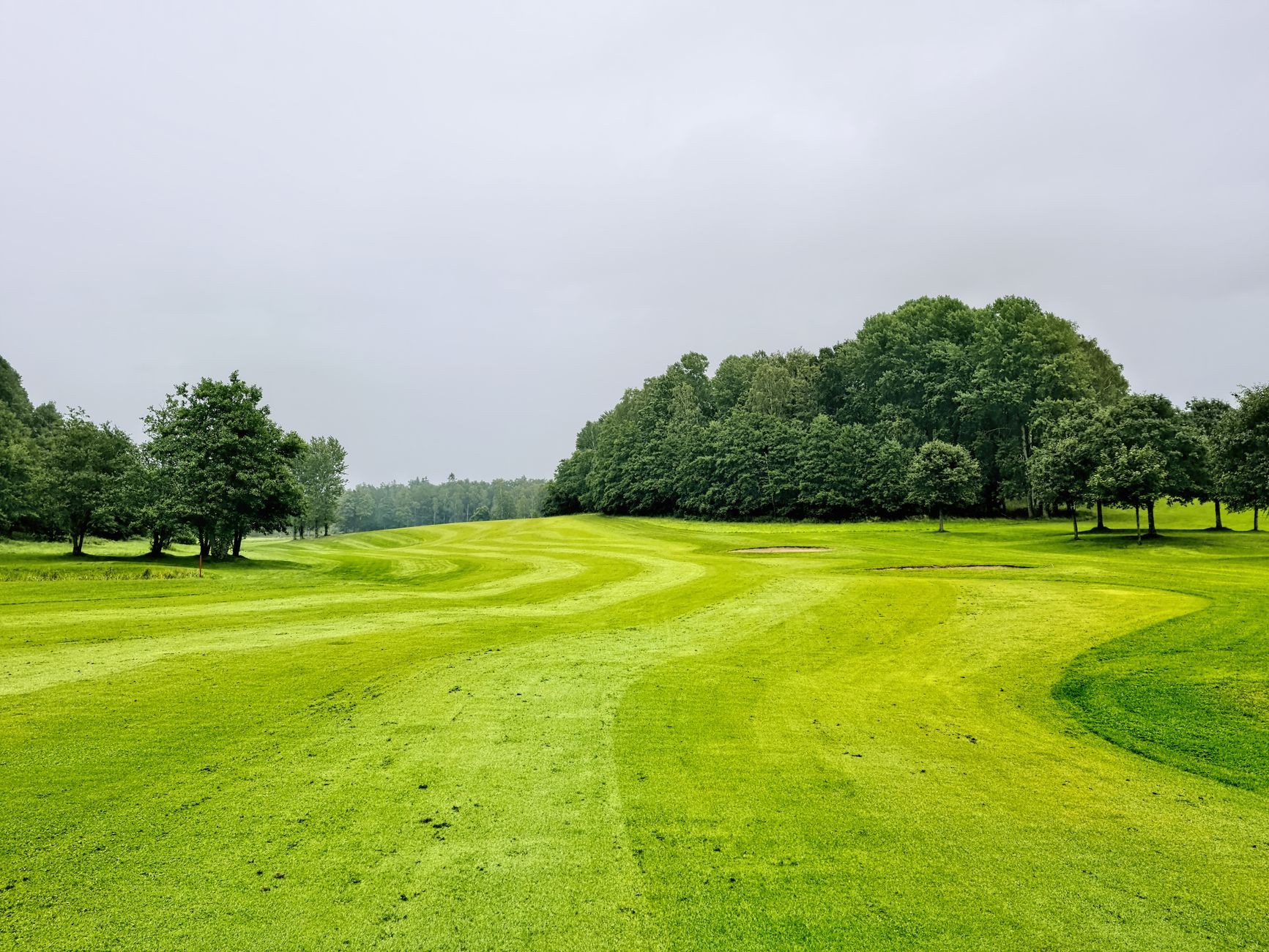
Robot mowers that use RTK positioning depend on a clear view of the sky. One vendor guide (rtkdata.com, 2026, vendor-reported) puts fix accuracy at about 1 to 2 cm horizontally near the reference station in open sky, and advises walking the boundary to find tree or building blockage. On a nine-hole course with mature tree lines along the doglegs, that walk is the real mapping job, and clubs tend to underestimate it.
The same guide says the reference base must stay fixed after mapping, since moving it is a common cause of trouble. Ask who relocates a base if a cart barn gets moved, and whether that trip is in the proposal. Some kits add LiDAR as well. FJD's golf-course kit combines RTK with LiDAR hybrid navigation and LiDAR mapping, according to its product page, which is one more reason to confirm which sensors the proposal actually includes.
- Who walks the boundary, marks blocked sky, and how many site visits does that take?
- Is the base local or network-corrected, and what does the mower do when the club's Wi-Fi or 4G link drops?
- Which events trigger a re-map, such as storm-downed limbs, a new cart path or a relocated tee?
- Who pays for a re-map, and how long does it take to return a corrected map to service?

Who hears about a fault first, and who acts on it?

Fault alerts are the first link in the chain. Toro's GeoLink autonomous fairway mower sends real-time text alerts about faults and required operator actions, according to Toro's product page as checked in November 2026. Husqvarna describes its fleet platform as included with commercial robotic mowers, and says a club can grant its dealer view or edit access so troubleshooting starts sooner.
An alert helps only if it reaches someone who can act on it at six on a Saturday morning. Ask whether the text goes to the club's mechanic, to the vendor's dispatch desk, or to both, and who answers the phone on weekends. A manager who finds the alert on Monday has already lost a week of fairway cuts.
John Deere's brochure for a conventional fairway mower, not an autonomous model, describes engine hours shown in real time through JDLink, dealer monitoring of maintenance only if the club opts in, and remote diagnostics with permission. It is not a robot document, but it shows what a remote support model can look like, and it is a useful comparison point when a vendor describes its own alerts.
How fast can a technician reach a nine-hole site?
This is where published information runs thinnest. In the research for this piece, no dealer network named above published response times, service-level commitments or travel distances to nine-hole sites. A phrase like fast support tells you nothing. Get the numbers in writing, and treat a vendor that will not give them as having left the question open.
Distance matters more in rural country than a brochure implies. A technician who drives two hours each way has used half a day before touching a mower. Ask where the nearest service engineer is based, whether that person covers your state, and whether a backup unit or the most common spare parts can travel with the first visit.
- Time to first remote triage after an alert
- Time to on-site dispatch and arrival at your address
- Parts stocked for the most common faults
- Loaner or spare unit when a repair runs past one visit
Why one mechanic cannot absorb every fault
The labor market explains why this matters. The 2022 GCSAA labor survey found 63% of respondents rated the labor market bad or very bad, up from 45% in 2016 and 19% in 2012, according to a summary posted by GCM. Only 9% rated it good or very good. We did not find a more recent staffing percentage in this search, so treat the 2022 figure as the latest we could confirm.
A club with one mechanic has no spare person to draw on. Each robot fault competes with greens work, bunker repair and equipment maintenance. That means the vendor's service model has to carry part of the load, which is why these questions belong in the written proposal rather than in a phone call after something breaks.
How Service Robot Co. approaches these three questions
Service Robot Co. is an OEM-neutral integrator. We select the robot across manufacturers for the job, then lease it through financing, deploy and integrate it, train staff, and service every unit under RoboCare, our service plan. Regional service engineers cover every state we service, so the alert, the map and the technician come from one contact rather than three.
For a club, the practical step is a site assessment. Commercial robot leasing for a course starts there, and the lease is quoted as one fixed lease payment after that assessment. The figure then reflects your nine holes, your tree lines and your drive time, not a generic plan. The assessment is also where the mapping, alert and response questions in this article get written down.
What to bring to the first conversation
Bring a sketch of the nine holes with cart paths, drainage, water hazards and tree lines marked. Add the mechanic's weekly hours, the crew's mowing schedule, and the drive time from the nearest technician the vendor can name. Those three inputs let a vendor answer the questions above for your course instead of a template.
Frequently asked questions
Want a robot working for you?
Tell us the job and the site. We will recommend the robot, quote the lease, and keep it serviced.
Sources
- GCM golf course labor tag page (summary of 2022 GCSAA labor survey)
- rtkdata.com, Wire-Free Robot Mower RTK Accuracy Guide 2026 (vendor-reported)
- FJD golf-course robot mower kit product page
- Toro GeoLink Solutions Autonomous Fairway Mower Series
- Husqvarna fleet services for robotics
- Husqvarna fairway mowers for golf courses
- John Deere fairway mower brochure (conventional model, GB)