Key takeaways
- The fastest robot ROI usually sits where floor miles, repetitive motion, and wet-floor exposure overlap on thinly staffed shifts.
- Janitorial services posted a 2.5 total recordable case rate in 2024 versus 2.3 across private industry overall, according to BLS.
- Overexertion and same-level falls are the two biggest direct cost drivers in serious workplace injuries, which is exactly where floor-care automation can remove exposure.
- A robot earns its place fastest when it takes over long autonomous scrubbing routes, not detail work that still needs hands and judgment.
- Robot as a service and monthly payment programs matter because injury-risk reduction usually starts on the hardest shift, not in a capital budget meeting.
Where does a cleaning robot usually pay off first?
It usually pays off first on the routes that combine long floor coverage, repetitive machine handling, and weak staffing on second or third shift. That means big boxes of polished concrete, endless retail aisles, hospital back corridors, airport concourses, school commons, and any site where one person spends hours pushing or riding floor equipment just to keep up.
The labor argument is real, but the quicker financial win often comes from exposure removal. In 2024, the Bureau of Labor Statistics counted 2,447,700 janitors and building cleaners in the United States. That is a huge workforce doing physically repetitive work every day. When a commercial cleaning robot rental or floor scrubber monthly lease removes the most punishing miles from that work, the benefit is not abstract. It lands in fewer strain-prone tasks, fewer wet-floor passes by tired crews, and less dependence on a thin overnight roster.
The same logic sharpens in 2026 because the current OSHA Injury Tracking Application data set now covers 2025 work-related injury and illness submissions filed from January 1, 2026 through March 15, 2026. Facility leaders no longer need to talk about risk in broad, dated terms. They can look at current establishment-level patterns and ask a practical question: which cleaning tasks still expose our people to the injury categories that cost the most?
Why is injury-cost ROI different from labor ROI?
Labor ROI asks how many paid hours a robot offsets. Injury-cost ROI asks where automation removes the kinds of tasks that generate strains, sprains, lost days, temporary reassignment, turnover pressure, and the operational chaos that follows even one bad incident. Those two views overlap, but they are not the same thing.
According to the National Safety Council, the average cost per medically consulted workplace injury was 43,000 dollars in 2023. Liberty Mutual’s Workplace Safety Index says overexertion involving outside sources accounted for 12.49 billion dollars in direct costs and falls on the same level accounted for 9.99 billion dollars. Those are not exotic failure modes. They map directly to pushing heavy machines, handling hoses and tanks, working on wet surfaces, and repeating the same floor-care motions across long shifts.
That is why a night shift autonomous scrubber can beat a simple staffing-replacement calculation. If the machine eliminates a large share of the most repetitive passes while a human handles edge work, spot response, and exceptions, the return comes from a safer task mix as much as from fewer labor hours.
What injury exposures make floor-care automation compelling?
OSHA’s housekeeping ergonomics guidance is blunt about the hazard profile. Housekeepers and cleaners face strain and sprain risk from pushing and pulling heavy carts, using vacuums and floor equipment, moving beds or furniture, lifting trash and linens, and spending long periods bending, kneeling, twisting, and reaching. OSHA also lists janitors and cleaners among high-risk occupations for musculoskeletal disorders.
For facility managers, that means the strongest automation candidates are not the most visible spaces. They are the tasks with the ugliest exposure stack: long repetitive scrubber runs, repeated water handling, turns around fixtures, ramp entries, dock-adjacent corridors, and routes that force one operator to cover a large facility alone. A robot floor cleaner rental does not erase every hazard, but it can remove the longest continuous portion of the job where fatigue and repetition build.
The BLS data supports the point. Janitorial services recorded a 2.5 total recordable case rate in 2024, above the 2.3 rate for private industry overall. Its days-away-from-work rate was 1.2, versus 0.8 across private industry. Those are exactly the cases that ripple through coverage plans and overtime budgets.
Which facilities tend to see the fastest payoff?
Warehouses are near the top of the list because the floor miles are relentless and the routes are easy to standardize. A floor scrubber for warehouses or warehouse cleaning robot rental can run the same wide lanes nightly, reduce operator exposure to long pushing or riding cycles, and keep overnight cleaning no operator focused for the highest-square-foot segments.
Retail chains and grocery stores also move quickly when aisle scrubbing happens after close or on a lightly staffed overnight crew. The injury-cost case gets stronger when one associate is expected to cover spill-prone front-of-house areas and still complete the full floor route. In that setting, autonomous floor scrubber rental protects coverage quality and reduces the pressure to rush wet-floor work.
Healthcare campuses, airports, schools, convention centers, and other multi-wing properties also stand out. Not because every corridor should be automated, but because the long predictable loops can be. Once the robot owns those loops, the crew can spend its time on restrooms, touchpoints, recovery tasks, and incident response instead of grinding through the same floor miles every night.
- Fastest-payback profile: more than one hour of repeatable scrubber work per shift on the same route
- Operational accelerant: second or third shift with chronic understaffing or absentee coverage
- Higher-risk signal: wet-floor work combined with long pushes, turns, ramps, or heavy tank handling
- Best fit: wide, repeatable, obstruction-light zones where consistency matters more than hand detailing
What tasks should stay manual?
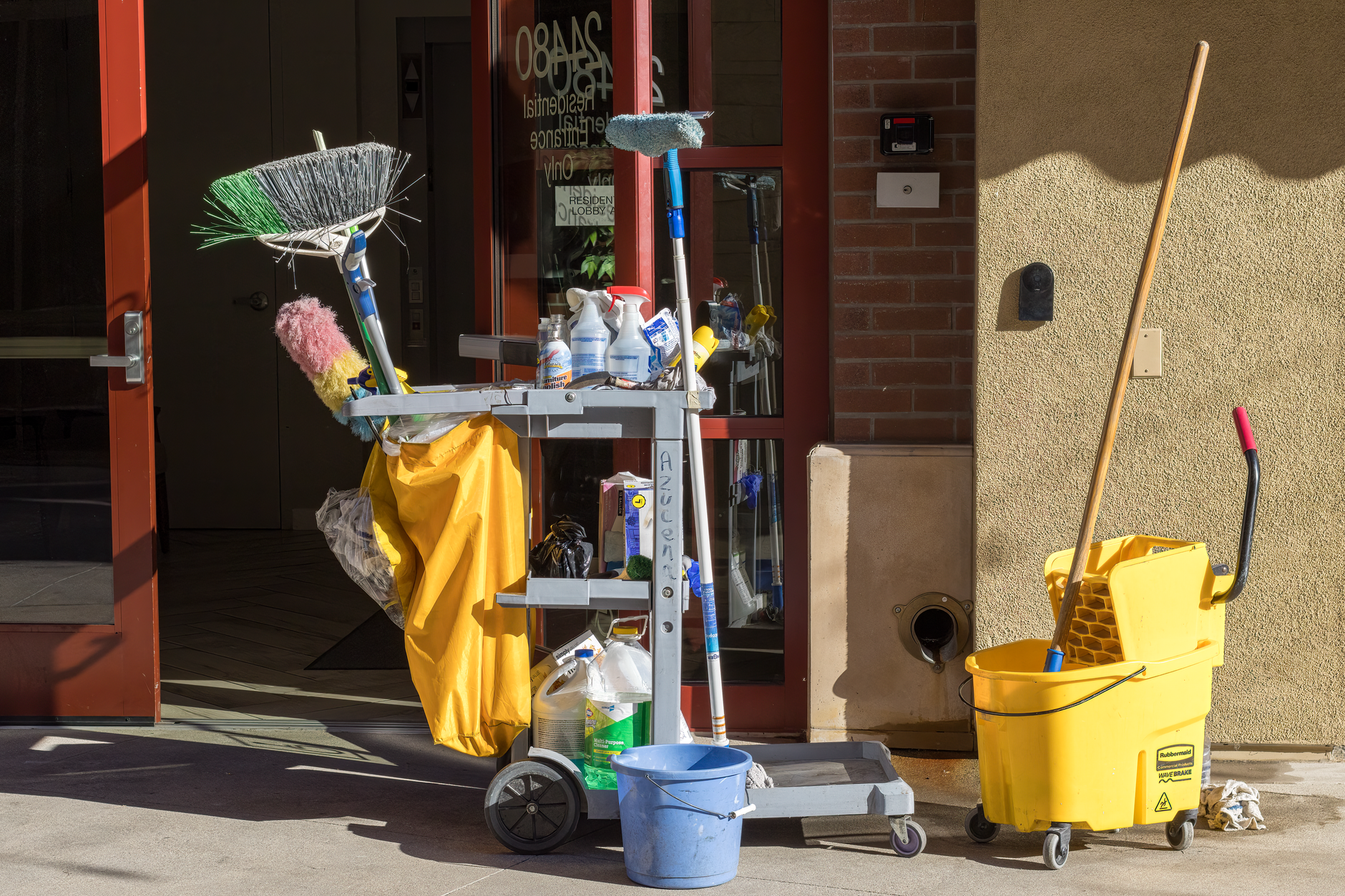
Not every cleaning task belongs on a robot. Tight restroom resets, cluttered back rooms, staircase work, heavy spot cleanup, and furniture-dense spaces still depend on human judgment and dexterity. Trying to force automation into those areas usually muddies the business case and frustrates the crew.
The smarter play is to automate the miles and keep the finesse manual. Put the industrial floor scrubbing robot on the broad, repeatable route. Keep technicians on setup, inspection, edge recovery, and exception handling. That division is where injury-cost ROI gets clean, because the robot removes the most repetitive exposure while people stay on the tasks that genuinely need people.
This also keeps expectations honest. A commercial robot demo should prove route stability, recovery behavior, and shift fit, not pretend that one machine replaces a whole environmental services program.
How should a facility manager rank sites before starting?
Start with exposure density, not excitement. Rank buildings by nightly floor miles, number of scrubber hours, frequency of wet-floor work, overtime used to finish routes, and how often a supervisor has to reshuffle coverage when someone calls out. Then layer in your safety signals such as strains, sprains, slips, temporary transfers, and days-away cases linked to floor care or material handling inside housekeeping.
Next, inspect task design. Are crews moving heavy machines in and out of storage? Are they hauling water long distances? Are routes concentrated into one punishing shift? Does a single missed callout push the remaining crew into rushed work? Those are the conditions where robot leasing for business or a month to month robot lease can outperform a buy-first mindset because you can place automation exactly where risk is concentrated.
Finally, compare the route, not the building. A mixed-use campus may only have one or two loops that really justify automation. That is enough. Fast ROI often starts with one hard route, one hard shift, and one clearly defined exposure problem.
- Count floor miles per shift and actual scrubber hours, not just square footage on a brochure
- Review OSHA logs and workers’ compensation history for strains, sprains, slips, and transfer cases tied to floor care
- Flag shifts that rely on one person for large facility coverage
- Prioritize routes with stable geometry and repeat frequency of at least five nights per week
Why does the deployment model matter almost as much as the machine?
A weak deployment can erase a good safety case. If the robot is down, poorly mapped, badly trained, or unsupported on nights and weekends, the work snaps back to the same strained crew and the exposure returns. Injury-cost ROI only holds when uptime, service response, and retraining are part of the operating model.
That is where Service Robot Co. fits. We are a full-service commercial robot integrator for US businesses, and we are OEM-neutral. We choose the robot that fits your floor, then finance, deploy, integrate, train, and service it through a nationwide engineer network. One partner, one number, and one lifecycle owner matters more than most buyers expect because floor-care automation fails operationally when support is fragmented.
For many buyers, commercial robot rental, robot rental monthly, or a robot as a service structure is the practical entry point. It lowers upfront friction, keeps maintenance included, and makes it easier to start on a single high-risk route before expanding.
What does a credible first pilot look like?
A credible pilot is narrow, measurable, and tied to exposure reduction. Pick one route with known floor miles, one shift with known coverage pain, and one baseline for manual machine time. Measure how much operator run-time disappears, how often the route finishes on schedule, and how much wet-floor exposure is taken out of the night.
Do not judge the pilot only by shine. Judge it by task mix. If the crew spends less time on repetitive scrubbing and more time on high-value detail, infection-sensitive touchpoints, or service recovery, that is the operational signal you want. If supervisors stop using overtime or emergency reshuffles to complete the same route, that matters too.
Service Robot Co. often advises buyers to start with a free site assessment and a pilot that isolates one route before scaling into a multi-site program. That keeps the math grounded in the real building, the real shift, and the real safety exposure instead of generic vendor averages.

What should your decision look like after the pilot?
If the pilot removed long repetitive machine time from an understaffed shift, held route consistency, and reduced dependence on last-minute coverage moves, the business case is already stronger than a simple labor-offset spreadsheet suggests. You have reduced exposure to the injury categories that cost the most and destabilize operations the fastest.
If the route stayed too cluttered, too fragmented, or too dependent on constant human intervention, keep that work manual and move the robot to a better loop. The goal is not to automate for its own sake. The goal is to put automation where janitorial injury exposure is repetitive, expensive, and operationally disruptive.
That is where cleaning robots pay off fastest. Not in every room. In the miles that quietly grind people down night after night.
Frequently asked questions
Sources
- BLS Occupational Outlook Handbook: Janitors and Building Cleaners
- OSHA ITA Data: 2025 submissions filed in 2026
- OSHA Injury Reporting FAQs
- BLS IIF Home: 2024 injury and illness highlights
- BLS 2024 industry injury rates table
- OSHA housekeeping ergonomics and MSD hazards
- OSHA ergonomics overview
- National Safety Council safety costs and injury average