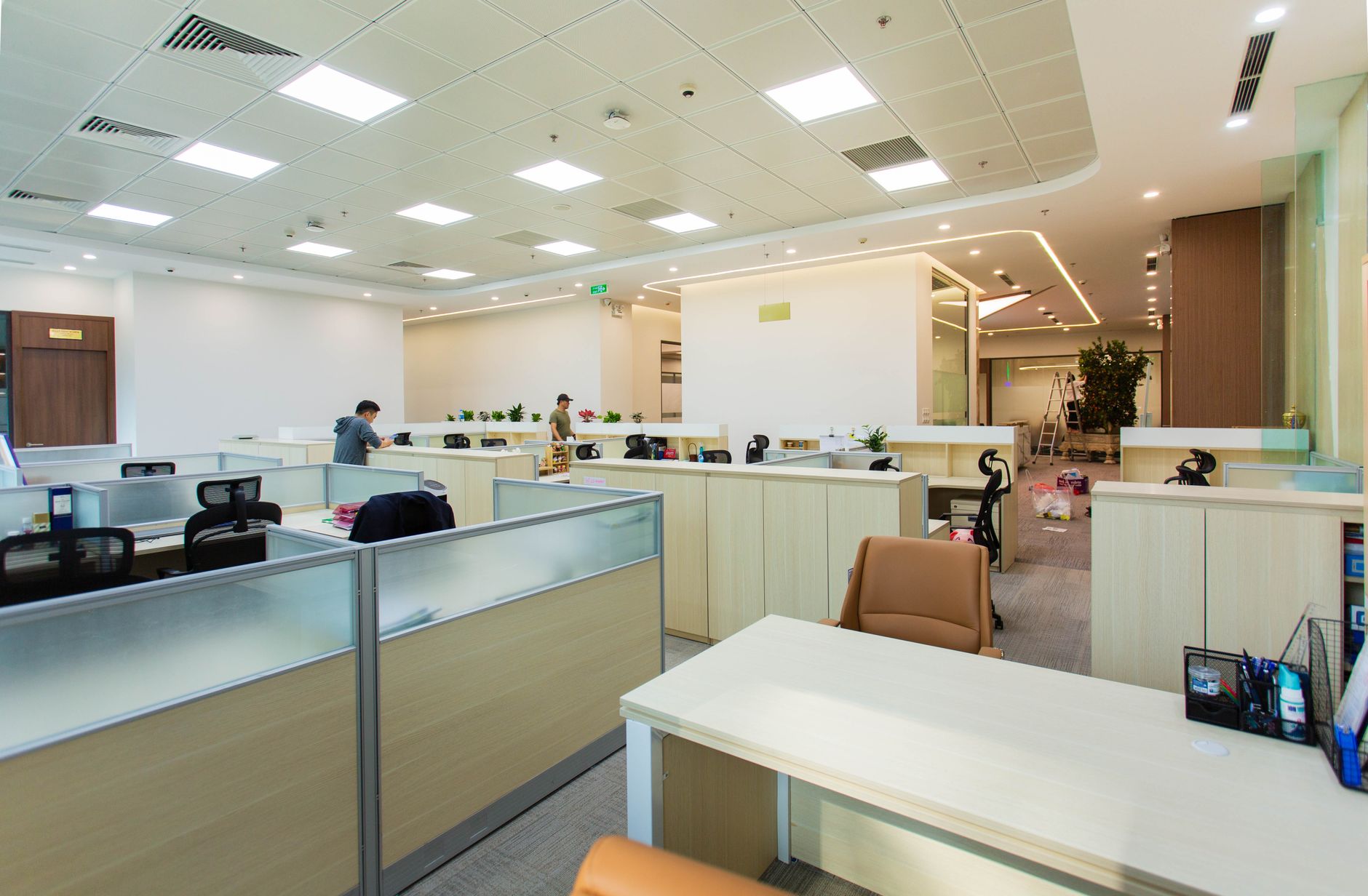
a multi-floor office headquarters in a dense urban business district
Office Cleaning Case Study: 60 Minutes Down to 20 on One Floor
A documented office real estate example shows how autonomous vacuuming cut one floor's cleaning labor from 60 minutes to 20 and supported a 20% cost reduction.
- 60 to 20 min
- Labor time on one floor
- 20%
- Cost reduction achieved
- 1,000 m2
- Robot-covered vacuum area
- 2 robots
- Units used on the floor
Based on a documented real-world deployment. Figures are from public reporting; the organization is not named.
Operating Pressure on a High-Density Office Floor
This office headquarters was managing cleaning in a setting that had become more demanding on two fronts at once. The facility team needed tighter cost control, but it also needed a more defensible standard for hygiene work on occupied office floors where expectations around cleanliness had sharpened.
The floor itself was substantial. One floor measured 1,900 square meters, with 1,500 square meters falling within the routine vacuuming scope. Under the old pattern, one worker spent 60 minutes cleaning a single floor, which left limited room to add more detailed wipe-down work without driving labor back up.
That created the real operational bind. The job was no longer just about finishing the vacuum pass. It was about reallocating labor toward higher-touch tasks while keeping the floor covered, the cleaning spec credible, and the cost profile under control.
- One floor totaled 1,900 square meters
- 1,500 square meters were in vacuum scope
- Routine cleaning took 60 minutes per floor with one worker
- Management was pursuing both cost reduction and stronger cleaning standards
Rebalancing the Floor Between Autonomous Vacuuming and Human Detail Work
The operator introduced autonomous vacuuming as a targeted layer inside the existing cleaning workflow, not as a wholesale reset. Of the 1,500 square meters in vacuum scope, 1,000 square meters were assigned to the robot and the remaining 500 square meters stayed in human hands. That split matters. It shows a practical deployment shaped around real floor conditions rather than a theoretical full-automation claim.
Two robots were used on the floor, and the route design was pushed tightly around furniture to widen the machine-covered area. The documented operating benchmark on the source page is about 500 square meters per hour, which aligns with the 1,000 square meters assigned to the robotic portion of the work.
Just as important, the labor model was deliberately rewritten. The point was not to remove people from the process. It was to take repetitive carpet vacuuming off the cleaner's critical path, then redirect time into wipe-down and hygiene work that needed a human hand and better technique.
- Map the floor and assign 1,000 square meters of vacuuming to the robot
- Keep 500 square meters for manual cleaning where human access still made sense
- Use two robots on the floor and tighten route design around furniture
- Retrain the labor mix so saved time goes into wipe-down and hygiene tasks
Measured Gains, Not Just Activity
The clearest result is the labor compression on one floor. Cleaning time for one worker fell from 60 minutes to 20 minutes once autonomous vacuuming was in place. That is a 40-minute reduction on the same floor and the sharpest signal in the case because it ties directly to a defined task, a defined worker, and a defined floor.
The second result is financial. The documented deployment achieved a 20 percent cost reduction through the revised cleaning arrangement. Crucially, that reduction was not framed as a bare cut. The operator used the change to strengthen wipe-down cleaning, keeping overall cleaning spend in line while upgrading the mix of work being delivered.
The third result is qualitative but still concrete. By shifting repetitive vacuuming to the robot, the team made room for more appropriate wipe-down technique and broader hygiene coverage, while also reducing the need for extra outside disinfection work that would have added cost.
What This Means for U.S. Office Operators
This example is useful because it shows what a commercial cleaning robot rental or robot leasing for business should actually accomplish. The win was not gadget value. It was labor reallocation on a defined floor, backed by a measured reduction from 60 minutes to 20 minutes and a documented 20 percent cost reduction.
For U.S. buyers, that is where a vendor neutral robot integrator earns its keep. Service Robot Co. does not claim this deployment as its own. What we do offer is the operating model many office real estate teams want when they evaluate an autonomous vacuum robot rental, a service robot rental, or a robot as a service program. We help select the right machine across manufacturers, then finance, deploy, integrate, train, and service it through one partner.
That matters most when the business case depends on execution after the sale. A lease rental or sale structure, monthly payment programs, maintenance included, on-site dispatch, remote triage, and robot deployment and integration all shape whether labor actually gets reworked on the floor. For teams that want no upfront capital or no long term contract, the commercial question is not only which robot fits. It is who will own the whole lifecycle once the machine is on site.