
The short answer
For an autonomous mobile robot vs material handler in Las Vegas, the robot usually makes sense when the moves are repetitive, the routes are fixed and the work runs long or overnight. It makes less sense when loads change shape every shift, routes change often, or the number of moves is too small to keep a robot busy. In most cases the right setup is a robot working beside the same or fewer people, not a robot replacing the whole crew.
Key takeaways
- A robot fits best on fixed, repetitive routes where the same moves repeat across a shift.
- The local wage for this job is shown in the government wage data on this page, so compare measured hours and labor, not a single pay figure.
- Turnover in warehousing and logistics is high enough that staffing a route is hard to plan.
- Injury rates in warehousing and storage are high enough that the robot is a safety decision as well as a labor one.
- Plan on a robot plus people, and get the lease quoted after a site assessment.
Autonomous mobile robot vs material handler in Las Vegas: when does a robot make sense?
An autonomous mobile robot is a wheeled machine that navigates a building on its own, using a site map and sensors, and carries loads from one point to another. A material handler is a person who moves goods by hand or with carts, pallet jacks and similar equipment. In Las Vegas, the choice between the two depends mostly on the shape of the work.
The robot tends to make sense when the moves are repetitive, the routes are fixed and the work runs long or overnight. Examples include a steady flow of totes from receiving to a packing line, or pallets moved between staging and dock doors on a predictable cycle. It makes less sense when each load needs judgment, when the layout changes every few weeks, or when the total number of moves is too small to keep a machine busy.
Adoption is still early in the wider market. A 2025 supply chain trade publication survey of 110 qualified respondents, fielded in December 2024, found that about 10 percent of companies use AGVs or AMRs, and 30 percent expect to evaluate them within one to two years. Those are respondent shares, not a count of Las Vegas sites, but they show that a decision to pilot a robot is common and a decision to replace a crew is not.
Our role begins with the site assessment. We pick the robot that fits the floor, lease it through financing, deploy and integrate it, train the staff who will work with it, and service it nationwide. The lease payment is quoted after that assessment, once the route, the load and the shift pattern are known.
What does a material handler actually do during a shift?
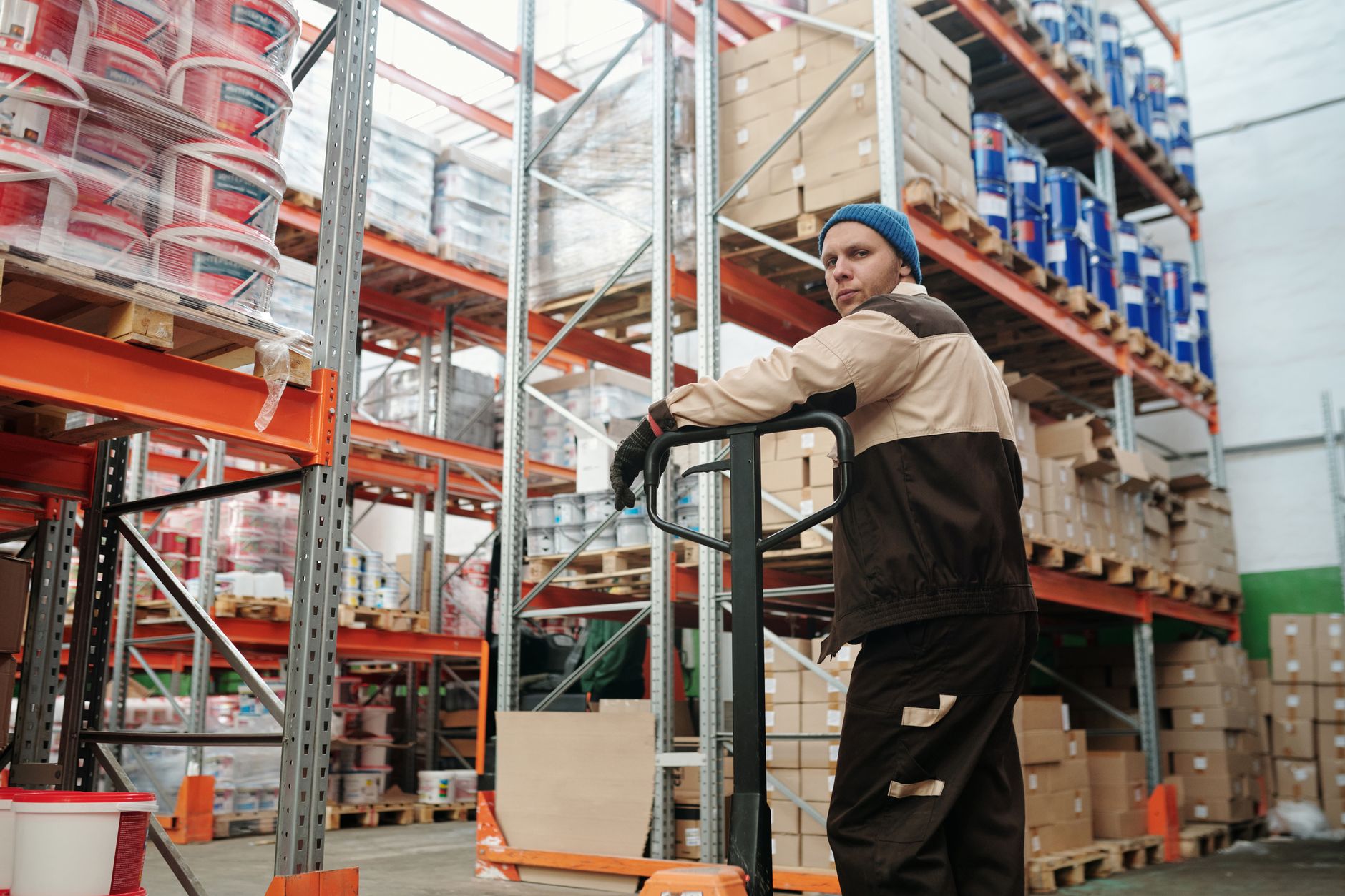
Hand laborers and material movers load, unload, sort and stage goods, and move them between receiving, storage, production and shipping. The Bureau of Labor Statistics counts 6,917,800 jobs in this occupation nationally in 2025, according to its Occupational Outlook Handbook. That same handbook projects 4 percent growth from 2025 to 2035, about 288,900 added jobs, which it describes as as fast as average.
Most of a shift is walking, waiting and lifting, in roughly that order. A handler receives a task, travels to a pick location, moves the load, sets it down at a staging point, then returns for the next one. Much of the time goes to travel and to waiting for a load, not to the lift itself, which is why the route and the queue usually matter more than the handler's speed.
Two things make a shift-level comparison harder than the national totals suggest. First, the same job title covers very different work, from a dock worker staging pallets to someone sorting returns. Second, a handler's day is rarely one task, so a headcount tells you little about how many hours a specific route consumes. The measure that matters is the route.
Distribution work in the Las Vegas Valley often runs extended or overnight hours, though the exact pattern varies by operator and was not measured for this page. When fewer supervisors are on the floor, routing errors and missed moves are more likely to build up. A robot on a planned route removes some of that pressure, but only for the part of the job that is truly routine.
Median hourly wage, Laborers and Freight, Stock, and Material Movers, Hand
$4,322
Monthly cost of one full-time worker in Las Vegas, NV, at the median wage plus payroll costs (an estimate, not a quote).
Which parts of the job can a robot take, and which can it not?
A robot does well at the steady, route-based part of the job: carrying totes or pallets along fixed corridors, repeating a known trip many times in a shift, and returning to a charging point between jobs. Those trips are predictable, and a robot does not slow down on the fortieth trip of the night.
It is weaker at the parts that need a person's judgment. A handler can reach into a mixed pallet, notice a damaged label, rearrange a load that will not stack, or wait for a blocked door to clear. Loads that vary widely in weight, shape or fragility are hard for a standard unit, and so are routes that change from day to day.
Two boundary cases need checking on site. The first is loading and unloading trucks, where the vehicle and dock vary from one delivery to the next. The second is the last stretch into a crowded aisle, where people and forklifts are moving unpredictably. Many sites keep a person on those tasks and let the robot handle the middle of the route, and that split is usually where the results are most reliable.
- Repeated fixed route
Autonomous Mobile Robot
Runs the same path on every trip without fatigue
Material Handler
Adapts when the route changes or a path is blocked
- Night coverage
Autonomous Mobile Robot
Can run a planned route with no operator present, if the route is clear
Material Handler
Can respond to problems the route did not plan for
- Mixed or damaged loads
Autonomous Mobile Robot
Handles standard loads well and is weak on irregular ones
Material Handler
Spots damage, stacks awkward loads and decides what to do
- Pace over a long shift
Autonomous Mobile Robot
Steady pace, with stops for charging and clearing blockages
Material Handler
Slower on the repetitive trip, but can speed up for a rush
- Changing layouts
Autonomous Mobile Robot
Needs remapping and route updates before it runs well
Material Handler
Adjusts to a new layout after a short walk-through
- Turnover exposure
Autonomous Mobile Robot
Unaffected by quits, but needs scheduled service
Material Handler
Leaves the route when they quit, so hiring and training start again
What do the local labor numbers say about turnover and staffing?
The local wage for this job is shown in the government wage data on this page, and it is the figure to set against the robot's total cost of operation. The labor side is harder to pin down. We did not find a verified Las Vegas metro or Nevada headcount for this occupation in this review, so the national count in the earlier section is the only verified headcount here. Local payroll records and a staffing agency's view of the market will fill that gap better than a national average.
Turnover is the other part of the picture. A workforce vendor's blog estimates annual voluntary turnover in warehousing near 27 percent, derived from 2025 quit rates for transportation, warehousing and utilities. That is a vendor-derived benchmark, not a survey of warehouses, so treat it as a planning range. A 2025 consulting firm survey reports that blue-collar staff leave at 12.5 percent, though that figure covers all blue-collar work and not warehouses specifically.
Demand for this kind of labor is expected to grow. A Las Vegas television news report from May 2025 cited data projecting more than 25,000 new jobs in logistics, warehouse and storage operations in the Las Vegas Valley from 2020 to 2030. That is a forecast from the data the report cited, not a headcount, and it means operators are competing for the same people.
Job listings show a similar mix of experience levels. A set of Las Vegas warehouse and logistics job listings, last updated July 2026, showed 131 postings, split into 57 entry level (44 percent), 50 mid level (38 percent) and 24 senior (18 percent). These are point in time listings, not employment counts. The same May 2025 news report quoted a Las Vegas logistics operator saying entry-level workers can be trained to operate robots that lift packages and pallets, with the training depending on the robot's complexity.
How many hours does the task take, and how does a robot change them?
No local figure for hours per shift was available for this page, so the table below is a method, not a measurement. Measure before you decide. Count the moves per shift, time a sample of them from pickup to drop, and note how much of each shift goes to travel, waiting, breaks and exceptions.
A simple method works for most sites. Choose one route, time three ordinary shifts, and log each trip with its start, end, load type and any wait. Then total the trips that are identical, which are the candidates for a robot, and total the rest, which stay with people. Do this at the busiest hour as well as the average, since a route that works at midday can jam at shift change.
The useful split is between moves that repeat and moves that need a person. Repeated transport can usually be assigned to the robot, while the people who remain handle exceptions, loading and checks. The shift does not shrink to nothing. It changes shape, with people making fewer trips and spending more time on work that needs a decision.
Overtime, night coverage and sick days matter here too. A robot running a planned route can cover an overnight window without a handler present, which can reduce how many people must work those hours. We did not find local data on overtime or absence rates for this occupation in Las Vegas, so those figures should come from your own payroll records.
How does a team work with a robot in place?
The robot does not replace the team. It changes what the team does. A typical setup keeps a lead handler or supervisor on the floor, keeps at least one person for loading and exceptions, and assigns the robot to the repetitive route. The robot works alongside fewer people, not zero people.
Training matters more than most decision makers expect. Staff need to know how to clear a blocked path, recover a load that has fallen off, load the robot correctly, and when to call for service. Training also changes who can move up. An entry-level handler who learns to supervise a robot route has a clearer path than one who only pushes carts.
Phase the rollout. Start with one route and one robot, run it for a set period, measure moves and exceptions, then add units only when the numbers hold. Keep a backup plan for the days the robot is down, so the people on shift are not left without a way to move the load.
What can an autonomous mobile robot not do?
It cannot judge a load. It will not notice that a pallet is leaning, that a box is crushed or that the wrong item was picked, unless a sensor or a person catches it. Quality checks, returns handling and damage inspection stay with people, and they should be in the staffing plan from the start.
It cannot clear its own path. A pallet left in the wrong place, a forklift parked across the route or a changed layout can stop a robot until someone resolves it. Plan for the time those stops take, and for the staff who must clear them. Most units in this class also do not handle stairs or multi-floor moves without extra equipment.
It cannot run without a current map and scheduled maintenance. A new rack position, a moved dock or a change in shift timing means the route needs updating. Batteries and wheels need service on a schedule. Service plans cover these tasks, and the scope should be confirmed in the written lease quote rather than assumed.
What do injury and safety figures add to the decision?
According to the Bureau of Labor Statistics, warehousing and storage recorded a total recordable injury and illness rate of 4.8 per 100 full-time workers in 2024. Cases with days away, restriction or transfer ran at 4.1 per 100 full-time workers, and days away cases alone at 1.5. Those are national industry figures, not Las Vegas figures, but they show that repetitive and heavy hauling carries real risk.
The same BLS page reports 32 fatalities in the sector in 2024, up from 28 in 2023, and notes a series break from 2023 because of a change in industry classification. Those counts are small in absolute terms, yet they point to the same conclusion: moving repetitive, heavy hauling away from people deserves a place in the comparison next to the labor figures.
A robot is not a safety system on its own. It needs an approved site plan, marked zones where people walk, and staff trained to work near moving equipment. Put those requirements into the site assessment rather than treating them as afterthoughts after installation.
How do we get started, and what does a lease look like?
Start with the route. Pick the one flow that repeats most, measure it for a few shifts, and compare what the people on that route do now with what a robot plus staff would do. That comparison, not a generic brochure, should drive the decision.
Robots are leased through financing, and the lease payment is quoted after a free site assessment. We map the floor, review the routes and load types, and recommend a robot and a setup that fits. Terms are quoted in writing after that assessment, based on the site rather than on a rough estimate of floor size.
- Share your shift pattern, the route you want to automate and the load types it carries.
- Schedule a site assessment, which includes mapping the floor and timing the current moves.
- Review the robot recommendation, the staff training plan and the service plan.
- Receive the lease quote and the go live schedule in writing.
- Phase the rollout from one route, then add units once the measured numbers hold.
Frequently asked questions
Put a robot to work in Las Vegas.
We walk your site, learn the job, and recommend the unit that fits. Then we quote the lease, deploy it, and keep it serviced.
Sources
- US Bureau of Labor Statistics, Occupational Employment and Wage Statistics (OEWS May 2024)
- BLS Occupational Outlook Handbook, hand laborers and material movers
- BLS injuries and illnesses data, warehousing and storage (NAICS 493)
- Las Vegas television news report on logistics jobs and robots, May 2025
- Las Vegas warehouse and logistics job listings aggregator, updated July 2026
- Workforce vendor blog on warehouse turnover rate
- 2025 supply chain trade publication industry outlook survey on warehouse automation