
The short answer
In a cleaning robot vs janitor in Baltimore comparison, the robot makes sense when most of the janitor's time goes to large, open, hard floors that can be cleaned unattended overnight. It does not make sense when the work is mostly restrooms, trash, spills and detail cleaning. In most buildings the best setup is a robot plus fewer staff, which a free site assessment can confirm for your floor.
Key takeaways
- A robot fits Baltimore floors where most of the janitor's shift is open floor that can run unattended.
- Restrooms, bins, spills and stairs stay with people, so a robot means fewer staff, never zero staff.
- The local wage in the panel sets the cost of staff hours, and a site assessment sets what a robot can take over.
- Turnover is described as relatively high for this occupation, so a robot can soften a staffing gap but cannot close it alone.
- Start with a free site assessment and one leased unit before committing a whole building.
When does a cleaning robot make sense versus a janitor in Baltimore?
A cleaning robot makes sense when most of a janitor's floor work is large, open and repetitive: warehouse aisles, retail sales floors, office corridors, school hallways and gym floors. Those spaces have clear routes, the floor can be mapped once, and the cleaning can run when nobody is there. That combination is where a floor machine takes the most hours off a staff member's shift.
It makes less sense where the day is made of many small tasks. Restroom servicing, emptying bins, wiping surfaces, responding to spills, moving furniture and working on stairs all stay with people. A building that changes layout often, or has heavy traffic at unpredictable hours, also needs a closer look before anyone commits.
So the useful question is not robot against janitor in the abstract. It is how many hours of open floor work your team does in a window when a machine could run unattended, and whether that is where your coverage gaps actually are.
What does a janitor actually do in a Baltimore shift?
A janitor's shift is a mix of floor work and small recurring tasks, and the occupation covers a wide range of buildings. The BLS Occupational Outlook Handbook reports about 2.4 million jobs for janitors and building cleaners in 2024. Building services is the largest employer group at 35 percent, and state, local and private educational services follows at 17 percent, so school buildings appear often in this work.
The local wage for this job is in the panel beside this text. Read it as the cost of the staff hours, not the whole cost of cleaning. The BLS regional release for Baltimore defines the metro as Anne Arundel, Baltimore, Carroll, Harford, Howard and Queen Anne's counties, plus Baltimore city, so that is the area the panel reflects.
On most shifts the work falls into four groups: floor passes (sweeping, mopping, scrubbing, vacuuming), restrooms and fixtures, waste and supplies, and reactive requests such as spills. Floor passes are the block a robot can take. They are rarely the whole job.

Median hourly wage, Janitors and Building Cleaners
$3,997
Monthly cost of one full-time worker in Baltimore, MD, at the median wage plus payroll costs (an estimate, not a quote).
Which parts of the job can a robot take, and which can't it?
Autonomous floor scrubbers and sweepers take over the repetitive, large-area floor passes. In the ISSA and AACEM autonomous cleaning survey from 2019, the most recent edition we found, 89 percent of adopters used scrubbers, 46 percent used vacuums and 32 percent used large-area sweepers. The full report is members only, so these figures come from the public summaries.
On a mapped route the robot can make the same pass each night, return to its dock, and repeat the next night without a break. It cannot clean a restroom, empty a bin, pick up a fresh spill, or decide that one corner needs a second pass. Those are the tasks that set how many people the building still needs.
- Night coverage
Cleaning Robot
Runs unattended on a mapped route once staff set it up
Janitor
Works the shift and needs breaks
- Open floor passes
Cleaning Robot
Repeats the same route and pass count each night
Janitor
Adjusts the pass to what is on the floor that night
- Restrooms and fixtures
Cleaning Robot
Does not clean restrooms or fixtures
Janitor
Handles restrooms, fixtures and touchpoints by hand
- Fresh spills
Cleaning Robot
Can run its route but does not respond to a new spill
Janitor
Responds at once and judges what is needed
- Stairs and tight spaces
Cleaning Robot
Limited to the routes it was mapped for
Janitor
Works stairs, corners and around furniture
- Changes on the day
Cleaning Robot
Needs a remap when the layout changes
Janitor
Reads the building and adjusts
- Absence cover
Cleaning Robot
Runs whether or not staff are absent
Janitor
A sick day leaves a gap unless someone covers it
- Where cost moves
Cleaning Robot
Lease cost is quoted after a site assessment
Janitor
Wage and overtime scale with hours worked
What do the hours and labor numbers say?
The national outlook projects employment for janitors and building cleaners to grow 2 percent from 2024 to 2034, which is slower than the average for all occupations, with about 47,800 new jobs. The BLS also says the occupation typically requires no formal education and that most workers learn on the job. Entry requirements are low, but the BLS figures do not measure how long a vacant shift stays empty.
Turnover is where staffing gets hard. A career site describes relatively high turnover for this occupation, but that is a qualitative description and not a measured rate. Our review did not find a published turnover rate, overtime figure or sick day figure for this occupation, so those numbers belong in your own payroll and scheduling records.
Operating time is the other side of the picture. An industry equipment comparison of manual scrubbers, which predates autonomous machines, lists a 20-inch walk-behind scrubber at 6.47 minutes to clean 1,000 square feet and a 36-inch rider at 2.61 minutes for the same area. Those are machine times, not whole shift times, which is why the floor pass looks short while the surrounding work takes the rest of the shift.
How does a team work with a robot?
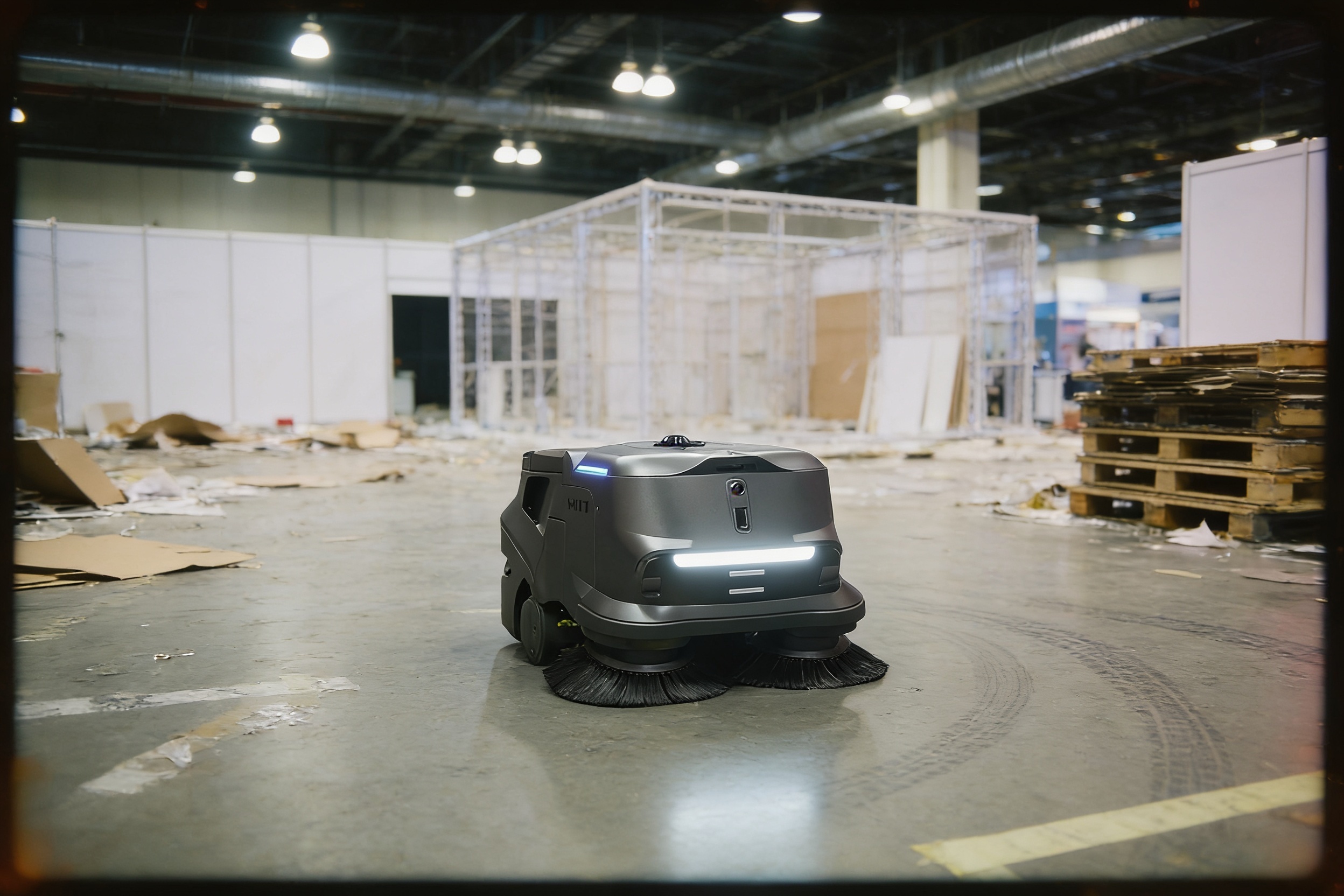
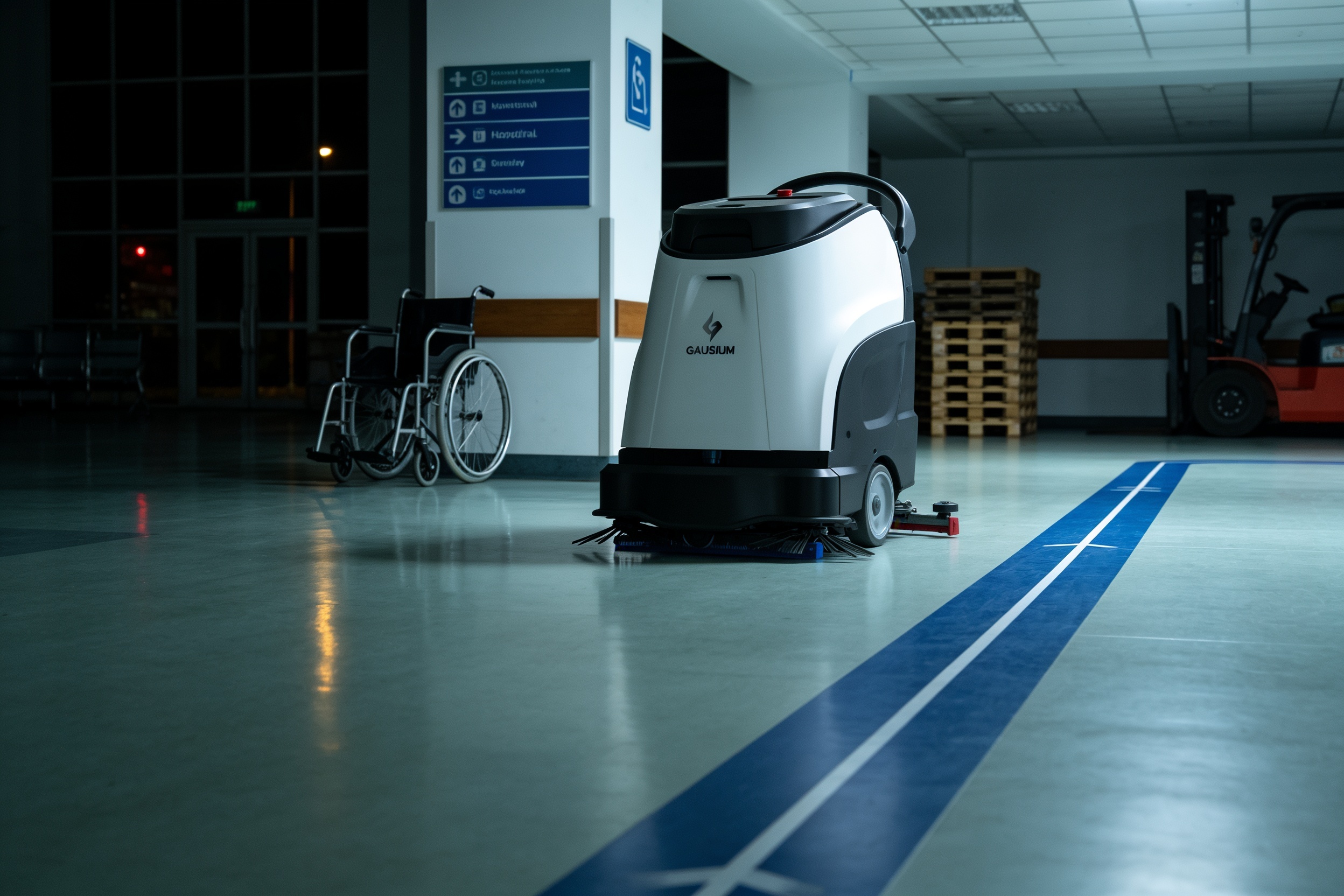
A robot works best as part of a team with fewer staff, not as a replacement for the whole crew. Staff move from pushing machines to setting the route, checking the dock, handling restrooms and reactive tasks, and reviewing what the robot did. Headcount drops only where open floor passes are a large share of the work and the schedule has real gaps to cover.
Relatively high turnover, as described by the career site, makes this model more useful. If one janitor leaves, the mapped floor passes still run, and the remaining staff covers restrooms and spills until a replacement is trained. That is a support effect, not a guarantee, and it depends on how the shift is scheduled.
Build the handover as a short routine: confirm the route is clear before the robot starts, log any incident, and check the dock and battery status the next morning. The routine matters as much as the machine, because a run that starts on a blocked route wastes the night.
What can the robot not do?
A robot cannot clean restrooms, empty bins, respond to a fresh spill, work stairs, or handle furniture that moves every night. It cannot judge the state of a floor the way a person can, and it cannot take over tasks that involve direct contact with people. Those gaps keep the janitor in the plan.
There are site limits too. A robot needs a mapped route, a clear floor at run time, and a layout that does not change often. Heavy traffic late at night, loose cords, or constant rearrangement of chairs and stock can stop a run or cut into what it covers. An assessment should check those before any lease is signed.
The robot also does not remove supervision. Someone has to confirm runs complete, handle alarms, and decide when a route needs remapping. Budget that time, or the savings on the floor will not show up in the schedule.
Does a robot change the cost and savings picture?
The honest comparison is between the leased robot and the staff hours it actually takes over, plus the work that does not change, like restroom and reactive tasks that stay with people. Lease cost is quoted after a free site assessment, because floor area, route complexity, hours and service terms shape the scope. A general figure from an article will not match your building.
Savings depend on hours you can reassign or stop covering. If the robot covers only the open floor pass, the gain may be the time that pass takes rather than a full position. Overtime and sick day coverage matter here, and without your own records those are the first numbers to pull.
Service terms change the math. A lease with maintenance included moves repair work into the agreement, so ask what it covers, including on-site dispatch, remote triage and emergency replacement. Get those answers in writing before you compare payback.
How do you get started with a leased cleaning robot in Baltimore?
Start with the floor. Measure the open area that could run overnight, note how many hours your janitor spends on it, and list the restrooms and reactive tasks that will stay with staff. Those three lists decide most of the site question.
We begin with a free site assessment. We map the building, set the route, and check floor type, obstacles and dock location. A fixed robot lease payment is quoted after that assessment and financed, and then we deploy and integrate the robot, train your staff and support go live. Service is available nationwide, so the same team can support a Baltimore site for the length of the lease.
Pilot before you scale. One leased unit on one zone shows real run times on your floor and lets staff practice the handover. Expand only after the logs show the route holds up on ordinary nights.
What do injury and adoption figures say about this decision?
The safety numbers are worth reading before you decide. A BLS injury snapshot covering 2016 to 2020 reports 21,100 nonfatal injury and illness cases involving days away from work for janitors and cleaners in 2020. It also reports 42 fatal work injuries in 2020, compared with 45 in 2019. Those are national counts, not Baltimore counts.
A secondary summary of BLS data puts janitorial services at 2.5 total recordable cases per 100 full-time workers in 2024, with a relative standard error of 5.0 percent. That is an industry rate, not an occupation rate, so treat it as context and not as a direct comparison with your site.
Adoption figures in the most recent survey we found are from 2019. That ISSA and AACEM survey drew 250 complete responses, with a margin of error of 6 percent at 95 percent confidence. Among non-users familiar with the equipment, 73 percent cited labor savings, 66 percent cited productivity and 52 percent cited cleaning efficacy. About one third of non-adopters said they were somewhat likely to adopt within a year, and we did not find a 2025 or 2026 facility adoption rate.
Frequently asked questions
Put a robot to work in Baltimore.
We walk your site, learn the job, and recommend the unit that fits. Then we quote the lease, deploy it, and keep it serviced.
Sources
- US Bureau of Labor Statistics, Occupational Employment and Wage Statistics (OEWS May 2024)
- BLS regional news release, Baltimore area occupational employment and wages, May 2024
- BLS Occupational Outlook Handbook, Janitors and Building Cleaners
- BLS injury and illness snapshot, Janitors and Cleaners, Except Maids and Housekeeping Cleaners, 2016 to 2020
- AACEM/ISSA Autonomous Cleaning Survey Report (2019)
- CleanLink equipment comparison of manual floor scrubbers
- SafetyNow janitorial safety statistics (secondary summary citing BLS)
- Vault, Janitors and Cleaners career outlook