
The short answer
Cleaning robot vs janitor in Boston is rarely either-or: for most buildings the robot works alongside janitorial staff, taking repeatable floor passes on large, mostly clear routes, often overnight, while people keep restrooms, trash, spills and judgment work. A cleaning robot does not make sense in small, cluttered or highly varied buildings, or where no trained person can own its daily checks. A lease quote follows a free on-site assessment that measures your floor area, clear floor share and schedule.
Key takeaways
- A cleaning robot takes repeatable floor passes, while restrooms, trash, spills and judgment work stay with people.
- The Bureau of Labor Statistics counted 44,360 janitors and cleaners in the Boston metro in May 2023, so labor supply is not the only question.
- Janitor injury incidence reached 191.6 per 10,000 full-time equivalent workers in 2020, so cutting manual floor passes deserves a close look.
- A robot works best as a shift addition with a named person who owns its daily checks, never as zero staff.
- The lease payment is set in a quote after a free on-site assessment of your floor and schedule.
Cleaning robot vs janitor in Boston: which fits your building?
Most Boston buildings do best with both. A cleaning robot takes the repeatable floor work: long corridors, open lobbies, wide retail aisles and warehouse floors that get the same route every night. A janitor keeps the work that changes from hour to hour, including restrooms, spills, trash, glass and the detail work a floor machine cannot reach.
A robot makes less sense when the space is small, cluttered, or split into many short rooms, because route setup takes a bigger share of the value. It also makes less sense when most of the shift is non-floor work, or when no one on site or on call can clear the route, check the machine or handle a problem. In those buildings a janitor or a contracted cleaning crew usually fits better.
Three questions settle the decision: how much of the shift is floor work on a clear, mapped route, how much coverage is lost when a shift goes unfilled, and whether a trained person will own the robot each day. A lease quote follows a free on-site assessment that answers all three for your building.
What does a janitor actually do in a Boston shift?
A janitor's shift is a string of short tasks, not one long job. Typical work includes restocking supplies, emptying bins, cleaning restrooms, wiping high-touch surfaces, responding to spills, sweeping or mopping, and moving between floors and rooms. Floor scrubbing is often one block in that sequence, and it is the block that repeats most predictably.
The interruptions matter more than the list. A spill in a lobby stops a scrubbing pass, a locked room changes the order of work, and a broken fixture gets reported by someone who happened to notice it. Staff absorb these changes without planning. A robot follows the route it was given, which is why the route has to be clean and stable before anything else.
The Bureau of Labor Statistics notes that no formal education is typically required for this work, and it projects slower than average growth for the occupation. That makes the hiring pool broad, but each new hire still needs training on your building, its access and its cleaning standards. Training time is part of the labor cost, and it is easy to miss when a shift is described as one janitor on nights.
Median hourly wage, Janitors and Building Cleaners
$5,202
Monthly cost of one full-time worker in Boston, MA, at the median wage plus payroll costs (an estimate, not a quote).
Which cleaning tasks can a floor robot take, and which can it not?
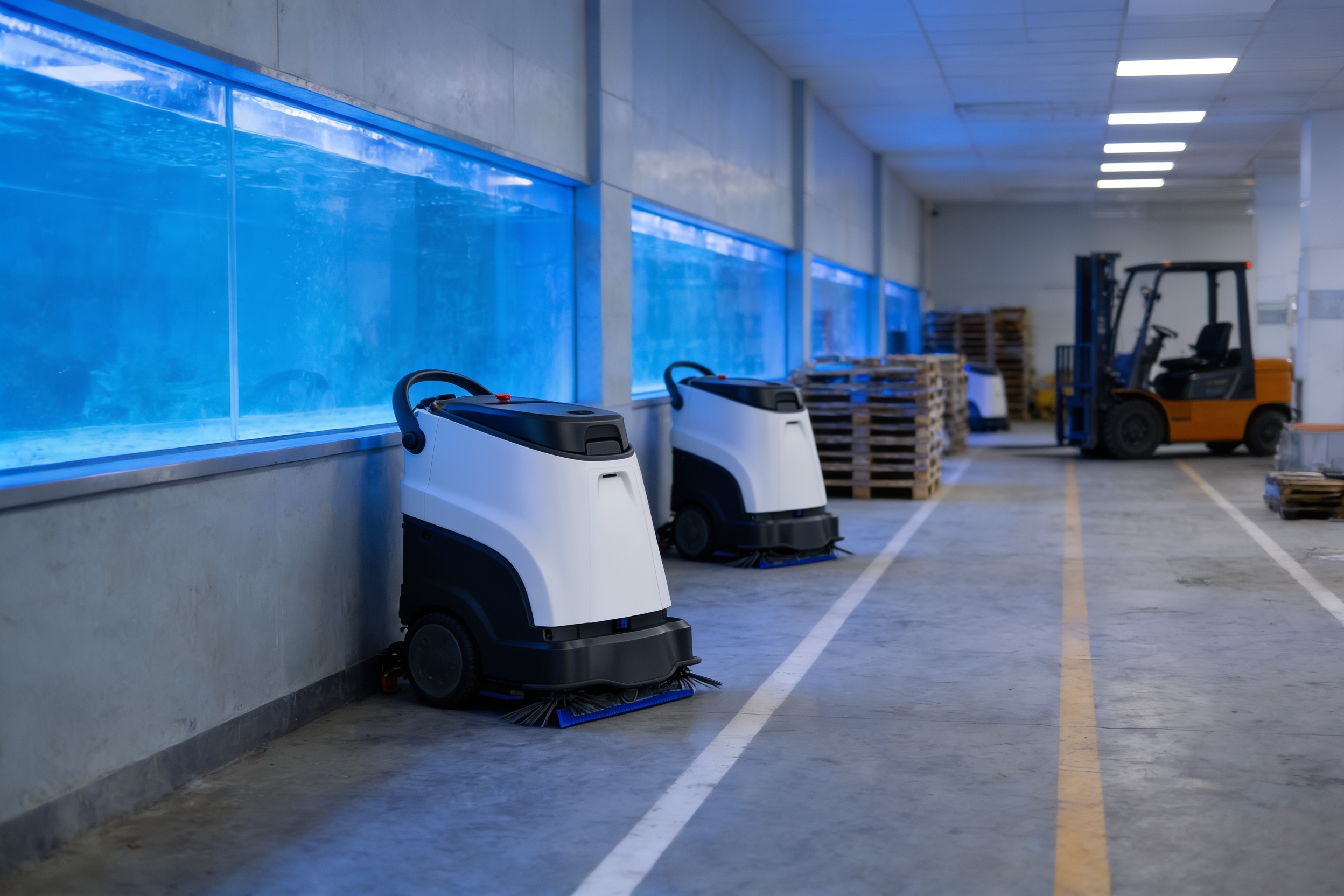
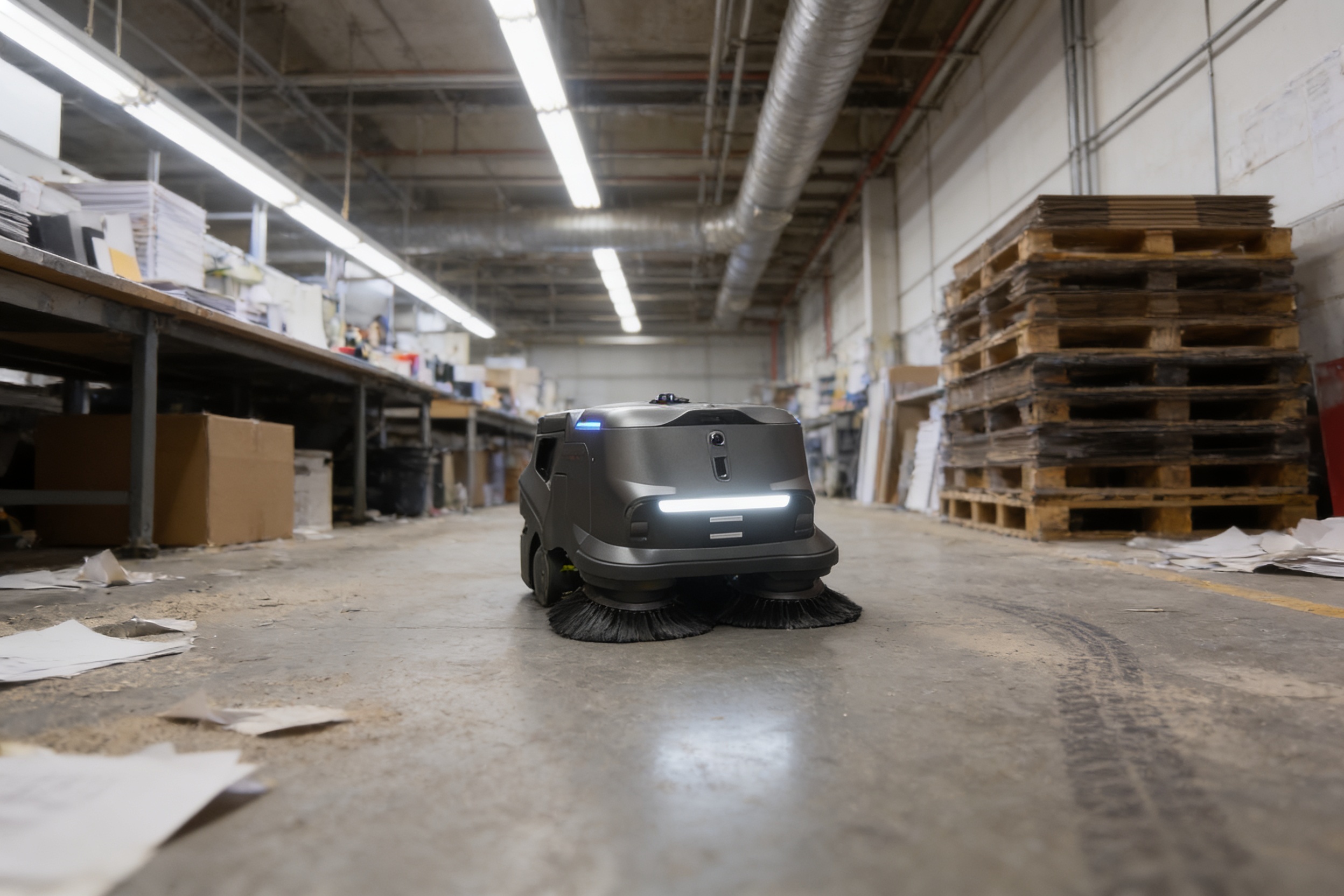
A floor robot takes the scrubbing and sweeping that follows a fixed route on a mostly clear floor. It works best on open corridors, lobbies, retail aisles, warehouse floors and similar spaces where the same pass runs on a set schedule. Because the route repeats, the work can happen at night, while staff are on other floors or handling other tasks.
People keep the work that needs judgment or hands. Restroom cleaning, trash and recycling, spills of unknown material, glass, stairs, furniture moves, high dusting, and corners or edges the machine cannot reach all stay with staff. So do checks a person would notice, such as a leak under a sink or a door that will not lock.
Layout decides a lot. Cords, pallets, carts and loose furniture block a route and force a stop. Frequent changes to the floor plan mean the map has to be updated again. A large open space with few obstacles is a far better fit than a building with many small rooms and constant changes, even when both have similar square footage.
- Repeat floor pass on a clear route
Cleaning Robot
Runs the same route on a schedule, including overnight, once mapped
Janitor
Works fixed hours and needs breaks, but adjusts the route on the fly
- Restrooms and trash
Cleaning Robot
Cannot do this work
Janitor
Handles it with supplies and judgment
- Unknown spill or hazard
Cleaning Robot
Stops and needs a person to clear it
Janitor
Assesses, contains and reports it
- Layout change
Cleaning Robot
Needs the map updated before it runs well
Janitor
Adapts without any setup
- Consistency across repeat passes
Cleaning Robot
Same path every run
Janitor
Quality varies with fatigue, staffing and time pressure
- Absence and turnover
Cleaning Robot
No sick days, but needs a trained owner and service visits
Janitor
Absence and turnover need cover and training time
What does the labor picture look like for Boston janitors?
According to the Bureau of Labor Statistics, 44,360 janitors and cleaners were employed in the Boston-Cambridge-Nashua, MA-NH metro in May 2023, with a location quotient of 1.12. A location quotient above 1 means the metro has a larger share of these jobs than the national average. This is the most recent verified Boston count we could confirm for this run.
Nationally, the Bureau of Labor Statistics counted about 2.4 million jobs for janitors and building cleaners in 2024 and projects 2% growth from 2024 to 2034, which it describes as slower than average. Its May 2024 national release reports about 2.2 million janitors and cleaners, excluding maids and housekeeping cleaners. The two counts use different scopes, so they should not be added together.
Turnover is harder to pin down. The Bureau of Labor Statistics does not publish a turnover rate for this occupation, and its outlook projects openings largely from workers who leave. A secondary aggregator citing an ISSA survey reports 42% annual turnover for janitorial work. We treat that figure as indicative only, since we did not read the ISSA report itself.
We did not find verified figures for overtime, sick-day use or shift-level hours for Boston janitors. Those numbers differ from building to building and matter most to this decision. The site assessment measures them from your own schedule and payroll records rather than from averages.
The May 2024 Boston estimates exist, but the metro definitions changed for that release, so a direct comparison with 2023 is not valid. Use the local wage for this job in the government wage data on this page as the baseline, and check it against your own payroll.
How do injury rates affect the janitor versus robot decision?
Janitor work carries real injury risk. In the Bureau of Labor Statistics Survey of Occupational Injuries and Illnesses, the days-away-from-work incidence rate for janitors and cleaners, excluding maids and housekeeping cleaners, was 191.6 per 10,000 full-time equivalent workers in 2020. That was the highest figure in the 2016 to 2020 series, up from 137.1 in 2018. In 2019 the same survey counted 18,680 nonfatal injury and illness cases with days away from work in private industry for this occupation.
Across all private industry, the Bureau of Labor Statistics reports 2.3 total recordable cases per 100 full-time equivalent workers in 2024, down from 2.4 in 2023, according to news coverage of that release. We did not find a janitor-specific rate for 2024, so the 2019 and 2020 figures are the latest occupation-level numbers we verified.
The snapshot we reviewed does not break these rates down by cause, so we do not attribute them to particular tasks here. Manual floor passes add exposure, and fewer of them can help. A robot does not remove lifting, bending or chemical handling, though, so the site assessment checks those tasks separately.
How much does a cleaning robot lease cost compared with a janitor?
The cleaning robot vs janitor in Boston comparison is not robot price against wage. The cost of a janitor includes the local wage for this job, overtime when shifts go unfilled, training for each new hire, supervision, and the coverage gap while a vacancy stays open. Those costs are easy to miss because they spread across payroll, hiring and schedule changes. The government wage data on this page gives the base for the local wage, and the rest comes from your own records.
The robot side is a lease through financing. Our integrator team selects the unit for your floor, deploys and integrates it, trains staff, and services it nationwide. The fixed lease payment is set in a quote after a free on-site assessment, so no figure is promised before the floor has been measured.
Payback depends on what the robot replaces. If it covers an overnight floor pass nobody does today, it adds coverage rather than replacing labor, and the question becomes what that coverage is worth to you. If it replaces part of an existing shift, the question is which paid hours it can actually take. Both cases need the same inputs: floor area, clear floor share and the schedule.
Worth it is a question about your numbers, not a general rule. A robot can be the better choice in a warehouse with long nights and open floors, and a poorer one in a building with many small rooms. The assessment should answer that before anyone signs.
How does a team work with a cleaning robot?
The model we recommend is a robot plus fewer staff, never zero staff. The robot takes the repeat floor pass. A person owns the robot's day: the pre-shift route check, the map, status checks during the night, and the response when the machine stops. Staff move from the floor pass to restrooms, trash and spills, which is where much of the value shows up.
Turnover and absence change how the team works. When someone leaves, the scheduled route keeps running while a replacement trains, which narrows the gap. It does not remove the need to hire. A night with a sick call still needs someone on site to clear the route and cover the non-floor work.
The timeline below is an illustrative night for a mid-size open building, not a measured one. Times and tasks will change with your floor, your schedule and your building's rules.
What can a cleaning robot not do?
It cannot clean restrooms, empty trash, handle unknown spills, clean glass or stairs, or move furniture. It cannot judge that a new hazard is unsafe, and it cannot notice a leak or a broken fixture the way a person walking the floor does.
It needs a clear, mapped route. Cords, pallets, carts and loose furniture stop it, and every significant layout change means the map must be updated. A building that changes every week is a poor fit unless someone owns those updates.
It does not run itself when things go wrong. A stuck robot, a blocked route or a low battery still needs a person on site or on call, and the unit is out of service until the problem is resolved. Service visits and remote triage help, but the building still needs a named person for the daily check.
Be direct about fit. A small, cluttered or highly varied building may return less than the setup and staff time it takes. If that describes your site, a janitor or a contracted cleaning crew is the better answer, and the site assessment should say so plainly.
How do you get started with a robot lease in Boston?
Start with a free on-site assessment. We measure the floor area, the share of clear floor, the non-floor tasks in each shift, the schedule and any coverage gaps you see today. That data decides whether a robot fits and which unit does the job.
Next comes the site map and the unit choice. We are a vendor neutral integrator, so the robot is chosen for the floor rather than for one product line. Mapping happens before anything runs, and the route is tested with staff present.
Then comes the lease quote. The robot is leased through financing, and the fixed lease payment is set in that quote after the assessment. Deployment, staff training and go live support follow, and service continues across the country, including on-site dispatch and remote triage when a unit needs help.
Many buildings start with one leased unit in a pilot program on the most repeatable floor, then decide on more units or a backup unit based on the logs. That keeps the first decision small and the data real.

Frequently asked questions
Put a robot to work in Boston.
We walk your site, learn the job, and recommend the unit that fits. Then we quote the lease, deploy it, and keep it serviced.
Sources
- US Bureau of Labor Statistics, Occupational Employment and Wage Statistics (OEWS May 2024)
- Bureau of Labor Statistics, OEWS May 2023, Boston-Cambridge-Nashua, MA-NH metro
- Bureau of Labor Statistics, Occupational Outlook Handbook, Janitors and Building Cleaners
- Bureau of Labor Statistics, May 2024 OEWS national release
- Bureau of Labor Statistics, Survey of Occupational Injuries and Illnesses snapshot, janitors and cleaners 2016-20
- Census County Business Patterns, cleaning industry statistics as reported by startbusinessbystate
- AACEM/ISSA Autonomous Cleaning Survey, as published by FMLink
- Gitnux, citing an ISSA cleaning industry survey
- Business Insurance, news coverage of BLS 2024 workplace injury data