
The short answer
A cleaning robot vs janitor in Birmingham comparison favors the robot for large, open, repeatable floor passes such as warehouse aisles, retail floors, corridors and lobbies, especially on night shifts. It does not favor the robot for small, cluttered sites or work dominated by restrooms, trash, spills and detail work, which stay with people. In nearly every case the answer is a robot plus fewer staff, not zero staff, and the decision turns on measured floor area and timed floor hours from a site assessment.
Key takeaways
- A cleaning robot fits large, open, repeatable floor passes, while people keep restrooms, trash, spills and judgment work.
- The decision starts with measured floor area and timed floor hours, not with a job title.
- Cleaning work carries high turnover and real injury exposure, which argues for a robot plus fewer staff, not zero staff.
- Industry surveys show adoption growing from a low base, but this review found no local count for Birmingham.
- The lease is quoted after a free site assessment, so the terms reflect your floor and your hours.
Cleaning robot vs janitor in Birmingham: which makes sense?
A cleaning robot makes sense in a Birmingham building when a large share of the night work is repeatable floor passes on open hard floors, such as warehouse aisles, retail floors, corridors and lobbies. It makes less sense when the site is small, cluttered or full of changing obstacles, or when most of the work is restrooms, trash, spills and detail work that a person handles better. In most cases the answer is a robot plus staff, with the robot taking the floor passes and the people keeping the rest.
The useful question is not whether a janitor can be replaced. It is how many hours of the shift go to floor passes that a machine can repeat without an operator on the floor. That number comes from measuring the building, not from a job title, and it is the first thing a site assessment checks. The government wage data on this page gives the local labor cost of the job, so you can set the hours a robot would take against what those hours cost today.
What does a janitor actually do in a shift?
Janitors and building cleaners do many small tasks, and the floor is only one of them. A typical shift can include emptying trash and recycling, restocking restrooms, cleaning fixtures, sweeping or vacuuming, mopping, scrubbing hard floors, responding to spills, and walking the building to check for problems. The mix changes by building type. A warehouse is mostly floor area. A school adds classrooms and restrooms in volume. An office building is more about trash, restrooms and kitchens.
Because the work is split into many small tasks, the labor is hard to see from the outside. Some of a shift goes to moving between areas, fetching supplies and handling interruptions, not to the cleaning itself. That is why a site assessment starts with a walk through the building rather than a headcount. Map each task, note where it happens and how often, and time it. The hours you find are the only hours a robot can take off the list.

Median hourly wage, Janitors and Building Cleaners
$3,447
Monthly cost of one full-time worker in Birmingham, AL, at the median wage plus payroll costs (an estimate, not a quote).
Which parts of the cleaning work can a robot take?
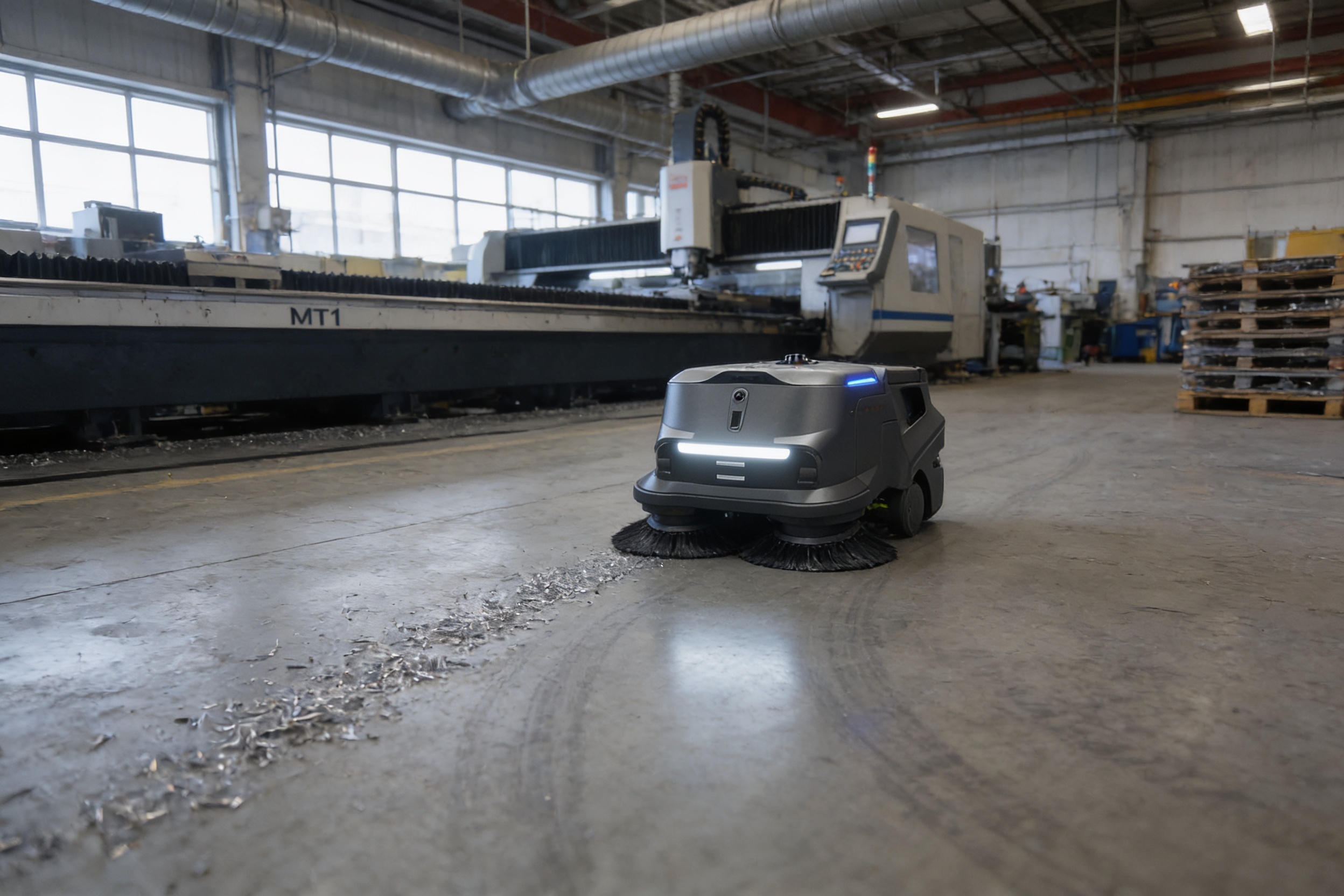
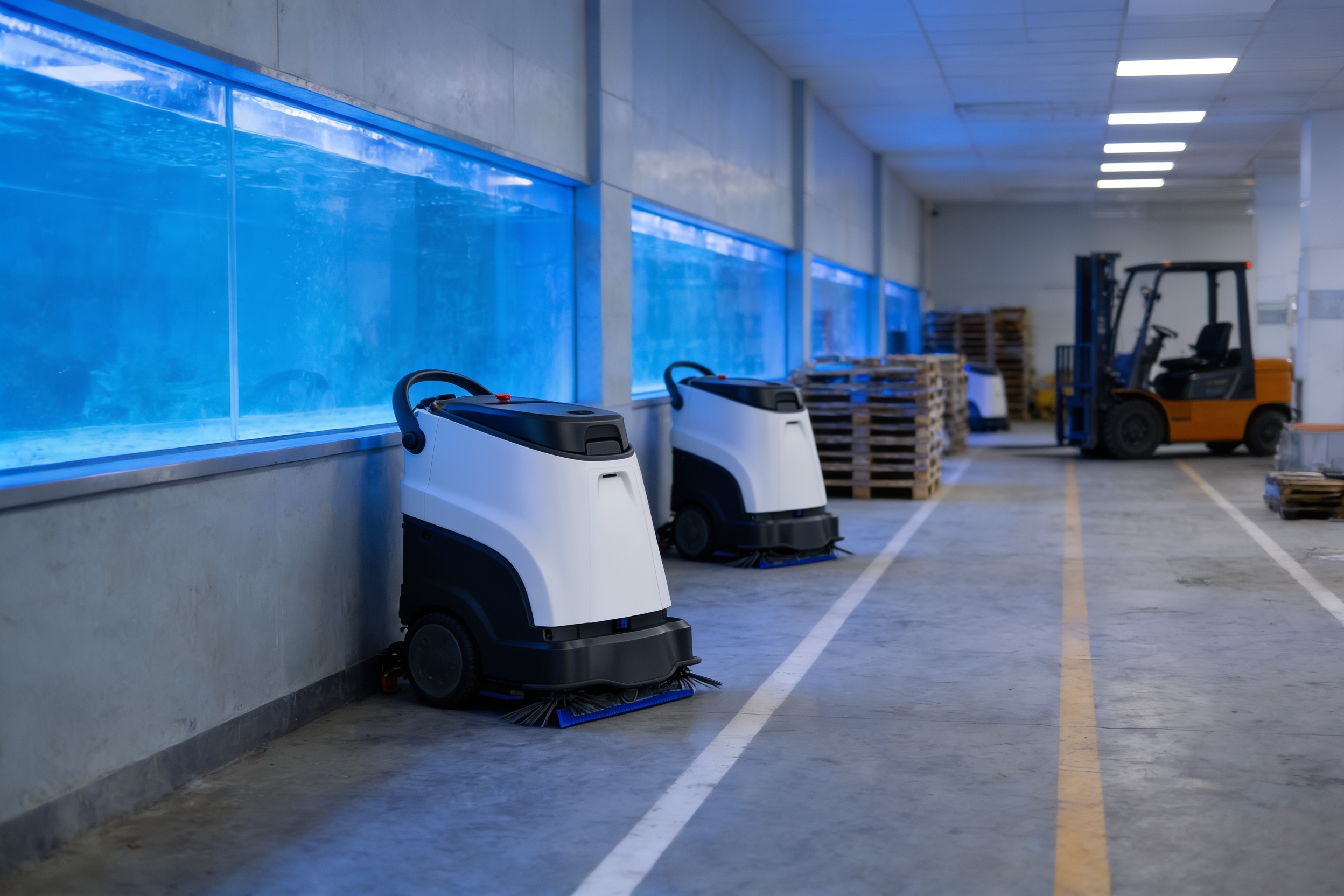
A floor scrubbing robot takes the flat, open, repeatable passes: hard floors in aisles, corridors, lobbies and sales floors where the route is the same from night to night. The machine follows a mapped route, scrubs the floor and returns to charge. It does not need an operator on the floor while it runs, which is the main reason it fits overnight work.
It cannot take the parts of the job that need hands, judgment or access to small spaces. Restrooms, trash, spills, glass, furniture moves, detail work around fixtures and anything that happens in the middle of a route stay with people. The split matters. A robot that covers the floor passes lets staff spend the shift on the tasks that need them, instead of pushing a scrubber across the same aisles.
How many hours does floor work take, and what changes the number?

No published study in this review gives hours per shift for janitors in general, so the reliable method is to measure your own building. The best available reference for machine speed is a vendor guide to walk-behind scrubbers. It puts a 20 inch machine at 3 mph at about 18,000 square feet per hour in theory, and estimates 13,000 to 15,000 square feet per hour after turns and overlap. That is a vendor figure, not a time study, so use it only as a planning range.
To turn that into a rough machine time, divide the measured area of the open hard floors by the estimated output. A large area with long straight passes takes far fewer hours than the same area broken into small rooms. Battery runtime, which the same guide lists at about 2 to 4.5 hours, sets how many charging breaks the schedule needs. Staffing levels, sick days and overtime should come from your own timesheets, because no independent figures for them were found.
What do turnover, injury and overtime data say about cleaning labor?
The Bureau of Labor Statistics reports that janitors and building cleaners held about 2.4 million jobs in 2024. The largest employer group was services to buildings and dwellings at 35 percent, followed by educational services at 17 percent. The same source projects 2 percent growth from 2024 to 2034, which is slower than average, so this workforce is not expanding quickly. Staffing for this job is therefore a recruiting and retention question as much as a scheduling one.
Turnover is the harder number to pin down. A janitorial trade blog says cleaning turnover is high and ranks it second only to leisure and hospitality, citing BLS data, but it gives no exact rate. No official turnover rate for this occupation was found in this review. Treat turnover as a local measurement by counting open shifts, departures and training hours over the past year at your own site.
Injury exposure is the other part of the labor picture. In 2020, the BLS recorded 21,100 nonfatal injury and illness cases with days away from work for janitors and cleaners, excluding maids and housekeeping cleaners, along with 42 fatal work injuries. A salary comparison site, citing 2023 BLS data, lists an injury rate of 3.5 per 100 workers for this occupation. That is not an official BLS rating, so cite it as a secondary figure.
How does a team work with a cleaning robot?
The working model is a robot plus fewer staff, never a robot alone. The robot takes the scheduled floor passes, and the team keeps the restrooms, trash, spills and checks. The headcount change depends on what the site assessment shows. It usually means fewer open night shifts to fill and less pushing across the same aisles, not zero staff on the floor.
We pick the robot for the floor, lease it through financing, deploy and integrate it, train the staff who will work alongside it, and service it nationwide. The lease is quoted after a free site assessment, which maps the building, measures the floor and sets the route. Training covers what to do when the robot stops, how to clear its path, and what to report.

What can a cleaning robot not do?
A cleaning robot cannot clean restrooms, empty trash, handle a spill on arrival or move furniture. It can stop when its path is blocked, and it needs a clear, mapped route to run well. A site with frequent layout changes, loose cords, heavy foot traffic during run times, or wet and uneven floors needs a close look before a route is set. These are reasons to test on one area first, not reasons to rule the idea out.
It also cannot replace the judgment a person brings. Someone still has to notice a leak, a broken fixture or a hazard in the walkway and decide what to do. The robot runs its route and reports, and the team handles the rest. Being candid about this is what separates a deployment that holds from one that gets switched off.
Are other cleaning businesses adopting robots?
Adoption is growing from a low base, based on the survey data found in this review. In a joint survey of autonomous cleaning use, measured against a 2019 baseline, 62 percent of building service contractors, 68 percent of in-house service providers and 69 percent of facility and property managers had not used autonomous cleaning equipment, according to an FMLink summary. About one-third of those non-adopters said they were somewhat likely to adopt within a year.
More recent figures point the same way. An ISSA Today summary of the 2025 ISSA Cleaning and Maintenance Management benchmarking survey reports that 43 percent of respondents planned to add autonomous cleaning equipment, though the full report is restricted to members. Cleaning and Maintenance Management also reports that the labor shortage pushing managers toward robotics remains acute, without giving a figure. These are signals, not proof that a robot suits your building.
- Overnight floor passes
Cleaning Robot
Runs a mapped route with no operator on the floor once set up
Janitor
Needs a scheduled shift, a relief plan and a trained person on site
- Restrooms and trash
Cleaning Robot
Cannot do them
Janitor
Does them, along with restocking and checks
- Spills and obstacles
Cleaning Robot
Needs a clear path and a person for any spill
Janitor
Handles the spill on the spot and decides what to do
- Consistency on a large flat floor
Cleaning Robot
Repeats the same route on every pass
Janitor
Varies with the shift, the individual and the day
- Judgment and flexibility
Cleaning Robot
Follows its route and reports what it cannot handle
Janitor
Adapts, notices hazards and makes calls on the spot
- Staffing and turnover
Cleaning Robot
Does not add open shifts, but still needs a written service plan
Janitor
Hiring and training continue whenever turnover is high
How do you get started with a cleaning robot in Birmingham?
Start with a site assessment rather than a sales conversation. Measure the open hard floor area, log the floor tasks by shift, note the layout and obstacles, and record how many night shifts are hard to fill. That gives a basis for a single pilot area rather than a whole building. Most sites do better starting with one zone and extending after the first results are measured.
Leasing is arranged through financing, and the quote comes after the assessment, so the terms reflect your floor, your hours and your route. Ask for the service plan in writing, including how a stopped unit is handled, how service is dispatched, and how training is delivered to the staff who will work with it. Compare the government wage data on this page with your own staffing records before deciding.
Frequently asked questions
Put a robot to work in Birmingham.
We walk your site, learn the job, and recommend the unit that fits. Then we quote the lease, deploy it, and keep it serviced.
Sources
- US Bureau of Labor Statistics, Occupational Employment and Wage Statistics (OEWS May 2024)
- Bureau of Labor Statistics, Occupational Outlook Handbook: Janitors and Building Cleaners
- Bureau of Labor Statistics, Injuries, Illnesses and Fatalities snapshot: Janitors and Cleaners, 2016 to 2020
- ISSA Today, 2025 benchmarking survey summary
- FMLink, AACEM/ISSA autonomous cleaning survey
- US Cleaning Tools, walk-behind floor scrubbers buyer's guide
- Janitorial Manager blog, janitorial industry turnover rate
- WageDex, Janitors and Cleaners (Except Maids and Housekeeping Cleaners)
- Cleaning and Maintenance Management, CMM survey on BSC robotics adoption