
The short answer
In a cleaning robot vs janitor in Fresno decision, a robot usually works best as a partner to janitorial staff rather than a replacement for them. An autonomous floor scrubber can take the large, flat, repeatable passes on a fixed route, often overnight, while people keep restrooms, trash, spills and anything that needs judgment. The right answer depends on floor area, route layout and how much of the shift is hands-on work, which a site assessment measures before any lease is quoted.
Key takeaways
- A robot fits best on large, open, repeatable floor routes that can run while the building is empty.
- Restrooms, trash, spills and judgment calls stay with people in almost every case.
- Industry estimates describe high janitorial turnover, so a robot helps coverage but does not remove the staffing need.
- Fresno-specific turnover, overtime and night shift data were not found, so measure your own hours first.
- Plan for a robot plus fewer staff, never zero staff.
Cleaning robot vs janitor in Fresno: when does a robot make sense?
A robot makes sense when a building has a large amount of open hard floor that gets cleaned the same way on the same route, and when that work can happen while the building is empty. Warehouses, big-box stores, school corridors, gyms and office towers often fit that pattern. What matters is the number of hours that floor takes each week, not the building's size on paper.
A robot makes less sense for small or cluttered buildings, for spaces where the layout changes every day, and for sites where most of the shift is restrooms, trash and spot cleaning. In those buildings a janitor's time is spread across tasks a floor scrubber cannot touch, so the robot saves little. A short site assessment usually shows which group a building belongs to within the first visit.
Fresno is a useful place to ask the question. The BLS release for the Fresno metro, covering May 2024, reports that average hourly wages for all occupations there sat below the national average. The local wage for this job appears in the government wage data on this page, and that figure only means something when set against your own floor hours.
What does a janitor actually do in a Fresno shift?
Janitorial work is rarely one task. A typical shift mixes floor care such as sweeping, mopping and scrubbing with restroom servicing, trash and recycling runs, restocking paper and soap, spill response, and spot cleaning of glass, doors and high-touch surfaces. The mix changes with the building. A school shifts toward classrooms and cafeterias, while an office tower leans toward restrooms and lobbies.
Most of this work is learned on the job. The BLS Occupational Outlook Handbook says formal education is typically not needed for janitors and building cleaners, and that most workers learn on the job. That matters for a robot decision because staff move between tasks, so a robot changes how the shift is split rather than removing one clean position.
Nationally, about 2,447,700 people held janitor and building cleaner jobs in 2024, according to the BLS Occupational Outlook Handbook. The largest employer group was services to buildings and dwellings, at 35 percent, and state, local and private educational services came next at 17 percent. Schools and building service firms are where much of this labor sits.
Median hourly wage, Janitors and Building Cleaners
$4,097
Monthly cost of one full-time worker in Fresno, CA, at the median wage plus payroll costs (an estimate, not a quote).
- Floor passes on a fixed route
Cleaning Robot
Repeats the same mapped route each night without a person pushing
Janitor
Adjusts the route by hand when the layout changes
- Overnight coverage
Cleaning Robot
Runs when the building is empty, with no operator on the floor
Janitor
Available to answer calls and respond to spills during the shift
- Restrooms and trash
Cleaning Robot
Cannot do these tasks
Janitor
Handles them as part of the normal round
- Judgment about what is clean
Cleaning Robot
Follows its route and sensors only
Janitor
Spots new problems and decides when to escalate
- Covering more floor
Cleaning Robot
Adds floor coverage per hour once the route is mapped
Janitor
Requires hiring, training and scheduling more people
- Bad nights
Cleaning Robot
Stops for faults that need a technician
Janitor
Keeps working through many small disruptions
Which parts of the work can a cleaning robot take on?
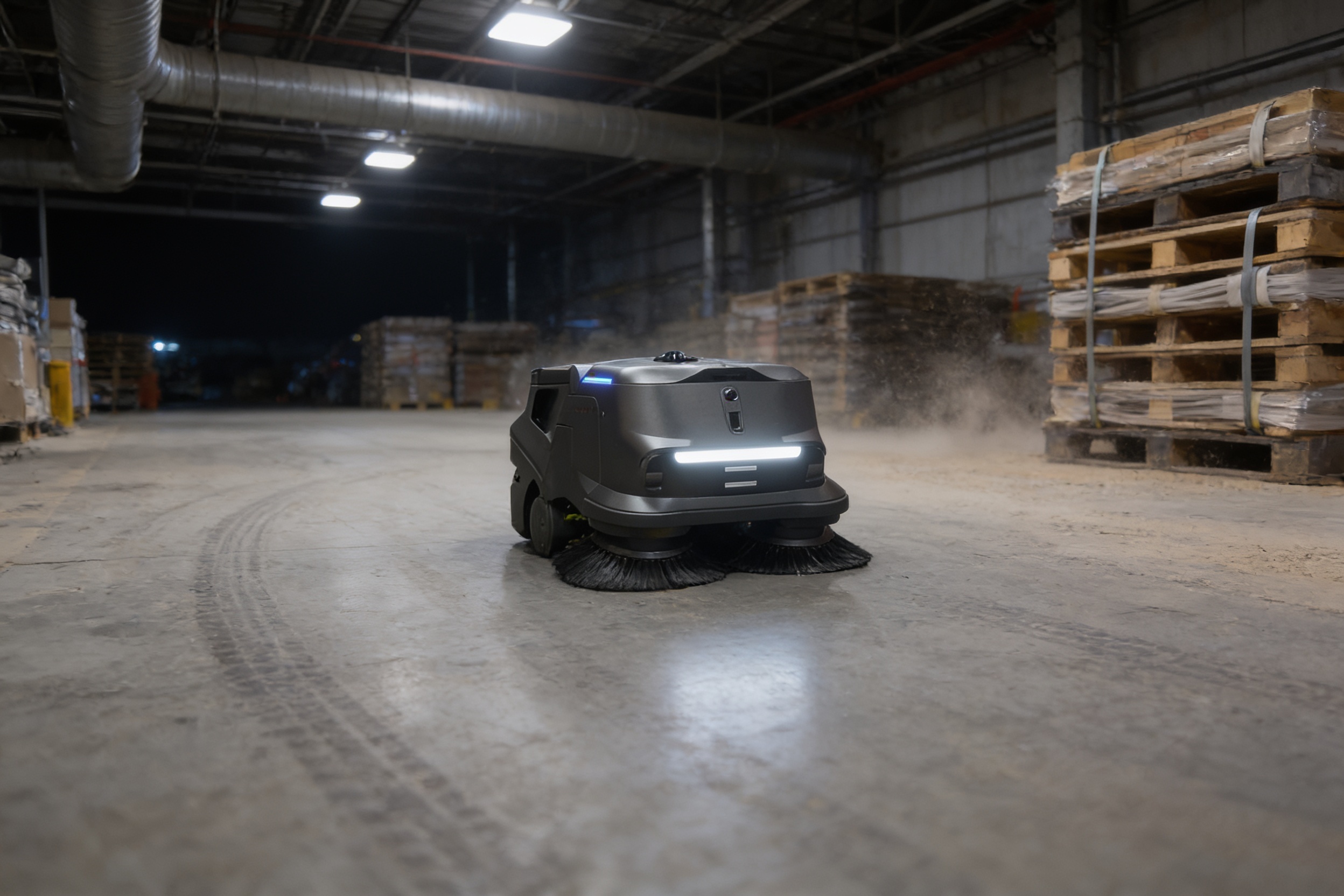
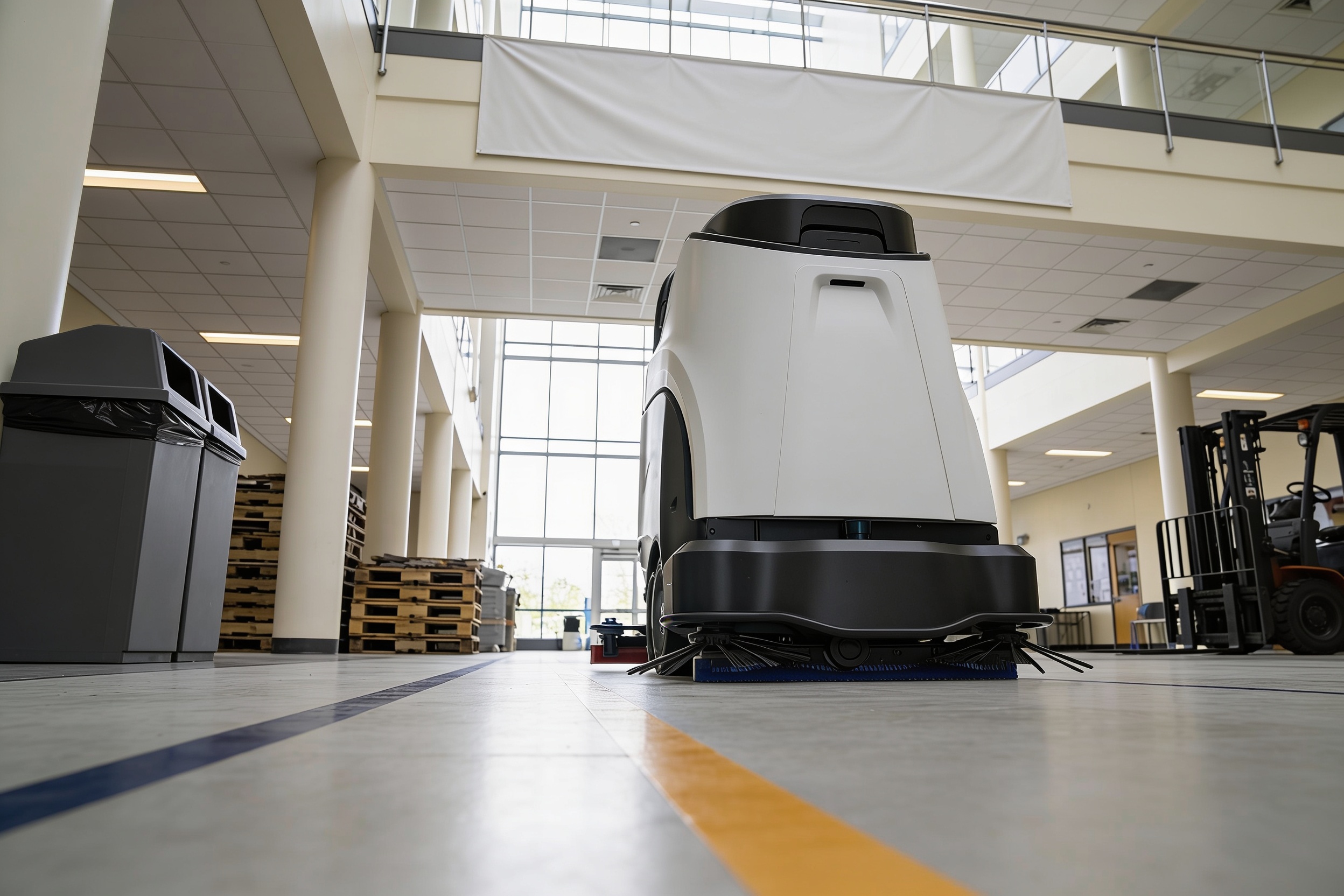
A floor scrubber handles the flat floor work well. It follows a mapped route, scrubs or vacuums the floor, and returns to charge. The gain is in covering the same ground repeatedly without a person pushing a machine, which is where a large share of floor hours goes in a big building.
It cannot take the rest of the shift. It does not clean toilets, empty bins, refill dispensers, wipe handrails or deal with a spill it has not been told about. It also needs a clear route. Pallets left in an aisle, a wet floor sign or a mop bucket can stop it or force a detour, and staff have to reset the route after layout changes.
- Can take: large open floors, corridors and aisles on a fixed route.
- Can take: repeated passes overnight when the building is empty.
- Cannot take: restrooms, trash, restocking and spot cleaning.
- Cannot take: spills outside the route, clutter and layout changes without a staff reset.
What do the hours and labor look like for janitorial staff?
Turnover is the labor issue most managers feel first. Swept reports annual turnover in janitorial work between 75 and 375 percent, and Netchex says separation rates commonly exceed 50 percent, with many contract cleaners at 100 percent or more. These are industry estimates, not government statistics, but they point the same way: the work is hard to staff steadily, and every vacancy lands on the people still on shift.
We did not find Fresno-specific figures for turnover, overtime, night shift coverage or sick days in this review. Those numbers change a robot decision more than any national average, so the site assessment should measure them from your own schedules and sign-in records rather than borrowing rates from another city.
Hours per task are also specific to the building. The most detailed public case we reviewed is a vendor-reported hospital example, shown in the table below. Treat it as one site's experience, not as a forecast for a Fresno building.
| Task | Today | With a robot |
|---|---|---|
| Scrub and dry mop a 50,000 square foot area | Two floor technicians, more than 8 hours a night | Scrubbing hours down 50 percent |
| Total manhours for the night's floor work | 16 manhours a night | 5 manhours a night |
| People on the floor | 3 people | 2 people, with two autonomous scrubbers |
| Restrooms, trash and spot cleaning | Not broken out in the case study | Still done by staff |
Figures come from a vendor-reported hospital case study from 2023, covering one site and not Fresno. Build your own hour figures during the site assessment.
What do injury rates and adoption figures say about robots?

The BLS injury and illness snapshot for janitors and cleaners, covering 2016 to 2020, reports an incidence rate of 191.6 cases per 10,000 full-time equivalent workers. The snapshot does not tie those cases to specific tasks, so it cannot say how many would be avoided by a robot taking over floor passes. It is a reason to review your own injury log alongside the floor hours.
Adoption is growing, but it is still a minority practice. According to ISSA's 2025 benchmarking, 43 percent of respondents reported plans to add autonomous cleaning equipment, which describes intent rather than use. An older ISSA and AACEM survey of about 23,000 respondents found that about two-thirds had not used autonomous cleaning equipment, and that 27 percent were active users. The year of that survey was not confirmed in our review, so read it as background.
How does a team work with a cleaning robot?
The model we recommend is a robot plus fewer staff, never zero staff. The robot takes the repeated floor passes on its route. The janitor moves to restrooms, trash, spills and the tasks that need a person. Over time, the crew covering the floor shrinks, while the people left on shift spend their time on work only people can do.
The hospital example shows the shape of this. Two floor technicians spent more than eight hours a night on scrubbing and dry mopping across a 50,000 square foot area. After two autonomous scrubbers were added, the team went from three people to two, scrubbing hours fell by 50 percent, and total manhours per night dropped from 16 to 5, according to the vendor-reported case study. Those are the vendor's figures for one site.
Team roles need an owner. Someone checks the route each shift, clears obstacles and resets the robot after a stop. Someone else handles faults and calls for service. Without those roles, the robot sits idle and the staffing reduction never appears on the schedule.
What can a cleaning robot not do?
A robot does not clean restrooms, empty bins or decide what counts as clean. It works from a mapped route and its sensors, so it will not notice a new problem the way a person does. A plan that assumes otherwise will fail on the first busy night. Those tasks stay with people, and the plan should say who owns each one.
Maintenance is a real requirement. Floor robots carry brushes, squeegees, batteries and sensors that need routine checks and occasional repair, and a stopped unit is idle floor. Ask how faults are reported, how quickly a technician can respond and what happens when a unit is out for service, before any deployment.
Robots also add a small amount of labor of their own. Setup, route changes and fleet checks take time, and industry estimates of that overhead vary by site. The net time saved should be measured after several weeks of running, not assumed from the first day.
How do you decide and get started in Fresno?
Start with a site assessment. Measure the floor area, map the routes, list the hours of floor work by night and day, and record which tasks stay with staff. That gives a clear basis for deciding whether a robot fits and for choosing a unit sized to the floor rather than to a brochure.
Service Robot Co. is a US commercial robot integrator. We pick the right robot for the site, lease it through financing, deploy and integrate it, train the staff and service it nationwide. The lease is quoted after a free site assessment, once the floor data is in hand, so the fixed lease payment reflects your building rather than a generic plan.
Begin with one unit in one building and set a measured target before expanding, such as scrubbing hours and staff time per night. A phased start keeps the decision small and gives your team time to learn the route and the reset steps before a second unit is added.

Frequently asked questions
Put a robot to work in Fresno.
We walk your site, learn the job, and recommend the unit that fits. Then we quote the lease, deploy it, and keep it serviced.
Sources
- US Bureau of Labor Statistics, Occupational Employment and Wage Statistics (OEWS May 2024)
- U.S. Bureau of Labor Statistics, Fresno metro occupational employment and wages, May 2024
- U.S. Bureau of Labor Statistics, Occupational Outlook Handbook: Janitors and Building Cleaners
- U.S. Bureau of Labor Statistics, Injuries and Illnesses snapshot: Janitors and Cleaners, 2016 to 2020
- Swept, janitorial industry turnover rate (industry estimate)
- Netchex, separation rates in cleaning staffing (industry)
- Vendor-reported hospital floor care case study, 2023
- ISSA Cleaning and Maintenance Management benchmarking, 2025
- ISSA and AACEM autonomous cleaning survey report