
The short answer
A cleaning robot vs janitor in Grand Rapids is rarely either or. A leased cleaning robot makes sense for large, mostly open hard floors that a janitor cannot cover during night or early hours, while restrooms, trash, spills and detail work stay with a person. It does not make sense for small, carpeted or cluttered sites where most labor is that detail work, and the right call comes from measuring your own floor hours, usually ending in a robot plus fewer staff, never zero staff.
Key takeaways
- A cleaning robot takes repeatable floor passes, not the whole janitorial job.
- Measure your reachable hard floor and your night hours before deciding anything.
- Published savings come from vendor-reported case studies and a model that is not peer reviewed.
- Plan for a robot plus fewer staff, never zero staff.
- No official turnover rate was found, so local overtime and absence figures must come from your own payroll records.
Cleaning robot vs janitor in Grand Rapids: when does a robot make sense?
A cleaning robot makes sense in Grand Rapids when a building has large, mostly open hard floors, a predictable cleaning window and a janitor who spends much of the night on floor passes. Warehouses, big-box stores, offices with wide corridors and facilities that run night shifts are the usual fit. The real question in a cleaning robot vs janitor comparison is which share of the work is repeatable enough for a machine and which share needs a person's judgment.
It does not make sense when the floor is small, heavily carpeted, cluttered with furniture or cords, or broken up by stairs and thresholds the machine cannot cross. It also fits poorly where most labor goes to restrooms, trash, glass and spills. In those buildings a machine adds equipment to manage without taking meaningful hours off the schedule.
Treat the answer as a measurement, not a feeling. If the floor passes take a large, fixed share of the night and that share can run without a person, the case is strong. If they do not, a janitor on a tighter schedule may be the better fit.
What does a janitor actually do in a shift in Grand Rapids?
A janitor's shift is rarely one task. It usually runs as a loop: empty trash and recycling, restock paper and soap, clean restrooms, wipe high-touch surfaces, and then sweep or scrub the hard floors. The order changes by building, but the floor work tends to fill the open hours between the other tasks.
Most of the scheduling problem sits in the floor passes. A large open area takes a person a long time to cover by hand, and the work has to fit around occupied hours, deliveries or a store's opening time. That is why the night and early morning window often matters more than total hours on paper.
Injury risk belongs in the labor picture too. According to the BLS injuries snapshot, janitors and cleaners except maids and housekeeping cleaners in private industry had 21,100 nonfatal injury and illness cases with days away from work in 2020, an incidence rate of 191.6 per 10,000 full-time equivalent workers. Across the years that snapshot lists, the rate ranged from 137.1 in 2018 to that 191.6 in 2020, so it is not a steady trend, but repetitive pushing and lifting is worth a line in any labor review.
Median hourly wage, Janitors and Building Cleaners
$3,910
Monthly cost of one full-time worker in Grand Rapids, MI, at the median wage plus payroll costs (an estimate, not a quote).
Which parts of the cleaning can a robot take, and which can it not?
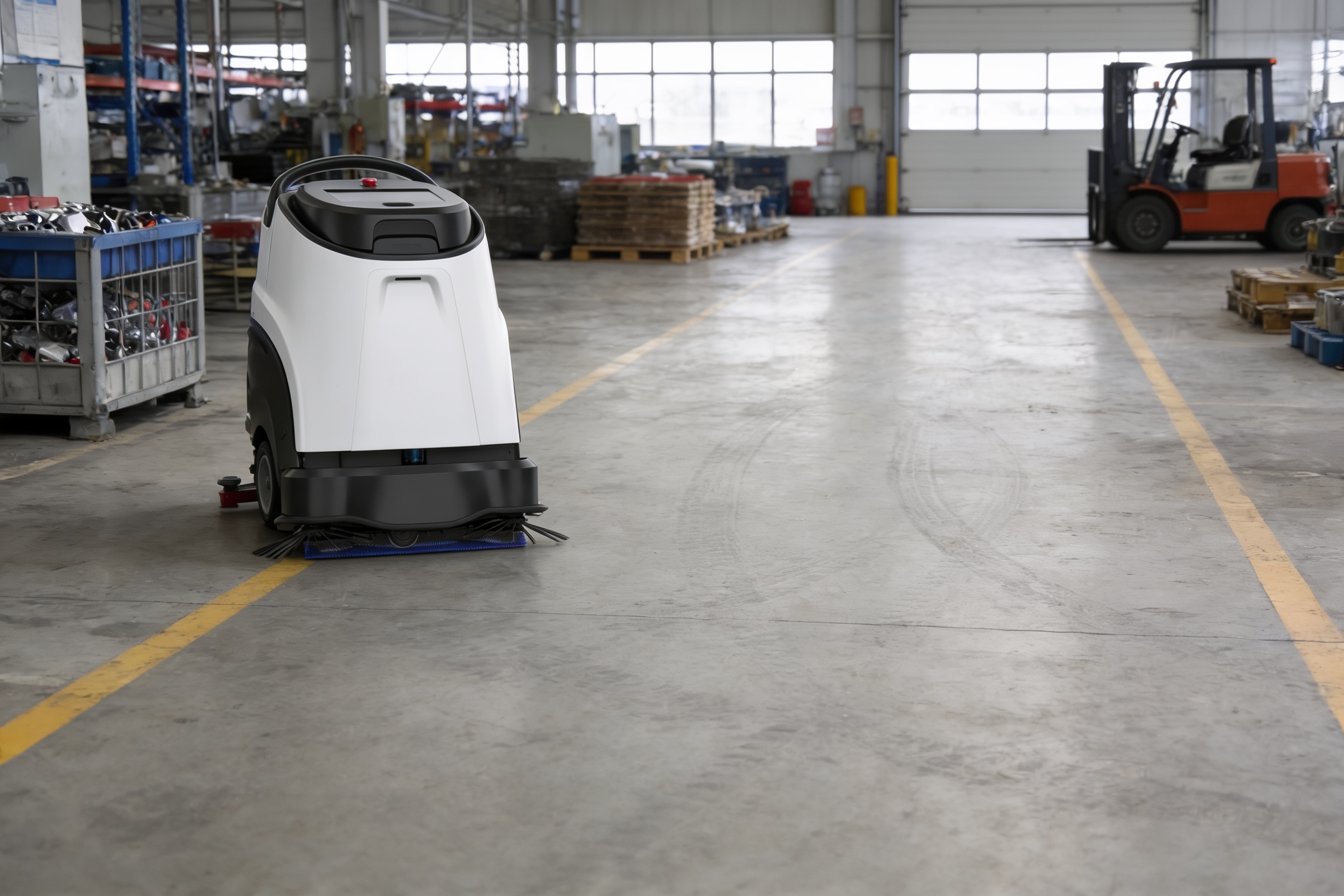
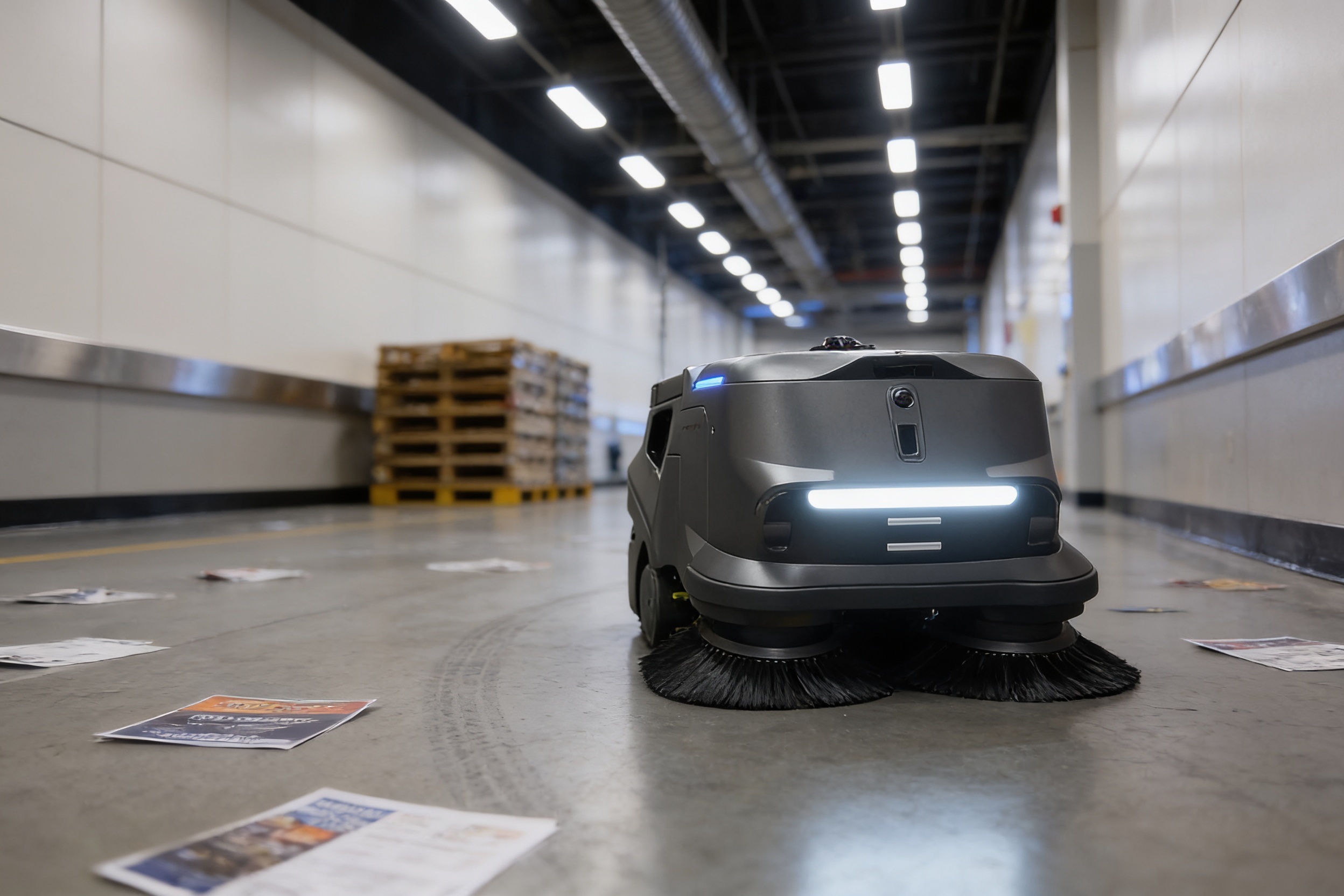
A cleaning robot takes the repeatable floor work: scrubbing or sweeping hard floors along a set route, on a schedule, without a person pushing the machine. It needs a mapped route, clear aisles and floors it can drive over. Once set up, it runs the same route each night, without the variation that comes from a tired person at the end of a long shift.
It cannot take the parts of the job that need hands or judgment. That covers restrooms, emptying bins, wiping surfaces, restocking, handling spills and broken glass, and deciding what looks dirty. Stairs, raised thresholds, wet floor signs and a door propped open with a cart also need a person.
The zones below show where a machine usually works and where a person still has to be on the floor.
What do the hours and labor numbers look like for janitors?
Nationally, janitors and building cleaners held about 2.4 million jobs in 2024, according to the BLS Occupational Outlook Handbook. The same page projects 2 percent growth from 2024 to 2034, which it describes as slower than average, with about 351,300 openings a year, mostly from replacement hiring. In plain terms, most openings come from people leaving, not from new positions.
The Grand Rapids-Wyoming-Kentwood metro covers Barry, Ionia, Kent, Montcalm and Ottawa counties, according to the BLS Midwest Information Office. A third-party jobs list citing BLS May 2024 data counts 10,180 janitors and cleaners in that metro, or 18.13 per 1,000 jobs. That list is not an official release, so check the count against the official OEWS table before using it in a plan.
Turnover is where the local picture is weakest. We did not find an official turnover rate for janitors, and a janitorial industry blog only says janitorial turnover runs above construction, education and retail, with only leisure and hospitality higher. Overtime, night premiums and sick-day figures for your own building are not in the public data we pulled, so take them from your payroll and absence records. The local wage for this job, shown in the government wage data on this page, sets what each hour costs, so the question is how many night and weekend hours that rate has to cover.
- Repeatable floor passes
Cleaning Robot
Same route and coverage on each run
Janitor
Adjusts pace and detail on uneven or cluttered floors
- Restrooms, trash and spills
Cleaning Robot
Not a machine task
Janitor
Done by a person
- Stairs and thresholds
Cleaning Robot
Needs a drivable route
Janitor
Handles any level
- Night and early hours
Cleaning Robot
Runs a set schedule, with a person to start and check it
Janitor
Can work the shift, but needs staffing for it
- Sick days and turnover
Cleaning Robot
Does not call in sick, but needs a trained operator and a backup
Janitor
Absence and turnover take time to refill
- Cost basis
Cleaning Robot
Fixed lease payment quoted after a site assessment
Janitor
Wage, overtime and night premiums on the payroll
- Physical load
Cleaning Robot
Pushes the machine without a person's hands
Janitor
Repetitive pushing and lifting, the load linked to the injury rate in the BLS snapshot
How many hours of floor work can a robot take off a shift?

The honest answer depends on the reachable floor and how many passes the building needs each night. The most detailed independent source we found is a cost model on a blog, which estimates that about 80 percent of today's floor time on reachable floor can be saved, minus 0.4 hours of attended time per night. The same model says small sites often do not pay back. It is not peer reviewed, so read it as a model, not a result.
Vendor case studies show larger examples. A 2023 hospital case study published by a robot vendor reports two scrubbers running from 8:30 pm to 2 am, with floor-care labor falling from 16 hours to 5 per night and the team dropping from 3 people to 2. A trade press report on a logistics facility says that over about nine months, from summer 2020 to April 2021, the site saved more than 300 labor hours compared with conventional cleaning. Both figures are vendor-reported, so they show what is possible, not what your building will do.
Measure your own floor first. Time the current scrub or sweep on the reachable area, and keep restroom and trash time separate, since a machine does not change those hours.
How does a team work with a cleaning robot?
The team does not disappear. A workable setup keeps a person on the building for restrooms, trash, spills and checks, and gives the machine the repeatable floor passes. In the hospital case above, the team went from three to two, not from three to zero, and that is the pattern to plan for.
Someone still owns the machine. That means clearing the aisles before each run, starting the route, checking the report at shift start and calling for help when it stops. We handle the site assessment, mapping, installation, training for the staff who run it and service after go live, so the janitor who stays on site knows exactly what the machine needs.
Plan a backup as well. A machine out of service should not leave the building uncleaned, so ask about spare unit coverage or a loaner before you sign anything.
What can a cleaning robot not do?
A machine cannot clean a restroom, empty a bin, wipe a door handle or notice that a corridor is blocked by a cart. It cannot climb stairs or step over a raised threshold, and most sites need the route cleared before each run. Heavy carpet, loose cords and standing water are poor fits.
Uptime depends on more than the machine. Batteries wear, sensors need cleaning and a route change means remapping. A unit that stops in a busy aisle needs someone to reach it. If the floor changes often, such as a warehouse that reracks every quarter, the upkeep is higher than in a building with a fixed layout.
It does not solve turnover either. It can reduce how many hours have to be staffed, but it does not fill a shift when someone calls out sick. For many Grand Rapids sites the honest result is a smaller team with a clearer night plan, not an empty building at night.

How much does it cost to lease a cleaning robot vs a janitor?
Cost is the first question most people ask, and the honest answer depends on the floor, the hours and the lease term. A cleaning robot is leased through financing, with a fixed robot lease payment that is quoted after a free site assessment. We do not give a figure from a web page, because the right unit and route depend on your building.
Compare the lease against the hours it removes, not against a janitor's full schedule. The independent cost model above says small sites often do not pay back, which is exactly the case where a person and a tighter schedule win. Larger, open, night-heavy buildings are where the case studies show savings, and that is what the site assessment should test.
Ask for the payback calculation built on your own hours, not on a generic floor. Then check the service terms in writing before you compare offers.
- Payback calculation based on your measured reachable floor hours
- Route time and attended time per night
- Lease term length and what the lease covers
- Response time for on-site dispatch and remote triage
- What happens while a unit is down, including spare unit coverage
How do you get started with a cleaning robot lease in Grand Rapids?
Start with a site walk and a free site assessment. Bring the floor plan, the current cleaning schedule, the hours the floor takes, the shift times and any areas the machine must avoid. We map the reachable floor and check doors, thresholds and aisles before anything is quoted.
Then run a pilot on one area or one unit before scaling. A pilot shows real route time, the stops and how the janitor's shift changes. Phased deployment keeps the building open, so the rest of the site keeps cleaning while the machine learns its route.
Get the lease terms in writing: term length, what is included, service response and how a spare unit is handled. Sign only after those answers are clear. The goal is a robot plus fewer staff, with a janitor still on the building and a plan for every task the machine cannot take.
Frequently asked questions
Put a robot to work in Grand Rapids.
We walk your site, learn the job, and recommend the unit that fits. Then we quote the lease, deploy it, and keep it serviced.
Sources
- US Bureau of Labor Statistics, Occupational Employment and Wage Statistics (OEWS May 2024)
- BLS Occupational Outlook Handbook, Janitors and Building Cleaners
- BLS Injuries, Illnesses and Fatalities snapshot, janitors and cleaners
- BLS Midwest Information Office, Grand Rapids metro wages, May 2024
- Stacker, lowest-paying jobs in Grand Rapids
- SoftBank Robotics hospital case study, 2023 (vendor-reported)
- Trade press article on a logistics facility floor scrubbing deployment (vendor-reported)
- Janitorial Manager blog on janitorial turnover (vendor blog)
- Independent blog cost model for commercial cleaning robot leasing