
The short answer
For most Hartford, CT buildings, a cleaning robot makes sense for large, mostly open floors cleaned on a repeating route, especially overnight when the space is empty. It does not replace a janitor on its own, because restrooms, spills, trash and reactive calls still need a person. For a cleaning robot vs janitor in Hartford decision, the right setup is a robot plus fewer staff, chosen by the hours of repeat floor work in each shift rather than by headcount alone.
Key takeaways
- A cleaning robot fits large, mostly open floors cleaned on a repeating route, most of all overnight.
- Restrooms, spills, trash and reactive calls stay with people, so the model is a robot plus fewer staff.
- The latest official Hartford count verified here is about 8,510 janitors and cleaners, from May 2020.
- Decide on measured floor hours per shift and the local wage for this job, not on headcount.
- Lease quotes come after a free site assessment, which sets the route, the coverage and the payment.
Cleaning robot vs janitor in Hartford: which makes sense?
For most Hartford, CT buildings, the cleaning robot vs janitor question is not a straight swap. A cleaning robot makes sense where floors are large, mostly open and cleaned on a repeating route, particularly overnight when the building is empty. It does not make sense where most of the shift is hands-on, varied work such as restroom cleaning, reactive spill response and carrying trash, because a machine cannot take those tasks and removing the person would leave gaps.
The useful test is how many hours of repeat floor work each shift contains, and whether a machine can clear those hours on a fixed schedule without a coverage gap. When floor work is a large share of the shift, a robot plus fewer staff deserves a close look. When it is a small share, a robot adds complexity for little labor relief.
Hours are the weak point of any outside estimate. The research behind this page did not verify typical hours per shift for Hartford buildings, so treat any figure here as a starting assumption until a timed site walk measures it.
What does a janitor actually do in a Hartford shift?
A janitor's shift is part fixed route and part reaction. The route usually covers floors, restrooms, trash and recycling, and high-touch surfaces. The reactive part covers spills, broken fixtures, requests from tenants or staff, and anything the building manager adds that day. Reactive work is the hardest to schedule, and it is the work most likely to pull a person off the route.
Government data sizes the local workforce. According to the BLS Occupational Employment and Wage Statistics table for the Hartford-West Hartford-East Hartford metro, about 8,510 janitors and cleaners, except maids and housekeeping cleaners, were employed in May 2020. That is the latest official Hartford count we could verify for this page. Newer estimates built on BLS data exist from third parties, but we have not used them here.
For the cost side, use the local wage for this job from the government wage data on this page. Multiply that hourly rate by the hours the robot would take over, then set the result against the lease quote. The hourly rate is what turns a floor-hours estimate into a real comparison, and it should come from your own shift count, not a rule of thumb.
Median hourly wage, Janitors and Building Cleaners
$4,046
Monthly cost of one full-time worker in Hartford, CT, at the median wage plus payroll costs (an estimate, not a quote).
Which floor cleaning tasks can a robot take over?
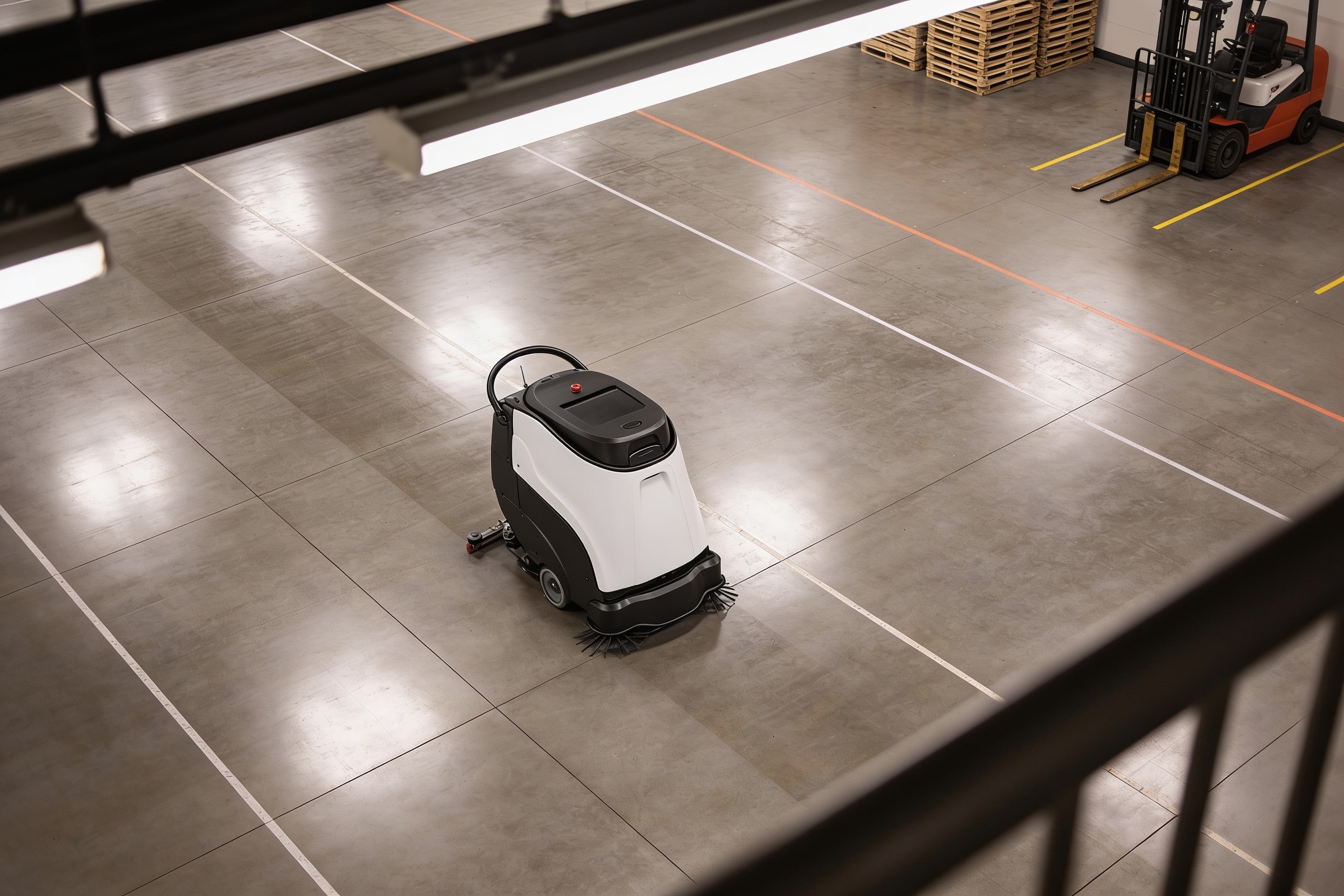
Floor work is where a robot earns its place. Scrubbing and sweeping open hard floors on a set route are the most established tasks. In the 2019 AACEM/ISSA autonomous cleaning survey, 89 percent of adopters used scrubbers, 46 percent used vacuums and 32 percent used large-area sweepers, according to the survey report as summarized in a trade publication. Scrubbers lead the adopter list, which fits a building where hard floor work is the largest repeatable block of the shift.
Carpets, thresholds, stairs and cluttered floors reduce what a machine covers without help. A robot follows a mapped route, so a space that is rearranged often needs a separate plan from a warehouse aisle, an office corridor or a school hallway with a stable layout. Site mapping is where these limits become clear, before any lease is quoted.
What do the labor numbers look like for janitors in Hartford?
Turnover is the labor issue decision makers feel first, and this research did not find a verified primary turnover rate for janitors. A janitorial trade blog reports cited turnover ranging from 75 to 400 percent. A range that wide says more about inconsistent measurement than about any one building, so pull your own separations and rehire counts from payroll before using any outside rate.
Injury data points the same way. According to the BLS Injuries, Illnesses, and Fatalities snapshot for janitors and cleaners in private industry, there were about 21,100 nonfatal injury and illness cases with days away from work in 2020, an incidence rate of 191.6 per 10,000 full-time equivalent workers, up from 137.1 in 2018. The snapshot does not isolate causes, so review your own incident log before assuming a robot changes the rate.
National demand is steady rather than rising fast. According to the BLS Occupational Outlook Handbook, about 2,447,700 janitors and building cleaners were employed in 2024, and employment is projected to grow 2 percent from 2024 to 2034, slower than average, adding about 47,800 jobs. The case for fewer hours on repeat floor work does not depend on a local hiring boom.
Overtime, night shift premiums and sick day figures for this occupation were not verified in this research. They belong in the payroll review, along with the hours that call-outs push onto the rest of the crew.
| Task | Today | With a robot |
|---|---|---|
| Scrub the main corridors | Hours to be measured in a timed site walk | Mapped route on a set schedule, staff check at the end |
| Sweep or vacuum open floors | Hours to be measured in a timed site walk | Mapped route on a set schedule |
| Clean restrooms | Hours to be measured in a timed site walk | Stays with staff |
| Empty trash and recycling | Hours to be measured in a timed site walk | Stays with staff |
| Respond to spills and reactive calls | Hours to be measured in a timed site walk | Stays with staff, alerts sent to the on-call person |
No verified hours per shift for Hartford buildings were found in this research, so the today column is filled from a timed site walk, not from published averages. The withRobot column describes how the work is split, not measured time.
How do a robot and staff work together?
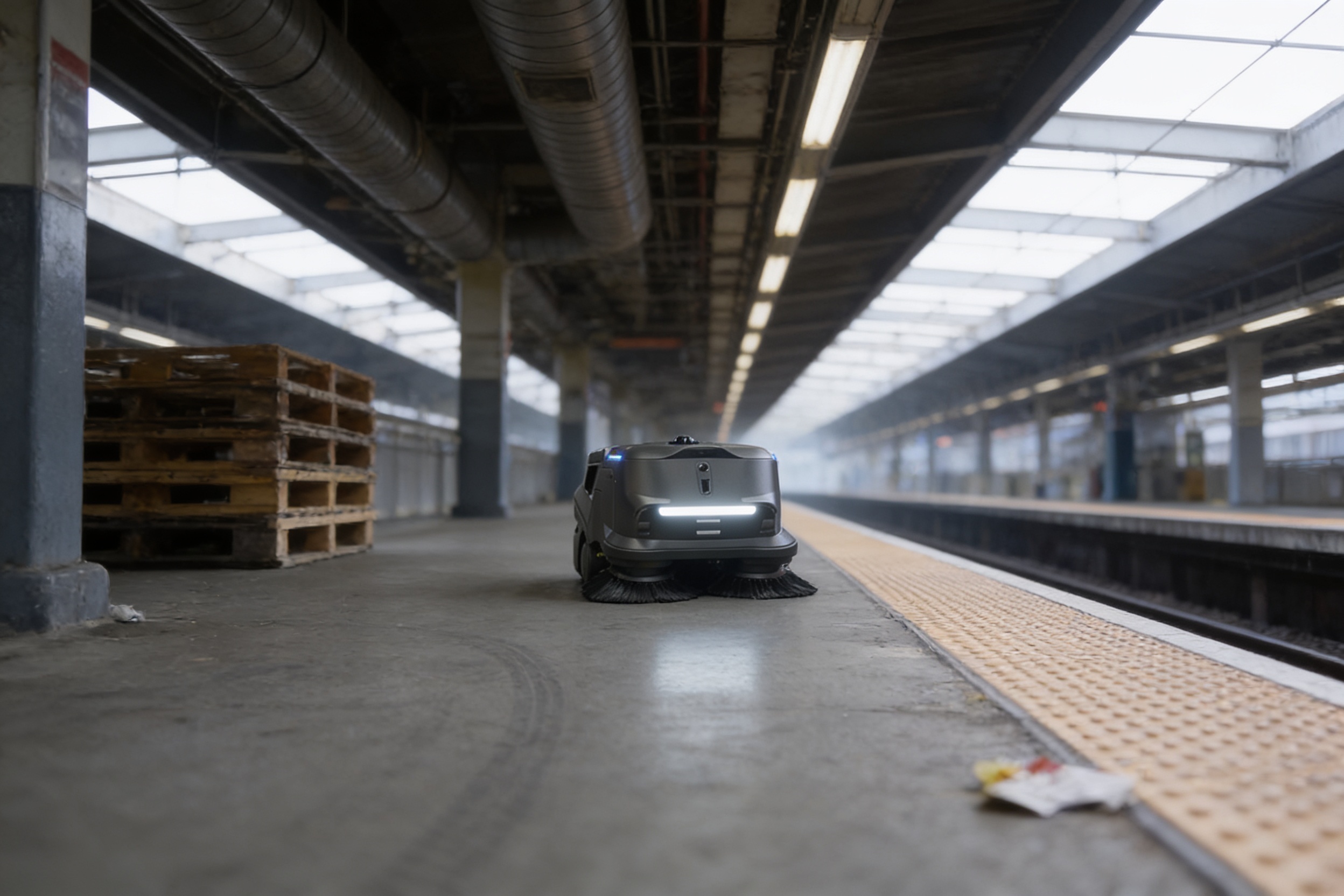
The model we recommend is always a robot plus fewer staff, never zero staff. The robot takes the repeating floor route on a set schedule, often after the building empties, and people cover what it cannot: restrooms, trash, spills, odd corners, access problems and the morning check. Staff move from pushing a machine to supervising the route and handling exceptions, which uses their time in another way.
Set up the overnight route with a verified map and a clear exception path. If the robot is blocked or stops, it should flag the problem to the person on call, who decides whether to clear it now or leave it for the morning. We select the robot for the site, lease it through financing, deploy and integrate it, train the staff who receive alerts, and service it nationwide.
What can a cleaning robot not do?

A cleaning robot does not clean restrooms, empty bins, pick up dropped items, or judge a spill that is not on its map. It does not climb stairs or cross thresholds unless the site is set up for that. Even on a suitable floor, a robot may stop at an obstacle it cannot pass, and someone has to clear it. These limits are why staffing does not drop to zero.
Maintenance and capacity are the other limits. A market research report on commercial robotic scrubbers names frequent maintenance and limited cleaning capacity as restraints on the market's growth, according to that report. Ask in any quote how quickly a unit is serviced and how the site covers hours when a unit is down.
- Night coverage
Cleaning Robot
Runs a scheduled route with no operator once the building empties
Janitor
Works a shift and can respond to an incident at once
- Restrooms and high-touch surfaces
Cleaning Robot
Does not clean them
Janitor
Cleans them and checks them
- Stairs and thresholds
Cleaning Robot
Depends on the site setup, often needs staff
Janitor
Handles them directly
- Unmapped spills and debris
Cleaning Robot
May stop and send an alert
Janitor
Deals with it on the spot
- Judgment and tenant requests
Cleaning Robot
None
Janitor
Yes, including access and safety calls
- Route consistency
Cleaning Robot
Same mapped route each run
Janitor
Varies with fatigue, staffing gaps and call-outs
How is the cost to lease a cleaning robot worked out?
We do not publish robot prices, and no lease figure appears on this page. A fixed robot lease payment is quoted after a free site assessment, because the quote depends on floor area, route length, how many units the site needs and the service coverage. Maintenance is part of the service plan, so the payment is the number to compare against labor hours, not a set of separate invoices.
The comparison that matters is the labor the robot takes over, valued at the local wage for this job from the government wage data on this page, set against the fixed payment and the coverage you still need. A lease does not remove a person from the schedule. It changes which hours that person spends on floor work.
What do adopters report about payback and labor savings?
The AACEM/ISSA autonomous cleaning survey from 2019 drew nearly 23,000 professionals. Facility and property managers were 19 percent of respondents. About 69 percent of those managers had not used autonomous cleaning equipment, and about 26 percent had, according to the survey as reported in a trade publication. Labor savings was the top driver, cited by 77 percent of respondents.
A payback analysis for small and mid-sized facilities, based on 250 complete responses, reports that about 70 percent of organizations evaluating autonomous cleaning expected to recover their investment within two years, according to that press release. That is an expectation, not a measured result, so ask for the hours and the lease quote in your own building before trusting any payback date.
Adoption is climbing. A 2026 industry press release reports that planned robotic floor equipment adoption roughly doubled in 2026 compared with 2025. That source sits closer to the vendor side of the market, so read it as a direction rather than a precise measure.
How do you get started with a cleaning robot in Hartford?

Start with a free site assessment. We map the floor, measure the route, note thresholds, stairs, carpets and reactive tasks, and count hours of repeat floor work per shift from a timed walk. That gives the quote its basis and shows whether a robot plus fewer staff fits the building at all.
A common start is one leased unit in a phased deployment, so the building keeps running while the route, alerts and staff training are tested. Go live support covers the first nights, and spare unit coverage limits how long one machine failure leaves a gap. Service runs nationwide, with remote triage first and on-site dispatch when a repair needs a technician.
Bring three things to the first call: a floor plan or rough sketch, the hours of each cleaning task you can measure, and your latest incident log. With those, a site assessment can answer the Hartford question directly, rather than working from assumptions.
Frequently asked questions
Put a robot to work in Hartford.
We walk your site, learn the job, and recommend the unit that fits. Then we quote the lease, deploy it, and keep it serviced.
Sources
- US Bureau of Labor Statistics, Occupational Employment and Wage Statistics (OEWS May 2024)
- BLS Occupational Outlook Handbook: Janitors and Building Cleaners
- BLS Occupational Employment and Wage Statistics, Janitors and Cleaners, May 2020
- BLS Injuries, Illnesses, and Fatalities snapshot: Janitors and Cleaners, 2016 to 2020
- AACEM/ISSA autonomous cleaning survey report, summarized in a trade publication
- Press release: autonomous cleaning payback analysis for small and mid-sized facilities
- 2026 industry press release on robotic floor equipment adoption
- Janitorial trade blog on turnover rate changes
- Market research report on US commercial robotic scrubbers