
The short answer
A cleaning robot makes sense in Indianapolis when a building has large, mostly open hard floors, cleaning work that can run overnight, and open shifts that are hard to fill. It does not replace a janitor entirely, because restrooms, spills, trash and judgment work still need people on site, so the practical model is a robot plus fewer staff. Check the fit with a free site assessment, and use the government wage data on this page to value the staff hours a robot would free up.
Key takeaways
- A robot takes the repeatable floor passes, while staff keep restrooms, spills, trash and judgment work.
- Plan for a robot plus fewer staff, never zero staff.
- Size the hours from your own open-shift and overtime records, since published janitor figures for those are thin.
- Turnover estimates vary widely, so treat industry blog figures as estimates and not government data.
- Start with a site assessment and a single-unit pilot before you change the schedule.
Cleaning robot vs janitor in Indianapolis: which makes sense?
A cleaning robot makes sense in an Indianapolis building that has large, mostly open hard floors, cleaning work that can run overnight, and open shifts that are hard to fill. It does not fit as a full replacement for a janitor. Restrooms, spills, trash, glass and any task that needs judgment still need people on site.
It fits poorly where floors are small and split into many rooms, where the building is open only a few hours a day, or where loose items must be picked up before any machine can run. In those buildings the staff already covers the floor inside the window, and setup time takes a larger share of the benefit.
The cleaning robot vs janitor in Indianapolis question is really a question about hours. How much of the floor work can a machine take, and how many staff hours does that free for the work left behind? The government wage data on this page lets you value those hours locally, and a site assessment shows how much floor a robot can actually cover.
What does a janitor actually do in a shift?
A janitor's shift is rarely one task. In most commercial buildings it runs as a sequence: empty trash and recycling, restock restrooms, wipe touch points such as handles and rails, sweep or vacuum entrances and corridors, mop or scrub hard floors, clean glass and break rooms, and answer spills or requests that come in during the shift. The order changes by building, and the lead often sets it from what was flagged the day before.
The job asks for little formal education. The Bureau of Labor Statistics Occupational Outlook Handbook lists no formal educational credential typically required, so most training happens on the floor. That low entry bar explains part of the staffing problem: each new hire needs route knowledge, supply knowledge and building quirks before running a full shift alone.
Look at the shift in three groups. The restroom and trash loop keeps the building usable. The floor passes make it look clean. The spill calls arrive at random and take whatever time is left. A robot can take part of the second group, and it does nothing for the first and third.

Median hourly wage, Janitors and Building Cleaners
$4,006
Monthly cost of one full-time worker in Indianapolis, IN, at the median wage plus payroll costs (an estimate, not a quote).
Which cleaning tasks can a robot take over?
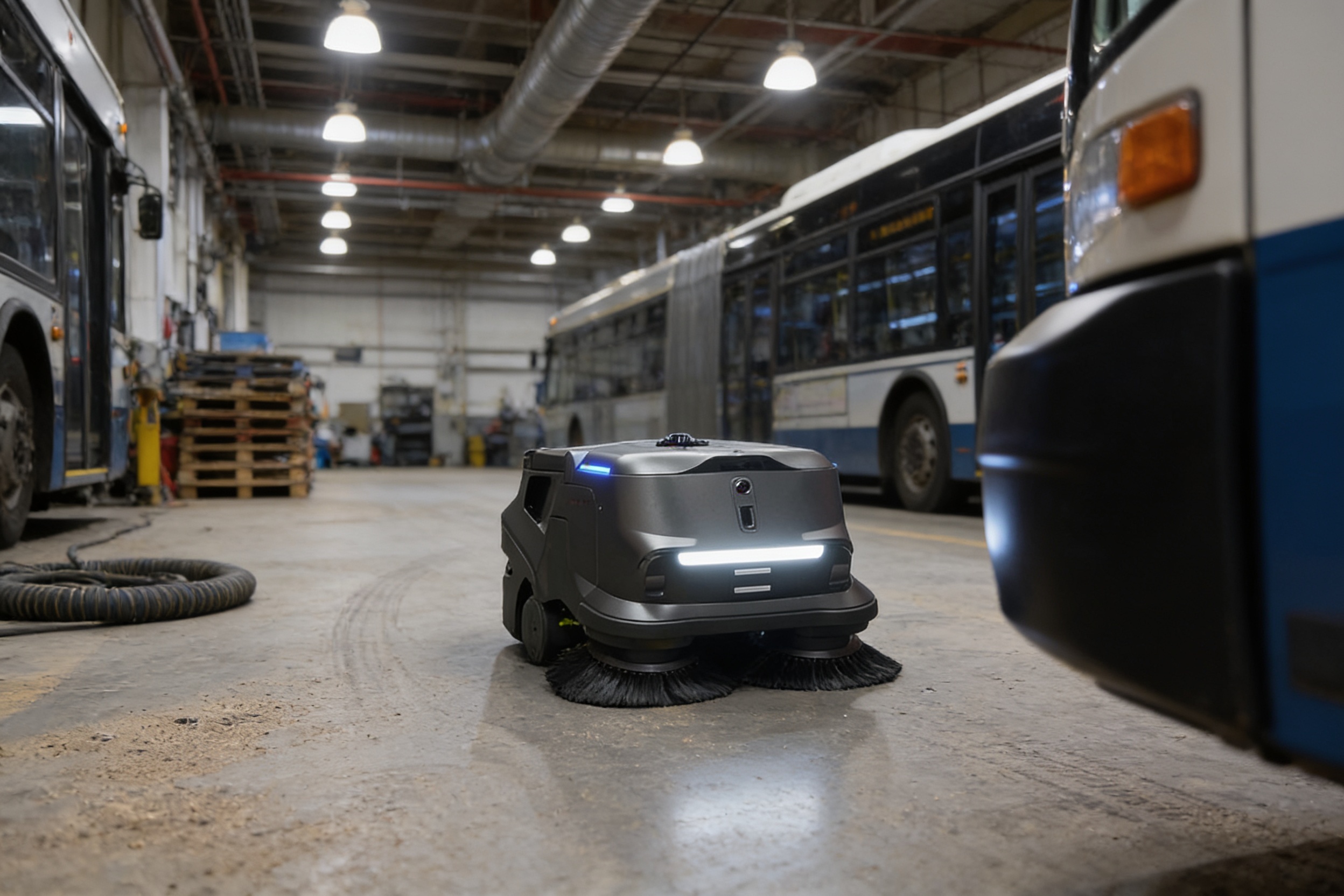
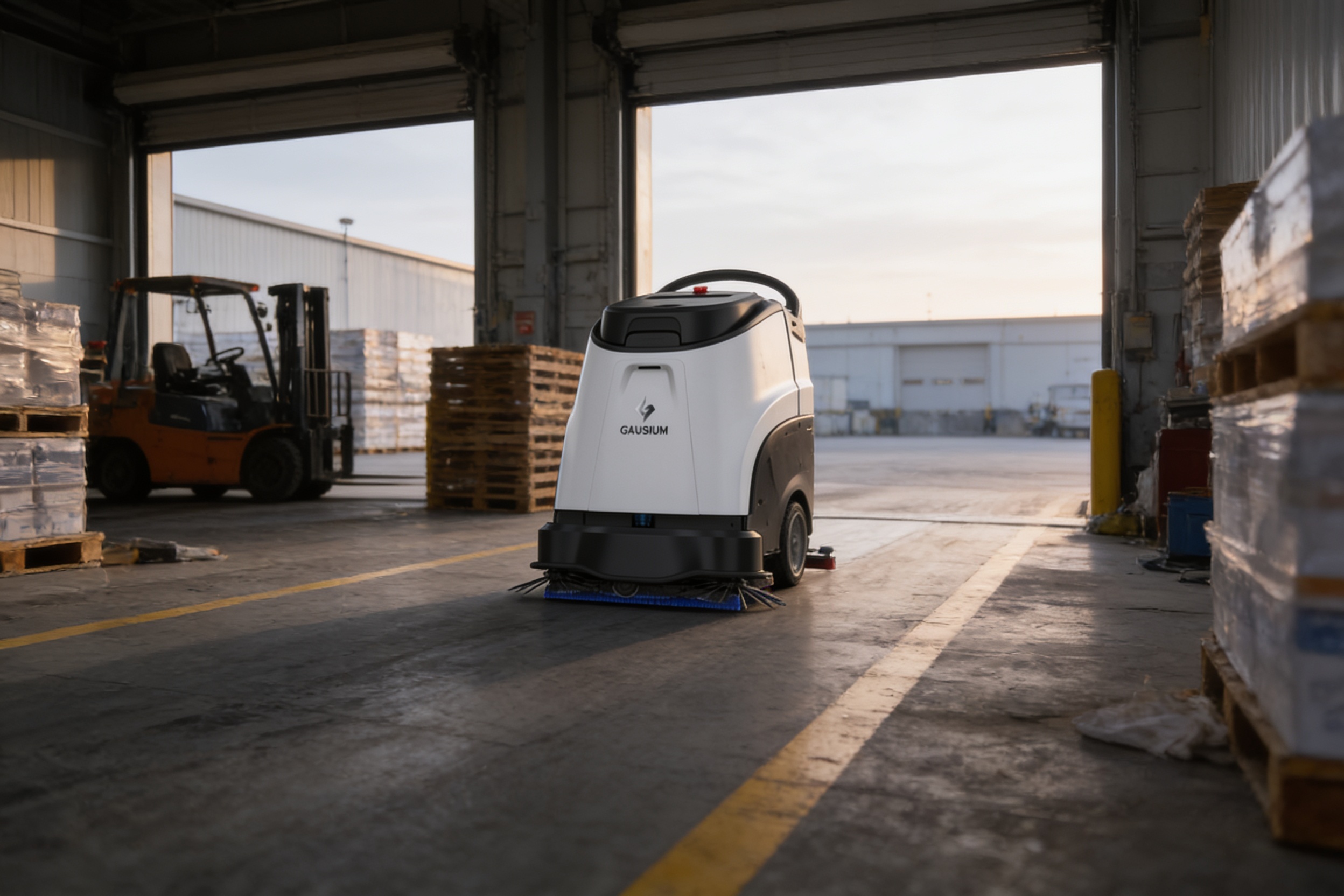
Autonomous floor scrubbers and sweepers handle the repeatable passes: long corridors, open retail aisles, warehouse floors and lobbies with clear paths. Once a route is mapped, the machine runs it on a schedule and returns to its dock. Nobody has to steer it, which is why floor passes are the part of the work that can come off the janitor's list.
A robot cannot empty bins, restock paper or soap, clean restrooms, wipe fingerprints off doors and glass, handle a broken bottle, move furniture, or decide that a stain needs another product. It cannot step in when a door is blocked. Someone still walks the building before and after a run to clear the route and check the seams and corners.
The split changes the schedule. The robot takes the long passes that otherwise pull a janitor away from touch-point work, and the remaining hours go to tasks that need eyes and hands. That is where staff time is hardest to replace, so it is the part to protect.
- Long floor passes
Cleaning Robot
Runs a mapped route on schedule with the same pass count each time.
Janitor
Covers the same route, but needs breaks and time off, and overtime adds hours.
- Night coverage
Cleaning Robot
Runs while the building is empty, with no staff on the route.
Janitor
Can respond to a spill, a blocked door or a request in real time.
- Restrooms and touch points
Cleaning Robot
Cannot clean restrooms or wipe handles, rails and fingerprints.
Janitor
Does the full restroom reset and touch-point work by hand.
- Judgment and exceptions
Cleaning Robot
Stops and logs when the path is blocked, then waits for a person.
Janitor
Decides what to do about a hazard, a stain or a moved object.
- Sick days and turnover
Cleaning Robot
Takes no sick days and needs no retraining after a resignation, though its route still needs an owner.
Janitor
Sick days and resignations create open shifts that must be covered.
- Tight, cluttered spaces
Cleaning Robot
Works steadily on long clear paths, but needs a mapped route first.
Janitor
Moves faster in tight, cluttered spaces and adjusts on the spot.
How many janitors work in the US, and is the job growing?

The Bureau of Labor Statistics counts about 2,447,700 janitors and building cleaners employed in 2024, and projects 2% growth from 2024 to 2034. The handbook calls that slower than average, adding about 47,800 jobs over the decade, and it projects about 351,300 openings a year on average.
Slow headcount growth does not make the hiring problem small. Openings keep appearing every year, so the pressure on a building is to keep the roster full, not to add positions. When a shift goes unfilled the floor does not wait, and the gap shows up as a missed pass or a restroom that is not ready at opening.
For the local wage, use the government wage data panel beside this text, which shows the OEWS May 2024 figure for Janitors and Building Cleaners in Indianapolis. The BLS release for the Indianapolis-Carmel-Greenwood metro reflects the new metro definitions from OMB Bulletin 23-01, so match any older regional table to the same metro before you compare numbers.
How much turnover and injury risk does this job carry?
Turnover is the figure that most affects covered hours. A netchex blog cites BLS-based data showing average annual total separation rates around 45% since 2017, excluding 2020. This review did not confirm that series against the BLS, so treat it as directional. Janitorial Manager, an industry blog, reports industry estimates of hourly turnover from 100% to 400%, with about 200% as the most-cited median. Those are not government data, and they vary by company.
Every new hire takes training time away from the floor. A robot does not quit, but it still needs a mapped route and a trained person to handle its stops, so the lever is fewer open shifts and less retraining, not zero people.
On injuries, the Bureau of Labor Statistics reports that the days-away-from-work rate for janitors and cleaners except maids and housekeeping cleaners was 157.4 per 10,000 full-time equivalent workers in 2019 and 191.6 in 2020, the top of its 2016 to 2020 series. That series ran as low as 137.1 in 2018. For the whole private sector, BLS data for 2024 reported 2.2 injury cases per 100 full-time equivalent workers, and illness incidence fell to 13.9 per 10,000 from 19.0 in 2023, according to CPA Practice Advisor's report of the BLS release. This review did not find a 2024 rate for janitors specifically.
This review also did not find published figures on overtime, night-shift share, or sick days for janitors. Pull those numbers from your own time records before you size a robot, because they are the hours a robot can actually recover.
How does a team work with a cleaning robot?
The model that holds up is a robot plus fewer staff, never zero staff. The robot takes the long floor passes on a set schedule, usually in hours when the building is empty, and the staff takes the work that needs hands and judgment. The crew shrinks to what the building actually needs, and the people who stay are trained to handle the robot's stops.
The day-to-day change is in who owns the floor. Someone reviews the route report each morning, clears anything blocking the path, and handles the one-off jobs the robot logged as a stop. This takes less time than a manual pass, but it is a real task, and it has to be assigned to a named person.
We pick the robot for the floor, lease it through financing, deploy and integrate it, train the staff who run it, and service it nationwide. Training covers the route, the stop conditions, and what staff do when the robot pauses. Service runs through one partner and one number, so the site does not have to track a manufacturer and a local vendor separately.
What can a cleaning robot not do?
A robot does not clean the way a person does. It sweeps and scrubs a mapped path, and it can miss a corner where a chair sits, a cord lies, or a spill spreads under a rack. It does not reach a restroom stall, a window or a ledge, and it cannot lift a full trash bag.
It also depends on the floor. Uneven thresholds, loose rugs, standing water and temporary displays that are not on the map slow it or stop it. A building that rearranges its layout every week needs frequent route updates, and the robot is only as good as its map.
A robot is not a security guard or a safety inspector. It will not report a broken door, a leak or a hazard it was not built to detect, unless a staff member checks the floor after it runs. Set that expectation before the robot arrives, not after the first missed spill.
How do you estimate savings and payback?
Start with the hours, not the machine. Count the staff hours spent on repeatable floor passes each week, the hours lost to open shifts and overtime, and the hours lost to sick days and retraining. Those three numbers, not the robot's headline speed, set the case. Value the hours at the local rate from the government wage data on this page.
Then measure the floor. No published third-party benchmark for square feet per hour from autonomous scrubbers was found, so coverage rates should come from a site assessment that maps the route and times a test run. Ask any integrator for a coverage estimate tied to your floor, and ask what that estimate assumes about stops.
The lease is quoted after a free site assessment, as a fixed robot lease payment over the lease term. Lease financing programs can keep the upfront ask low, and a phased start with one leased unit lets you test the numbers before you commit to the whole floor plan. Compare the quote against the staff hours it frees and the open shifts it covers, and build in training and ramp-up time.
How do you get started in Indianapolis?
Start with a free site assessment. We map the floor, time a test run, and check floor types, stops and access hours against your schedule. The result is a clear answer on whether a robot fits, which zones it should cover, and what stays with staff.
Then start small if the numbers allow. A phased deployment with one leased unit lets the site learn the route and the report before it changes the whole schedule. A backup robot program or spare unit coverage keeps the floor working while a unit is serviced, and on-site dispatch and remote triage handle faults, with emergency response available nationwide.
Go live support covers the first weeks, while the route and the stop rules are still being tuned. A pilot in one wing or one building tells you more about recovered hours than any estimate, and it gives the staff time to adjust before the rest of the site moves. Keep the team on the work the robot cannot do, and give one person the job of owning the robot.

Frequently asked questions
Put a robot to work in Indianapolis.
We walk your site, learn the job, and recommend the unit that fits. Then we quote the lease, deploy it, and keep it serviced.
Sources
- US Bureau of Labor Statistics, Occupational Employment and Wage Statistics (OEWS May 2024)
- U.S. Bureau of Labor Statistics, Occupational Outlook Handbook: Janitors and building cleaners
- U.S. Bureau of Labor Statistics, Occupational Employment and Wages, Indianapolis-Carmel-Greenwood metro
- U.S. Bureau of Labor Statistics, occupational injury snapshot: janitors and cleaners except maids and housekeeping cleaners, 2016 to 2020
- CPA Practice Advisor, report of the BLS 2024 injury and illness release
- Netchex, why turnover is high in janitorial and cleaning services
- ISSA, In-House and Facility Management Benchmarking Survey 2025
- CMM, survey on building service contractor adoption of robotics
- Janitorial Manager, how the janitorial industry turnover rate has changed