
The short answer
Cleaning robot vs janitor in Jacksonville is rarely an either-or choice. A robot makes sense for large, open, mostly level floors cleaned on a repeating route, especially overnight, while restrooms, spills and detail work still need a person. For most Jacksonville businesses the workable setup is a robot plus fewer staff, not zero staff.
Key takeaways
- A robot fits large, mostly open floors cleaned on a repeating route, especially overnight.
- Restrooms, spills, stairs and furniture moves still need a person.
- Plan a robot plus fewer staff, never zero staff, and keep a person on every shift.
- Measure your own floors and hours in a free site assessment before you compare numbers.
Cleaning robot vs janitor in Jacksonville: when does a robot make sense?
Cleaning robot vs janitor in Jacksonville is almost never a choice between a robot and nobody. It is a choice about which hours and which floors a robot covers, and which work stays with people. For most Jacksonville businesses the answer is a robot plus fewer staff.
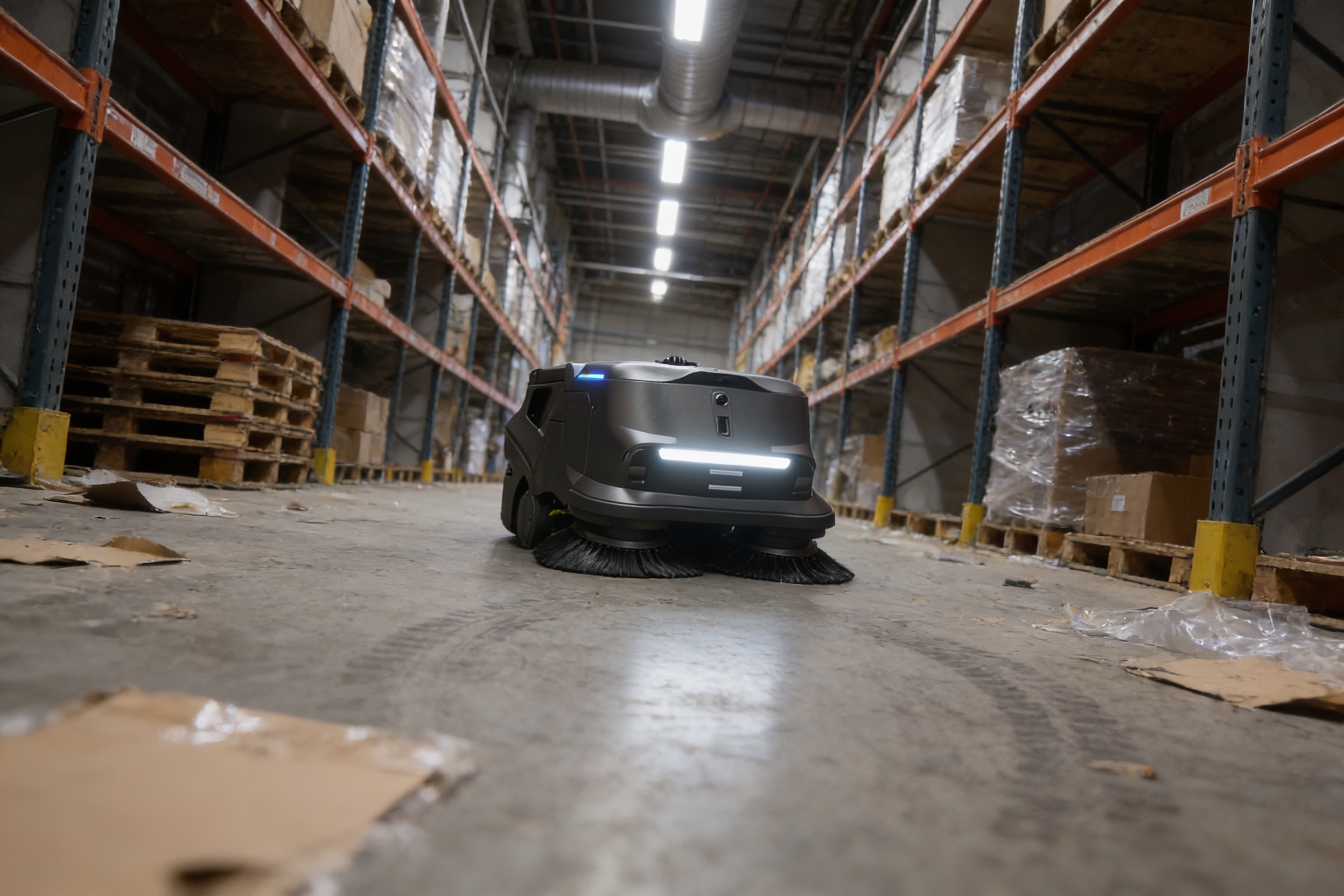
A robot tends to make sense when the floor is large, open, mostly level, and cleaned on a fixed route, especially overnight when the building is empty. Warehouses, big-box stores, airport terminals, school buildings after hours and wide gym floors fit that pattern. The payoff comes from repeated passes that run without a shift to schedule.
It makes less sense when the building is a cluster of small rooms, when furniture or stock moves every week, or when most of the work is restroom cleaning and spill response. A short shift on a small footprint often favors a person with a good cart and schedule. A site assessment will show which group your building falls into.
What does a janitor actually do in a shift?
A janitor's shift is a mix of repeating floor work and reactive work. The repeating part is sweeping, mopping, scrubbing and vacuuming along set routes. The reactive part is restroom restocking, trash runs, spill response, and requests from managers or tenants that arrive in the middle of the shift.
Much of the physical load sits in the carts and the floor passes. Pushing a bucket, lifting full bags and bending to reach corners are the tasks where the injury data concentrates. That is why the job matters to a facility manager beyond the cleaning itself.
For a Jacksonville site, the government wage data on this page gives the local wage for this job. Use it as a baseline, then compare it against the hours your floors actually need, the coverage gaps on nights and weekends, and the cost of sick days and turnover on your own roster.
Median hourly wage, Janitors and Building Cleaners
$3,667
Monthly cost of one full-time worker in Jacksonville, FL, at the median wage plus payroll costs (an estimate, not a quote).
Which parts of the cleaning work can a cleaning robot take?
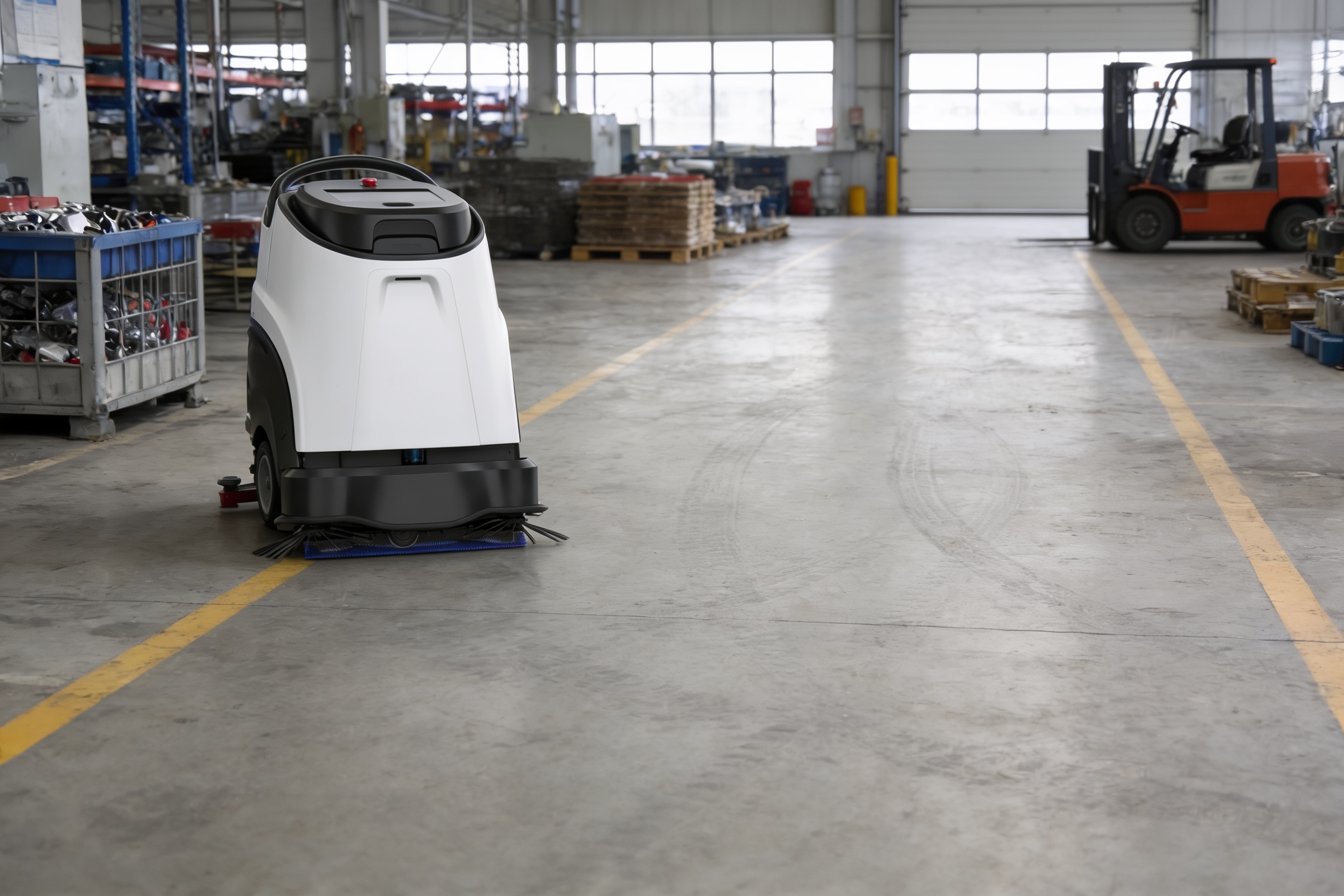
A floor scrubbing robot takes the flat, repeating work. It scrubs or sweeps large open areas along a mapped route, returns to its charging station, and runs the same path on every cycle. Once the route is mapped, consistency is the main thing a person cannot match night after night.
Robots work best on a predictable layout: hard floors, clear aisles, known obstacles, and doors that stay in place. The site assessment records floor type, thresholds, obstacles, door positions, and whether the route crosses a ramp, a carpet edge or a wet zone that needs manual handling.
What it takes over is mostly the open-floor scrubbing and sweeping. Restroom cleaning, detailed corner work, stairs and moving furniture stay with staff. The line between the two is drawn from your floor plan, not from a generic list of tasks.
- Open-floor coverage
Cleaning Robot
Repeats the same mapped route on the open floor
Janitor
Covers the open floor, but quality slips when the load is heavy
- Night coverage
Cleaning Robot
Runs when the building is empty, with no shift to schedule
Janitor
Needs a night shift, a supervisor and overtime planning
- Consistency
Cleaning Robot
Same path and passes on every cycle once mapped
Janitor
Varies with fatigue, staffing and the day's workload
- Restrooms and spills
Cleaning Robot
Not suited, so a person still handles them
Janitor
Handles restrooms, spills and odd requests on the spot
- Changing layouts
Cleaning Robot
Needs remapping when furniture or stock moves
Janitor
Adjusts on the spot when an aisle closes
- Judgment and first response
Cleaning Robot
Reports obstacles and stops, but cannot decide what to do next
Janitor
Decides what to do next, including calling for help
What does the labor picture look like for janitors?
The occupation is large and hiring is continuous. The Bureau of Labor Statistics counts 2,447,700 janitors and building cleaners jobs in 2024, according to its Occupational Outlook Handbook, and the typical entry route is short-term on-the-job training with no related work experience required.
Openings are steady, though growth is modest. An older edition of the same handbook, using 2023 to 2033 projections, estimated about 350,300 openings per year on average, and those openings include replacements for workers who leave. The handbook projects 2 percent growth for 2024 to 2034, slower than the average for all occupations, so most hiring is replacement hiring.
Injury exposure is the bigger operational issue. Bureau data for janitors and cleaners, except maids and housekeeping cleaners, showed 21,100 nonfatal cases involving days away from work in 2020, an incidence rate of 191.6 per 10,000 full-time equivalent workers. The 2019 rate was 157.4, which the Bureau reported as nearly twice the rate for all occupations, 86.9. There were 42 fatal work injuries in 2020, compared with 45 in 2019.
A California count for local government alone recorded 4,160 nonfatal days-away-from-work cases for this occupation group in 2023 to 2024. That covers one state's public sector, so it signals scale rather than a Jacksonville figure. Turnover, overtime, night-shift share and sick-day rates for this occupation were not verified for this page, so check your own vacancy and absence records before you decide.
| Task | Today | With a robot |
|---|---|---|
| Scrub the open main floor | The largest block of floor time, set by your route | A setup and map check at shift start |
| Sweep and vacuum open areas | Repeated passes on the staff schedule | The same route, run without a staff member pushing equipment |
| Restroom cleaning | Staff time, unchanged | Still done by staff |
| Spill response and restocking | Reactive, scattered through the shift | Still done by staff |
| Run check and log review | Not needed today | A brief check at the start and end of the shift |
No hour-per-shift figures for janitorial floor work were verified for this page. Time your own routes during the site assessment and use those numbers in the decision.
How does Jacksonville's growth affect janitor staffing?
Jacksonville is a large and growing metro. According to USAFacts, it had about 1.76 million residents in 2024, which ranks 38th among US metros, and it grew 30.5 percent from 1.35 million in 2010. A metro that size has a large and growing building base that needs floor care.
A Jacksonville local news report, citing the US Census Bureau's May 2025 release, says the city was among the 15 US cities with the most population growth in 2024. Growth brings new buildings and expanded floor areas, and those often open with the same or thinner staffing than the older buildings they replace.
The practical step is to measure the floor area each shift must cover, not only the headcount you have today. A building that gains floor area without a matching roster change is where a robot route helps most.
How fast are cleaning robots being adopted?
Adoption is moving, but most of the figures come from vendors. According to a September 2026 press release from a cleaning industry vendor, planned adoption of robotic floor equipment roughly doubled from 2025 to 2026, and about 32 percent of building service contractors plan to adopt it within 12 months. The release is promotional, so read it as direction rather than measurement.
The same release says 44.6 percent of respondents expect labor challenges to increase. It also notes that the surveys it draws on used other samples and questions, which limits how far the numbers can be compared across years.
An earlier survey from a cleaning industry trade association, published in 2019, found autonomous cleaning equipment adoption at an early stage. The gap between that picture and planned adoption now explains why site trials and local references matter more than headline numbers.
How does a team work with a cleaning robot?
The working setup is a robot plus fewer staff. The robot takes the open-floor route, and people take everything else. Staff move from pushing equipment to clearing the route before a run, supervising the machine, and handling restroom and spill work.
Do not plan for zero staff. A building with nobody on site has no first responder for a spill, a blocked door or a machine that stops mid-route. Keep at least one person on the schedule every shift, including robot-heavy nights, and name who responds to alerts.
Plan the staffing change in the roster before go-live. Confirm headcount per shift, agree on who clears obstacles and who reviews the run log, and set a rule for when a manual crew comes in. Staff who know the limits are quicker to spot a problem.
What can a cleaning robot not do?
A cleaning robot cannot handle restrooms, reach corners the route cannot map, lift and move furniture, or respond to a spill it did not detect. Those limits are real, and they are the reason the robot plus staff setup exists.
Layout drives reliability. Stairs, raised thresholds, wet floors and low obstacles can stop a route. A layout that changes often, such as event floors or stock that moves every day, needs remapping, and that work falls on staff.
Expect a person to restart the machine after an obstacle, clear a route when a door is blocked, and call for service when a part wears. Service coverage, response time and backup arrangements belong in the decision, not in an afterthought.
How do you get started with a robot lease in Jacksonville?
Start with a free site assessment. We map the floor, record layout and obstacles, measure the route and the hours the open floor is cleaned, and then either recommend a robot setup or tell you a robot is not the right fit. The lease quote comes after the assessment, not before it.
We are a US commercial robot integrator. We pick the robot for your site, lease it through financing, deploy and integrate it, train your staff, and service it nationwide. The fixed lease payment is set in the quote after the site assessment.
Ask for the same terms in writing from any provider: the go-live period, the staff training plan, the service response terms for your location, and what happens when a unit is down. Keep the janitor team on the roster through the first weeks, and compare the run log against your own floor checks before you expand the setup.
- Free site assessment: floor map, obstacles, route and open-floor hours
- Lease quote after the assessment, with service terms
- Deployment and integration, with staff training
- Go-live period with a staff walkthrough
- Review of run logs against your own floor checks
Frequently asked questions
Put a robot to work in Jacksonville.
We walk your site, learn the job, and recommend the unit that fits. Then we quote the lease, deploy it, and keep it serviced.
Sources
- US Bureau of Labor Statistics, Occupational Employment and Wage Statistics (OEWS May 2024)
- Bureau of Labor Statistics, Occupational Outlook Handbook: Janitors and Building Cleaners
- Bureau of Labor Statistics, injuries and illnesses snapshot: janitors and cleaners, except maids and housekeeping cleaners, 2016 to 2020
- California Department of Industrial Relations, days away from work by occupation, local government 2023 to 2024
- USAFacts, Jacksonville metro population
- News4JAX, Jacksonville among 15 cities with most population growth in 2024 (US Census Bureau, May 2025)
- Cleaning industry vendor press release on robotic floor equipment adoption, September 2026
- Cleaning industry trade association, autonomous cleaning survey report (2019)