

The short answer
A cleaning robot makes sense in Kansas City when a building has large, mostly open floors cleaned on a repeat schedule, such as warehouse aisles, big-box sales floors and large hall floors after events. It does not replace a janitor in restrooms, trash rooms and cluttered back-of-house space, so the realistic result is one leased robot working alongside fewer hours of manual floor work, never zero staff. Test that split with a site assessment before you decide.
Key takeaways
- A floor robot fits large, open and repeatable passes, not restrooms or cluttered back rooms.
- The local wage for this job is in the government data panel on this page, so the decision rests on hours and coverage.
- Hard-to-fill shifts are a reason to test a robot, since a robot does not call out sick.
- Plan for one robot plus staff, never zero staff, and measure your own floor before you lease.
- Start with a site assessment, because the fixed robot lease payment comes in a quote after it.
Cleaning robot vs janitor in Kansas City: when does a robot make sense?
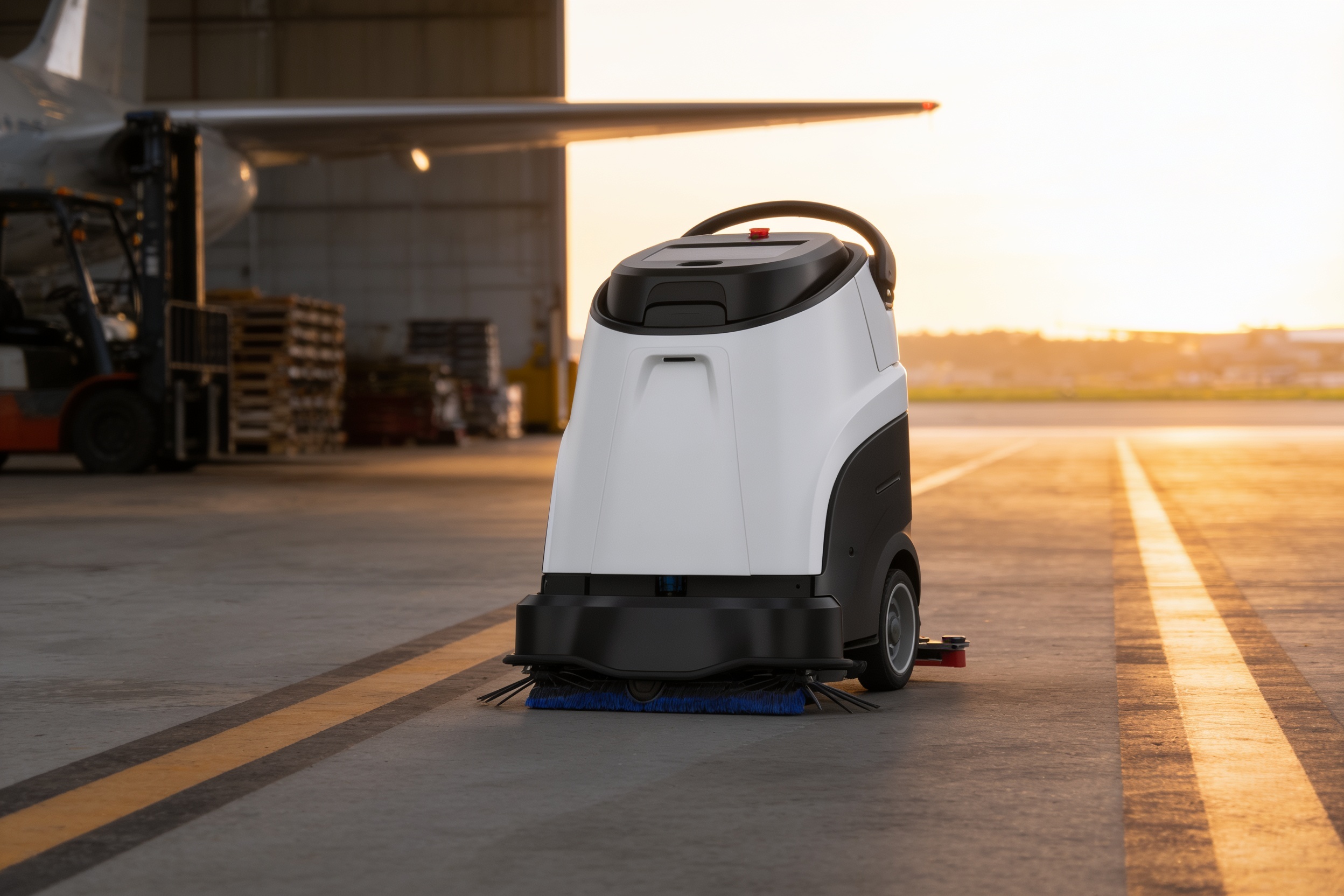
For most Kansas City buildings the honest answer is a split, not a swap. A floor robot is a good fit where much of the work is the same floor pass repeated on a set schedule: warehouse aisles, distribution floors, big-box retail sales floors and large open halls that need scrubbing after an event. In those spaces the robot does the repeat work and a person checks the result.
It is a poor fit where the job is mostly variety. Restrooms, trash rooms, spills, sinks, stairs and rooms full of furniture need hands and judgment, and a robot cannot do them. A building that is mostly offices and restrooms will see little benefit from a floor machine alone.
Kansas City's job market shows the same split. Local postings for janitors and building cleaners include evening and downtown shifts and an airport cleaner role, which points to night work as the place where a robot can cover the floor while people handle the rest of the building. The local wage for this job appears in the government wage data panel on this page, so the decision should rest on hours and coverage, not the rate alone.
What does a janitor actually do in one shift?
A janitor's shift is a list of unrelated tasks, not one job. Typical work includes cleaning restrooms, emptying trash and recycling, restocking paper and soap, wiping touchpoints, sweeping and mopping, responding to spills and broken glass, and checking locked doors. Much of it is interrupted, so the order changes through the night.
The entry bar is low. According to the Bureau of Labor Statistics, janitors and building cleaners need no formal credential, and short-term on-the-job training is the usual route in. A robot does not change that skill mix. It changes how many floor passes a person has to make.
The useful way to plan is to split a shift into floor work and everything else. Floor work is the repetitive part a robot can take. Everything else stays with a person, and it is often the part that decides whether the building looks clean to the people who use it.
Median hourly wage, Janitors and Building Cleaners
$3,966
Monthly cost of one full-time worker in Kansas City, MO, at the median wage plus payroll costs (an estimate, not a quote).
| Task | Today | With a robot |
|---|---|---|
| Scrub open corridors and aisles | a person on a set route, a full pass | a mapped pass run by the robot, checked by staff |
| Clean restrooms | a person, every shift | still a person, the robot does not help here |
| Empty trash and recycling | a person on a route | still a person |
| Spot-clean spills and broken glass | a person, when reported | a person, flagged by staff before the robot runs |
| Restock paper, soap and supplies | a person, usually mid-shift | still a person, planned outside the robot run |
| Check locked doors and the closing walk | a person at close | still a person, the robot does not check doors |
No hour figures per task appear here because we did not verify hours per task for this job. Time each task on your own floor with a timed walk before relying on any number, and use the same method to time the robot run.
Which parts of the job can a robot take, and which can't it?
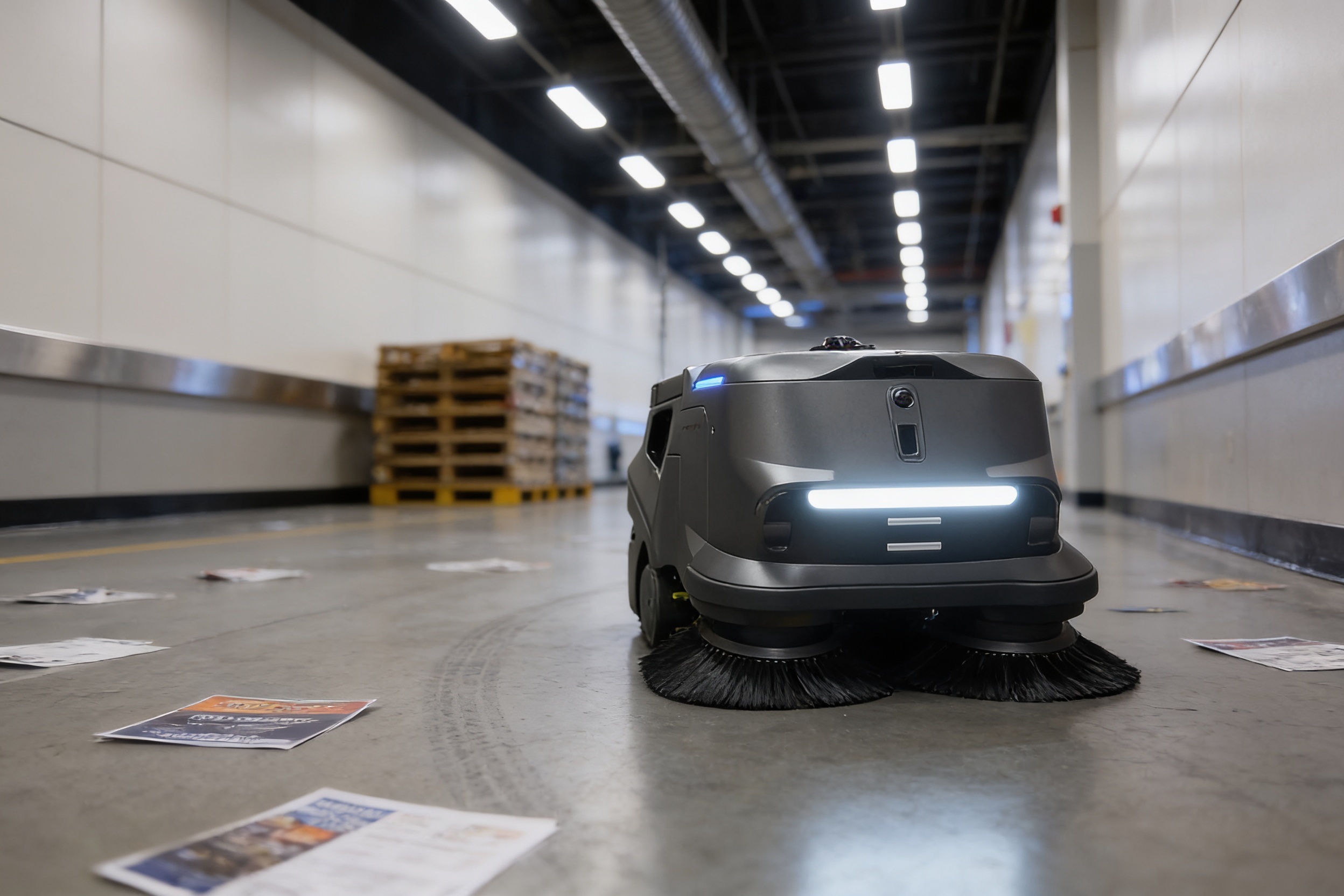
A floor robot can take repeat scrubbing or sweeping on open, mapped floors, especially aisles and corridors that look the same every night. It needs a clear path, a known layout and a route it can run without a person steering it. Those conditions are why warehouses and large open halls are the strongest candidates.
It cannot clean a restroom, empty a trash can, wipe a handrail or reach a corner it was never mapped to reach. It cannot decide that a spill is dangerous, that a sign is wrong or that a door should be locked. Much of the real janitorial labor sits in these tasks, and a robot does not remove them.
The table below sets the two side by side. The person wins on flexibility, judgment and anything that happens off the route, and the robot wins on repeatable coverage of open floor.
- Repeat floor passes on open aisles
Cleaning Robot
Runs the same mapped route every time
Janitor
Adjusts to clutter, but tires and varies from shift to shift
- Restrooms and sinks
Cleaning Robot
Cannot do it
Janitor
Cleans with hands, supplies and checks
- Trash and recycling
Cleaning Robot
Cannot do it
Janitor
Empties bins and handles bags
- Judgment on spills and hazards
Cleaning Robot
Can stop and alert, cannot assess
Janitor
Can assess, warn people and act
- Night coverage
Cleaning Robot
Runs without a person steering, given a clear route
Janitor
Needs a scheduled shift, breaks and supervision
- Absences and staffing gaps
Cleaning Robot
No sick days, but a fault needs a service dispatch
Janitor
Can call out, leave or need training, which the robot does not
What is the labor picture for janitors in Kansas City and the US?
Nationally, the BLS Occupational Outlook Handbook reports that janitors and building cleaners held 2,447,700 jobs in 2024, with a projected change of 47,800 jobs over 2024 to 2034. That is 2 percent growth, which the BLS labels slower than average. A job that grows slowly will not solve staffing gaps by itself.
For Kansas, the wage aggregator WageDex, citing BLS data, reports about 15,820 janitors and cleaners, excluding maids and housekeeping cleaners, in May 2024. That is a state count, not a Kansas City count. We did not verify a metro employment figure for Kansas City, so treat the state number as context only.
Turnover and overtime are where the real cost hides. A trade publication, Facility Cleaning Decisions, ran a reader survey that reported an industry average of 73 percent turnover. That is a survey result, not an audited rate, and it is not specific to Kansas City. We did not verify national figures for overtime, sick days or night-shift absence for this job, so pull those from your own time records before you decide.
Adoption is still early. An ISSA and AACEM autonomous cleaning survey from 2019 found that about one-third of non-adopters said they were somewhat likely to adopt within a year. The full report is limited to ISSA paid members, and the survey is several years old.

How risky is janitorial work, and what do injury rates show?
The injury record for this job is worse than many office roles. A BLS injury snapshot for janitors and cleaners, using 2019 data, reports 157.4 days-away cases per 10,000 full-time equivalent workers, nearly twice the 86.9 rate for all occupations. A later BLS snapshot reports 21,100 nonfatal days-away cases for the occupation in 2020, a rate of 191.6 per 10,000 full-time equivalent workers.
A page that quotes BLS data for the janitorial services industry puts the 2024 total recordable rate at 2.5 cases per 100 full-time workers. That page is a secondary source, and we could not confirm the figure on bls.gov, so use it as a rough check rather than a benchmark. We did not retrieve an official 2024 occupation-level injury rate.
A Washington State survey by the state's Labor and Industries department, covering 660 janitors and reported by Safety and Health magazine, pointed to rushed work and inadequate equipment as common problems. Those are workload problems. A robot may ease some of the repeat floor passes where a rushed shift usually starts, but it does not remove chemical handling, lifting or slip hazards from restroom and trash work.
How much floor can a robot cover, and how do you measure it?
We do not have a verified square footage figure per shift to quote here. Washington State's janitorial workload study, now the CORE study, was still in a field validation planning stage in its 2024 annual report, and its workload calculator was still being developed. Treat any per-shift square footage number you see as an estimate until a study confirms it.
So measure your own floor. Walk the route a janitor takes on a typical night and time it. Note the open square feet, the corners and obstacles, and how many passes the team makes. Then compare that with the route a robot runs on the same mapped space during a site assessment. The gap between those two results is the decision.
How does a team work with a robot, and does it ever replace everyone?
The right setup is one robot plus staff. The robot takes the repeat floor passes on a set schedule, and people handle restrooms, trash, spills and the parts of the building that change every day. Zero staff is not a realistic plan. Plans without people usually leave restrooms undone and spills unreported.
Our company leases the robot through financing, selects the unit for your floor, deploys and integrates it, trains your staff and services it across the US. Training matters because the person who checks the robot each night is the one who notices a blocked route, a spill the sensors missed or a door left open.
The sample night below shows how the handoff works. It is an example schedule, not measured hours.
What can a cleaning robot not do in a Kansas City building?

A floor robot cannot clean a restroom, handle trash or manage a space that changes faster than its map. It is not built for stairs, and it will stop at a cord or pallet left in its route. Any site with frequent stacking, pallets or event setup needs staff to clear the route first.
It also cannot make the judgment calls a janitor makes all day: whether a spill needs a warning sign, whether a sink is leaking, whether a door is secured. A robot reduces the number of floor passes a person makes. It does not remove the need for someone who notices what is wrong.
If a building's labor is mostly one kind of task, such as restrooms in a mostly office building, the robot's share of the work is small. Be honest about that before you lease.
How do I get started with a leased cleaning robot in Kansas City?
Start with the floor, not the robot. Map the open areas, note the obstacles and cords, and time the night route as described above. Then request a site assessment. Our team maps the space, recommends the unit that fits the floor and provides a lease quote for the fixed robot lease payment after that assessment. The payment comes in that quote, not before.
A reasonable first step is one leased unit on a single zone, with staff trained on the nightly check and a clear rule for what the robot does not touch. Measure hours and missed passes for several weeks, then decide whether to widen the route. We service the unit nationwide, so a fault during a night shift has a path to a fix.

Frequently asked questions
Put a robot to work in Kansas City.
We walk your site, learn the job, and recommend the unit that fits. Then we quote the lease, deploy it, and keep it serviced.
Sources
- US Bureau of Labor Statistics, Occupational Employment and Wage Statistics (OEWS May 2024)
- BLS Occupational Outlook Handbook: Janitors and Building Cleaners
- WageDex: Janitors and Cleaners (except Maids and Housekeeping Cleaners), Kansas
- BLS Injury and Illness Snapshot: Janitors, 2015 to 2019
- BLS Occupation Snapshot: Janitors and Cleaners, 2016 to 2020
- Safety Record: Janitorial services injury data quoting BLS (secondary)
- ISSA and AACEM Autonomous Cleaning Survey Report, 2019
- Safety and Health Magazine: Janitors in Washington State have an elevated risk of injury
- Career.com: Evening janitor job posting, downtown Kansas City