
The short answer
Comparing a cleaning robot vs janitor in Madison comes down to one factor: whether floor scrubbing is a large, repeatable block of the shift, and if so, a robot makes sense as a partner to the janitorial team, taking overnight scrubbing on large open floors while staff handle restrooms, spills, entrances and detail work. It does not make sense where floors are cluttered, heavily carpeted, full of stairs or changing every night, or where most of the work is non-floor tasks a robot cannot touch. The lease quote follows a free site assessment, so the decision can rest on your own floor plan and hours.
Key takeaways
- A cleaning robot works best as a partner to staff on large, open, mostly clear floors, not as a full replacement.
- The robot takes repeat floor passes on a fixed schedule, while restrooms, spills and judgment calls stay with people.
- The local wage for this job sits in the panel beside this page, so the decision turns on hours and coverage.
- Turnover and overtime data for Madison janitors were not found, so check your own payroll before deciding.
- A lease quote follows a free site assessment that measures your floor, your hours and your gaps.
Cleaning robot vs janitor in Madison: which makes sense?
A cleaning robot makes sense in Madison when floor scrubbing is a large, predictable part of the work and the floor is open enough for a machine to run its route without help. It makes less sense when the building is full of small rooms, stairs, carpet, furniture that moves, or tasks that need a person's eyes and hands. In most buildings the answer is a mix: a robot on the big open floors and the same janitorial team on everything else.
This page is written for the person who signs off on the decision. It uses the government and trade data we could find, names the source for each figure, and says plainly where Madison-specific numbers were not found. We are a robot integrator, not a janitorial contractor, so the goal is a decision you can test against your own floor plan and your own shift records.
When does a cleaning robot make sense, and when does it not?
The clearest case is a large floor with wide aisles or corridors, mostly clear of obstacles when the machine runs, and a fixed cleaning window such as overnight. Warehouses, big-box stores, distribution centers, school corridors after hours, convention halls and airport concourses are typical examples. In those spaces a machine can repeat the same route for hours without a person standing beside it.
The case against is just as concrete. Floors with frequent furniture moves, heavy carpet, thresholds or steep changes in level cut the robot's coverage, and so does foot traffic at the hour you want to clean. Madison's winters add a factor of their own: snow, slush and road salt arrive at entrances, and that entrance work stays with people.
Client expectations are moving too. According to BSCAI, a trade association for the cleaning industry, the share of clients expecting automation in contracts rose from 25 percent in 2025 to 38 percent in 2026. A 2019 survey by AACEM and ISSA found that 27 percent of building service contractors used autonomous equipment, while 68 percent did not use it and were not considering it. The trend is clear, but it signals where the market is heading, not whether a robot will pay off in any one building.
Median hourly wage, Janitors and Building Cleaners
$4,146
Monthly cost of one full-time worker in Madison, WI, at the median wage plus payroll costs (an estimate, not a quote).
What does a janitor actually do in a shift in Madison?
A janitor's shift is rarely just floor care. It usually includes emptying waste and recycling, restocking paper and soap, cleaning restrooms, wiping high-touch surfaces, responding to spills, and checking entrances and mats when weather brings water and salt inside. Floor work such as sweeping, mopping and scrubbing is one block of that shift, and in a large building it is often the longest block.
The mix changes with the building. A school, an office tower and a warehouse each run a different shift, and a healthcare facility adds disinfection protocols that a machine cannot follow on its own. The first step on any site is a time study of the actual shift, not an estimate built from the job title.
According to ISSA, floor cleaning time can be estimated from published production rates, where time equals the area divided by the rate for that task. That arithmetic lets you test the claim on your own floor. A large open corridor with a known area and a published rate gives a time you can check against what the crew actually logs.
- Overnight open-floor scrubbing
Cleaning Robot
Runs a taught route on schedule with no operator on site
Janitor
Covers the same floor, but needs breaks and setup time
- Restrooms and spills
Cleaning Robot
Does not handle them
Janitor
Handles them directly with the right products
- Blocked route or fallen object
Cleaning Robot
Stops and waits for a person to clear it
Janitor
Steps around it, moves it and keeps going
- Entrances in snow and road salt
Cleaning Robot
Limited, since wet and salty entry areas need staff
Janitor
Mats, wet spots and salt tracking handled on the spot
- Night coverage when someone is out
Cleaning Robot
Route keeps running on schedule
Janitor
Needs a replacement or overtime to cover the gap
- Judgment about a hazard
Cleaning Robot
Has no judgment about hazards
Janitor
Assesses the hazard and escalates it
Which parts of the floor work can a robot take?
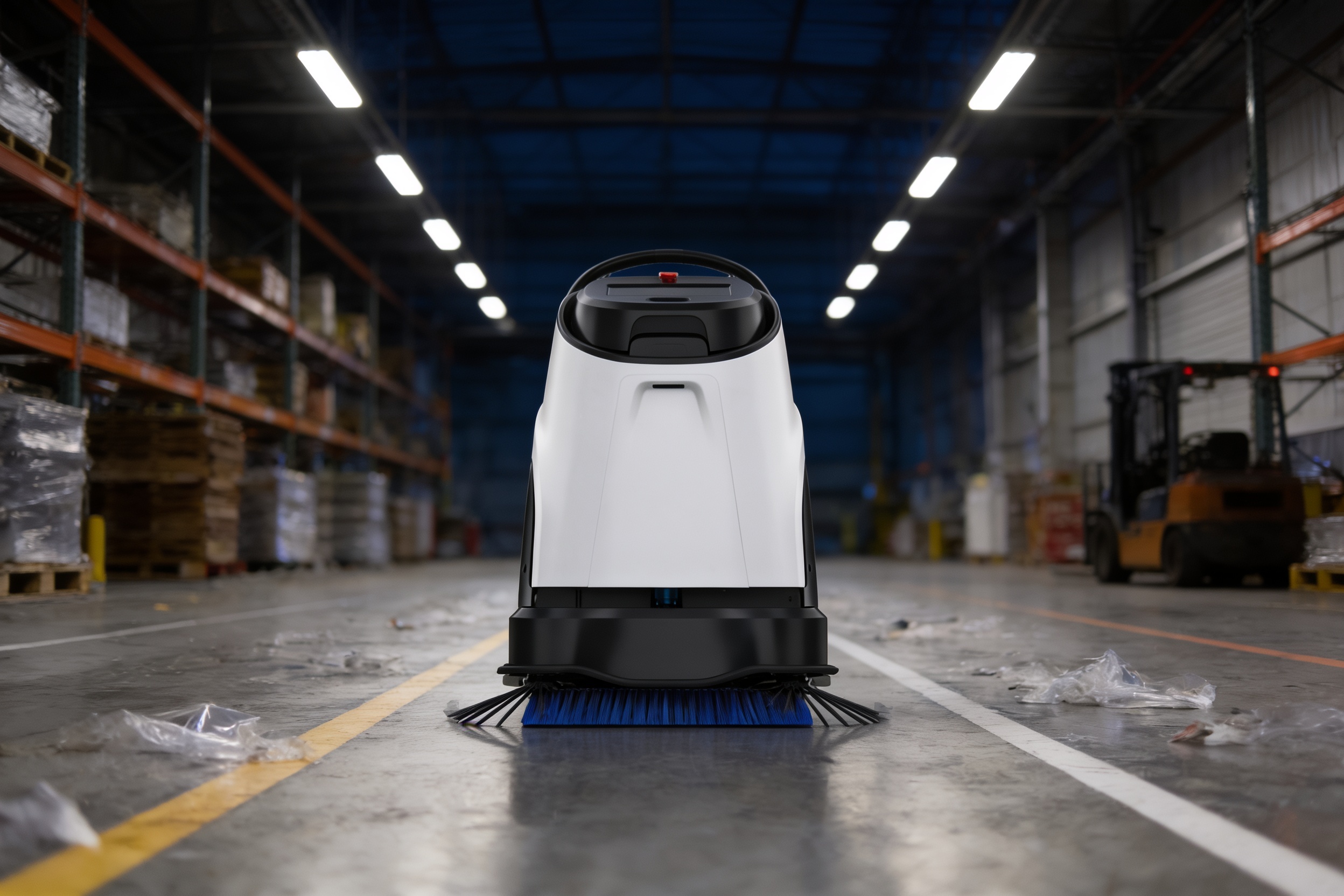
A floor scrubbing robot takes the repeatable floor passes. It sweeps or scrubs a mapped route, returns to a charging station, and repeats the route on a fixed schedule. On large floors that repetition is where most crew hours go, which is why the open-floor passes are the first place to look.
A robot takes the open-floor work only where the route is clear and the schedule is fixed. Outside those conditions the crew is back on the floor, so the site assessment checks the route, the area and the cleaning window before any claim about hours is made. The work a robot can take usually looks like this:
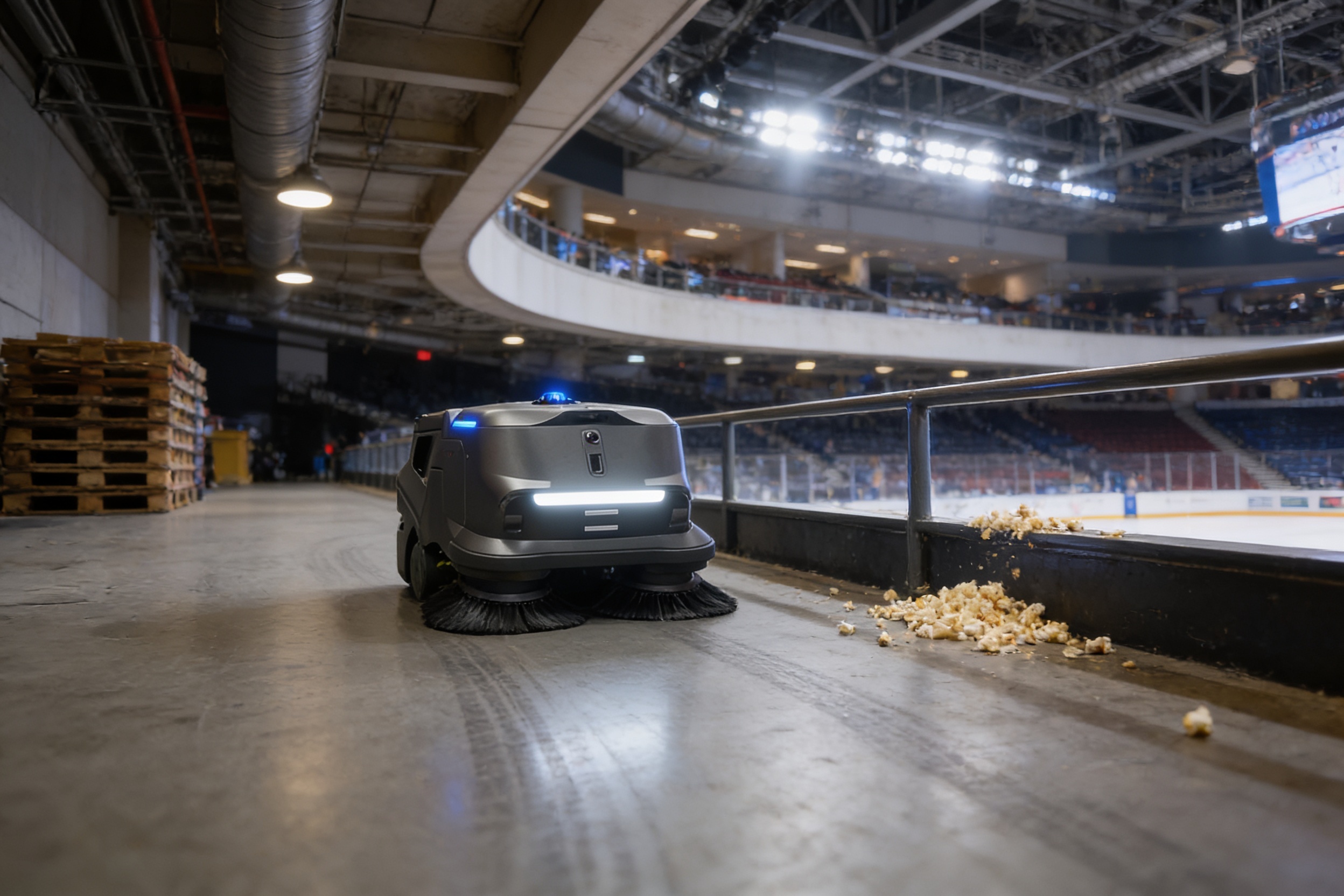
The six zones below show where that work usually sits. Each is a common space type where the robot is a good fit or a clear misfit, depending on clutter and the cleaning window.
- Sweeping or scrubbing large open corridors, aisles and lobby floors on a mapped route
- Repeat passes on high-traffic floors during a set overnight window
- Running the same route with no operator on site once the route is taught
- Covering floor areas that are clear of furniture, stock and cords at run time
Which cleaning tasks still need a person?

Anything that needs judgment, hands or a specific sanitizing protocol still needs a person. Restrooms, unknown spills, trash and recycling, dusting, glass, stairs, upholstery and the corners a route cannot reach make up much of a typical janitorial shift. A machine does not know that a spill is hazardous or that a stain needs another product.
Staff also handle the moments that stop a robot. A blocked route, a fallen box, a pallet left in an aisle or a door that will not open all need someone to clear the path, reset the unit and check the result. That is why every robot deployment keeps staff on the shift.
What do the hours and labor data say about janitor staffing?
Government data gives the broad picture. According to the BLS Occupational Outlook Handbook, about 2.4 million people held janitor and building cleaner jobs in 2024, and employment is projected to grow 2 percent from 2024 to 2034, slower than average. The same source projects about 351,300 openings a year, mostly to replace workers who leave, so the job stays open to hire.
For Madison, the BLS Midwest regional release on the Madison area covers Columbia, Dane, Green and Iowa counties and carries the May 2024 local data. The local wage for this job is in the panel beside this text. What the research did not find is a Madison count of establishments that employ janitors, staffing levels per building, or occupation-level overtime, night-shift share and sick-day figures. No occupation-level turnover rate was found in the government sources either, so trade blog turnover ranges should be treated as unverified.
Injury data points the same way. According to the BLS injury and illness snapshot for janitors and cleaners, private industry recorded 18,680 days-away-from-work cases in 2019, an incidence rate of 157.4 per 10,000 full-time equivalent workers. Those are national figures, and they do not show a Madison trend. They do show that a cleaning shift carries real physical load.
How does the team work with a robot on site?
The working model is a robot plus fewer staff hours on the same floors, never zero staff. The machine takes the open-floor passes overnight, the crew arrives to a floor already covered, and then works restrooms, entrances, spills and detail. The job shifts from pushing a machine to checking it, clearing blockages and handling exceptions, which is another skill and needs training.
One practical benefit shows up when someone is out. The route can still run on schedule, so the remaining staff are not left with the whole floor. That helps coverage, but it does not change the need for a person on every shift.
What can a cleaning robot not do?
A cleaning robot cannot do judgment work. It does not handle restrooms, clean glass or upholstery, empty bins, apply a sanitizing protocol or decide that a spill is hazardous. It cannot climb stairs or cross a steep change in floor level, and it cannot clean areas that are not mapped or stay cluttered.
Conditions matter too. Heavy carpet, wet or icy floors and busy foot traffic at run time all reduce what it can do. A unit that stops at 2 am still needs a person to reset it, so the plan has to include a backup approach and a clear answer on how fast a fault gets a response.
How do I get started with a cleaning robot in Madison?
Start with the floor, not the machine. Measure the open area, note clutter and carpet, record the actual cleaning window and write down the hours of floor work the crew logs now. That baseline is what the site assessment uses to decide whether a machine fits and which unit to propose.
We pick the right robot for the site, lease it through financing, deploy and integrate it, train the staff and service it nationwide. The lease quote comes after a free site assessment, so you see the fixed robot lease payment, the service terms and the training plan before any commitment. Ask that the quote state the maintenance coverage, the backup approach and who responds on site when a unit faults.
Pilot one area before you expand. A single leased unit on one floor shows the route, the exceptions and the real hours in your building. Expand only when those hours and the staff time match what the site assessment projected.
How should I read the local wage data in this decision?
The panel beside this text shows the government wage data for janitors and building cleaners in Madison, from the BLS May 2024 estimates. Read it as the local cost of the labor you already have, then compare it with the hours the floor work actually takes. The wage alone does not decide the question, because a robot does not remove the staff on the shift.
Do the math with hours, not job titles. Multiply the floor-work hours per shift by the number of shifts, then compare that with the hours the robot would take over and the staff time it still needs. The hardest part to estimate is overtime, sick days and turnover, which the local government data on this page does not give, so take those from your own payroll records.
Frequently asked questions
Put a robot to work in Madison.
We walk your site, learn the job, and recommend the unit that fits. Then we quote the lease, deploy it, and keep it serviced.
Sources
- US Bureau of Labor Statistics, Occupational Employment and Wage Statistics (OEWS May 2024)
- BLS Occupational Outlook Handbook, janitors and building cleaners
- BLS injury and illness snapshot, janitors and cleaners 2015 to 2019
- BLS Midwest region, Madison area occupational employment and wages, May 2024
- BSCAI, 5 trends defining contract cleaning in 2026
- AACEM and ISSA autonomous cleaning survey report
- ISSA production rates for cleaning tasks