

The short answer
Put simply, a cleaning robot vs janitor in Miami decision favors the robot for large, open, mostly level floors that can be scrubbed on a fixed route during empty hours. A janitor still makes sense for restrooms, spills, detail work and cluttered or irregular spaces, so the common result is a robot plus fewer staff rather than a robot in place of the team. Government data shows the work is physically demanding and heavily shaped by turnover, which makes reliable coverage the real question for most Miami sites.
Key takeaways
- A floor robot covers open floors on a fixed route, while restrooms, spills and detail work still need a person.
- The government wage data on this page sets the local labor baseline for janitors and building cleaners.
- Most sites end up with a robot plus fewer staff, never zero staff.
- Mapping, route blockers and night access decide the fit as much as floor size does.
- The lease payment is quoted after a free site assessment, so the decision starts with the floor plan.
Is a cleaning robot vs janitor in Miami the right choice for my building?
A cleaning robot makes sense when the floor is large, open and mostly level, the route repeats, and the work can run while the building is empty. Warehouses, big-box retail floors, airport concourses, gym floors and wide office corridors often fit that profile. The strongest candidates have hard flooring in wide aisles, because the robot spends its time scrubbing rather than navigating furniture.
A janitor is the better choice when the work is mostly restrooms, kitchens, trash, spill response, glass and detail corners, or rooms that change layout every day. It also makes sense for small buildings, carpeted and cluttered floors, and sites where someone must be on hand for tenants, deliveries and incidents. A robot does not replace that judgment.
Most Miami decisions land between these two cases. The useful question is not robot or person in general. It is what share of total cleaning hours sits on open floor that a machine can cover without help.
What does a janitor actually do in a shift in Miami?
A janitor's shift is rarely one task. It usually starts with a walkthrough, then moves through restroom servicing, trash and recycling removal, sweeping or mopping, spot cleaning of glass and doors, and restocking paper and soap. Office cleaners often work evenings because buildings are empty, and BLS says 24-hour facilities such as hospitals schedule cleaners across nights, weekends and holidays.
The task mix sets the fit. Floor work is one of several tasks, but in a large open building it can be the largest single block of hours. Hour-by-hour data for Miami janitor shifts was not found in our research, so any shift breakdown should come from your own cleaning log before it is used to size a robot.
Median hourly wage, Janitors and Building Cleaners
$3,437
Monthly cost of one full-time worker in Miami, FL, at the median wage plus payroll costs (an estimate, not a quote).
Which cleaning tasks can a robot take, and which can it not?
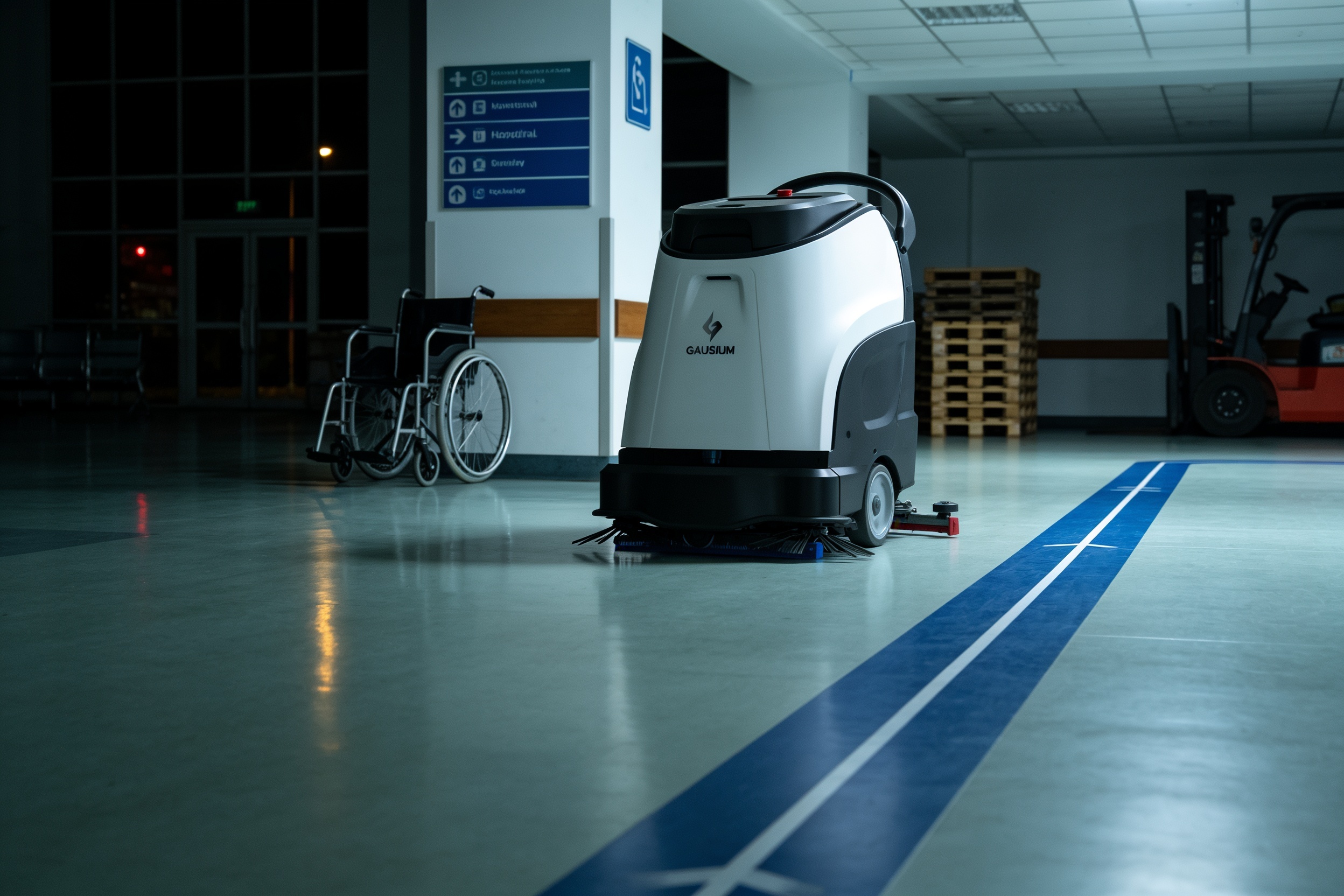
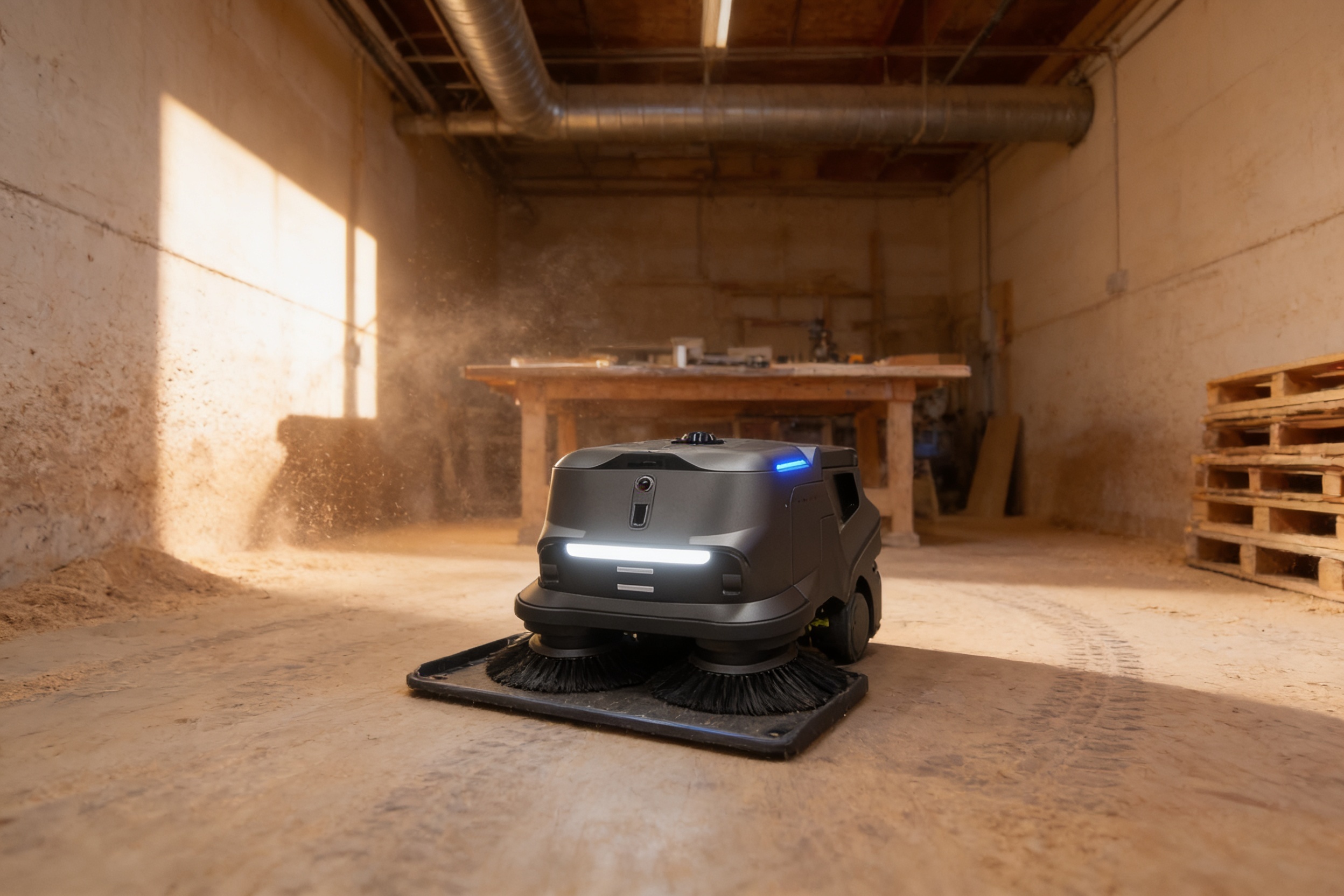
A floor scrubber or sweeper can take the repeatable floor passes: aisles, corridors, lobbies, food court floors and open retail floors along a mapped route. It can run overnight without an operator, and it can stop and alert staff when it meets an obstacle it cannot clear.
A person still handles restrooms, toilets, sinks, mirrors, trash removal, spill response, glass, stairs, detail corners, furniture moves and any decision made mid-shift. Doors, elevators and loading docks usually need staff coordination. Expect the robot to need a clear route, a prepared path and someone who checks the output.
- Open hard floor on a fixed route
Cleaning Robot
Covers repeat passes on a mapped route, including overnight
Janitor
Adjusts the route when furniture or spills block it
- Restrooms and high-touch surfaces
Cleaning Robot
Not its job
Janitor
Handles toilets, sinks, mirrors and disinfection by hand
- Spill response
Cleaning Robot
Stops and alerts staff, but does not handle an unexpected spill
Janitor
Responds, cleans and decides whether a hazard needs a supervisor
- Night coverage
Cleaning Robot
Runs in empty hours without an operator on the floor
Janitor
Needs a scheduled shift, breaks and supervision
- Consistency of passes
Cleaning Robot
Follows the same route and pass count every shift
Janitor
Varies with fatigue, staffing and the day
- Tenant contact and judgment
Cleaning Robot
Limited to alerts
Janitor
Talks to tenants, receives deliveries and handles exceptions
What do the labor numbers say about janitor staffing in Miami?
BLS reports about 2,447,700 janitors and building cleaners nationally in 2024, with projected growth of 2 percent from 2024 to 2034 and about 351,300 openings a year, mostly from workers leaving the occupation. That churn is the practical reason staffing is hard to hold steady, and it is a national figure, not a Miami one.
The government wage data on this page gives the local wage for this job in Miami. Read it alongside hours, not on its own. For many operators the bigger risk is an unfilled shift, overtime to cover it, or a skipped night. BLS notes that most janitors work full time, part time is common, and schedules vary.
A report from a service workers union and UCLA found that Miami office janitors are the lowest paid of all major US cities and that 89 percent of large office buildings outsource cleaning to low-bid contractors. Outsourcing makes crew continuity harder to plan. Labor relations matter too: according to a Miami public radio report, janitors at a large Miami university voted unanimously to authorize a strike and reached a tentative agreement in late August 2025. Overtime, sick-day and turnover rates for this occupation in Miami were not found in our research, so ask your contractor for those records directly.
How much floor can a robot actually cover per hour?

Coverage claims need careful reading. An ISSA reference cited in a cleaning equipment publication puts a mop and bucket at about 1,500 to 2,000 square feet per hour. A manufacturer datasheet, which is vendor-reported, lists about 49,400 and 52,300 square feet per hour for two scrubber models, but that is a theoretical maximum over a four-hour runtime, not a measured job.
Vendors often calculate productivity as total facility area divided by cleaning time, and some also track a separate true performance figure that counts only the area actually cleaned. The second number is the one to ask for. No independent third-party test of autonomous scrubber coverage was found in our research.
Ask any supplier for true cleaned area on a site similar to yours, measured over a full shift, and compare it with the floor area your crew covers now.
Do injury rates change the janitor versus robot decision?
BLS data shows janitors and cleaners (except maids) had 191.6 cases with days away from work per 10,000 full-time equivalent workers in 2020, up from 157.4 in 2019. The private industry count for that occupation was 21,100 cases in 2020, down from 21,230 in 2016, so the rate and the count moved in opposite directions.
Across all private industry, BLS reported a 2024 rate of 2.3 per 100 full-time workers, the lowest since 2003, as reported by a waste industry trade publication. That figure covers every industry, so it is a context number and not a janitor rate. The 2024 injury count for janitors specifically was not found in our research.
For a manager, the practical reading is that repetitive floor passes involving pushing, lifting and kneeling carry exposure, and a robot can take the most repetitive of those passes. It does not remove the need to handle the rest of the work safely.
How common is robotic floor cleaning among building service contractors?
A 2026 survey cited in a floor equipment manufacturer press release, which is vendor-reported, found about 32 percent of building service contractors plan to adopt robotic floor equipment within 12 months, roughly double the 2025 share. Among evaluators, 77 percent cited labor savings as an influence.
An earlier survey by AACEM and ISSA in 2019 found about one-third of non-adopters said they were somewhat likely to adopt within a year. The full report is members-only, so that figure comes from a summary. Adoption trends help with timing, but they do not prove that a robot will work on your floor.

How does a cleaning robot work with a team day to day?
The working model is a robot plus fewer staff. One person owns the robot, the route, the charging area and the exceptions, while the rest of the team handles restrooms, trash and spot cleaning. Zero staff is not the goal, because someone still has to respond to spills, blocked routes, alarms and tenant requests.
The schedule usually runs the robot in empty hours and keeps daytime for spot work. Staff check the route before each run, clear the path, and review the log afterward. The reduction comes from fewer floor hours, not from removing coverage.
We pick the robot for the site, lease it through financing, deploy and integrate it, train the staff and service it nationwide, so the person signing off works with one partner for the whole arrangement.
What can a cleaning robot not do?
A floor robot cannot handle restrooms, trash, toilets, mirrors or spills that need a human decision. It also struggles with cluttered rooms, loose cords, thick rugs, stairs, wet floors and areas where the layout changes daily. That is why the robot should be sized to a defined floor, not to the whole building.
Infrastructure matters too. Doors, elevators, charging space, Wi-Fi coverage and a clear route all affect uptime. A robot that stops often can use up the staff time it was meant to save, which is why a site assessment comes before any commitment.
A robot also does not supervise itself. Someone still signs off that the floor is clean and that exceptions get handled, and every stopped unit needs a clear response path during the shift.
How do I get started with a cleaning robot lease in Miami?
Start with a free site assessment. We map the floor, check route width, doors, charging space, night access and the surfaces the robot must cross, then recommend the unit that fits. The lease payment is quoted after that assessment, so there is no figure on this page to compare.
Lease financing spreads the commitment over a set term, and the quote states what is included. Maintenance can be part of the arrangement, so the operator does not have to arrange repairs alone. Ask for the on-site dispatch and remote triage process, and ask what happens during an outage, including whether a spare unit is available.
A phased start works well. Begin with one leased unit on the highest-value floor, measure the true cleaned area and the staff hours it frees over a few weeks, then decide whether to add units. That keeps the decision tied to your own data.
Frequently asked questions
Put a robot to work in Miami.
We walk your site, learn the job, and recommend the unit that fits. Then we quote the lease, deploy it, and keep it serviced.
Sources
- US Bureau of Labor Statistics, Occupational Employment and Wage Statistics (OEWS May 2024)
- BLS Occupational Outlook Handbook, Janitors and Building Cleaners
- BLS Injuries, Illnesses and Fatalities snapshot, janitors and cleaners 2016 to 2020
- Service workers union and UCLA report on Miami office janitor pay and outsourcing
- Miami public radio report on university janitors tentative agreement, August 2025
- Waste industry trade report on BLS 2024 injury and illness data
- Floor equipment press release on 2026 building service contractor survey (vendor-reported)
- AACEM and ISSA autonomous cleaning survey report, 2019