
The short answer
For most police stations, the cleaning robot vs night janitor question comes down to the open hard floor. A cleaning robot can cover public lobbies and hallways on a set schedule, which is the floor work a night janitor does in a 24-hour building, but it cannot handle restrooms, holding areas, biohazards or anything that needs judgment. The practical fit is a robot running the scheduled floor passes with a smaller night crew still on site for everything else.
See what a cleaning robot costsRun the numbers in the ROI calculator
Key takeaways
- A cleaning robot fits the scheduled floor passes in public lobbies and hallways, not the whole night shift.
- Restrooms, holding areas and biohazard work stay with trained staff.
- Police staffing data shows hiring and turnover pressure, so coverage needs a plan for gaps.
- The injury and labor figures here are national janitor data, not police-specific measurements.
- Start with one site assessment, one route and written service terms.
Does a cleaning robot vs night janitor setup make sense at a police station?
Police stations are a large and varied set of buildings. According to the Bureau of Justice Statistics, about 12,000 local police departments operated in the US as of January 1, 2013, and municipal and township departments made up 98% of them. That is the most recent local count we could confirm, so the total is likely to have shifted since then.
A robot makes sense where the floor work is open and repeatable: public lobbies, the hallway from the front door to the counter, waiting areas and open administrative corridors. It makes less sense where the building has many small rooms, heavy obstacles, or areas with rules about who may enter. In those spaces the night janitor stays the main worker, and a robot, if used at all, handles only the open passes.
The honest answer is that a robot does not replace the night janitor at a police station. It takes over a slice of the floor work on a schedule, and it works best when a smaller night crew stays on site. We never plan for zero staff. We lease robots through financing, deploy and integrate them, train staff and service them nationwide, and the lease payment is quoted after a free site assessment, so the decision starts with the floor plan.
What does a night janitor actually do in a police station shift?
The night janitor in a 24-hour building works around staffed shifts. At a police station that usually means floor work in public spaces during the quietest hours, plus restroom service, trash and recycling removal, sanitizing high-touch surfaces and restocking supplies. The order of tasks varies by building. The government wage data on this page shows what the local job pays, so this page focuses on the work itself.
Much of the job is interruption management. The janitor waits for a door to open, moves around a shift change, stops for an officer who needs a room opened, and returns to the task. Some areas can only be entered with a sworn officer present. The janitor also reports damage, spills and biohazards, which requires a judgment a robot cannot make.
Because the janitor is a person, the job absorbs small changes, such as a spill at the front counter or a request to clean a room after a meeting ends. That flexibility is the main reason a person keeps the job, even where a robot takes over the scheduled floor passes.
Median hourly wage, Janitors and Building Cleaners
$4,041
Monthly cost of one full-time worker, at the median wage plus payroll costs (an estimate, not a quote).
- Hours covered
Cleaning Robot
Runs the scheduled floor route whenever it is started and ready
Night Janitor
Covers the whole shift and can change plans on the spot
- Open hard floors
Cleaning Robot
Repeats the same mapped route with consistent coverage
Night Janitor
Works the route but tires over a long shift
- Restrooms and sanitizing
Cleaning Robot
Not suited, stays with staff
Night Janitor
Handles fully, with trained judgment
- Spills and incidents
Cleaning Robot
Stops and reports, cannot judge
Night Janitor
Judges, cleans or escalates
- Interruptions
Cleaning Robot
Pauses at a blocked path and waits for staff to clear it
Night Janitor
Steps around people and reorders tasks
- Staffing needs
Cleaning Robot
Needs a staffed check before and after each run
Night Janitor
Needs a crew that can cover call-outs and sick days
Which floor work can a cleaning robot take, and which can it not?
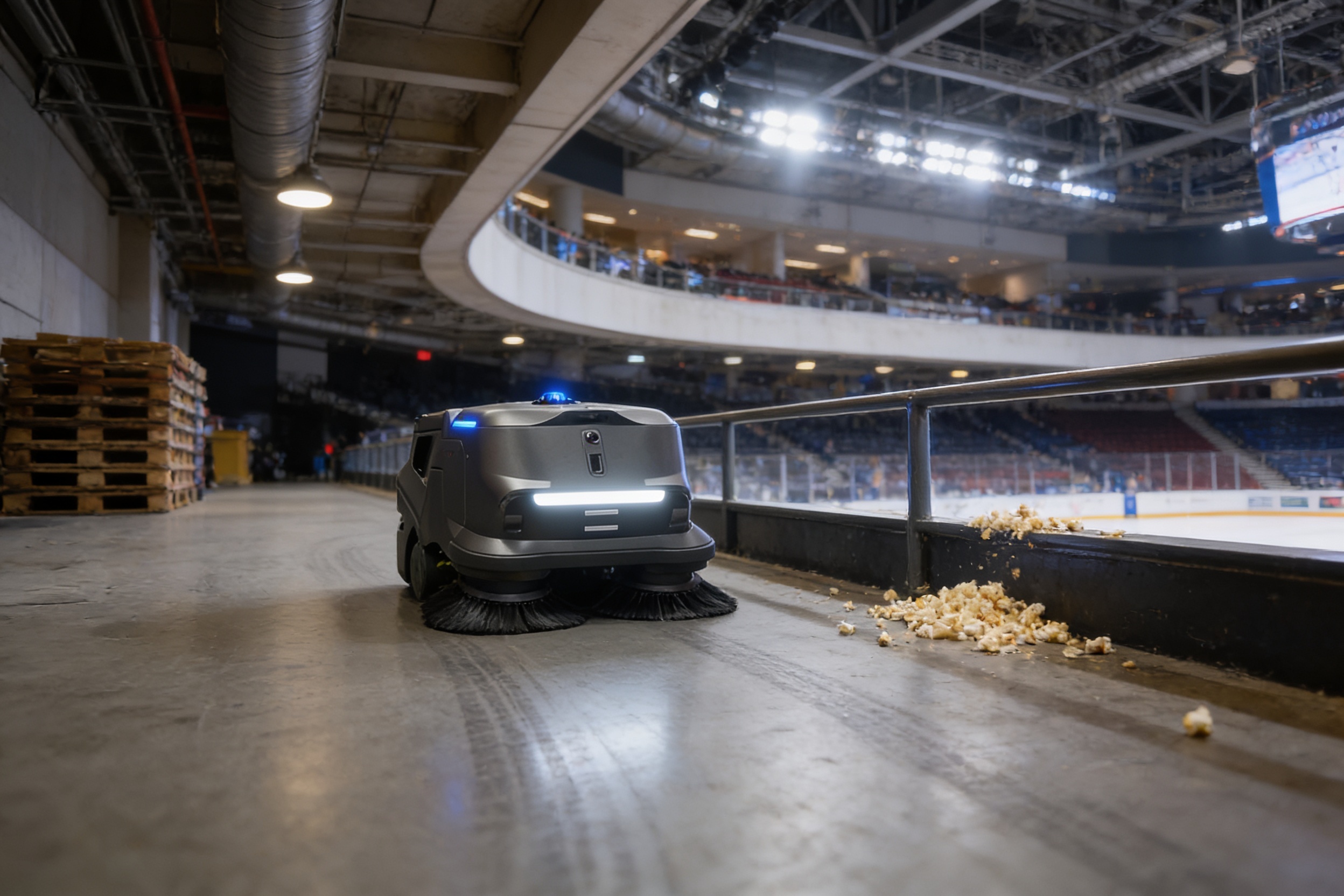
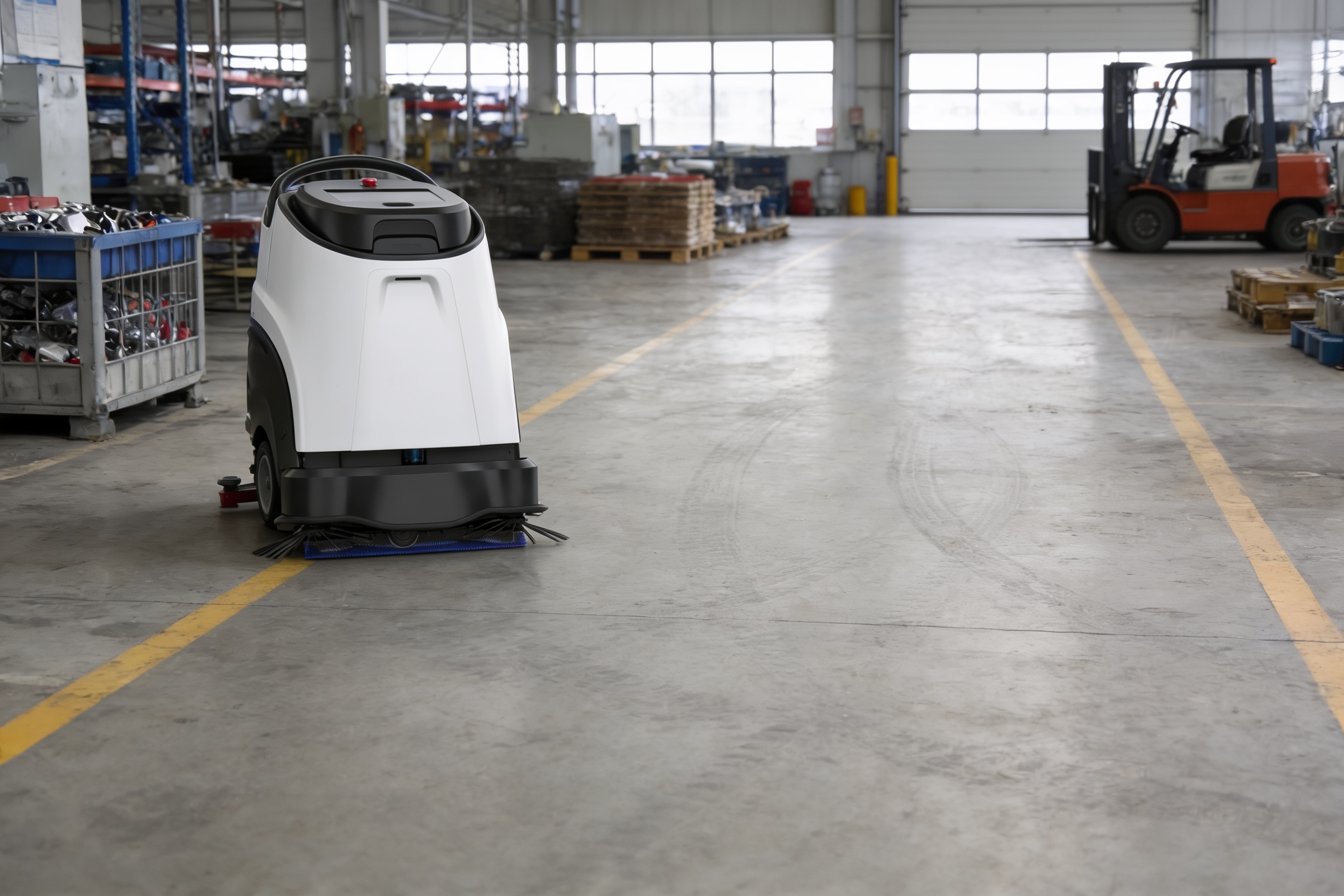
A robot suits floor work that repeats along a fixed route over clear, open surfaces. In a police station that usually means public lobbies, public hallways, waiting areas and administrative corridors with few obstacles. The zones below show the areas where the route is most likely to work, once the route is mapped and the floor is cleared before each run.
The robot cannot clean restrooms, holding or detention areas, sally ports, or any space with bodily fluids. It cannot judge a spill that needs a specialist, a hazardous material, or a damaged floor. It needs a clear route and a plan for doors, elevators and restricted zones, and the site assessment checks each of those before any route is built.
Coverage speed deserves caution. Vendor guides and manufacturer claims give coverage rates for floor scrubbers, but those are vendor-reported figures, not measured results in police buildings. No independent figure for police floor area was found, so the floor area of your building has to be measured on site before any hour count is trusted.
How many hours does the night cleaning take, and what does the labor picture look like?
Published data does not give hours per shift for police station cleaning, so this page does not offer a number. The honest method is to time the night crew's own route for a set period, separating open hard-floor work from restroom, trash and sanitizing work. Those timed figures, not a national average, decide how many hours a robot can take over.
National data shows how thin the labor pool is. The Bureau of Labor Statistics Occupational Outlook Handbook reports about 2.4 million janitors and building cleaners jobs in 2024, with projected growth of 2% for 2024 to 2034, which it describes as slower than average. It also reports about 351,300 openings per year on average, mostly from replacing workers who leave.
The Handbook gives no turnover rate for this occupation, and we did not find a verified one. Janitorial Manager, a trade publication, says janitorial turnover stayed steady after 2020 while other industries rose. A stable but hard-to-fill workforce means a night crew can be short in any given week, which is why coverage needs a plan.
The night shift is documented mainly outside the US. A UNI Global Union survey of about 2,500 night cleaners in 32 countries found nearly seven in ten reported too little sleep. That is not a US labor statistic, but it describes the same shift pattern and the fatigue that comes with it, which matters for safety on wet floors.
| Task | Today | With a robot |
|---|---|---|
| Scrub or sweep open lobby and public hallway floors | Timed on site during the night crew's route | Scheduled run, with staff setting up and checking it |
| Restroom cleaning and restocking | Timed on site, done by the crew | Stays with staff |
| Trash and recycling removal | Timed on site, done by the crew | Stays with staff |
| Spill and incident response | Timed on site, based on staff judgment | Stays with staff |
| Robot setup, route check and end-of-run review | None in the current routine | Added staff time, measured on site |
Published sources in this review do not give hour figures for police stations. Each today entry comes from timing the night crew's route over a set period, and the setup and check entry comes from timing the same way after deployment.
What do police staffing trends mean for night cleaning coverage?
Police staffing is itself under pressure, which affects the buildings they run. The Police Executive Research Forum staffing survey, released in May 2026 with 2025 data, surveyed 761 agency chiefs from 39 states, DC and 2 Canadian provinces. It reports that resignations rose 0.5 percent in 2025 over 2024, retirements rose 16.4 percent, and hiring rose 17 percent over 2024 and 40 percent over 2021.
The same survey reports that staffing fell 5.4 percent from January 1, 2020 to January 1, 2023, then stayed roughly steady through 2025. The survey is of chiefs, not a random sample of all departments, so read it as a signal about the field rather than a national count.
Separate news coverage, from KOMO News, cites a 24 percent rise in officers quitting major-city departments in the prior year. We did not check the underlying data behind that figure, so treat it as news-reported. For night cleaning, the point is that police buildings can face shifts that do not stay full, and a fixed janitor roster does not absorb those gaps easily.
How does a robot work alongside a smaller night crew?
The model we use is a robot plus fewer staff, never zero staff. The robot runs the open hard floor on a set schedule. A smaller crew handles restrooms, trash, sanitizing and incidents, and sets up and checks the robot before and after each run. The crew also covers the building when a run stalls, a sensor faults or a shift runs late.
Setup happens once. We map the route, set the zones and integrate the schedule with your existing shift plan. Staff train on starting a run, clearing the floor before it begins, responding to a stop, and logging issues. Training is part of deployment, so the night crew is not left guessing when the robot pauses at a blocked door.
Service is the other half. We service robots nationwide, and a service plan should name the response time and the backup plan in writing before any lease starts. A robot idle because of a fault is a shift of coverage lost, so ask how fast a technician is dispatched and what happens while the unit is down.
What do injury and illness rates say about night floor work?
The Bureau of Labor Statistics reports that janitors and cleaners, except maids and housekeeping cleaners, had 191.6 nonfatal injury and illness cases with days away from work per 10,000 full-time equivalent workers in private industry in 2020, a total of 21,100 cases. The BLS snapshot for janitors from 2015 to 2019 reports 157.4 per 10,000 in 2019, with 18,680 cases.
Those rates cover private industry, and police departments are government employers, so they do not describe police buildings directly. They are still the best national benchmark for the physical work involved: lifting, pushing, wet floors and repetitive motion on night shifts. Your own injury log is the number that counts for your building.
The practical use is simple. Each route the robot takes off the night crew removes a repetitive task from people. Review the injury log for the crew before the change and again after several months, so the effect is measured rather than assumed.
What can a cleaning robot not do at a police station, and what should worry you?
The robot cannot make judgment calls. It cannot tell a spill that needs a specialist from a harmless wet patch, and it cannot recognize a stain, a sharp object or a damaged floor the way a trained person does. Those decisions stay with staff, and the route should be set to keep the robot away from those areas.
It cannot secure or open a space, and it should never be given access to restricted zones. Interruptions are a real risk: an open door, a cart or a person standing in the path. The robot should stop and wait, and staff should clear the path and restart the run. Build those stops into the schedule so they do not look like failures.
The timeline is also a risk. Mapping, zone setup, staff training and the first check runs take time, and the first weeks are rarely as smooth as the final route. Plan a pilot period and do not promise full coverage on day one.
How do we get started with a cleaning robot at a police station?
Start with one site. A free site assessment maps the public floor, measures the route and the obstacles, and checks doors, elevators and the zones that need staff only. The output is a plain list of what the robot can take and what stays with the night crew, before financing is discussed.
Then the lease. We lease robots through financing, and a fixed robot lease payment is quoted after the site assessment, so the number reflects your floor, route and service level. Ask for the terms in writing: what maintenance is included, how quickly a fault is answered, and what the backup plan is. Clear terms matter more than a headline figure.
Use a pilot. Start with one leased unit on one route, measure the hours it takes over on your own log for several weeks, and decide whether to add a second route based on that record. That gives you real hours for your building instead of an estimate from someone else's floor.

Frequently asked questions
Upcoming public sector events
- Trade showAPC/PennDOT/PA Turnpike Fall SeminarNov 18 to 20, 2026Hershey Lodge, Hershey, PA
- Trade showMinnesota Buildings & Facilities Management Trade ShowNov 19, 2026Minneapolis Convention Center, Minneapolis, MN
- ConferenceCASBO CBO Symposium (Executive)Nov 19 to 20, 2026The Langham, Pasadena, CA
- ConferenceVirginia Association of Fairs ConventionJan 14 to 17, 2027Williamsburg Lodge, Autograph Collection, Williamsburg, VA
Want a cleaning robot at your police station?
Tell us about your site. We will recommend the robot, quote the lease, and keep it serviced.
Sources
- US Bureau of Labor Statistics, Occupational Employment and Wage Statistics (OEWS May 2024)
- Bureau of Justice Statistics, Local Police Departments 2013
- Police Executive Research Forum, staffing survey released May 2026
- Bureau of Labor Statistics, Occupational Outlook Handbook: Janitors and Building Cleaners
- Bureau of Labor Statistics, injury and illness snapshot for janitors and cleaners, 2016 to 2020
- Bureau of Labor Statistics, injury and illness snapshot for janitors, 2015 to 2019
- Janitorial Manager, janitorial turnover trends
- KOMO News, officers quitting major-city departments
- UNI Global Union, night cleaner survey