
The short answer
Cleaning robot ROI in Cincinnati comes from the floor cleaning hours a leased robot takes over from staff, valued at the local wage for this job, minus the lease payment and the supervision time that stays with people. Savings are a range, not a promise, and the size of that range depends mostly on how much of the floor work suits a robot. A free site assessment measures those inputs and produces a lease quote with a savings range built on your building.
Key takeaways
- The return comes from floor hours a robot takes over, not from cutting headcount alone.
- Only the share of floor work that suits a robot counts toward savings.
- Lease cost and staff supervision come off the top before any payback.
- Overnight floor care is often the work that gets postponed, and that is where the case is clearest.
- A free site assessment replaces estimates with measured hours and a lease quote.
Run the numbers for your site
Auto-detected from your location - we use the real BLS wage here. Not right? Pick your city or state above.
What do you want to automate?
The robot runs the open floor overnight; your crew keeps detail and edges.
What is cleaning robot ROI in Cincinnati?
Cleaning robot ROI in Cincinnati is the return a business gets when an autonomous floor cleaner takes over part of the floor care work that people do now. The return shows up as labor hours moving from staff to the robot, offset against the fixed robot lease payment that comes through financing. It is not one fixed number. It depends on how much floor your building has, how many hours of floor work happen each shift, and how much of that work the robot can actually handle.
The calculator on this page uses the local wage for this job from the government wage data shown in the panel beside this text. That wage is what gives the hours their value. We do not repeat the figure in the text, because the right number depends on your schedule and should be checked against the latest published table.
Cincinnati is one of the larger metros for which we hold local government wage data, so the calculator is pre-filled for this city. Pre-filled inputs are a starting point only. A site assessment replaces them with measured floor area, measured hours, and a lease quote for your building.
How big is the floor cleaning job?
The occupation is large and steady. According to the BLS Occupational Outlook Handbook, janitors and building cleaners held about 2.4 million jobs in 2024. Projected growth for 2024 to 2034 is 2%, which is slower than the average for all occupations. The same source projects about 351,300 openings a year, mostly from replacing workers who leave.
That replacement pattern is the part that matters for ROI. The handbook does not publish a turnover rate for this occupation, so we did not verify one, and staffing-site turnover claims were not used. What the openings figure does show is that filling floor care positions is a recurring job for employers, and every open shift is a set of hours someone has to cover.
Adoption is still early. In a 2025 ISSA benchmarking survey of in-house and facility managers, 43% of respondents reported plans for autonomous cleaning equipment. An earlier ISSA and AACEM survey found that 27% of respondents were already using it in 2019, but the two surveys use different populations and definitions, so they show interest and use, not a clean trend. A 2026 press release citing a building service contractor market study reported that about 32% of those contractors plan to adopt robotic floor equipment within 12 months, described as about double the 2025 share. We did not check the original study.
Median hourly wage, Janitors and Building Cleaners
$3,952
Monthly cost of one full-time worker in Cincinnati, OH, at the median wage plus payroll costs (an estimate, not a quote).
Where does the return come from?
The return comes from hours. Floor care on a commercial site is a set of repeated tasks: sweeping, scrubbing, and passes down the same corridors on a set schedule. A robot takes over those repeated passes, and the staff hours they used to take either move to other work or stop being needed on open shifts. The savings are the hours of that repeated floor work the robot takes over, valued at the local wage for this job.
Injury exposure is a secondary benefit and should be handled with care. A secondary compilation of BLS 2024 data gives 2.5 total recordable cases per 100 full-time workers for janitorial services, with a relative standard error of 5.0%. For carpet and upholstery cleaning, the same kind of summary gives 5.6 per 100, with a relative standard error of 24.3%, which makes that figure a rough indicator. Check both against the BLS injury tables before using them in a business case.
The hours in the table below show the type of work a robot can move off the floor, not the hours at your site. Your hours come from the site assessment. Our research did not find an independent, recent study with overnight hours saved at a commercial site. Published case studies report hour savings, but they come from the vendors selling the equipment, so we use them only as a sign of what to measure.
How does the savings math work?
The calculator works in four steps. Each step can be checked against your own records, which is why the assessment matters more than the defaults.
The result is a range, not a single number. The low end assumes a smaller share of the work suits the robot and more supervision stays with staff. The high end assumes more of the floor is open and repeatable, fewer passes need people, and the robot runs its full set of scheduled routes. The lease payment is quoted after a free site assessment, so until then the calculator uses placeholder inputs for it.
Headcount is the other input. Our research did not find a verified typical headcount for a site like this in this market, so the calculator starts from a placeholder. Replace it with the number of people who sweep, scrub, and run floor passes on each shift, not the total staff listed on the payroll.
- Start with the hours per week of repeated floor cleaning work in the building, counted from the schedule and not from the payroll total.
- Apply the share of that work a robot realistically takes over, which is almost never all of it.
- Value those hours at the local wage for this job from the government data panel.
- Subtract the fixed robot lease payment and any staff time that stays with the robot, such as charging checks, route review, and exception handling.
What changes the number up or down?

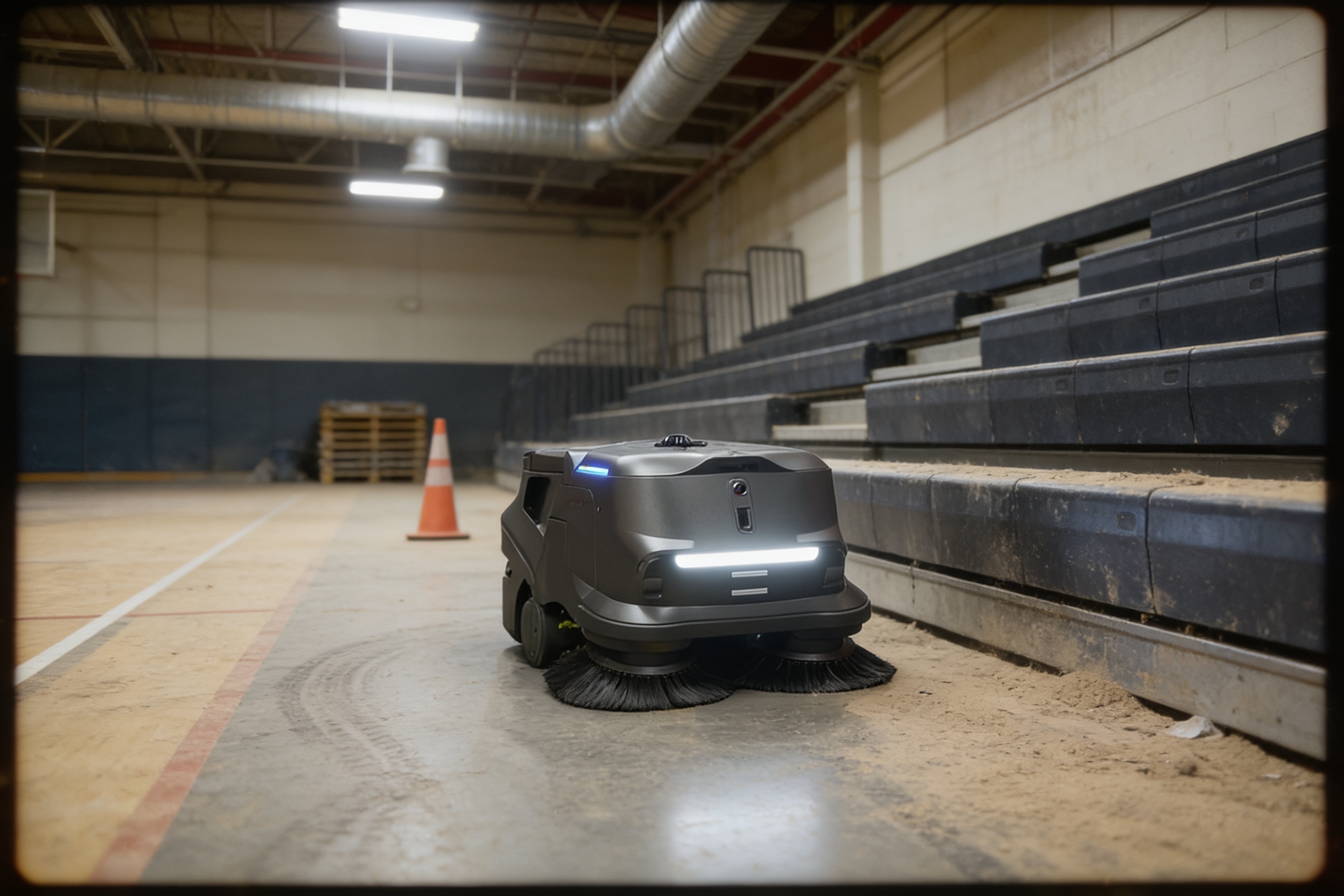
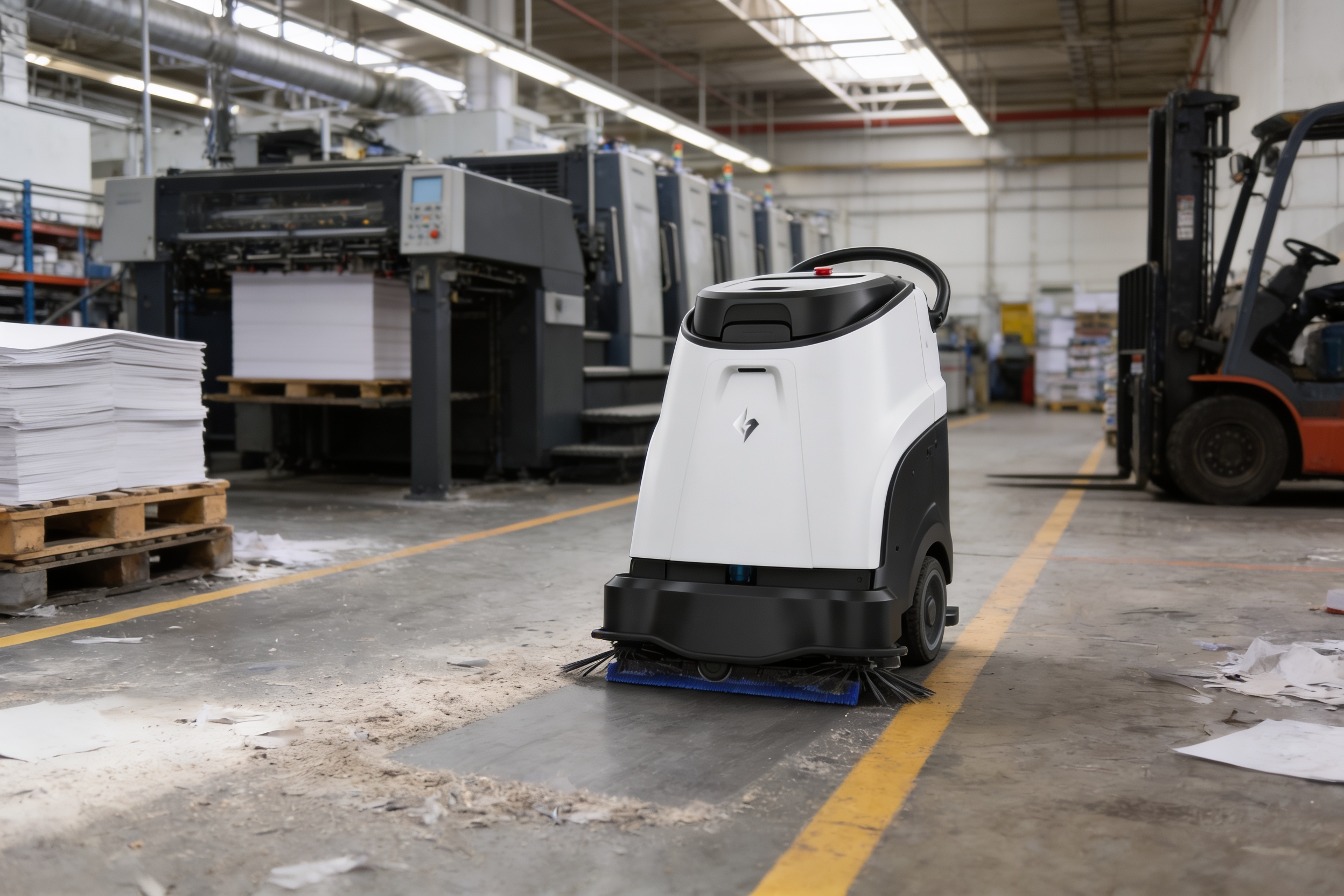
Four things move the number most. The first is how much of the floor is open and repeatable. A warehouse floor with clear aisles gives the robot more usable hours than a building with many fixed fixtures or frequent furniture moves. The second is shift timing. Work done when the building is empty is easier to schedule for a robot than work that must stop around customers or patients.
The third is the coverage gap. If your floor care already runs on a fixed schedule with spare staff, the robot replaces hours that were already on the books. If you cover open shifts with overtime or postpone the work, the hours saved are worth more, because the alternative is costlier. The fourth is cleaning frequency. A floor scrubbed daily gives the robot far more repeated hours than one scrubbed weekly.
A hospital pilot announced for 2026 shows which work gets targeted first. It aims at overnight shifts, when floor scrubbing is often postponed. That is the same kind of work this page is about, and a useful place to start measuring. The pilot has no results yet, so it shows direction, not proof.
Robot or person for overnight floor care?
A robot is not better than a person at everything. Its strength is consistency on repeated routes and availability on hours that are hard to staff. A person is better where the work changes from route to route or needs a decision. The comparison below covers the points that matter for the return.
The person keeps the work that needs judgment, such as spills, unusual debris, and any task that requires a decision on the spot. The return depends on keeping those tasks with people and handing the repeated floor passes to the robot. Replacing the whole crew is rarely the right model, because the work that stays with people is what keeps the floor ready for the next shift.
- Repeated floor passes
Cleaning Robot
Runs the same mapped routes on schedule
Staff
Runs them well, but tires and varies between shifts
- Overnight coverage
Cleaning Robot
Runs when the building is empty, with supervision by exception
Staff
Needs an overnight shift or overtime to cover
- Unusual debris or spills
Cleaning Robot
Needs staff to clear and respond
Staff
Handles it on the spot
- Consistency of coverage
Cleaning Robot
Same route and timing on each run
Staff
Depends on who is on shift and how many
- Coverage when staff are short
Cleaning Robot
Runs without an open shift to fill
Staff
Depends on hiring and retention
- Changes to the work
Cleaning Robot
Route changes need a mapping and integration step
Staff
Can be explained to staff the same day
What are the risks to the return and how do you avoid them?
The biggest risk is counting hours that never leave the schedule. A robot that runs during the night removes staff time from the roster only if those hours were scheduled and paid, or if they were covered with overtime. Count only the hours that actually go away, and keep supervision time in the math.
The second risk is low utilization. A robot that sits idle because the floor is blocked, a route is out of date, or a battery was not charged produces no hours. Set a clean-floor standard before each run, review the route after any layout change, and plan charging around the shift. Ask whether the lease includes maintenance, on-site dispatch, remote triage, and spare unit coverage, since downtime is what erodes the hours.
The third risk is a poor fit. A site with heavy traffic, many temporary obstacles, or floors that change every week may give only a small share of usable hours. A free site assessment tests this before any lease is signed, so the range reflects your floor rather than a generic one.
What is a realistic timeline from assessment to payback?
Most of the timeline comes before the robot arrives. The sequence runs from site assessment, which maps the floor and measures the work, to a lease quote, then deployment and integration, staff training, and go-live support. The assessment comes first because it produces the precise figure that everything else depends on.
After go-live, expect a settling period. The first weeks show which routes run cleanly, where obstacles or exceptions appear, and how much supervision time is really needed. The return is judged against those measured hours, not only the assessment estimate. A phased start, with one unit on one shift, lets you measure real hours before you commit to more.
Payback timing depends on your own inputs. Because the research found no independent overnight hour data for a commercial site, the payback date should be set from your measured hours after the first months of operation, not from a published average.

How do you get a precise figure from a free site assessment?
A precise figure needs three things: measured floor area and layout, a count of the repeated floor hours on each shift, and the share of that work the robot can take. We are a US commercial robot integrator. We pick the robot that fits the floor, lease it through financing, deploy and integrate it, train the staff, and service it nationwide. The assessment is where those choices are made for your site.
The output is a savings range built on your numbers, a lease quote after the assessment, and a short list of what would move the range up or down. Ask for every assumption to be shown line by line, so you can test each one against your own records before deciding.
Confirm headcount during the walk through. Our research did not find a verified typical headcount for a site like this in this market, so the number of people on the floor each shift is one of the first things the assessment should pin down.
Frequently asked questions
Put a robot to work in Cincinnati.
We walk your site, learn the job, and recommend the unit that fits. Then we quote the lease, deploy it, and keep it serviced.
Sources
- US Bureau of Labor Statistics, Occupational Employment and Wage Statistics (OEWS May 2024)
- BLS Occupational Outlook Handbook: Janitors and Building Cleaners
- ISSA Cleaning and Maintenance Management 2025 benchmarking survey
- AACEM and ISSA autonomous cleaning survey report (2019 baseline)
- 2026 press release citing a building service contractor market study
- Secondary compilation of BLS 2024 injury data for janitorial services
- Secondary summary of BLS 2024 carpet and upholstery cleaning injury rate
- Hospital overnight floor scrubbing pilot announcement, 2026