

The short answer
A cleaning robot in Buffalo, NY pays back by taking over the route-based floor work that janitors and building cleaners do on a fixed schedule, mostly scrubbing and sweeping open areas, often after hours. The return is a range, not a fixed figure: it depends on how much of each shift's floor the robot can realistically cover, the janitor hours that displaces, and the fixed lease payment quoted after a site assessment. Cleaning robot ROI in Buffalo is best judged by weekly hours offset against lease cost, not by a machine's rated speed.
Key takeaways
- The offset is the janitor hours a robot actually takes off the schedule, valued at the local wage for this job shown on this page.
- Realistic floor coverage is well below rated maximums, so measure output on your own floor before deciding.
- Unattended overnight runs free staff time that gets used. Daytime shadowing frees very little.
- Restrooms, detail work and entryways usually stay with staff, so the offset is partial by design.
- The lease payment is fixed and quoted after a free site assessment, and the payback is read from measured hours.
Run the numbers for your site
Auto-detected from your location - we use the real BLS wage here. Not right? Pick your city or state above.
What do you want to automate?
The robot runs the open floor overnight; your crew keeps detail and edges.
Can a cleaning robot pay back in Buffalo, NY?
A cleaning robot earns its place when it takes over floor work that janitors and building cleaners already do on a fixed schedule, mostly scrubbing and sweeping large open areas, often after hours. In Buffalo the return is judged the same way it is anywhere else: the hours of that work the robot covers, valued at the local wage for this job, set against a fixed lease payment. Cleaning robot ROI in Buffalo is therefore a range, and the range is only as good as the hours data behind it.
The page carries our ROI calculator pre-filled for Buffalo, NY, and the savings range it shows is computed from the government wage data in the panel beside this text. Read that range as a planning estimate, not a promise. It moves with three inputs covered below: the janitor hours the robot takes over, the share of each shift's floor it can realistically cover, and the lease cost quoted for your site.
We are a US commercial robot integrator. We pick the robot for the floor, lease it through financing, deploy and integrate it, train the staff, and service it nationwide. That matters for the math, because the hours offset depends on mapping, routing and setup at least as much as on the machine itself.
How many janitors and building cleaners are there, and is staffing getting harder?
According to the BLS Occupational Outlook Handbook, about 2.4 million jobs were held by janitors and building cleaners in 2024. Employment in the occupation is projected to grow 2 percent from 2024 to 2034, which the same source describes as slower than the average for all occupations. An older version of the BLS page lists about 350,300 openings a year on average over the decade. Most of those openings come from replacement rather than growth, which means sites are refilling shifts people leave, not adding shifts.
Turnover is where the staffing pressure sits. A staffing research page puts frontline turnover at multi-site cleaning operators at 150 to 200 percent a year. That figure is a third-party claim we have not checked against a BLS table, so treat it as a signal, not a benchmark. A janitorial industry blog says turnover stayed relatively steady after 2020, citing BLS data, though we could not confirm the underlying numbers. Either way, a site that loses a cleaner has to backfill the shift, and that gap is where a robot's hours matter most.
We did not find a verified headcount for a typical Buffalo cleaning operation, so this page does not claim one. The calculator uses a planning assumption that you should replace with your own schedule.
Median hourly wage, Janitors and Building Cleaners
$4,048
Monthly cost of one full-time worker in Buffalo, NY, at the median wage plus payroll costs (an estimate, not a quote).
How much floor can a cleaning robot clean in an hour?
Manufacturer and retailer figures give a sense of pace, but they are maximums. A retailer guide gives 8,000 to 12,000 square feet per hour for compact walk-behind scrubbers, 20,000 to 35,000 for large walk-behinds, and 35,000 to 70,000 or more for ride-ons with 28-inch or larger decks. Both kinds of source describe these as theoretical outputs, not what a route delivers on a typical night.
Real output runs lower. Obstacles, turns, floor condition, carts and stock left in the path, and the pace of the route all cut into the number. The honest method is to start from a measured floor area, divide by a practical rate tested on your own floor, then subtract time for charging, start and end checks, and emptying or refilling. Use rated speed only as an upper bound during planning, never as the basis of the savings.
Coverage matters more than speed. A robot that moves quickly over an open floor still leaves restrooms, entry vestibules and the spaces behind fixed fixtures, and that share of the work sets the offset more than speed does.
What does the local wage mean for the payback math?
The savings range is priced on the government wage data for Janitors and Building Cleaners (OEWS May 2024, Buffalo, NY), shown in the panel next to this text. That wage applies only to the hours of janitor and building cleaner work the robot takes over. It does not apply to other staff on the site, such as nurses or guest service teams, whose time the robot does not replace.
The math has four steps. Start with the hours of floor work per week the robot can realistically cover. Multiply by the local wage for this job, and add a loaded factor for payroll taxes and benefits if your payroll uses one. Then compare that weekly value with the fixed lease payment quoted after a site assessment, along with any one-time costs in the quote.
The payback point is where the cumulative value of the hours offset equals the cumulative lease payments plus one-time costs. Because the offset is measured in hours, a site that runs its robot in an unattended window gains more than a site that only runs it beside a daytime cleaner, even with identical floor areas.
What changes the number up or down?
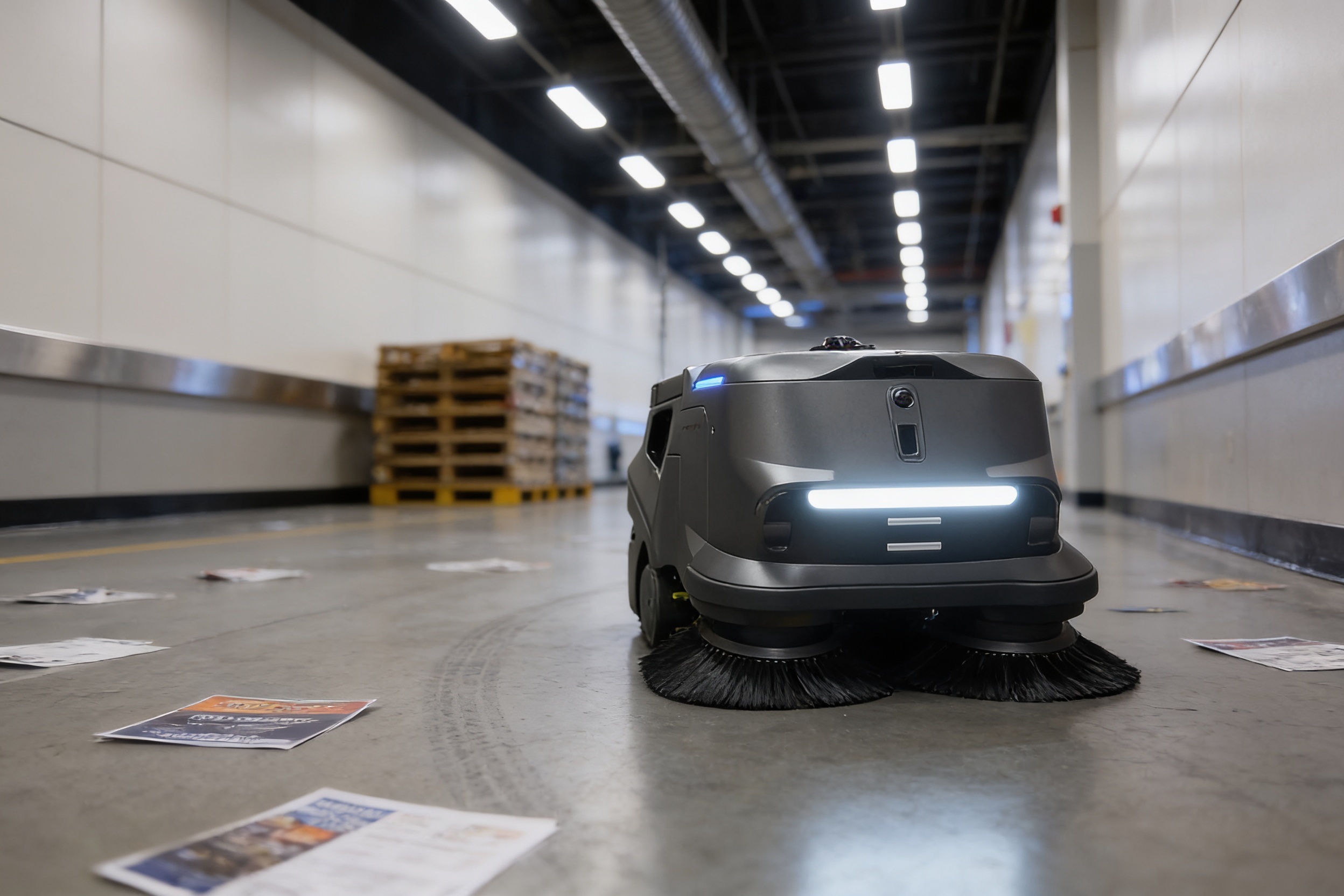
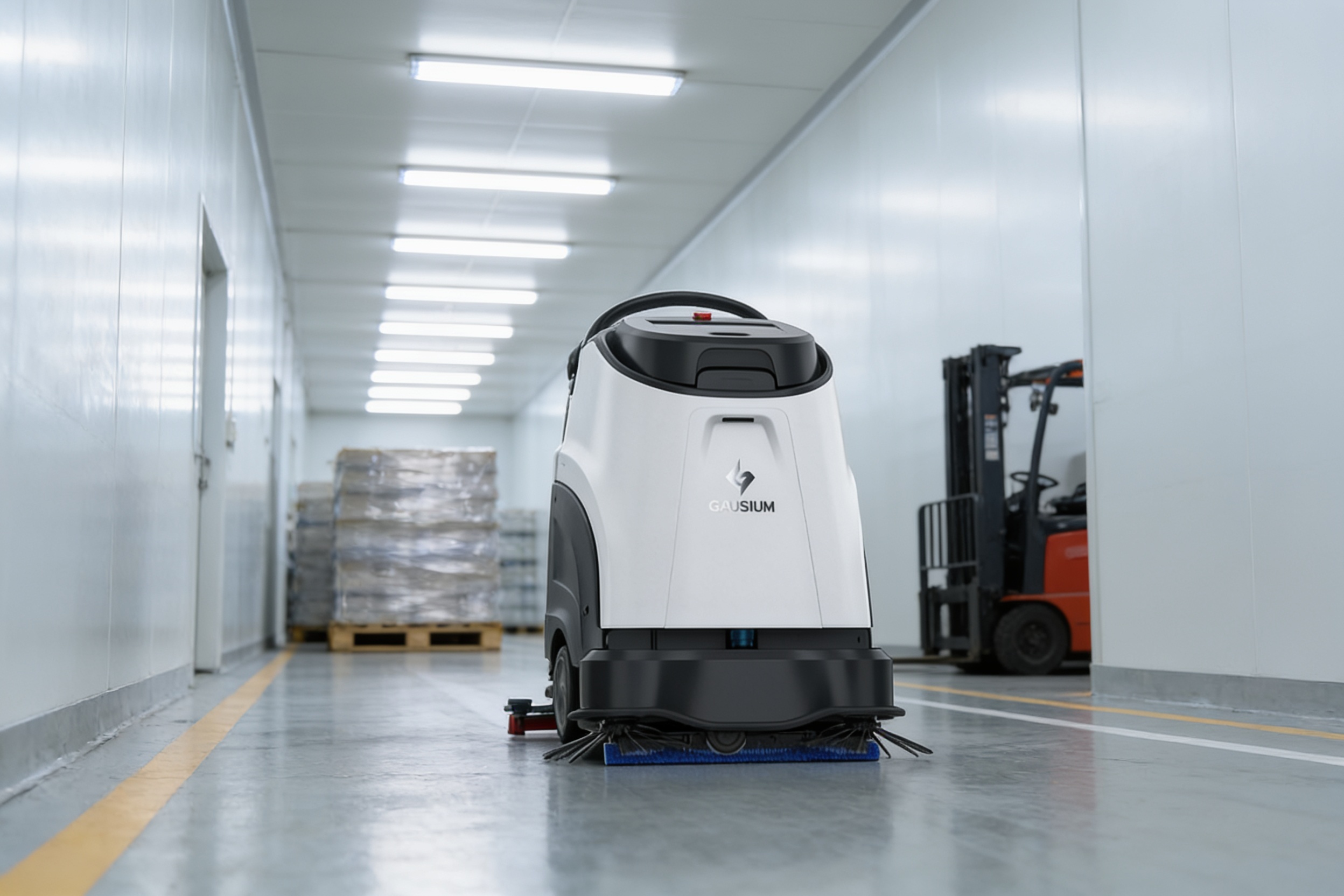
Three inputs do most of the work. The first is coverage. A building with long open aisles and few obstacles gets a higher share of its floor cleaned per shift than one with many small rooms, furniture and fixed equipment. The second is schedule. A robot that runs in a quiet overnight window frees staff time that can be used elsewhere, while a robot that only runs beside a daytime cleaner frees little. The third is layout change. A new partition or moved shelving can break the route, and an unupdated route loses hours quickly.
The lease side is set after a free site assessment, when we measure the floor, confirm the route, and quote a fixed lease payment with the service terms stated. Winter conditions matter for Buffalo sites. Salt, slush and grit tracked in at entrances add work a robot may not clear, so staff still need to cover entryways through the cold months. Plan for that rather than assuming the robot takes the whole floor.
Two smaller factors also move the number. Floor condition affects how well the route performs, and a rough or worn surface can slow it. Night access matters too. If a door is locked or a lift is in use during the window, the robot cannot run its route, and the offset shrinks without any change to the machine.
Where does the robot save hours, and where do people still win?
A robot takes repetitive, route-based floor work. It does not take cleaning that needs a hand, a judgment call, or someone noticing a problem. According to a press release on the 2026 BSC Market Study, about 32 percent of building service contractors plan to adopt robotic floor equipment within 12 months, about double the 2025 share, and 44.6 percent expect labor challenges to increase. That release comes from a vendor that sells floor scrubbers, and it notes that its older and newer samples differ, so read the numbers as direction, not a census.
A 2019 AACEM and ISSA autonomous cleaning survey described adoption as being at an infant stage, with about one-third of non-adopters saying they were somewhat likely to adopt within a year. Those are older numbers, and they describe intent more than results, so use them to frame the question rather than to set the savings.
Turnover adds the cost of backfilling a shift when someone leaves. That cost is real but harder to price, so count it from your own records rather than from a general rate.
- Long open aisle, overnight
Cleaning Robot
Runs a set route without breaks and without staff time during the run
Staff
Slower and needs breaks, but can adjust to what they see
- Spill or blocked aisle
Cleaning Robot
Stops or reroutes only if the map allows, and staff may need to clear it
Staff
Handles it on the spot
- Restrooms, tight rooms, furniture
Cleaning Robot
Limited by clearance and the mapped route
Staff
Does this work well and with care
- Hours of coverage
Cleaning Robot
Can run during a quiet overnight window
Staff
Limited by the shift and by who shows up
- Judgment and reporting
Cleaning Robot
Logs run data and flags exceptions it cannot handle
Staff
Notices damage, odors and hazards, and reports them
- Cost side
Cleaning Robot
Fixed lease payment set after a site assessment
Staff
Wages at the local rate for this job, plus backfill time when people leave
What are the risks to the return, and how do you avoid them?
The main risks are overestimating coverage, relying on rated speed, and letting routes go stale. A return built on maximum output will disappoint, and a return built on a measured route holds up. Test on your own floor, run a pilot on one unit, and keep the janitor hour baseline in the same timesheets you use today so the comparison is honest.
Safety and incident exposure belong in the review. According to BLS survey data reported by a business insurance publication, the 2024 private industry total recordable case rate was 2.2 cases per 100 full-time equivalent workers, and the illness rate was 13.9 cases per 10,000 FTE. Those are all-industry rates, not janitorial figures, so they tell you little about this job. They do give a baseline for logging incidents before and after deployment.
Ask in the quote whether a spare unit covers downtime, because a single robot out for repair can leave a route uncleaned. Also ask who owns map changes and who receives exception reports. A return that depends on one person remembering to update a route is fragile.
How long does it take from assessment to payback?
The path has five stages: site assessment and floor mapping, a quote with fixed lease payment and service terms, deployment and route setup, staff training and go-live support, and a measured operation period. The payback point is read from measured hours, not from the opening estimate. The first measured period should cover normal variation in shift patterns, which means a few weeks at minimum, and longer if your schedule changes by season.
Before go-live, confirm who owns map changes, who runs start and end checks, and who receives the run reports. Those three owners decide whether the offset holds after the first month. Staff training should cover what to do when the route stops, how to clear an obstacle, and when to call for remote triage or on-site dispatch.
We are a US commercial robot integrator. We pick the robot for the site, lease it through financing, deploy and integrate it, train the staff, and service it nationwide. Our team handles on-site dispatch and remote triage, and the service terms appear in the quote so the cost side stays fixed. Ask for the timeline in writing, with dates for mapping, training and go-live.
How do I get a precise figure from a free site assessment?
A precise figure needs three inputs: a measured floor area with clear zones, a baseline of janitor hours from your own timesheets, and the lease quote for your site. A free site assessment provides the first and third. We walk the floor, map the route, measure real coverage, and quote a fixed lease payment with the service terms included. The quote is the only place the lease cost appears, and it is set for your site, not taken from a general table.
Bring your janitor hours for the last few months, the floor plan, the shift schedule, and any known problem areas. We return a savings range built on those inputs and show how the range changes if coverage or schedule shifts. Treat that range as a decision aid for the person who signs off, not a promise.
Frequently asked questions
Put a robot to work in Buffalo.
We walk your site, learn the job, and recommend the unit that fits. Then we quote the lease, deploy it, and keep it serviced.
Sources
- US Bureau of Labor Statistics, Occupational Employment and Wage Statistics (OEWS May 2024)
- BLS Occupational Outlook Handbook, Janitors and Building Cleaners
- Staffing research page on janitorial industry costs
- Janitorial industry blog on turnover after 2020
- Business insurance report of BLS injury data for 2024
- 2026 BSC Market Study press release
- AACEM and ISSA autonomous cleaning survey summary
- Retailer guide on floor scrubber output per hour