

Key takeaways
- Verification took 31% of pharmacist time in a multi-setting study, so the steps around it deserve a close look.
- A cobot can take over repetitive tray loading and label application while pharmacists keep verification and clinical checks.
- A vendor-linked conference poster estimates 608.3 hours saved per year at 500 packs labelled per day.
- No peer-reviewed study we found isolates tray loading, so measure your own bench before you scale.
- Robots are leased through financing, and the payment comes in the quote after a free site assessment.
How can cobots for hospital pharmacies help?
Cobots for hospital pharmacies are collaborative robot arms that take over the repetitive hands-on steps, mainly loading unit-dose trays and applying labels, while pharmacists and technicians keep verification and clinical checks. The arm works beside a person at a bench rather than behind a fence, which keeps the team in the loop for every step that needs judgment.
The practical benefit is time. Tray loading and label application are not the most skilled work in the pharmacy, yet they take hours that staff could spend on patient-facing tasks. A peer-reviewed study of a large US hospital central pharmacy, as summarized by EBSCO, reported that the robotic dispensing system handled nearly 71% of workload by the final phase, with a dispensing error rate of 0% for the robot in that phase.
Be precise about that result. It describes a dispensing system, which is larger than a cobot arm, running a central pharmacy workflow, and the summary notes the gains may not transfer to other settings. It is the strongest large-scale signal we found, but it is not proof of what a cobot will do at a satellite bench.
Where does pharmacist time go today?
Hospital pharmacy work mixes verification, clinical review, dispensing, restocking and preparation, and the balance shifts with every shift. According to the 2025 edition of AHA Fast Facts on U.S. Hospitals, there were 6,093 hospitals in the country, and the 2026 ASHE fact sheet lists 907,216 total staffed beds, so bench-level pressure like this shows up across a very large number of pharmacies.
Verification is usually the largest block. In a time-and-motion study across retail, clinical, hospital, ambulatory and academic settings, checking prescriptions took 31% of pharmacists' time, more than any other activity. In one hospital outpatient dispensing room, verification was the bottleneck that set overall dispensing time.
Clinical work takes much of the rest. In a work-sampling study at two hospitals in British Columbia, published in a Canadian hospital pharmacy journal, clinical activities took 56% of total time. The repetitive steps around that work are the ones a cobot can take over, which keeps the verification queue with the people it needs.
What are the main benefits of cobots in hospital pharmacies?
The benefits are real but narrower than vendor material often suggests. The most controlled evidence we found is a UK teaching hospital study, in which two dispensing robots were installed at two sites in a controlled before-and-after design. The study found modest benefits and mixed results:
The labelling result matters for a label-focused cobot. That study's machines were dispensing systems, so the lesson is to measure label application and tray loading on your own bench before you assume a gain. A cobot is most likely to pay off in a fixed, repeated motion done in the same order all shift, and that is the test to run on your own bench.
Other benefits are workplace ones, such as less repetitive motion at the bench and a steadier pace through a large batch. These are plausible, but the sources we reviewed did not measure them for hospital tray loading, so confirm them in your own trial.
- Modest benefit in dispensing errors
- Picking times fell, while labelling and assembly times did not change
- Modest benefit for staff satisfaction and storage capacity
- No conclusive effect on turnaround times
How does a cobot work day to day?
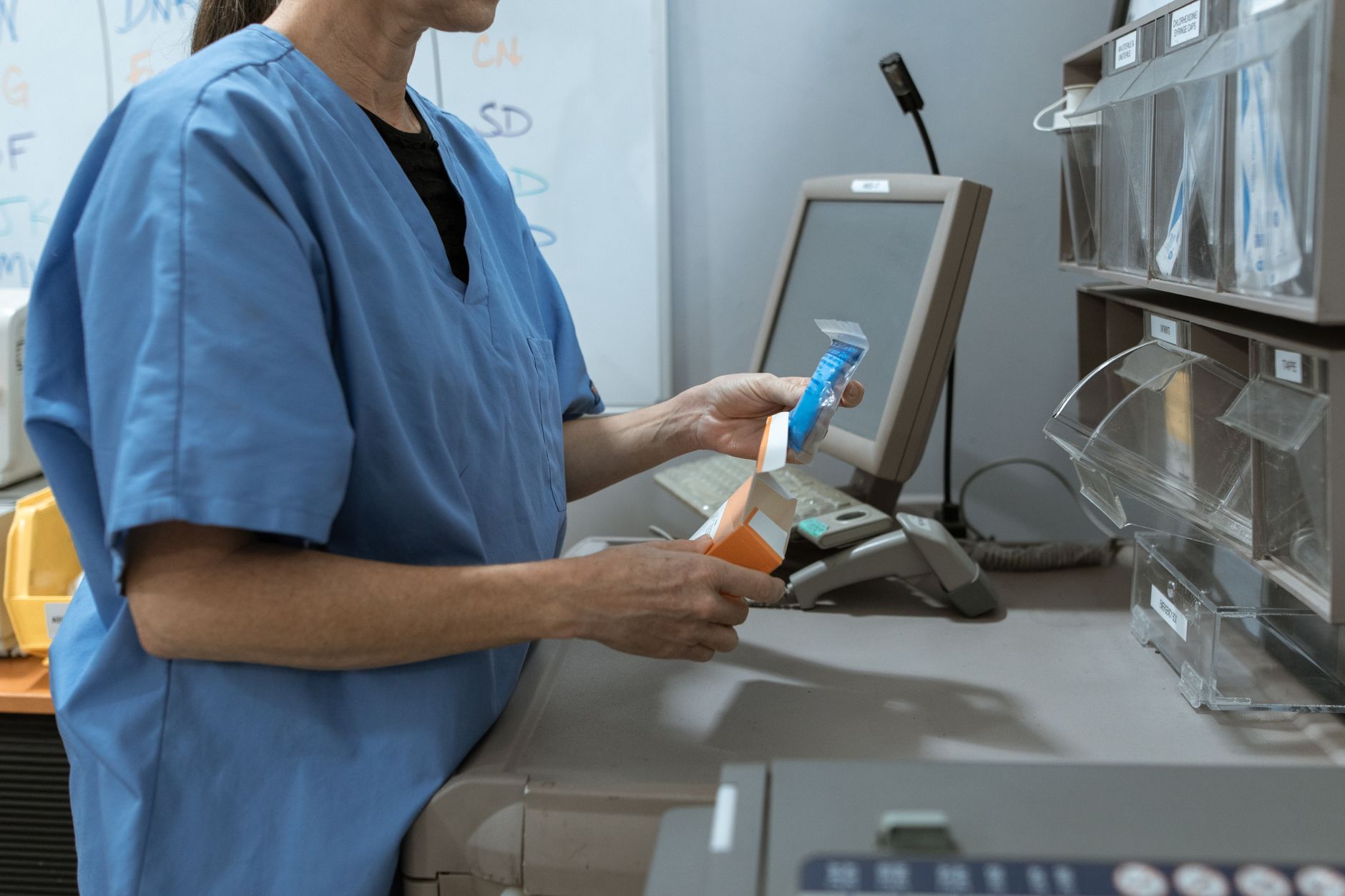
The workflow is simple to describe. A technician loads empty trays and stages prepared packs within the arm's reach. The arm picks each item, places it into the correct tray position, and applies the patient label to the marked area. The technician checks the output, and the tray moves to the pharmacist for verification.
Timing is where it earns its place. A conference poster listed on the European Association of Hospital Pharmacists site, which is vendor-linked and not peer-reviewed, puts manual labelling at 12 seconds per medication pack. The poster says that looks minimal alone but adds up at high volume, and a busy bench runs through many packs in a shift.
Staff set the batch size and watch for exceptions, such as a damaged pack or a label that will not seat. The arm pauses, a person clears the issue, and the cycle resumes. Nothing about the arm changes who is responsible for the final check.
Which areas of the pharmacy does the cobot work in?
A cobot works best at a defined station, not across the whole department. The arm's work sits in a few bench areas, and the verification and clinical areas stay with staff. Keeping the arm inside its station is what makes the layout easy to supervise.
The zones below show where the work happens in a typical hospital pharmacy layout. Your floor will likely differ, which is why the site assessment maps each station before any plan is set.
How do cobots work alongside existing staff?
A cobot does not replace the team. It takes a repetitive share of the bench work so the people who remain can focus on verification, clinical checks and exceptions. The usual pattern is one arm plus a smaller team on the repetitive bench, with pharmacists kept on verification and clinical work.
Never run the arm with no one in the room. Someone trained has to load stock, check output, clear exceptions and decide when to stop a batch. That person is part of the design, and training them is part of the deployment plan.
Plan for a learning period before you judge the bench. Staff need time to learn the arm's reach, the batch rhythm and the exception steps, and the first weeks will show the workflow's rough edges.
What drives the savings in hours and labor?
Savings come from hours, so the figures below are hours and full-time equivalents rather than a headline number. The most concrete estimate for label application comes from the conference poster: at 500 packs labelled per day, total time saved is 608.3 hours per year, equal to 0.29 technician FTE. The poster is vendor-linked and not peer-reviewed, so treat it as a model to test against your own counts.
The central pharmacy study offers a second view. According to the EBSCO summary, time savings from the two automated systems in that study were equivalent to 0.77 pharmacist full-time equivalents and 1.76 technician full-time equivalents. The authors said freed time could go to patient-centric tasks, though that came from a central pharmacy workflow and may not carry over to other settings.
The drivers you control are pack volume, the number of repetitive steps per pack, the share of the shift the bench sits idle, and the time staff spend rechecking output. Measure each of these over a few typical weeks before you accept any hour figure, including the ones in this article.
What can a cobot not do in a hospital pharmacy?

A cobot cannot verify a prescription, make a clinical judgment, or decide that a dose is appropriate for a patient. Those steps stay with a pharmacist, and the arm has no part in them. A technician who spots a problem with a pack still stops the batch, and the arm does not change that.
The evidence has clear gaps. The UK study found no conclusive effect on turnaround times, and labelling and assembly times did not change. We found no hospital-based or peer-reviewed study of cobots in medication packaging or tray loading, and no study that isolates tray-filling time. Vendor claims about dispensing or filling carry no outcome data.
Speed claims in trade material are not independent measurements. One trade article describes a vial-packaging system with a high hourly output, but that is a vendor claim we did not test. Treat it as a question for the supplier, not a planning figure.
Volume and layout also set limits. A low-volume pharmacy may not need a dedicated bench, and a cobot is one tool at one station, not a full central dispensing system.
How do I get started with a cobot for my pharmacy?
Start with a free site assessment. We map the bench, the stock flow, the tray and label steps and the hours your team spends on each, then recommend a robot and a deployment plan that fits that site. Many operators begin with one leased unit and a pilot period before they decide on more.
Service Robot Co. is a US commercial robot integrator. We choose the right robot for the site, lease it through financing, deploy and integrate it, train your staff, and service it nationwide. Robots are only leased, and the payment comes in the quote after the site assessment, so you see the terms for your own site before anything is committed.
Ask for the quote after the assessment. Ask how the arm handles your stock, your staff roles and your exceptions, not only its speed. Cobots for hospital pharmacies work best when the bench, the people and the verification steps are planned together.

Frequently asked questions
Want a cobot at your hospital pharmacy?
Tell us about your site. We will recommend the robot, quote the lease, and keep it serviced.
Sources
- EBSCO summary of a central pharmacy automation study
- Oxford Academic, UK teaching hospital dispensing robot study
- European Association of Hospital Pharmacists congress poster on manual labelling time
- Time-and-motion study on PubMed Central
- Hospital outpatient dispensing study on PubMed Central
- Canadian Journal of Hospital Pharmacy work-sampling study
- AHA Fast Facts on U.S. Hospitals, 2025 edition
- ASHE fact sheet on US hospitals, 2026