
The question, in the buyer's words
Our egg packing shed hand-loads cartons at the candling line through the spring flush, and we can't find enough packers before the big contract starts; how soon could a cobot load cartons at that line?
Key takeaways
- A cobot can take the most repetitive carton placements at a candling station, but it does not replace the quality judgment a person makes.
- No honest go live date exists until someone walks your line, so start the site assessment now.
- Published egg packing automation results are dated and come from single installations, so test on your own eggs.
- Plan the spring flush with people first and add the robot as a tested partial help, not the whole plan.
How soon can an egg packing shed cobot take carton loading before spring flush?
Many egg packing sheds run short of packers right when the spring flush arrives, because the peak is on the calendar and the packer pool does not grow with it. A cobot, which is a collaborative robot arm built to share a station with people, can take over the repeat motion of placing eggs into cartons. Whether that helps before a contract start date depends on the candling line itself, not on the robot.
A realistic timeline has four parts: a site assessment of the line and carton flow, a quote, financing, and then deployment with integration and staff training. This page does not give cycle times or install durations, because none were verified for egg packing lines. Any number offered without a walk of your line behind it is a guess.
So the direct answer on timing is this: start the assessment now and find out, rather than assume. Plan the peak staffing as a separate track, and treat the cobot as a way to take pressure off the packers you keep.
What does hand carton loading at a candling line involve today?
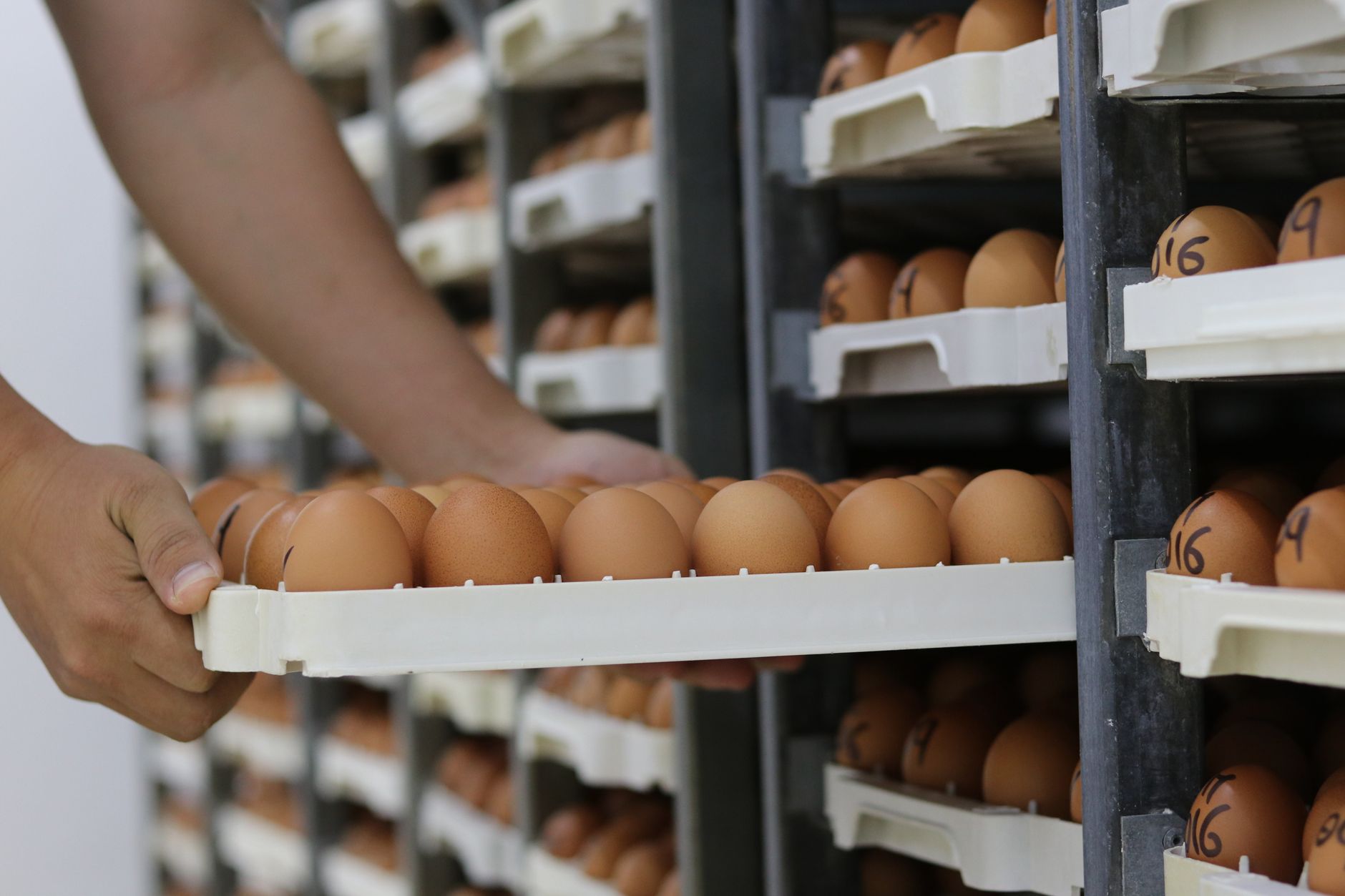
After candling, eggs are inspected and graded, and packers take them off the line and set them into cartons in a fixed pattern for each carton format. The motion is short and repeated, usually done standing or leaning over a conveyor for the whole shift. Each carton takes a reach, a pick and a placement, over and over through the peak.
Staffing trouble shows up in three places: how many packers can stand at the line, how long each person can hold a steady pace, and how fast a replacement can match an experienced hand. A cobot changes the first number only if the line geometry fits. It changes the second by taking the most repetitive picks off a person's shift.
What a robot does not change is judgment. Someone still has to check for cracks, dirty shells, mixed sizes and rejects. Keep a person at that check and put the robot on the placements that repeat the same way every time.
Is a cobot the right tool for carton loading at a candling line?
Cobots are built for close work beside people, which suits a station where a person and an arm share space. Egg handling needs gentle force, and a 2007 trade article described an Italian case-packing line that used collaborative arms with force control so eggs are not broken if something goes wrong. That article describes one installation nearly two decades old, so read it as a design principle, not a performance promise.
A cobot is a weaker fit when carton formats change often, when the line cannot hold a fixed station, or when the shed needs more throughput than one arm can give. In those cases the better step may be a change to the line layout, or another robot type for the job, and a site assessment will say which.
The good fits are a stable carton format, a station that can be marked off from foot traffic, and a shed willing to keep a trained person on quality checks. Those conditions decide more of the outcome than the arm itself, which is why the choice of arm comes after the walk.
How much staffing relief can a cobot give during the spring flush?
A cobot removes some repeat picks, so it can reduce the number of packers a station needs. It still needs a person to run, watch and clear faults at the cell, so the net relief is smaller than the robot's own working hours. Plan the math as packers freed minus operator time added, and do it for each shift.
Hiring alone is a hard path. According to Packaging Dive, a projection cited there says the US manufacturing labor shortage will grow to more than 3 million people by 2028. That figure comes from a staffing agency's presentation, not a government source, so use it as a directional signal, not a headcount forecast for your shed.
The same report noted that automation still needs technicians and operators who can run and maintain robotic systems. A shed that automates one station without a trained person to run it will not get the relief it expects.
What do injury rates tell us about hand packing work?
Repetitive hand work is where the injury data is most direct. According to Feedstuffs, reporting BLS data for 2024, poultry processing recorded a total recordable case rate of 2.4 cases per 100 full-time workers, the lowest BLS has recorded for that industry. The same report put food manufacturing at 3.3, all manufacturing at 2.7 and all general industry at 2.6.
Type matters as much as rate. Lab Manager, summarizing BLS data for 2023 and 2024, reported about 946,000 combined cases of overexertion, repetitive motion and related conditions. A cobot that takes the most repetitive placements targets that category, though these figures are industry-wide and do not measure your shed.
Your own incident log and your insurer's loss runs are the figures that apply to your shed. Use the industry rates for context and your records for the decision.
What have egg packers reported after automating carton and case work?
The public record is thin and dated. Packworld reported that a Minnesota egg packer installed automated casing and palletizing in 2009, and the plant reported casing and palletizing efficiencies up 20 percent, along with lower egg breakage after automated case packing. Those are plant-reported results from one installation, not independent measurements.
A 2007 trade article reported a vendor claim of about 83 percent labor cost reduction from a robotic egg picker placing cartons into shipping cases. Treat it as a marketing figure from nearly two decades ago, and ask any vendor for references from sheds with similar carton formats and egg grades.
USDA NASS reported approximately 80 egg breaking and processing plants in its November 2025 Egg Products report, based on a census of all commercial egg breaking and processing plants. That count covers breaking and processing plants, not the packing sheds that run candling lines, so it does not measure adoption in your segment.
How much automation is happening in North America right now?
A3 reported 7,212 cobot units ordered in North America in 2025, with cobots at 19.6 percent of total robots ordered. According to the same reporting, Q4 2025 was the highest quarter at 2,953 units. These are orders, not shipments, and they do not break out egg packing.
The order volume suggests cobot projects are now common, so a shed would not be the first to try one. It does not show that every shed is ready, and it says nothing about how quickly a specific candling station can be cleared for a robot.
Here is how we work. We pick the robot for the site, lease it through financing, deploy and integrate it, train your staff and service it under our service plan with regional service engineers. We are OEM-neutral, so the arm is chosen from the assessment rather than from a preset catalog.
What should the shed do before the contract starts?
Plan the flush in two tracks. Track one is people: short term hiring, cross training of other shed staff, and overtime limits so packers do not burn out. Track two is the robot: a site assessment now, so a decision can be made in time to test on a single station.
Start with one leased unit at one candling station. A pilot shows how the line, the carton format and your staff respond, and it gives you a real basis for any larger order. Ask for go live support that covers the first weeks of the flush, not only the install date.
The honest outcome may be that a cobot helps during the peak, or that it arrives after the flush has started. Write the staffing plan with a robot line item and a fallback for the case where the robot is not running on the first day of the peak.
Frequently asked questions
Want a cobot at your egg packing lines?
Tell us about your site. We will recommend the robot, quote the lease, and keep it serviced.
Sources
- Packworld, egg packer automates casing and palletizing
- Bakery and Snacks, robotic egg picker speeds up packing lines
- Packaging Dive, manufacturing skilled labor shortage and automation
- USDA NASS Egg Products, November 2025
- Feedstuffs, poultry processing incident rate hits new low in 2024
- Lab Manager, BLS injury and illness data shows continued decline in 2024
- A3, robot orders accelerate in Q3 as automation becomes a strategic imperative
- BLS OEWS, packers and packagers, hand