
The short answer
For a bank branch, the cleaning robot vs night janitor choice turns on how much of the overnight work is open floor. A floor robot makes sense for the lobby, teller area and main hallways, which it can scrub or sweep after close without a crew arriving after dark. It does not replace the night janitor for restrooms, trash, spills or judgment calls, so the usual answer is a robot plus fewer staff, not zero staff.
Key takeaways
- A floor robot fits open lobby, teller and hallway passes, not restrooms, trash or spills.
- The usual answer is a robot plus fewer staff, never zero staff.
- Branch size varies by source, but most new builds land between about 2,000 and 3,000 sq ft.
- The fixed robot lease payment comes in a quote after a free site assessment.
- Compare the quote with the government wage data beside this page for the local job.
Cleaning robot vs night janitor at bank branches: which makes sense?
A floor robot makes sense at a bank branch when most of the overnight work is open floor. The lobby, the teller area, the main customer hallway and the back corridor are the spaces where the same scrub or sweep pass repeats every night, and a robot can run that pass after the last employee leaves, so no crew has to arrive after dark to do it.
It does not make sense as a full replacement for the night janitor. Restrooms, trash, glass, spills that need a judgment call, and any area with its own cash handling rules still need a person. A branch with a lot of carpet, raised thresholds or heavy portable furniture needs a site check before the decision is made.
For most branches the answer is a robot plus fewer staff, with the person doing the tasks that need hands, tools and judgment while the robot covers the floor passes that otherwise take up much of the shift.
What does a night janitor actually do in a bank branch shift?
The night janitor at a branch usually works a fixed route rather than a deep clean each night. The route covers the entry, the lobby and teller area, the customer hallway, the offices, the break room and the restrooms, with trash removal and restocking added along the way. Shift hours and task times for branches were not found in our search, so this route is a general description of the job, not a timed standard.
The floor work is usually the largest block of open area time. Sweeping or vacuuming the lobby and hallways, then mopping or scrubbing hard floors, takes the longest in any building with a large open customer floor. Restrooms need a separate pass with their own chemicals and steps, and they are the part of the route a floor robot cannot take on at all.
Branch work also includes checks that are not cleaning at all, such as lights, doors, and a quick look for spills or damage. A crew that only sweeps and scrubs can miss these, so any robot plan has to say who does the checks and who reports them.
Median hourly wage, Janitors and Building Cleaners
$4,041
Monthly cost of one full-time worker, at the median wage plus payroll costs (an estimate, not a quote).
Which parts of the cleaning can a floor robot take, and which can it not?
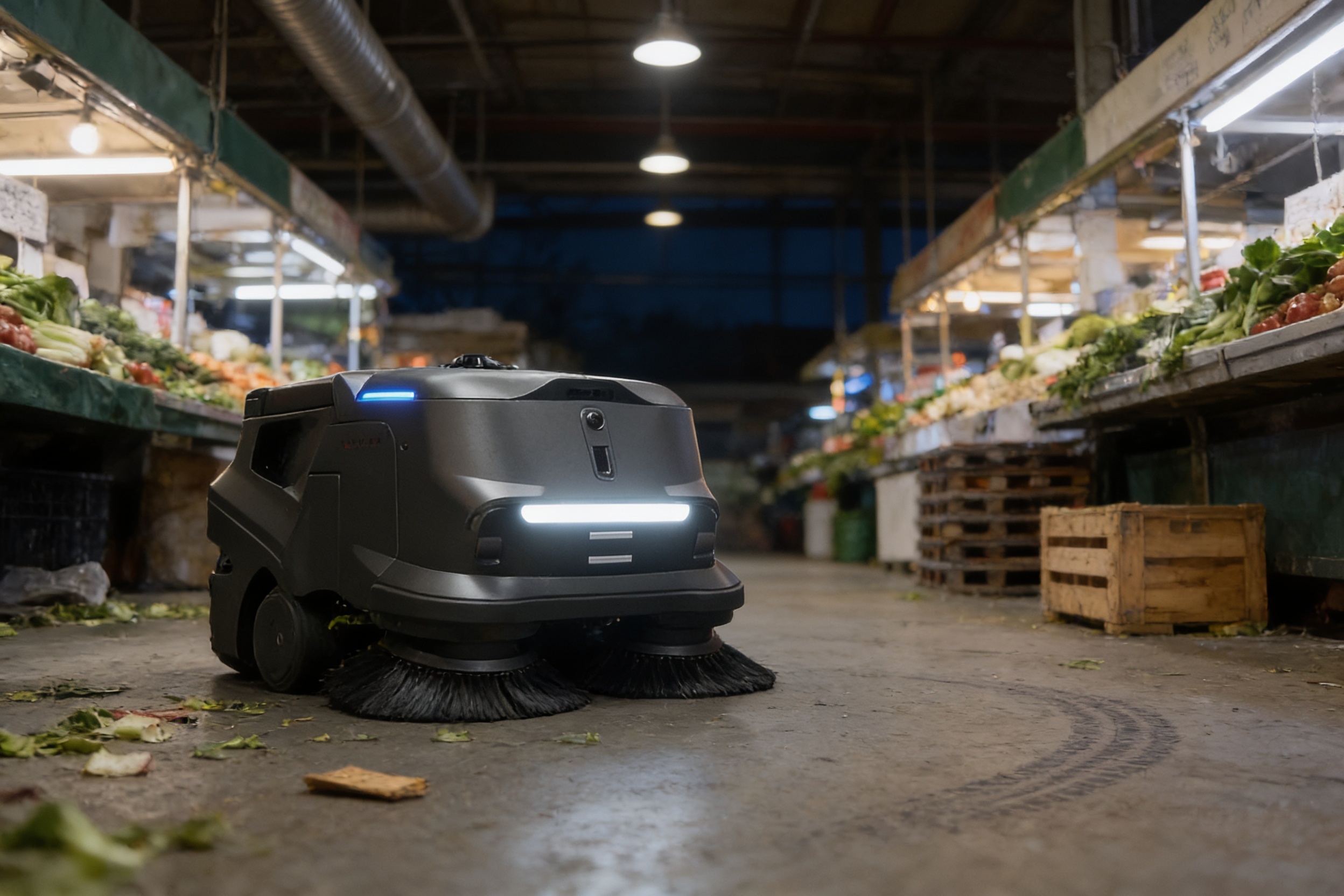
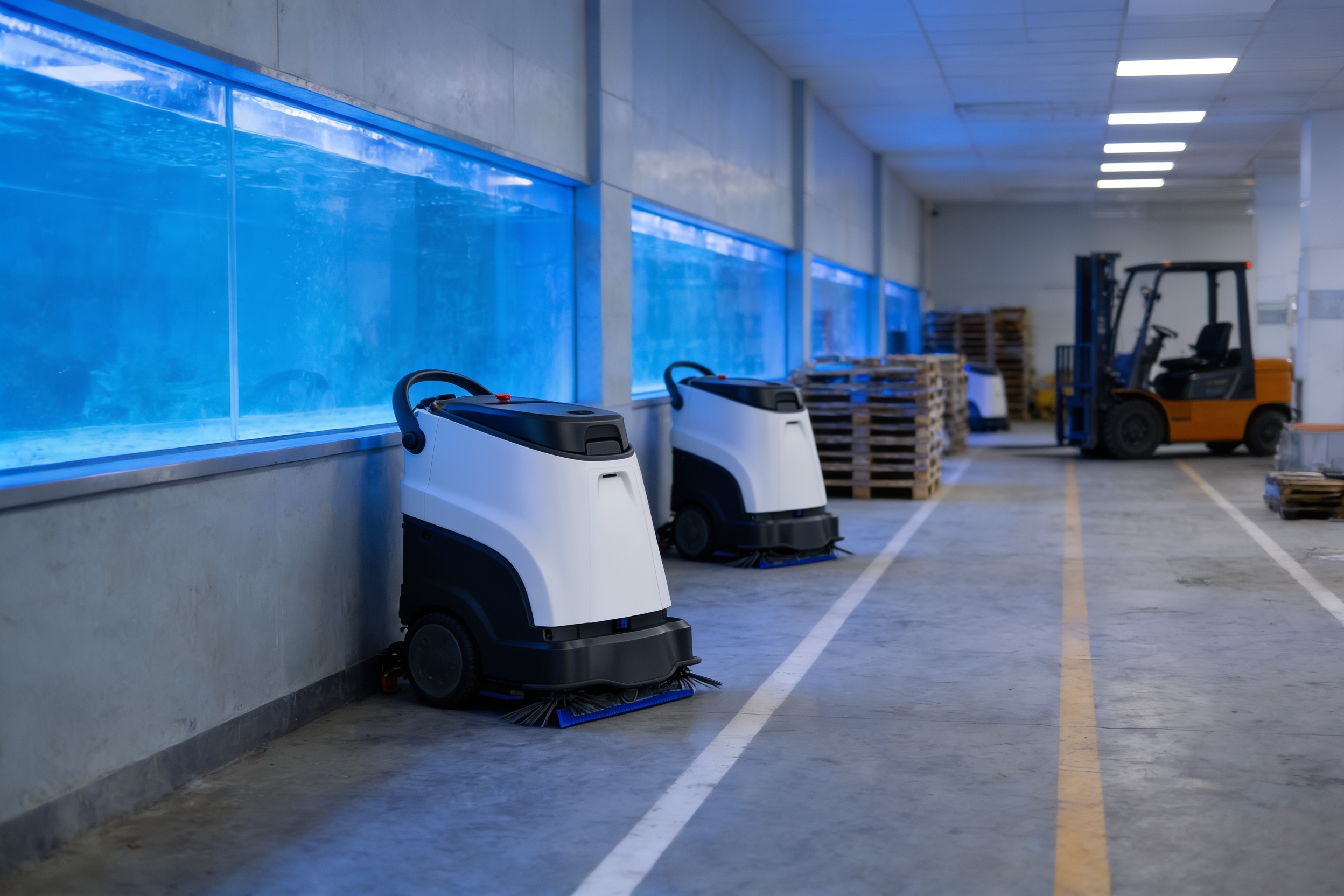
A floor robot takes the repeated open floor passes: scrubbing or sweeping the lobby, the teller area where it can move without obstacles, and the main corridors. These are large, mostly open areas on a path the robot can learn and repeat, which is the kind of work autonomous floor cleaning equipment is built for.
It does not take restrooms, trash emptying, glass and partitions, furniture moves, or the hand work on corners, edges and spills that a person has to judge. It also will not notice a new spill, a fallen fixture or a blocked exit on its own unless a person checks the route.
The fit depends on floor type and layout. Tile and sealed hard floors tend to suit floor scrubbers. Carpet, raised thresholds and loose cables need a site review. Mapping and route setup happen during the site assessment, and a change in furniture or displays can mean the route is run again.

How many bank branches are there in the US, and how big are they?
The FDIC's June 30, 2025 Summary of Deposits counts more than 76,000 domestic offices operated by more than 4,400 FDIC-insured institutions. Not every one of those offices is a full branch with a lobby and teller line, but the count shows how many buildings a branch cleaning decision touches.
Branch footprints have been shrinking. An ABA Banking Journal article on a 2016 Bancography update reported that planned freestanding branches averaged about 2,700 sq ft after removing three outlier banks, down from 3,000 sq ft in 2013 and 3,500 sq ft in 2006. A Codigo survey reported by The Financial Brand puts the average for all respondents at about 1,933 sq ft.
Newer design data points to a similar range. Turner & Townsend reports that ground-up branch prototypes average about 3,000 sq ft, roughly 1,800 sq ft customer facing and 1,200 sq ft back office. GlobeSt, reporting a Cushman & Wakefield study, says the average new branch for the five largest US banks shrank 46% between 2000 and 2023. The samples differ, so these figures are not directly comparable, but most land between about 2,000 and 3,000 sq ft. For a robot plan, the customer facing part is the area that matters.
What does the labor picture look like for janitors?
The Bureau of Labor Statistics Occupational Outlook Handbook reports about 2.4 million jobs for janitors and building cleaners in 2024, with projected growth of 2% from 2024 to 2034, which it describes as slower than average. It also projects about 351,300 openings a year, mostly from replacement of workers who leave the occupation.
That replacement figure matters most to a branch manager. Filling a night slot means recruiting into an occupation with steady openings every year. We did not find an official occupation turnover rate, and industry commentary describes janitorial turnover as high without giving a number, so turnover is a local risk to check, not a settled statistic.
Injury data is the other labor input. In 2019, the latest year in the BLS snapshot for janitors and cleaners, except maids and housekeeping cleaners, private industry recorded 18,680 nonfatal injury and illness cases with days away from work, an incidence rate of 157.4 per 10,000 full time equivalent workers. That supports taking heavy and repetitive floor passes off the crew, but it is not a branch level rate. Overtime, sick day and night shift figures for a specific branch were not found in this search. The government wage data shown beside this page gives the local wage for this job, which is the figure to use in any labor comparison.
How common is autonomous floor cleaning in buildings like this?
Adoption is still early. In the AACEM and ISSA autonomous cleaning survey, which used a 2019 baseline, 62% of building service contractors, 68% of in-house service providers and 69% of facility and property managers had not used autonomous cleaning equipment. The authors called adoption at an infant stage.
That survey is several years old, and its full report is paywalled, so it describes where the market started rather than where it stands today. Newer figures from vendors and trade press point to more interest, but they are self reported or sponsored and should not be used as a benchmark for a bank.
The practical read is that the adoption data does not show floor robots as standard in branches. The decision should rest on this branch's floor, hours and crew, not on the idea that robots are common in the sector.
How does a team work with a robot after it arrives?
In a cleaning robot vs night janitor comparison, the robot only lowers labor needs when the staff change is real. The robot does not replace the whole night team, and it does not run with zero staff. The person who used to push a scrubber across the lobby moves to restrooms, trash, spill response, checks and the corners the robot cannot reach.
Setup starts with a site assessment and mapping, followed by a go live period where someone watches the first runs and marks obstacles. Staff get short training on what the robot does, what to do when it stops and who to call. Service Robot Co. is a US commercial robot integrator. We pick the right robot for the site, lease it through financing, deploy and integrate it, train the staff and service it nationwide, so the branch works with one partner.
Expect the first weeks to take more attention, not less. Stuck runs, route changes after new furniture or displays, and the robot log all need a person to check and decide.
What can the robot not do?
The robot cannot handle restrooms, trash, glass or the judgment calls a night janitor makes on the spot. Unless a site is set up for it, a floor robot does not handle doors, stairs or carrying supplies between floors. It does not spot a new hazard on its own, so a person still watches for changes.
Floor conditions limit performance too. Lighting, floor texture, thresholds and cables all affect how well a floor robot runs, and a branch that rearranges its furniture often will need the route checked more often.
Coverage is limited by the cleaning window. A short overnight window or a heavy customer floor can leave part of the list undone, so the robot plan has to be measured against the branch's actual task list, not a generic estimate.
- Open floor passes
Cleaning Robot
Repeats the same route each night without tiring
Night Janitor
Adjusts on the spot around a new spill or moved furniture
- Restrooms and trash
Cleaning Robot
Does not do these tasks
Night Janitor
Handles them with tools, chemicals and judgment
- Spill and stain response
Cleaning Robot
Covers open floor but may not spot a new spill
Night Janitor
Spots it, decides and cleans it right away
- Doors, stairs and carrying
Cleaning Robot
Generally does not, unless the site is set up for it
Night Janitor
Opens doors, carries supplies and works on other floors
- Route consistency
Cleaning Robot
Same path on every run, with a log
Night Janitor
Varies by person and by shift
- Checks and reporting
Cleaning Robot
Logs route stops and faults
Night Janitor
Notices lights, doors and damage and reports them
How do you get started with a robot lease for a bank branch?
Start with the floor. Pick one branch, measure the open floor, map the route and write down which tasks stay with the crew. A pilot at one site will tell you more than any general figure, and it shows how the night crew's time changes before you commit to more units.
Robots from Service Robot Co. are leased through financing. A free site assessment comes first, and the fixed robot lease payment is quoted after that assessment, so the figure reflects your floor, your route and your coverage hours rather than a generic estimate. We also service the robot nationwide, and our service plan includes remote triage first and on-site dispatch when a visit is needed.
Bring three things to the assessment: floor plans or a walk through, the night task list as it is done today, and the local wage for this job from the government wage data beside this page. That gives the labor side of the comparison the local figure rather than a national average.
Frequently asked questions
Want a cleaning robot at your bank branch?
Tell us about your site. We will recommend the robot, quote the lease, and keep it serviced.
Sources
- US Bureau of Labor Statistics, Occupational Employment and Wage Statistics (OEWS May 2024)
- FDIC, Results of the 2025 Summary of Deposits Annual Survey
- BLS Occupational Outlook Handbook, Janitors and Building Cleaners
- BLS Injuries, Illnesses and Fatalities snapshot, Janitors and Cleaners (2016 to 2020)
- ABA Banking Journal, Branch costs and size are changing
- The Financial Brand, Bank and credit union branch sizes and costs
- Turner & Townsend, US Retail Banking Report 2026, Design strategies
- AACEM and ISSA Autonomous Cleaning Survey Report
- GlobeSt, Banks shrink footprints but double down on key locations