

The short answer
For a hotel, the cleaning robot vs night janitor decision usually favors the robot for repeated hard-floor passes through lobbies, corridors and back-of-house hallways after guest hours. It does not fit spills, restrooms, housekeeping, or any task that needs a person to make a judgment call in front of a guest. Most hotels should plan for a cleaning robot plus fewer night staff, not a robot in place of a team.
Key takeaways
- A floor robot fits repeated hard-floor passes, while a night janitor still covers spills, restrooms and judgment calls.
- Hotel hard-floor work usually follows the same route each night, which suits a mapped robot.
- Staffing is the real constraint: 65% of surveyed hotels reported shortages as of February 2025.
- Plan for a robot plus fewer staff on the night shift, never zero staff.
- Measure your own night hours before deciding, because published data gives no reliable hour figure for hotel hard floors.
Cleaning robot vs night janitor at hotels: which makes sense?
The short answer is that a cleaning robot earns its place on the repeated hard-floor work of a hotel night, and a night janitor earns theirs on everything that needs judgment, speed or a person in the hallway. Most of the decision comes down to how much of the night is the same route on hard floor, and how much is not.
A robot makes sense when the night shift is mostly scrubbing or sweeping the same lobby, corridor and back-of-house loops, the floors are open enough for a machine to route through, and the hotel struggles to cover every shift. It is a weaker fit when most of the work is carpeted guest areas, housekeeping turnover, restrooms, spill response, or a building whose layout changes often.
It also makes less sense when the hotel has only a small amount of hard floor to cover. A robot needs setup, mapping and a person to watch the first runs, so the payback depends on how many real hours of floor work it replaces. Check that before comparing it with a person on paper.
The realistic outcome for most hotels is a robot plus fewer night staff, with the janitor role narrowed to the work only a person can do. Replacing the whole night team with a machine is not what a hotel night usually looks like in practice.
What does a night janitor actually do in a hotel shift?
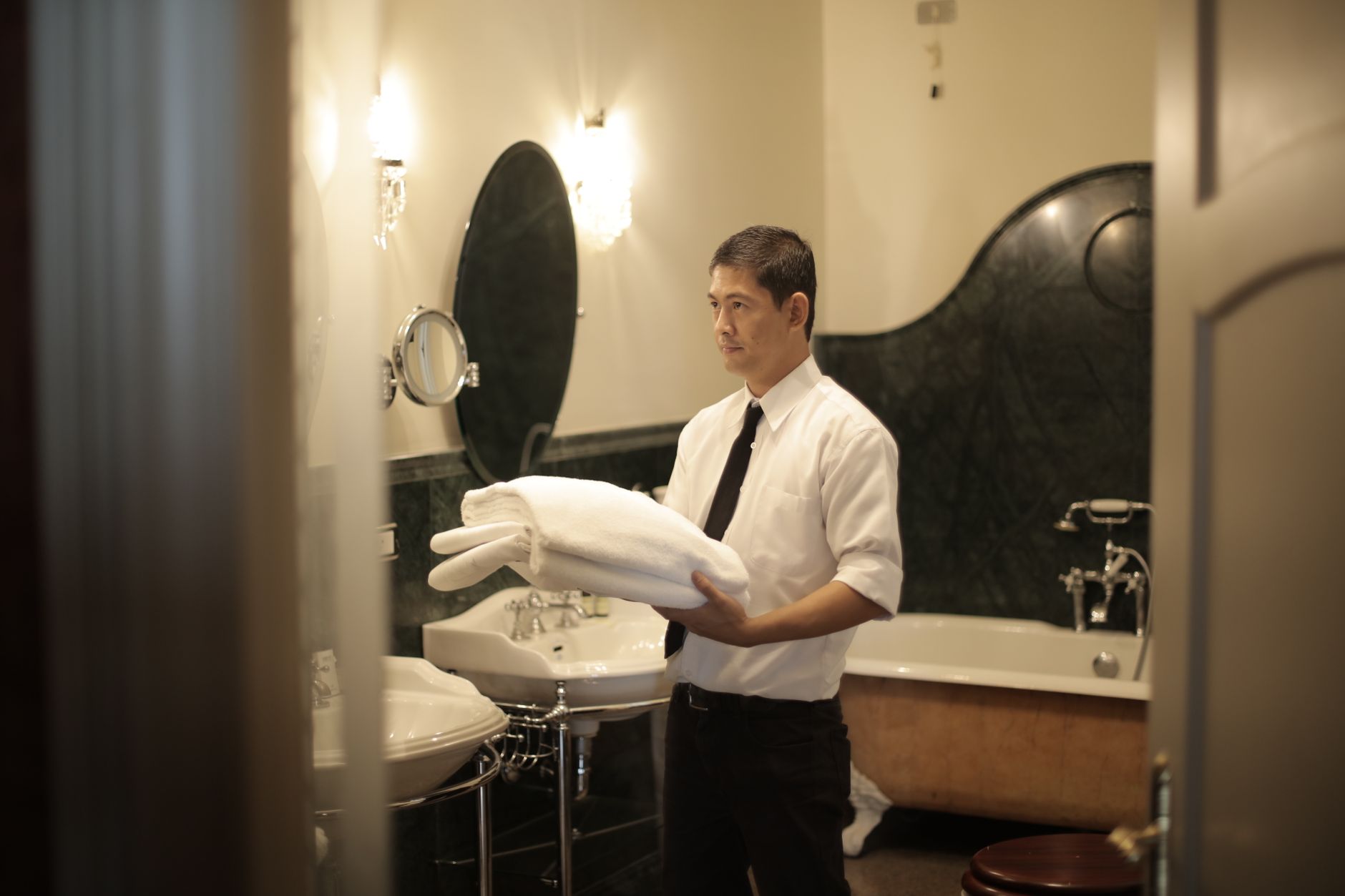
A night janitor at a hotel works the building while guests sleep. The shift usually mixes scheduled floor care, such as scrubbing lobbies, mopping corridors, and cleaning elevators and stairwells, with unscheduled work like spills, lost items, broken fixtures and requests that come through the front desk.
Back-of-house work is often part of the same shift: kitchen corridors, loading dock approaches, staff hallways, laundry and storage areas. These floors take heavy traffic from food and linen carts, so they need more frequent attention than a guest floor, and that changes how often the route has to run.
Public restrooms need a full cycle each night, with restocking and checks. Those tasks interrupt the floor work for set periods, so a shift that looks simple on paper often runs in pieces. Ask the night lead to walk the shift from start to finish before sizing anything.
Injury exposure is part of the job too. According to the Bureau of Labor Statistics, private industry recorded 18,680 nonfatal injury and illness cases with days away from work for janitors and cleaners in 2019, a rate of 157.4 per 10,000 full-time equivalent workers. Routes that a robot takes over are routes a person no longer walks with heavy equipment, which is worth weighing in the decision.

Median hourly wage, Janitors and Building Cleaners
$4,041
Monthly cost of one full-time worker, at the median wage plus payroll costs (an estimate, not a quote).
Which floor work can a cleaning robot take over?
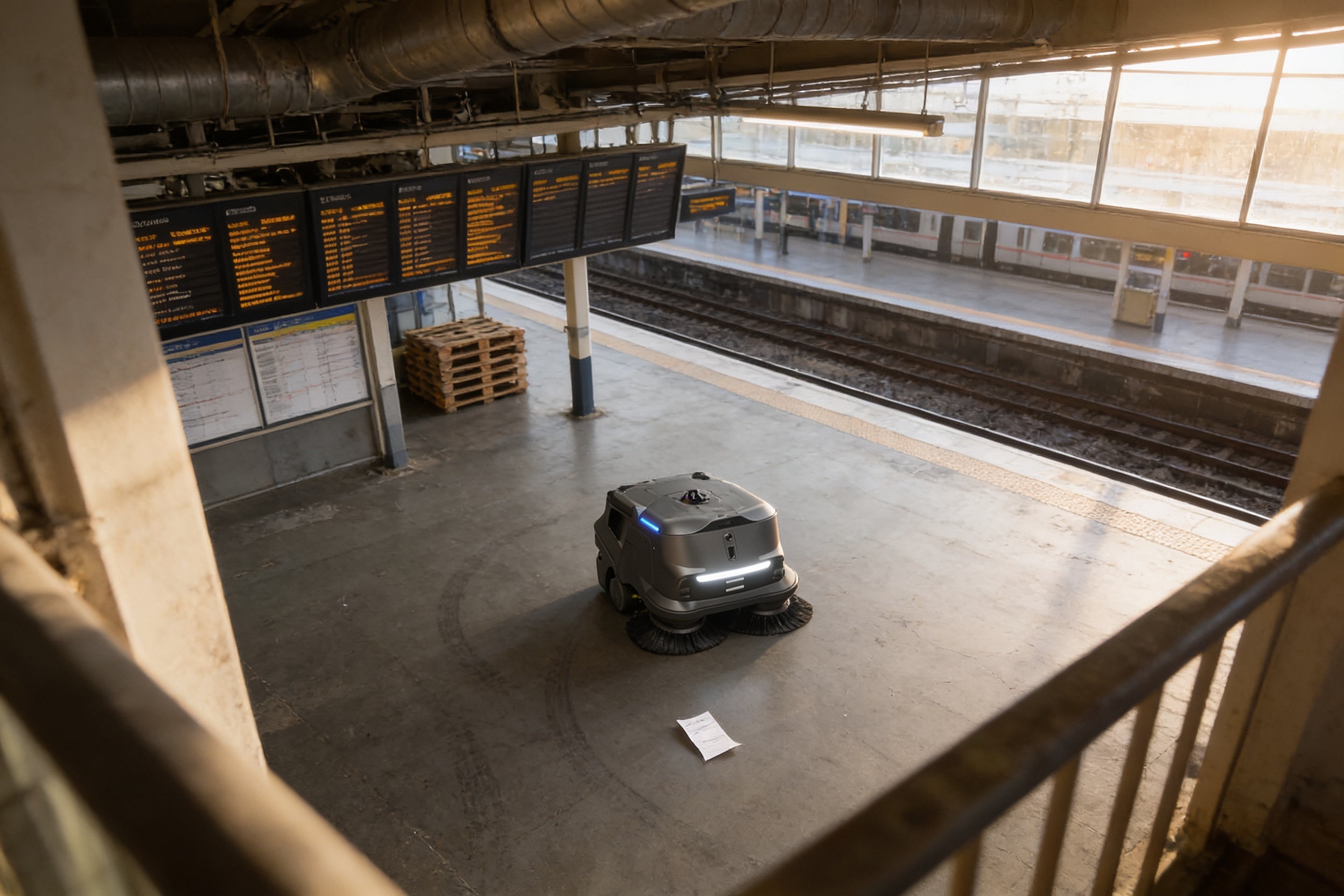
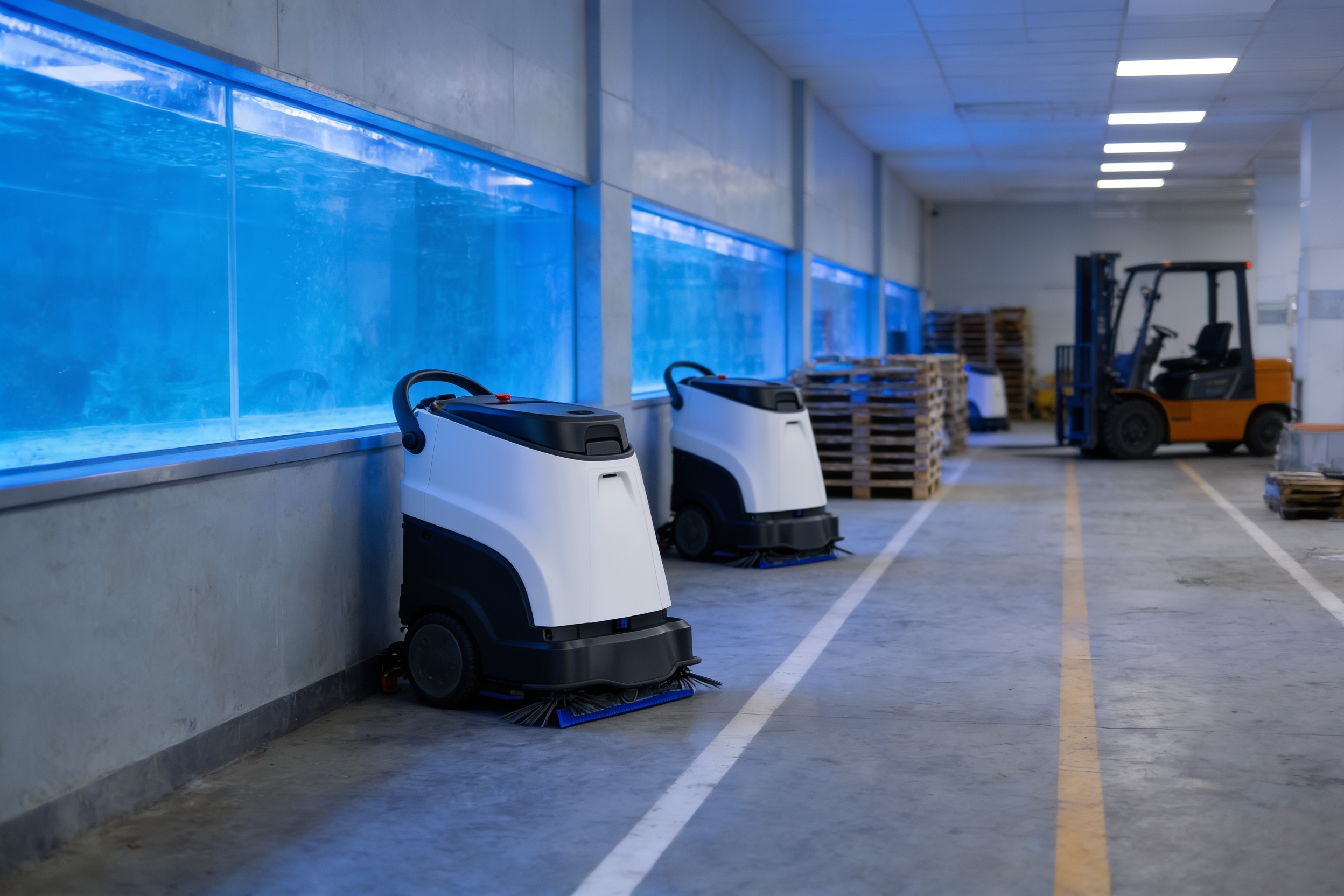
A floor-cleaning robot makes the same hard-floor passes through lobbies, corridors and back-of-house hallways that a night janitor would scrub after guest hours. The gain is consistency: the route runs the same way each night, does not skip a corridor on a busy shift, and frees a person for the rest of the building.
Robots take the scheduled, repeatable floor work well: scrubbing and sweeping hard surfaces along set routes, covering large open areas, and running the same loop once the route is mapped. The floor must be reasonably clear of obstacles at run time, or the run stops.
People still handle the rest: restrooms, spills and biohazards, furniture moved for events, carpeted guest areas, trash and recycling, stairwells, and any guest interaction. A robot will not notice a dropped item or a wet sign in the route unless the floor is cleared first.
Plan the split by zone, not by shift. Each area of the building should have a clear owner: the robot, a person, or a person who follows the robot.
How many hours does night floor work take at a hotel?
Published data does not give a reliable hour figure for hotel hard-floor work, so measure your own night before deciding. Time the scheduled floor routes for two weeks, separate out the unplanned calls, and note which tasks happen only on certain nights. That gives you the hours a robot could take over.
The national picture describes the job, not your building. According to the Bureau of Labor Statistics, 2,447,700 people were employed as janitors and building cleaners in 2024, and employment is projected to grow 2% from 2024 to 2034, which is slower than average. The same handbook projects about 351,300 openings a year on average, mostly from workers who leave, and it gives no turnover rate for the occupation.
The handbook also notes that office buildings are usually cleaned while empty, so many cleaning workers work evening hours. Hotels run on a different clock, with guests on site around the clock, so the night window is set by quiet hours and checkout rather than by an empty building. For the part-time and evening split, a Bureau of Labor Statistics compensation article using 2000 data found full-time janitors averaged 39 hours a week and part-time janitors 19. That data is old, so use it only as background.
The government wage data on this page gives the local wage for this job, so use that figure when you build the labor side of your comparison. Overtime, sick-day coverage and night pay differences were not in the sources reviewed, so leave those as blanks until payroll records fill them in. A robot does not cover a call-out, so the coverage gap remains a staffing question.
| Task | Today | With a robot |
|---|---|---|
| Scrub the lobby and guest corridors | Measure your own shift for two weeks | Route runs on its own after setup, with checks |
| Scrub back-of-house hallways | Measure your own shift | Route runs on its own once staff clear the path |
| Restrooms and spill response | Staff hours, unchanged | Still staff, no change |
| Stairwells and carpeted areas | Staff hours, unchanged | Still staff, no change |
| Route setup and map updates | Not applicable | Set up once, updated after layout changes |
No verified hours-per-shift figure for hotel hard-floor work was found in published sources, so fill this table from your own night records.
Why is hotel staffing so hard to hold?

Hotel staffing is the constraint that makes this decision urgent. According to a survey cited by the American Hotel and Lodging Association and reported by a hotel trade site, 65% of surveyed hotels reported staffing shortages as of February 2025. The survey was fielded from December 2024 to January 2025 and drew 282 hoteliers.
The gaps were uneven by department. Housekeeping had the largest gap at 38% of hotels, followed by front desk at 26%, culinary at 14% and maintenance at 13%. Housekeeping touches the most rooms, so its gap is the one most likely to slow the night turnaround.
A related report found that 71% of hotels had openings they could not fill, down from 79% the previous June. That is an improvement, but most hotels are still short on at least some positions.
One source reports hospitality departures in 2024 at 204% above the national average quit rate, but it gives no baseline, so treat that figure with caution. Turnover data for housekeeping specifically was not found. According to a trade summary of the American Hotel and Lodging Association 2025 State of the Industry report, U.S. hotels directly employed more than 2.15 million people in 2024.
How does a hotel team work with a cleaning robot?
The team keeps its size but changes its work. Staff set the route and the schedule, the robot runs the hard-floor passes, and a person follows to handle what the robot cannot clean. Fewer staff are needed on floor routes, but the team is never zero. Someone must own the robot, its charging, the clearing of its path and the escalations.
In practice, one trained lead checks the robot at the start of the shift, clears obstacles from the route, and reviews the run log at the end. The rest of the night team handles restrooms, spills, stairwells and the rooms that need attention. The robot's hours then show up as coverage, not as a headcount cut on paper.
Training matters more than the machine. A night lead needs to learn the stop and recovery steps, how to clear a blocked route, when to call for service, and how to keep the floor ready for each run. Expect the first few weeks to run with an extra person on the floor while the route is tuned.
We pick the right robot for the site, lease it through financing, deploy and integrate it, train the staff and service it nationwide. That support is part of how the team stays staffed while the robot does its share, because a robot sitting idle on a broken route saves no labor.
- Repeated hard-floor route
Cleaning Robot
Runs the same mapped loop every night without a break
Night Janitor
Covers the same route, but tires and adjusts less consistently on a busy shift
- Spills and guest-facing calls
Cleaning Robot
Cannot respond or speak to guests
Night Janitor
Responds, decides and handles guests
- Stairs, carpet and tight spaces
Cleaning Robot
Limited to mapped, mostly hard floor
Night Janitor
Covers stairs, carpet and tight spaces
- Restrooms and housekeeping
Cleaning Robot
Not part of its work
Night Janitor
Core of the night job
- Layout change or event setup
Cleaning Robot
The route needs remapping first
Night Janitor
Adapts within the same night
- Call-outs and coverage
Cleaning Robot
Does not cover a missed shift on its own
Night Janitor
Can be replaced, but replacement takes hiring and training time
- Scheduling
Cleaning Robot
Runs on a set schedule after setup
Night Janitor
Needs scheduling, breaks and overtime rules
What can a cleaning robot not do in a hotel?
A robot cannot handle everything a hotel night needs. It does not clean restrooms, respond to spills or biohazards, empty trash, or deal with guests. It cannot climb stairs, and it will not work around a cart or sign placed in its route unless the route is cleared first.
Carpet, thresholds and uneven floors limit where a robot can run, so its share of a hotel is often smaller than the total floor area suggests. Check the floor type in each zone before counting hours saved.
Robots also depend on the building. A layout change, a renovated lobby or a new event setup can break a mapped route. Someone must update the map, and that work does not appear on a shift schedule.
Downtime is the risk that matters most. A robot that stops in a lobby can close the area to guests while it waits for service, so the plan needs a backup for that route and a clear response path before the robot is trusted with a busy zone.
How do you get started with a cleaning robot at a hotel?
Start with a free site assessment. Map the hard-floor routes, measure the hours the night team spends on them, and mark the zones a robot cannot take. That map is the basis for choosing the right robot and for the labor comparison you take to the owner or finance team.
Pilot one unit on one route before expanding. Starting with one leased unit lets you test the route, the staff handover and the service response on a single corridor before the whole building runs on the schedule. Lease options come through financing, and the payment comes in a quote after the site assessment.
Set the staffing target before go-live, not after. Decide how many night staff the robot plus team needs, and write down the zones that stay with people. Keep a backup plan for downtime, including a loaner unit or spare unit coverage.
After a few weeks of runs, review the run log, the missed zones and the staff hours. Adjust the route first, and hold the headcount target steady until the numbers settle.
Frequently asked questions
Want a cleaning robot at your hotel?
Tell us about your site. We will recommend the robot, quote the lease, and keep it serviced.
Sources
- US Bureau of Labor Statistics, Occupational Employment and Wage Statistics (OEWS May 2024)
- Bureau of Labor Statistics, Occupational Outlook Handbook: Janitors and Building Cleaners
- Bureau of Labor Statistics, Injuries, Illnesses and Fatalities snapshot: Janitors and Cleaners 2015-19
- Hotel-Online: 65% of surveyed hotels report staffing shortages
- InsideHook: hotel survey on staffing issues
- Asian Hospitality: US hotels industry trends 2025 (AHLA State of the Industry summary)
- Bureau of Labor Statistics, Compensation and Working Conditions article (2000 data, archived)