
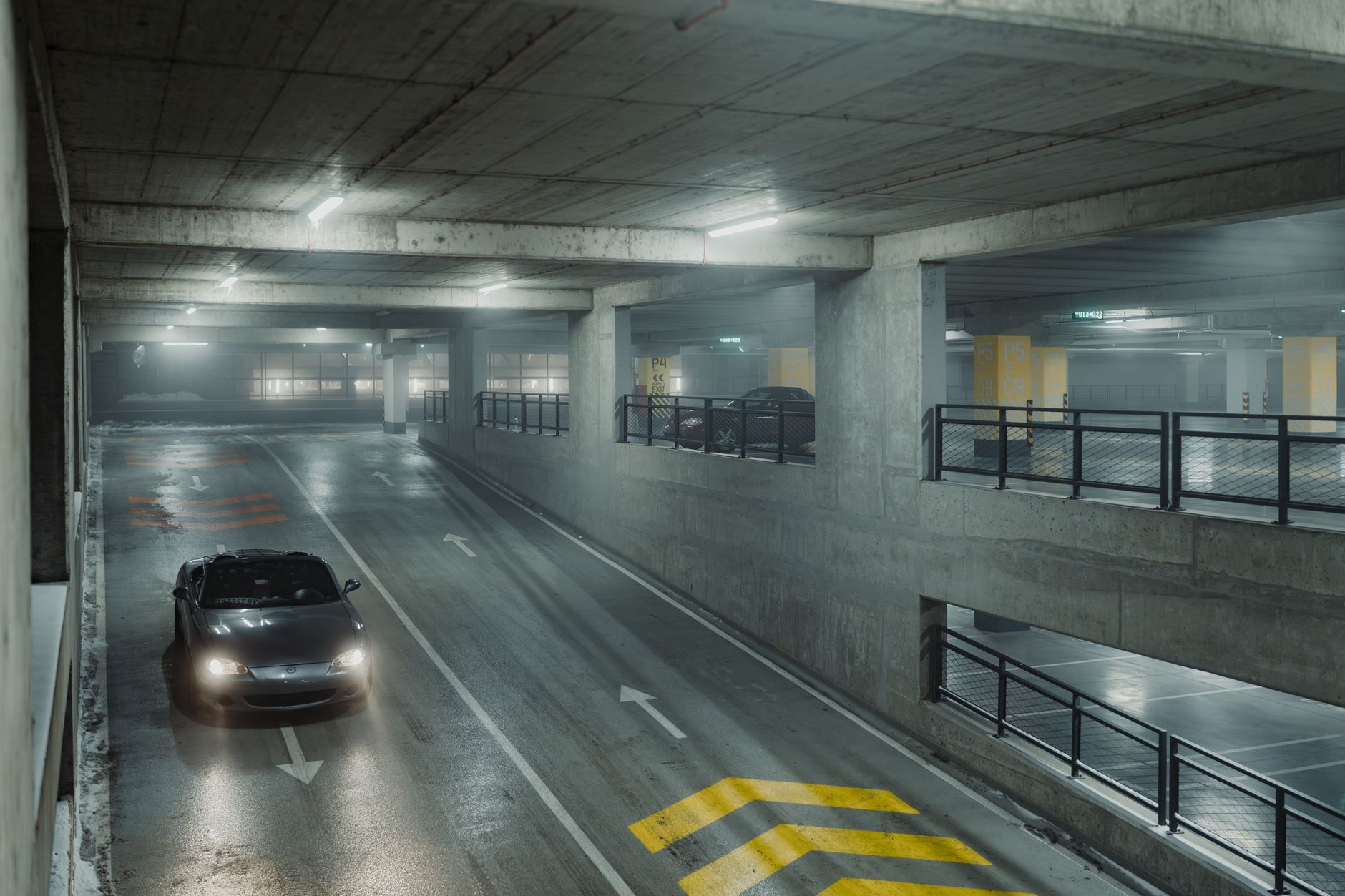
The short answer
Cleaning robot vs night janitor for parking garages comes down to the floor: a robot makes sense for repeated sweeping and scrubbing on open, flat decks, and it does not make sense where the work is mostly stairs, corners, spills and trash. For most garages the answer is a robot plus fewer staff, not zero staff, and a free site assessment decides which decks qualify.
Key takeaways
- A cleaning robot fits flat, open garage decks that repeat the same route every night.
- Stairwells, corners, spills, bins and damage reports still need a night janitor.
- For most garages the best outcome is a robot plus fewer staff, not zero staff.
- BLS projects about 351,300 openings a year for janitors and building cleaners, mostly from turnover.
- The lease is quoted after a free site assessment, so start by mapping the decks.
Cleaning robot vs night janitor: when does a robot make sense in a parking garage?
A cleaning robot makes sense in a parking garage when the work is the same sweeping run on open, flat decks every night. That is the route a night janitor walks level after level, and it is the part a robot can take over on a fixed, mapped path. A night janitor still makes sense for spills, trash, stairwells, restrooms and anything that needs judgment.
It does not make sense when the garage is mostly stairs, tight corners, or stopped cars and carts that change the route each night. In those cases a robot adds a second chore for staff instead of removing one. The sensible target for most garages is a robot plus fewer staff, and the floor itself decides how far that goes.
We are a US commercial robot integrator. We pick the robot for the site, lease it through financing, deploy and integrate it, train staff, and service it nationwide. The lease payment is quoted after a free site assessment, so this page does not give a figure.
How many parking garages are there in the US?
According to a UNLV architecture capstone, about 40,000 parking garages exist in the US, a figure that rests on a 2014 citation. UrbanCincy cites the Urban Land Institute for a similar figure of about 40,000 parking structures. Both numbers are dated, and no official federal count was found, so treat them as estimates.
A business-listing dataset counts 21,148 parking garages in the US as of June 2026, according to poidata. That count likely reflects listings rather than every structure, so it shows the commercially listed share of garages, not the full stock.
The total matters less than the pattern. An owner with several decks, or a portfolio of garages with similar layouts, repeats the same route across many levels, and that repetition is what makes a route-based robot worth testing.

Median hourly wage, Janitors and Building Cleaners
$4,041
Monthly cost of one full-time worker, at the median wage plus payroll costs (an estimate, not a quote).
What does a night janitor actually do in a parking garage shift?
Most of the night janitor's time goes to repeated floor work: sweeping grit and debris from drive lanes, scrubbing ramps and stairwells, and keeping walkways clear of trash. The same route is walked on each level, and the pace is set by how dirty the deck is that night.
The rest is one-off work that does not repeat on a schedule. That includes responding to spills, emptying bins, clearing a stall after a leak, cleaning elevator lobbies and call buttons, and reporting damage such as broken lights or cracked concrete. A person notices these things while walking, and that observation is part of the job.
Night schedules are normal for this work. BLS says janitor schedules may include evenings, nights or weekends. An archived BLS-derived page adds that janitors may be assigned to shifts when 24-hour maintenance is needed, which is why overnight staffing is a standing cost for many garage owners.
| Task | Today | With a robot |
|---|---|---|
| Sweep open deck aisles | A large share of the shift, walked on every level | A mapped run, with a person starting and checking it |
| Scrub ramps and straight drive lanes | A timed pass each night, slower on dirty decks | A scheduled robot run on the same route |
| Clean stairwells, corners and stall edges | Hand work that takes staff time each night | Still staff, no change |
| Empty bins and clear trash | Scheduled rounds through the shift | Still staff, no change |
| Respond to spills and report damage | Unscheduled calls that break up the route | Still staff, with a shorter list of calls |
| Shift setup and close | Walkthrough and log at start and end | Route check, docking and log review |
Our research did not find published per-level sweeping hours for garages, so this table uses shares of the shift instead of hour counts. We time the actual route on site during the assessment.
Which garage tasks can a cleaning robot take, and which can it not?
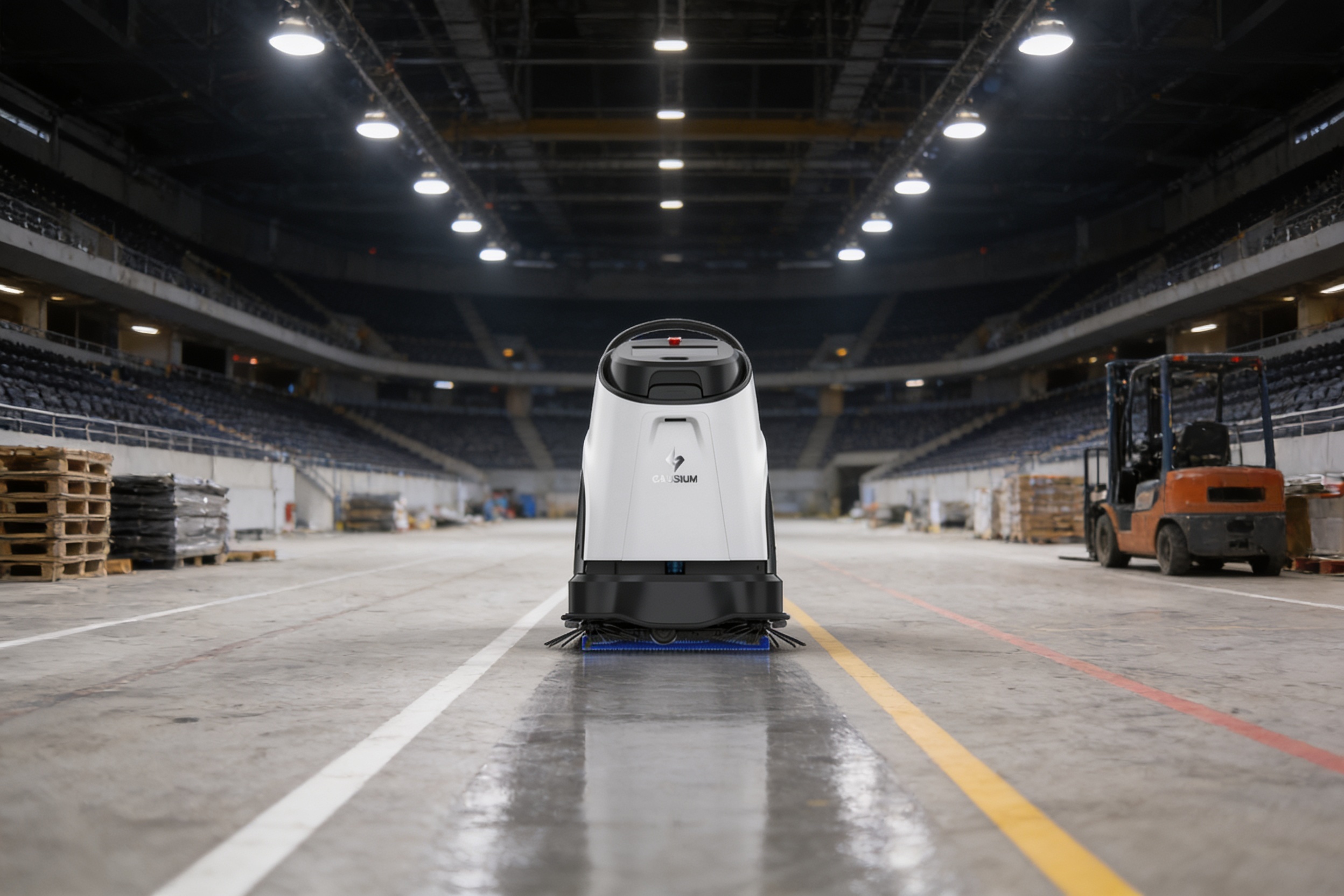
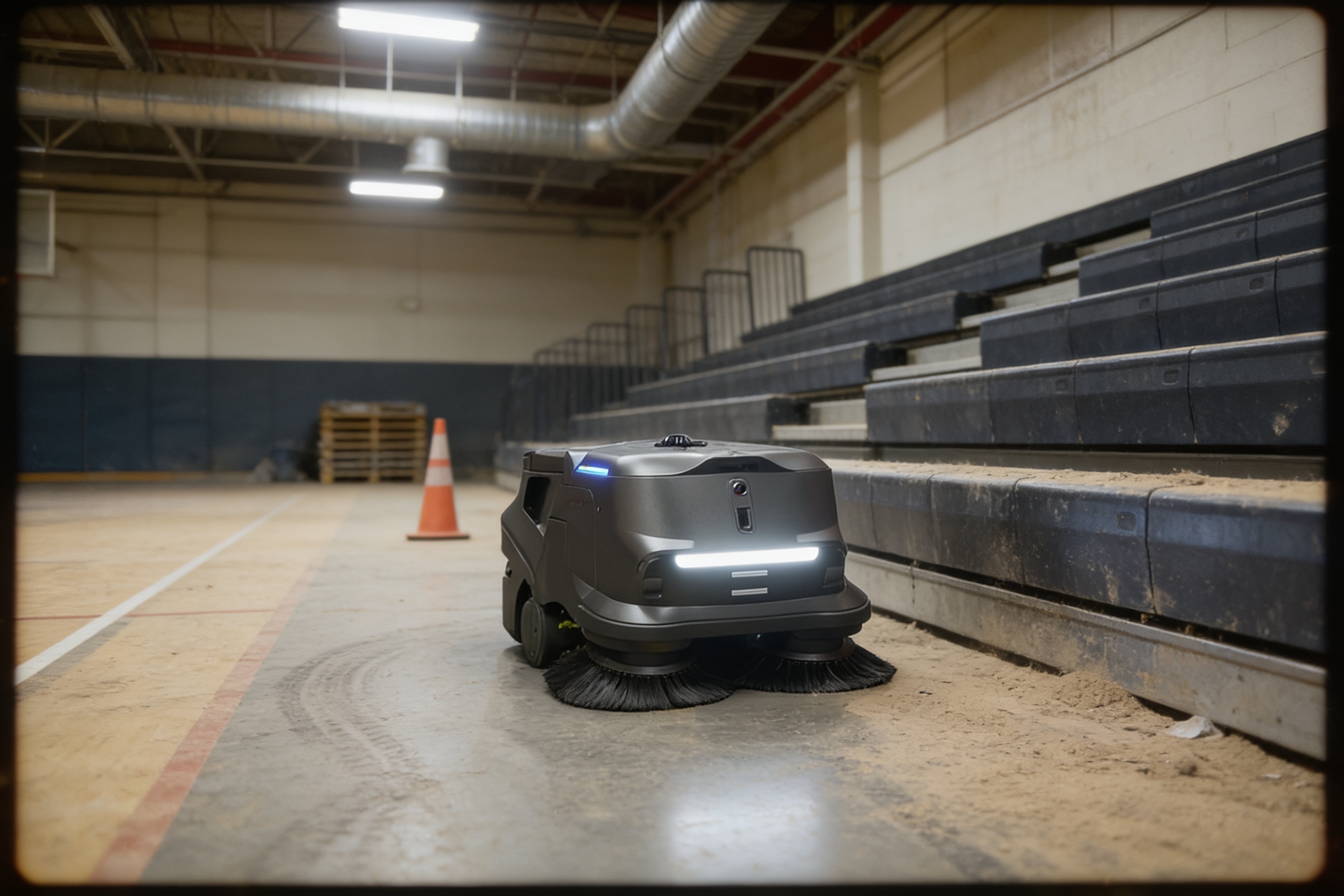
A robot can take the flat, open floor that repeats. Main aisles, long straight drive lanes and open deck sections with clear sight lines are the best fit, because the route can be mapped once and run again. Sweeping and scrubbing open decks are the two tasks to test first.
Some work stays with people. The list below separates the two groups so the scope is clear before anyone signs off.
- Robot can take: sweeping and scrubbing open deck aisles on a repeated route, long drive lanes and straight ramps without steps, and lanes kept clear during the run.
- Staff keep: stairwells and changes in level, corners and stall edges a robot cannot reach, trash and bin service, oil, chemical and spill response, restroom and elevator lobby cleaning, and reporting of damage and safety issues.
- Repeated deck sweeping
Cleaning Robot
Runs the mapped route the same way every night
Night Janitor
Varies pace, and can slow on a tired shift
- Stairs and corners
Cleaning Robot
Limited to mapped open floor
Night Janitor
Reaches stairwells, corners and stall edges
- Spills and hazards
Cleaning Robot
Can stop and alert, but cannot judge the spill
Night Janitor
Assesses, contains and reports
- Reporting damage
Cleaning Robot
Logs obstacles it runs into, not general damage
Night Janitor
Notices lights, cracks and leaks while walking
- Absence and cover
Cleaning Robot
No sick days, but needs backup units when down
Night Janitor
Can be absent, leaving a gap on the shift
- Route handover
Cleaning Robot
Stored route that any operator can start
Night Janitor
Depends on training and what the person knows
What do the labor and injury numbers say about night janitor staffing?
BLS projects about 351,300 openings a year on average for janitors and building cleaners, largely from turnover, according to the BLS Occupational Outlook Handbook. The same source projects employment growth of 2 percent from 2024 to 2034, so the work is steady rather than fast growing. Services to buildings and dwellings is the largest employing industry for the occupation, at 35%.
Turnover is the staffing problem most garage owners feel. No official BLS turnover rate for janitors was found for 2024. Janitorial Manager says turnover figures from 75% to 400% have circulated, and that professional and business services, a broad sector, runs about 64% on a BLS-based comparison. Treat those as rough signals, since every new night hire means a new training cycle on the route and the rules.
Injury rates matter too. BLS reports that janitors and cleaners, except maids and housekeeping cleaners, had 21,100 nonfatal cases with days away from work in private industry in 2020, at a rate of 191.6 per 10,000 full-time equivalent workers. In 2019 the rate was 157.4 per 10,000 full-time workers, against 86.9 for all occupations, per the BLS injury snapshot series. Those two years come from different snapshot pages, and no 2021 to 2024 figure was found. Overtime and sick day figures for this setting were not found, so this page does not quote them.
How does a team work with a cleaning robot?
The working model is a robot plus fewer staff. The robot covers the repeated deck sweeping, while a person starts it, checks the route, clears stray carts and cones, and handles everything on the exception list. The night janitor's job becomes a smaller route operator role with less walking of open floor.
Staff need short, specific training: how to start and stop the robot, what to do when it stops, how to clear a blocked route, and how to log what the robot could not finish. We train the team on site and handle service and dispatch after go-live.
Keep the same person on the route when possible. With turnover this high, a stored route and a written handover list keep the work consistent when someone new arrives, but they do not replace the person who knows the floor.
What can a cleaning robot not do in a parking garage?
A robot does not judge. It cannot tell a leaking car from a wet spot, cannot decide when a spill needs a barrier, and cannot report a damaged light or crack the way a person can unless the site sets up a separate reporting step. It needs a mapped, mostly clear route, so a deck full of parked cars or unplanned obstacles limits it.
It also does not replace the whole night shift. Stairs, corners, bins, restrooms and chemical spills still need people. A garage that is mostly those tasks will get little from a robot, and that is a reason to decide against one.
Adoption is still early. An AACEM and ISSA survey from 2019 of about 23,000 building service contractors, in-house providers and facility managers found that 62% of BSCs, 68% of in-house providers and 69% of facility or property managers had not used autonomous cleaning equipment. About one-third of those non-adopters said they were somewhat likely to adopt within a year. That survey is older than most of today's shifts, so ask your own contractor how they use this equipment now.
What does it cost to lease a cleaning robot compared with a night janitor?
We do not publish a lease payment on this page, because the right figure depends on the floor, the number of decks, and the hours the robot will take over. The lease is a fixed robot lease payment through financing, and the figure comes in a quote after a free site assessment. Maintenance can be included in the service plan.
On the labor side, compare the hours that move to the robot, not a headline wage. The government wage data on this page gives the local wage for this job, and that is the figure to set beside the robot's share of the shift. Include overtime, sick cover and any unfilled night shifts, since those are the costs that rise when turnover is high.
Savings are not guaranteed. Payback depends on how many decks run the same route, how many shifts go unfilled, and whether the staff left on the night crew can handle the exceptions. A phased pilot on one level shows the real hours before any broader decision.
How do you get started with a cleaning robot in a parking garage?

Start with a free site assessment. We map the levels, measure the open flat floor, count obstacles and stairs, and log what the night shift actually does. That map shows which robot fits and which decks belong on the route.
Then run a pilot on one level, usually with one leased unit. Use it to measure what the robot finished, what it could not reach, and how much time staff spent on exceptions. Plan a backup unit or loaner units so one robot down does not leave a deck uncleaned.
Roll out in phases so the garage stays open. We train the team, provide go-live support, and handle service with on-site dispatch and remote triage.
Frequently asked questions
Want a cleaning robot at your parking garage?
Tell us about your site. We will recommend the robot, quote the lease, and keep it serviced.
Sources
- US Bureau of Labor Statistics, Occupational Employment and Wage Statistics (OEWS May 2024)
- UNLV architecture capstone (2014 citation of about 40,000 US parking garages)
- UrbanCincy, citing the Urban Land Institute on about 40,000 parking structures
- poidata, US parking garage listing count as of June 2026
- BLS Occupational Outlook Handbook, Janitors and Building Cleaners
- BLS Injuries, Illnesses and Fatalities snapshot, Janitors and Cleaners (except Maids and Housekeeping Cleaners)
- FMLink, AACEM and ISSA autonomous cleaning survey
- ISSA, AACEM and ISSA autonomous cleaning survey report
- Janitorial Manager, ways the janitorial industry turnover rate has changed