
The short answer
A cleaning robot vs night janitor comparison at a stadium comes down to the repeated open floor. A robot makes sense for the same floor passes across concourses and seating aisles that run after every event, and it makes less sense for suites, restrooms, trash and cluttered or stepped areas. The practical setup is a robot plus fewer staff, never zero staff, with people handling the detailed and judgment work.
See what a cleaning robot costsRun the numbers in the ROI calculator
Key takeaways
- A robot takes the repeated open floor passes, while people keep suites, restrooms, trash and odd messes.
- One vendor cleaning blog puts a full post-game cleanup at 4 to 12 hours, so the share of open passes decides the fit.
- Plan a robot plus fewer staff, never zero staff.
- No official BLS turnover rate for this job was verified, so use your own overtime and sick day records.
- A free site assessment comes before any lease quote, so your floor and debris drive the number.
Cleaning robot vs night janitor at stadiums: which makes sense?
A cleaning robot makes sense in a stadium when the work is repetitive and open. Wide concourses, flat seating aisles and tunnel corridors get the same floor pass after each event, and a night janitor who covers those areas spends much of the shift repeating that pass. That repeated pass is where a robot earns its place.
It makes less sense where the floor is cluttered with debris, has steps or sharp level changes, or needs a person to judge what to pick up. It also makes less sense when most of the post-event work sits in suites, restrooms and waste areas, because those tasks stay with staff. On a night like that, a robot does not remove the need for a crew.
The real question is not robot or crew. It is how many of the repeated open-floor hours a robot can take, and how many detailed hours still need people.
What does a night janitor actually do after a game?
After the crowd clears, the work splits by area. Suites and restrooms get detailed attention, while concourses and seating aisles get sweeping, debris removal and mopping. Vendor task lists for stadium cleaning include sweeping and blowing debris from seating rows, bagging and staging waste, vacuuming suites, mopping concourses and resetting restrooms.
The crew can be large. A Stadia Magazine feature describes a split crew of 60 to 70 members covering suites, restrooms, the concourse and the media room. The split of tasks matters more than the headcount, because each group works a different part of the floor and few members can swap roles mid-shift.
The schedule runs backward from the next event day. The crew has to finish before the floor is needed again, so the work is planned from the next event, not from the final whistle. The robot route has to fit inside that same window.
Median hourly wage, Janitors and Building Cleaners
$4,041
Monthly cost of one full-time worker, at the median wage plus payroll costs (an estimate, not a quote).
Which parts of the floor work can a robot take, and which can it not?
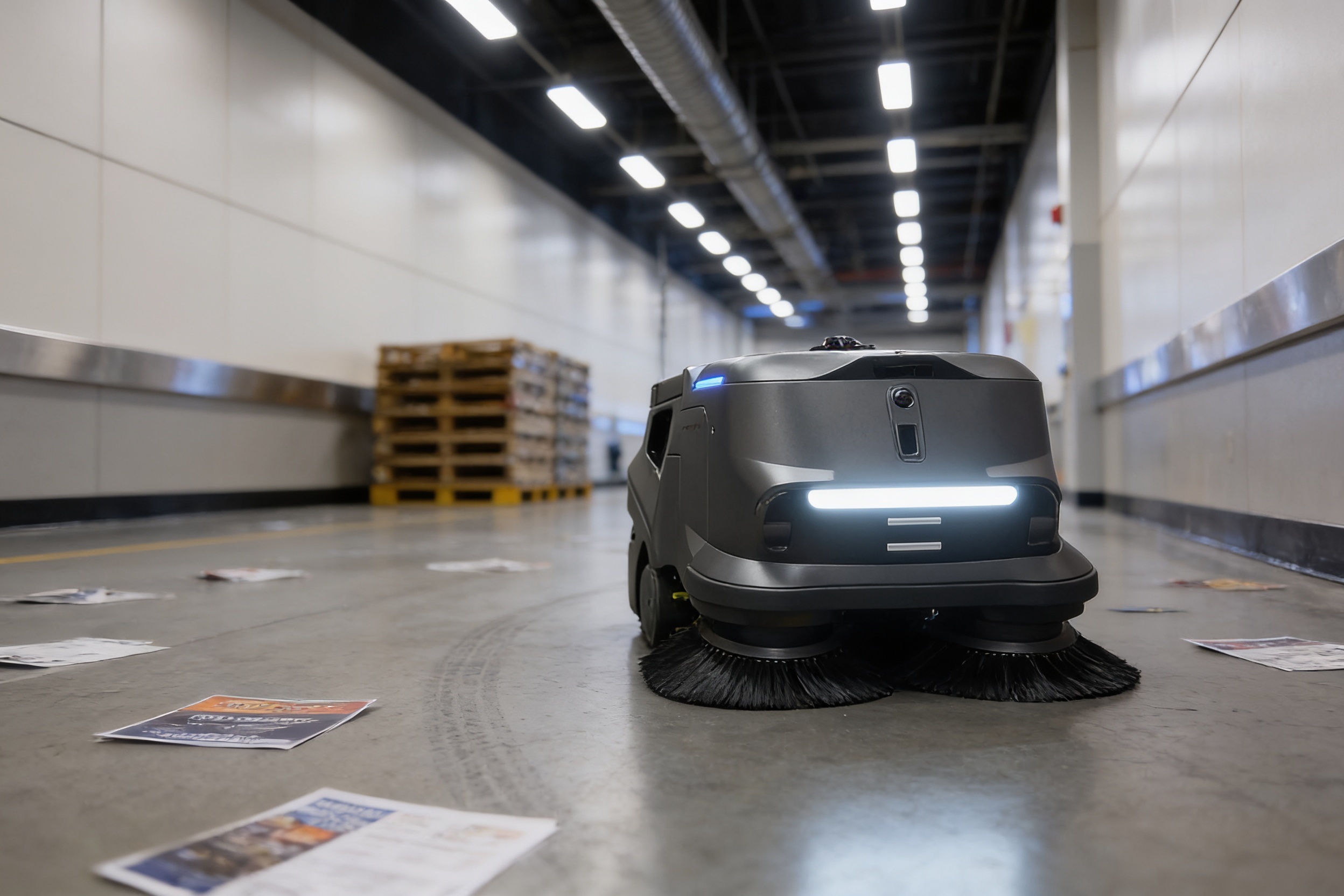
The robot can take the repeated, open floor passes: sweeping and scrubbing concourse walkways, flat seating aisles, and tunnel corridors. These areas have predictable paths and wide surfaces, so the robot can run the same mapped route night after night without a person walking behind it for every pass.
It cannot take the detailed or judgment work. Suites, restrooms and media rooms need hands and sometimes different products. Trash pickup, bagging and waste staging are people tasks. A person also has to stop the robot for unusual debris, a spill or a blocked route, and decide whether a spot needs a second pass by hand.
Some areas sit in between. Club level lounge floors and food court dining areas can suit the robot when they are flat and clear, but moved furniture and stand debris need a crew first. The site assessment should mark each zone as robot, mixed or staff only, so the schedule is built on that map and not on a guess.
- Repeated open floor passes
Cleaning Robot
Runs the same planned route every night without tiring
Night Janitor
Covers the route well, but the work is repetitive and tiring over a long shift
- Trash, bagging and waste staging
Cleaning Robot
Not suited, stays with staff
Night Janitor
Handles it directly
- Suites and restrooms
Cleaning Robot
Not suited, stays with staff
Night Janitor
Handles detailed cleaning and product changes
- Stairs and steep level changes
Cleaning Robot
Needs a flat, mapped route
Night Janitor
Can walk and clean stepped areas
- Odd spills and unusual debris
Cleaning Robot
Stops and needs a person to clear it
Night Janitor
Judges the mess and clears it on the spot
- Schedule and layout changes
Cleaning Robot
Needs the route re-mapped when the layout changes
Night Janitor
Adapts on the spot to a new layout
How many hours does the post-event job take?
One vendor cleaning blog puts a full cleanup after a sold-out game at 4 to 12 hours, depending on venue size and event scope. That range is wide and comes from a vendor, so treat it as a planning range, not a benchmark. The blog ties the spread to venue size and event scope, which is why the same route can take very different times in different buildings.
The number that matters for a robot is how much of those hours sit on the repeated open passes. Published data does not break the post-event shift down by task, so that split has to be measured at your venue. A tally of open-pass minutes against suite, restroom and waste minutes gives a real basis for the decision.
Time one post-event shift before deciding. Log the open-pass work separately from suites, restrooms and waste. The breakdown matters more than the total, because two venues with the same total hours can have very different open-floor shares.
| Task | Today | With a robot |
|---|---|---|
| Full venue cleanup after a sold-out game | 4 to 12 hours, according to one vendor blog | Robot covers the open passes; crew still works the rest |
| Sweep and scrub concourse walkways | Part of the crew's shift; not timed in published data | Planned route runs while staff check for debris |
| Suite and restroom cleaning | Staff hours, unchanged | Stays with staff |
| Trash pickup and waste staging | Staff hours, unchanged | Stays with staff |
The 4 to 12 hour range comes from one vendor cleaning blog. Published data does not split the shift by task, so measure the open-pass hours at your own venue before deciding.
How much staffing and turnover sits behind this job?
The government wage data on this page covers janitors and building cleaners nationally, and it is the reference point for the local wage for this job. The Bureau of Labor Statistics counted 2,447,700 jobs in this occupation in 2024 and projects 47,800 new jobs from 2024 to 2034, an outlook of 2% that BLS describes as slower than average, according to its Occupational Outlook Handbook. A slow outlook is one reason to plan for thin night coverage rather than assume a full crew will always be there.
Injury risk is part of staffing. BLS data for janitors and cleaners, excluding maids, shows 191.6 days-away-from-work cases per 10,000 full-time equivalent workers in 2020, up from 157.4 in 2019. For all private industry, the total recordable case rate was 2.3 per 100 full-time equivalent workers in 2024, down from 2.4 in 2023, according to a summary of BLS data in Business Insurance.
No official BLS turnover rate for this occupation was found in this research. A trade blog gives a very high frontline turnover figure, but its sources could not be checked, so it stays off this page. Use your own records for turnover, overtime on post-event nights and sick day calls. A night schedule that depends on a few people usually shows strain in those records first.
What can a robot not do at a stadium?
A robot does not handle the hard parts of a stadium night. It cannot judge a spill that needs a different product, lift and bag trash, reach into suites or restrooms, or decide what to pick up. Crews still walk the floor to catch what the robot misses, and that walk belongs in the staffing plan.
Routes change. Event layouts, temporary barriers and stage setups block aisles, and a robot runs on a mapped route. Plan a site survey and a map update whenever the layout changes, and allow planning time before the next event day. A route that worked for one event may not work for a game with different seating.
Surfaces need checking. Stairs, steep ramps and wet floors fall outside the open-floor case. The site assessment should confirm which surfaces the robot can run and which need a person, and it should check the floor after an event, not only on a quiet visit, because debris on a full night can differ a lot from an empty building.
How does a team work with a robot?
Always plan a robot plus fewer staff, never zero staff. The robot takes the repeated open passes, and the crew keeps suites, restrooms, waste and the judgment work. Staff stop to clear debris, check the route and handle the parts the robot cannot reach.
Training decides how well this goes. Lead staff need to start and stop the robot, clear a blocked route, handle an odd spill and know when to call for service. Training happens on site as part of deployment and go live support, and it should be repeated whenever the crew changes.
Adoption is still early. An AACEM and ISSA autonomous cleaning survey from winter 2019 described adoption as in an infant stage, and about one-third of non-adopters said they were somewhat likely to adopt within a year, according to FMLink. That data is dated, but it suggests your crew may be new to this kind of work, so plan for a longer first month.
When does a cleaning robot make sense, and when does it not?
It makes sense when repeated open floor is a large share of the post-event work, the floor is mostly flat and mapped, the route stays the same most nights, and the venue can keep a crew for the hard tasks. It makes less sense when most of the work is suites and trash, or when the floor is cluttered, steep or changes layout for every event.
Venue counts depend on the definition used. WNPR reports 203 ballparks used by affiliated professional baseball teams in the US, including minor league parks. BrilliantMaps reports 429 US stadiums with capacity over 10,000, though the year and definition are unclear. Neither figure is a national census, so count the venues you actually serve.
Start with one area before a wider rollout. Measure the hours on the open passes against your crew log, and expand only if the numbers hold across several event days, not just one.
How do I get started?
Start with a free site assessment. We map the concourses, seating aisles and tunnel routes, measure the open passes, and mark the areas that stay with staff. The lease quote comes after that assessment, so the fixed lease payment reflects your actual floor rather than a generic estimate.
The lease runs through financing, and the program covers deployment, integration, staff training and service. Maintenance included, on-site dispatch, remote triage and spare unit coverage keep the robot from sitting idle after the first event. Emergency response is nationwide.
Pilot one concourse or one venue first, then decide on expansion from your own hours log. Use the BLS figures for the staffing picture and the site assessment for the robot fit, and set a review date after the first full season of event days.
Frequently asked questions
Upcoming event venues & stadiums events
- Trade showBrats & RobotsNov 10, 2026Alliant Energy Center Exhibition Hall, Madison, WI
- MeetupMPI Virginia Morning Brew Meet-Up, November 2026Nov 10, 2026Hampton, VA
- SummitVA1 Governor's Tourism Summit 2026Nov 18 to 20, 2026Kalahari Resorts & Conventions, Spotsylvania, VA
- ConferenceVirginia Association of Fairs ConventionJan 14 to 17, 2027Williamsburg Lodge, Autograph Collection, Williamsburg, VA
Want a cleaning robot at your stadium?
Tell us about your site. We will recommend the robot, quote the lease, and keep it serviced.
Sources
- US Bureau of Labor Statistics, Occupational Employment and Wage Statistics (OEWS May 2024)
- BLS Occupational Outlook Handbook: Janitors and Building Cleaners
- BLS injury and illness snapshot: Janitors and Cleaners, Except Maids and Housekeeping Cleaners, 2016 to 2020
- Business Insurance: work injuries down in 2024, summarizing BLS data
- WNPR: ballpark count episode
- BrilliantMaps: largest stadium by capacity in each US state
- Vendor blog: event day cleaning playbook for stadiums and arenas
- Stadia Magazine: After the Crowd Clears feature
- FMLink: AACEM and ISSA autonomous cleaning survey