
The short answer
Cleaning robot cost in Grand Rapids depends on how much floor a site has, how many hours and shifts the robot covers, what the surfaces and traffic look like, and how the machine is mapped, integrated and serviced. There is no single figure for the metro, because a large open warehouse and a small showroom have unlike routes and hours. We set the lease quote after a free site assessment, which measures the actual floor and hours and lists every cost line.
Key takeaways
- Floor area, shifts and traffic move cleaning robot cost in Grand Rapids more than any single machine feature.
- The metro had 11,490 janitors and cleaners employed in May 2025, so night labor planning is a local issue.
- Mapping, software, service, insurance and training are the costs most sites miss at first, so get them on the quote.
- Winter salt and grit set the service schedule for entryways and filters.
- The lease quote comes after a free site assessment, with each service line listed.
What does cleaning robot cost in Grand Rapids depend on?
Cleaning robot cost in Grand Rapids is not one number, and any page that gives a single figure for the metro is skipping the site. A lease for an autonomous floor scrubber follows the floor it has to cover, the hours it runs, the surfaces it crosses and the support that keeps it working. Two buildings of similar size can land far apart if one runs overnight and the other has a long open floor with constant foot traffic.
The job itself is the same everywhere: scrub the floor, keep the route clear and leave the floor dry and safe for the morning. What changes is the labor it replaces and the conditions it meets. Grand Rapids has a sizable cleaning workforce and a long, wet winter, and both push the decision toward a scheduled machine rather than a shift that has to be staffed every night.
The sections below cover each cost driver, the costs that show up late, the labor hours involved, how a lease is set up, what the robot cannot do, and how to get a quote after a free site assessment.
What moves cleaning robot cost up or down at a Grand Rapids site?
Floor area is the first driver, but it matters through hours, not square footage alone. A machine that finishes its floor in one overnight run is easier to justify than one that has to pass a large floor several times a week. A vendor blog on scrubber output gives an estimate of 8,000 to 12,000 square feet per hour for a compact walk-behind and 20,000 to 35,000 for a large walk-behind, so the number of units follows from the floor and the available window.
Surfaces and obstacles come next. Sealed concrete, polished floors, carpet edges and dock transitions each change how the robot maps and how often it stops. Racking, pallets and parked equipment take away usable path width, and the site assessment measures that before we set a route.
Shifts and traffic set the working window. An empty building at night gives the robot a clean run. A building with deliveries, doors and staff on the floor needs a route that yields to people, which usually means more mapping work and a narrower schedule.
The number of units, mapping, integration and service are the last levers. One unit covers one defined zone. A second or third unit adds coverage and backup, but it also adds a charging plan and a service schedule. Integration with doors, lifts or building systems adds setup time, and a quote should show that time as its own line.
How many cleaners work in Grand Rapids, and why does turnover matter?
According to an aggregator citing BLS OEWS data for May 2025, the Grand Rapids metro had 11,490 janitors and cleaners, except maids, employed. That is the pool an in-house team or contract crew draws from, and it is the pool a site has to keep staffed every night.
Turnover is the harder part. A janitorial industry blog summarizing BLS data puts average annual total separations for the occupation at around 45% since 2017, excluding 2020. That is a trade-press summary, not a direct BLS table. A commercial cleaning industry blog puts annual turnover in commercial cleaning and building services at typically 50% to over 100%. Treat both as directional.
Each departure means recruiting, onboarding and a stretch of thinner coverage. A robot does not quit, but it does need one named staff member who knows its schedule and can clear a fault. Scheduling the hard, repetitive pass takes the floor out of the question of who shows up on a given night.
How many hours of cleaning does a robot take over?
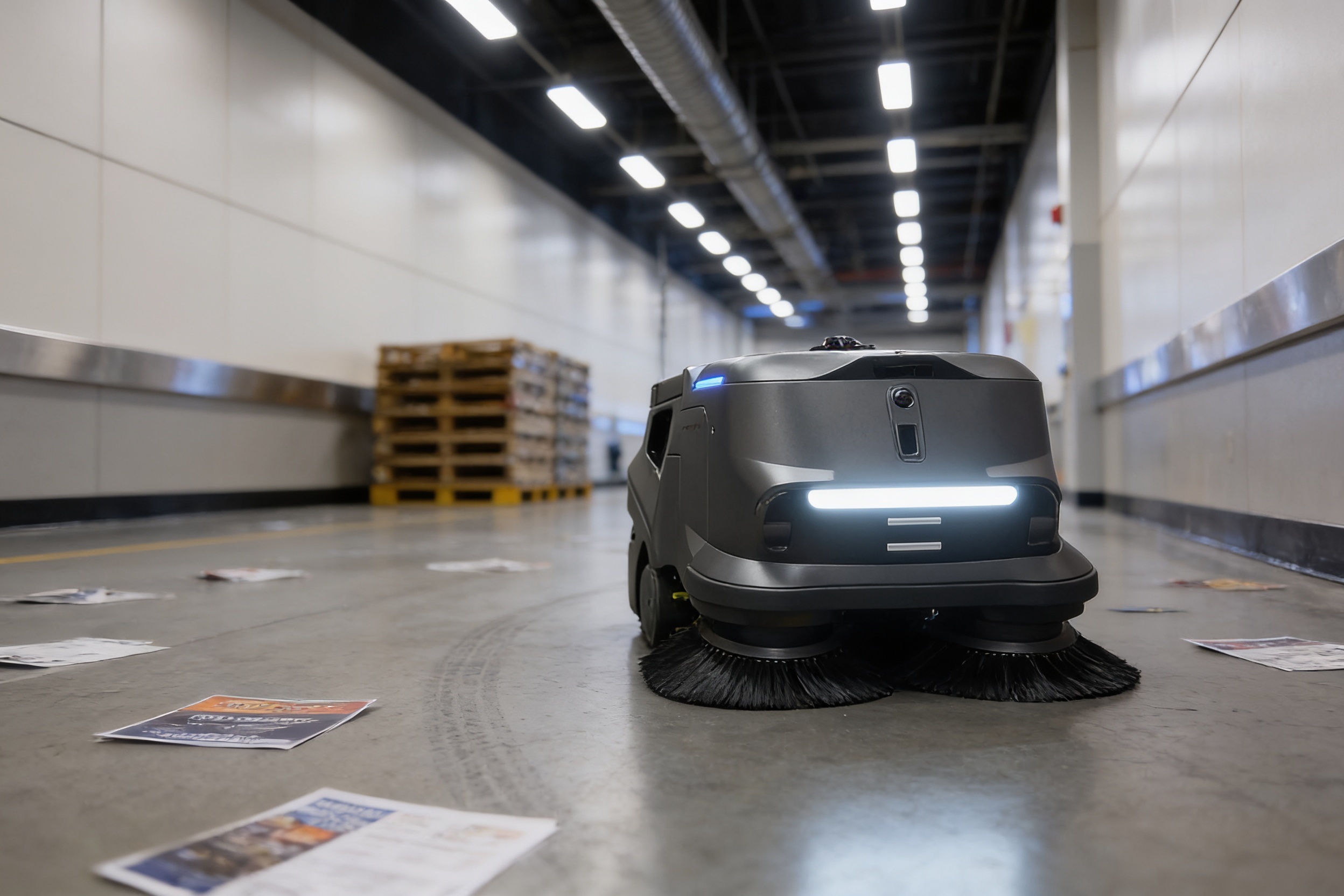
Published hours per shift for scrubbing in Grand Rapids buildings were not verified, so we do not give a local hour count here. What we can do is convert a rated output into machine time. The vendor estimate of 8,000 to 12,000 square feet per hour for a compact walk-behind works out to roughly 50 to 75 minutes of machine time for every 10,000 square feet, before turns, obstacles and breaks. Real output runs below listed figures, so the site assessment measures it on your floor.
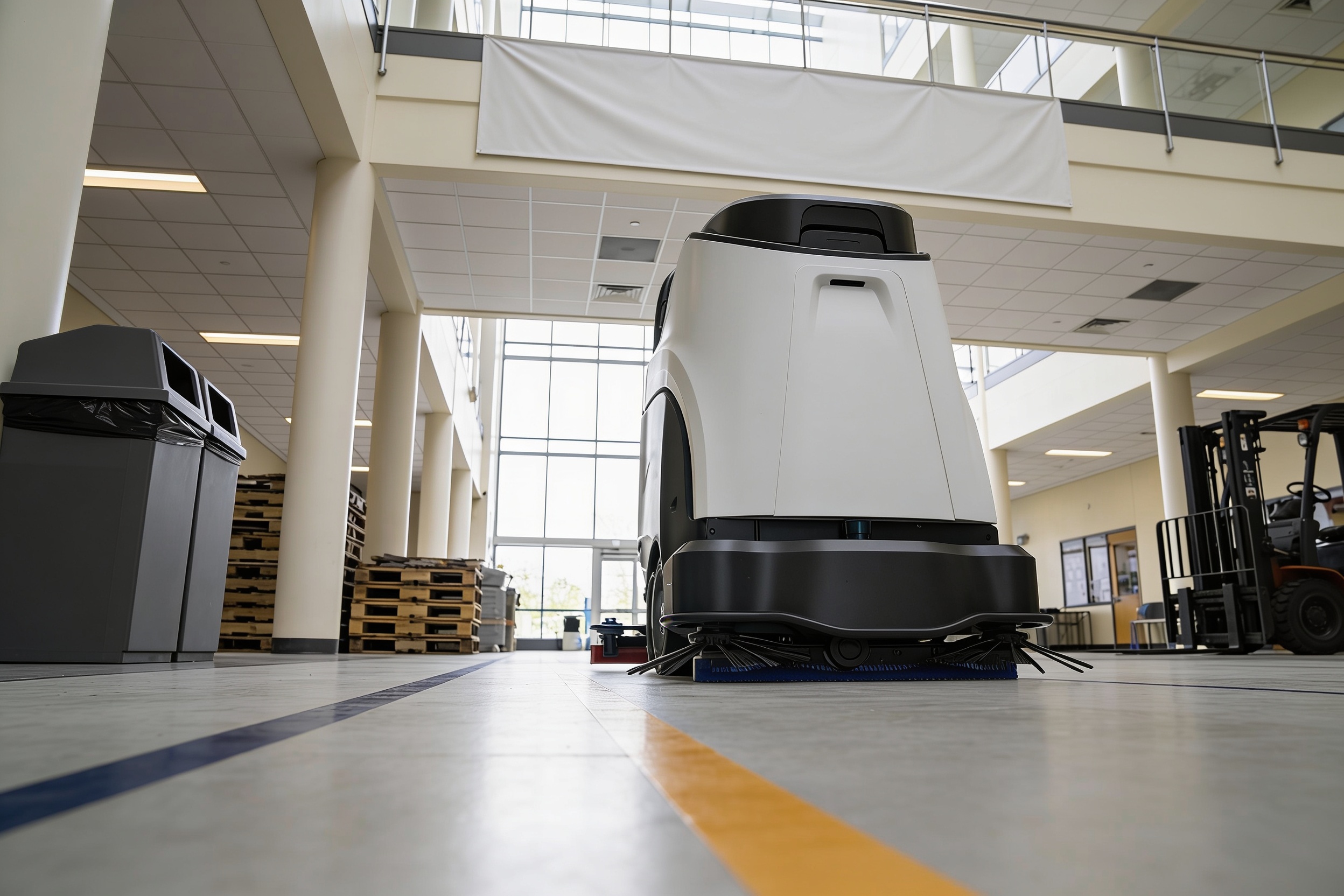
Ride-on machines cover far more ground. A distributor reference table reproducing a cleaning-width chart lists 44,669 square feet per hour for a 48-inch ride-on and 9,740 for a 20-inch walk-behind. Those are estimates too, but they show why machine size should follow the floor. The table below separates the crew work that stays from the work the robot takes over.
How does leasing through financing work, and what does the quote include?
Robots are leased through financing, not sold to your operation. The lease spreads the equipment cost across a fixed term, so the decision sits in the operating budget and the labor comparison can be shown on one page. The payment is set in the quote and stays fixed for the term.
The quote comes after a free site assessment, never before. We measure the floor, map the route, check the charging point and the network, and talk through shifts and staffing. The quote then lists the lease term, the fixed payment, deployment and integration, training, and the service plan, each as its own line. Anything the quote leaves to you, such as power or floor preparation, is named so nothing shows up later.
Many sites start with one unit on one zone. That lets the team test the route and the staff routine before it commits to more coverage, and it gives the approval group real site data. Backup coverage is a quote item if the floor cannot go uncleaned during a repair.
What do Grand Rapids winter and building stock change?
Winter is the main local factor. NOAA 1991 to 2020 normals put Grand Rapids snowfall at 77.6 inches a year, up 2.7 inches from 74.9 inches for 1981 to 2010, as reported by a local TV weather report citing NOAA. Snow brings salt, grit and wet entryways. A robot running a warehouse vestibule or a showroom entry picks up that grit daily through the winter, so brush and filter service intervals should be set at the start rather than after the first complaint.
Building stock is the second factor. We did not verify an age profile for Grand Rapids buildings. An older floor with patched concrete, uneven transitions or raised thresholds changes how the robot maps and how often it stops. The site assessment checks those conditions rather than assuming a flat, level slab.
Labor is the third. With roughly 11,490 cleaners in the metro, the labor comparison is strongest where a site cannot reliably fill a full night crew. A robot on a fixed night route removes the dependency on hiring for that shift, and that is the number a finance reviewer will want to see.
What can a cleaning robot not do?
A floor cleaning robot does not clean the whole building. It runs a mapped route on a floor it can cross. It does not clean stairs, glass, restrooms, trash rooms or high dusting, and it will not reach spills it cannot see or sticky residue that needs a hand tool. Those tasks stay with staff, and the hours table shows where they remain.
It cannot make a poor floor good. Cracked or heaved concrete, standing water and loose debris from construction can stop a route. Those are repair items, and a site assessment flags them before the machine is blamed for an unfinished run.
Injury risk does not disappear. The machine still moves through a building where people walk. According to BLS data for janitors and cleaners, floors, walkways and ground surfaces were the most common source of injury in 2019, and falls on the same level were the most common event. Marked zones, pedestrian rules and staff training stay part of the job.
How do I get a quote for a cleaning robot in Grand Rapids?
Start with the floor. Send the approximate floor area, the surface types, the hours the building sits empty and the entryways that take winter weather. We schedule a free site assessment, which measures the route, checks the charging point and sets the number of units. The quote follows that visit, with the lease term, the fixed payment and each service line shown.
Bring the person who will run it. A quote lands better when the shift lead or facilities manager walks the site, because they know where the route breaks and what the staff routine has to fit around.
If the approval group wants proof before a full commitment, ask for a single-zone start. One unit on one defined route, measured against the hours it takes over, gives real site data within normal building operations, and it shows whether a second unit is worth the added coverage.
Frequently asked questions
Put a robot to work in Grand Rapids.
We walk your site, learn the job, and recommend the unit that fits. Then we quote the lease, deploy it, and keep it serviced.
Sources
- AACEM and ISSA autonomous cleaning survey, 2019 summary
- Janitorial industry blog summarizing BLS turnover data
- Commercial cleaning industry blog on turnover
- BLS Occupational Safety and Health snapshot, janitors and cleaners, 2016 to 2020
- BLS chart data, janitors and cleaners, 2020
- Vendor blog on floor scrubber output rates
- Distributor reference table on industrial cleaning equipment widths
- Local TV report on West Michigan climate normals citing NOAA