
The short answer
Cleaning robot ROI in Baltimore comes from floor hours, not from cutting staff. A floor machine covers a set number of square feet per hour, so the hours a robot takes over depend on how much open hard floor a building has and how the route is laid out. Read any savings range as a planning estimate until a free site assessment measures your floor and your shift.
Key takeaways
- The return comes from floor hours the robot takes over, valued at the local wage for this job.
- Published coverage rates assume ideal conditions, so plan on less than the top-line figure.
- Detail cleaning, restrooms and obstacle clearing stay with staff.
- The lease payment is quoted in writing only after a free site assessment.
- Pilot one floor first, then widen the robot's route once the hours are proven.
Run the numbers for your site
Auto-detected from your location - we use the real BLS wage here. Not right? Pick your city or state above.
What do you want to automate?
The robot runs the open floor overnight; your crew keeps detail and edges.
What is cleaning robot ROI in Baltimore, and where does the return come from?
For a business in Baltimore, the return on a cleaning robot comes from the hours of janitor-type work the machine takes off the schedule. It is not a headcount cut. Janitors and building cleaners split their shifts between floor machine passes, detail work, restrooms, trash and resets, and a robot only replaces the machine passes on open hard floor.
The labor side is priced on the government wage data shown beside this page, for the Janitors and Building Cleaners occupation in the Baltimore area. Every hour the robot covers is valued at that local wage, and no other staff time is priced. If the people who mainly work your building are another job, such as nurses or guest service staff, the robot still takes janitor-type work off their plate, and that is the only labor it values.
We lease the robot through financing, then deploy and integrate it, train staff and service it nationwide. The cleaning robot ROI in Baltimore for your building depends on two inputs we measure on site: the open hard floor that a machine can scrub and the hours your team spends on it today.
How much janitorial work is there in the US?
The Bureau of Labor Statistics reports that 2,447,700 janitors and building cleaners were employed in 2024, according to its Occupational Outlook Handbook. The same source projects 2% growth from 2024 to 2034, which it calls slower than average, with 47,800 jobs added. A large occupation with slow growth means the work is common, and most buildings face the same staffing question.
That national count says little about one building. The number that matters is the hours your schedule holds for floor work. Pull a few weeks of timesheets and split them into floor machine passes, detail cleaning, restrooms, trash and set-up. Only the first group is a robot candidate. For this page, the model assumes three people on floor work at a site of this kind. That is a planning assumption, not a published figure, and the site assessment replaces it with your actual count.
Median hourly wage, Janitors and Building Cleaners
$3,997
Monthly cost of one full-time worker in Baltimore, MD, at the median wage plus payroll costs (an estimate, not a quote).
How does the labor hours offset calculation work?

The math has three parts: the hours the robot takes over, the local wage for this job applied to those hours, and the lease cost. The robot's hours come from coverage. According to a janitorial supplier's published estimate, a compact walk-behind scrubber covers 8,000 to 12,000 square feet per hour in ideal conditions, a mid-size unit 12,000 to 20,000, and a large unit 20,000 to 35,000. A tool listing gives a wider practical range of 6,600 to 37,780 square feet per hour, which shows how much machine size, layout and conditions matter.
Worked example: 60,000 square feet of open hard floor at 12,000 square feet per hour is about 5 machine hours in one pass. Those hours are the robot's share. Value them at the local wage for this job, then compare that value with the lease payment and any setup work. The payback period is the time the cumulative hours value takes to cover the cumulative lease cost and setup.
How much of the work does a robot realistically take?
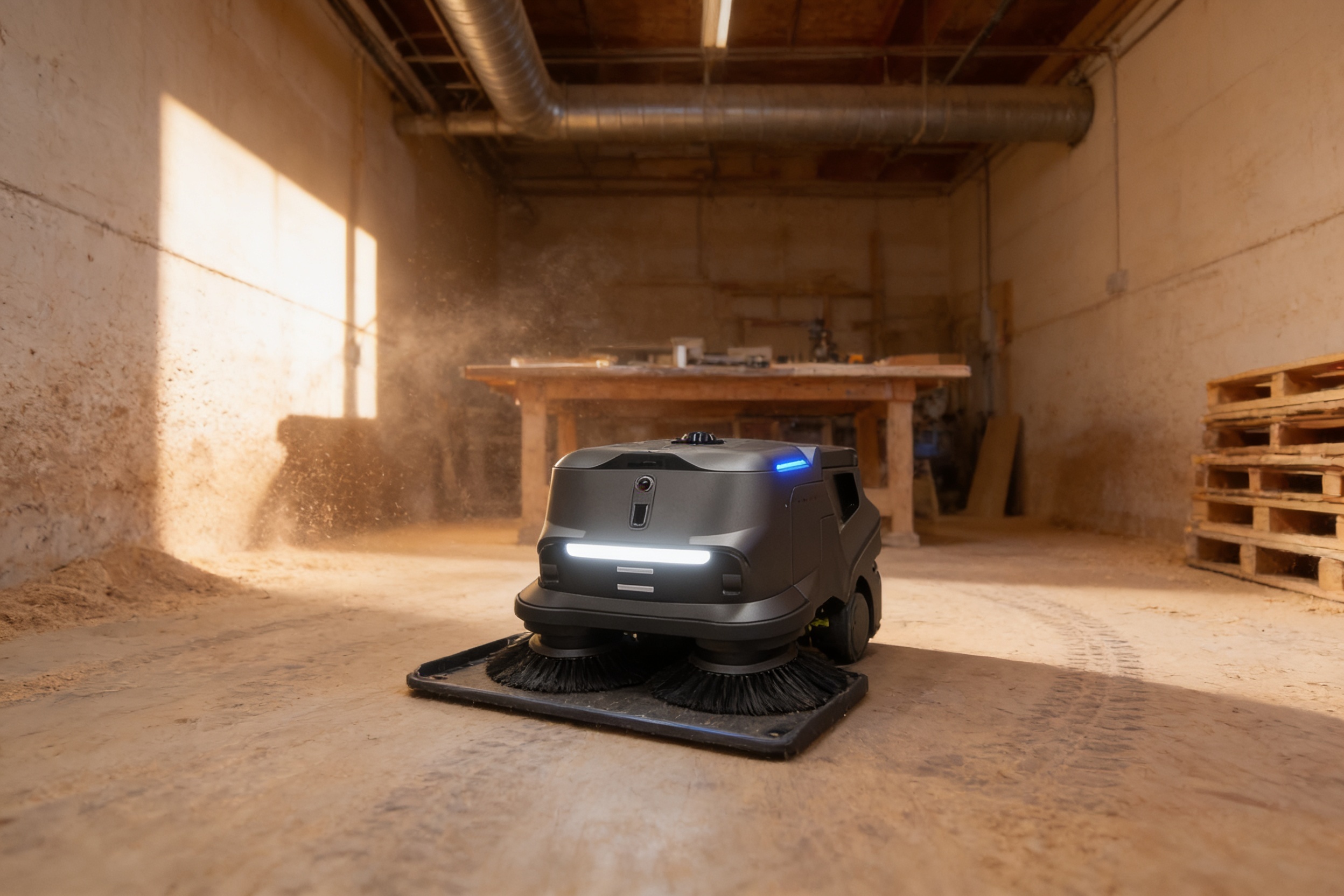
Coverage figures assume ideal conditions. Real output falls with cleaning width, machine speed, layout (turns, tight spaces and furniture), operator experience and floor condition, according to the same janitorial supplier's guidance. A floor with many turns and shelving loses more output than a long open corridor, so the same square footage can produce very different hours.
Plan the robot to take the open hard floor passes and assume staff keep the rest. Restrooms, trash, glass, spills and anything the machine cannot reach stay with people. Set the robot's share from the floor audit, not from the top-line coverage rate, and carry a margin for stops, rerouting and days the route is blocked.
What does the lease add to the math?
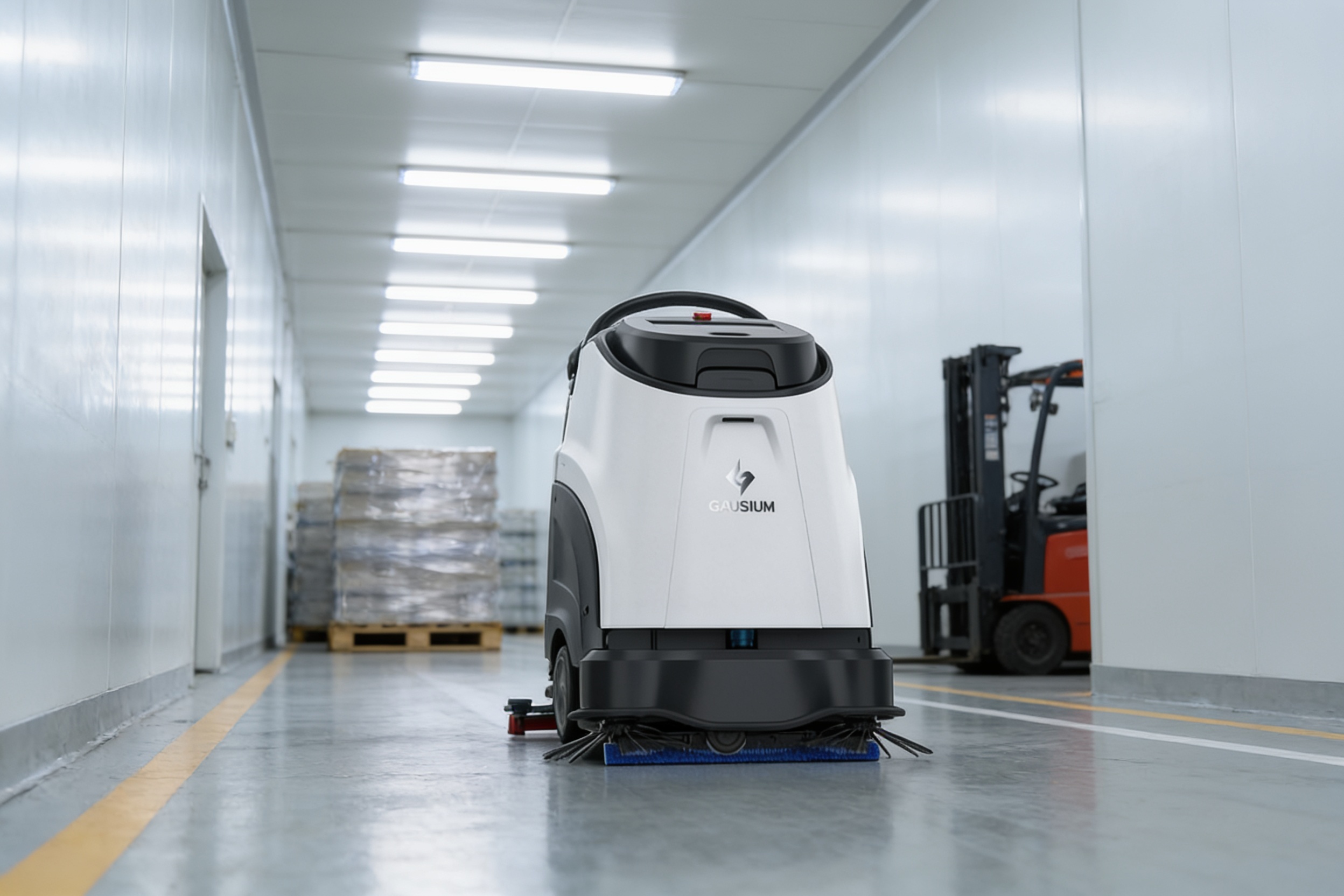
We lease the robot through financing, so there is no large upfront capital outlay. The lease is a fixed robot lease payment, and the number is quoted in writing after a free site assessment, not before. The quote depends on the machine suited to your floor, the lease term and the service level. Ask for the full list of what the lease covers, not only the payment.
In our program, maintenance is included, with on-site dispatch and remote triage when a fault appears. Your planning should carry the lease cost, any setup or integration work, and the staff time to check the route each shift. Set those costs against the hours value and you get a net return range, not a single figure.
What changes the number up or down, and what do injury rates show?
Four things move the range most: how much open hard floor there is, how many turns and obstacles the route has, how many floor hours the existing team already works, and whether the route can run without staff clearing it first. Each one changes hours, and hours set the payback period.
Injury data give a second reason to look closely at floor work. The Bureau of Labor Statistics recorded 18,680 nonfatal injury and illness cases with days away from work for janitors and cleaners, except maids, in 2019, a rate of 157.4 per 10,000 full-time equivalent workers. In 2020 the count rose to 21,100 cases, with a charted rate of 191.6 per 10,000. The Census of Fatal Occupational Injuries counted 42 fatal work injuries in this group in 2020, down from 45 in 2019. These are national figures, and we did not verify a Baltimore series, so treat them as context rather than a local input.
Which areas of a building does the robot cover?
The robot earns its hours on large, open, hard floors with predictable layouts. Office corridors, warehouse aisles, lobbies, parking garage levels and open sales floors usually suit it. Restrooms, kitchens, break rooms and areas crowded with furniture stay with staff. The site assessment maps each zone and marks where fixed equipment or doorways block the route.
Walk the floor before you decide. Mark the open passes and the detail work on a plan, because that split is the one the lease sits on. A zone that looks large on paper may have too many turns to earn many hours.
What are the risks to the return, and how do you avoid them?
The main risk is overcounting hours. Teams that size a robot to the top-line coverage rate, then find the route blocked, the floor changed or the detail work unchanged, end up with a return below plan. Avoid this by measuring the open floor you actually have and building in a margin for stops, rerouting and maintenance days.
Adoption is still early. In the AACEM and ISSA Autonomous Cleaning Survey from 2019, 62% of building service contractors, 68% of in-house service providers and 69% of facility or property managers reported no use of autonomous cleaning equipment. About one-third of those non-adopters said they were somewhat likely to adopt within a year. The survey is several years old, so read it as a baseline rather than a current rate.
Other risks include staff pushback when the robot arrives without a clear role for them, a route that is not updated when the building changes, and no plan for the day the machine is down. Pilot one floor, train the staff who check routes, and write down what the team does when the robot is out of service.

How do I get a precise figure, and how long until payback?
A free site assessment turns this range into a figure. We map the floor, mark the zones, measure the open hard area and time the floor work your team does now. The output is a site-specific hours estimate, the machine suited to the floor and a lease quote in writing. The result is a range, not a promise.
The path runs from assessment to floor mapping and route build, then a pilot on one floor, then wider rollout once the route holds. The pilot is where the range narrows, because it shows the hours the machine actually covers in your building. Expect the figure to firm up with the first working weeks of route data, not on day one.
Frequently asked questions
Put a robot to work in Baltimore.
We walk your site, learn the job, and recommend the unit that fits. Then we quote the lease, deploy it, and keep it serviced.
Sources
- US Bureau of Labor Statistics, Occupational Employment and Wage Statistics (OEWS May 2024)
- Bureau of Labor Statistics, Occupational Outlook Handbook: Janitors and Building Cleaners
- Bureau of Labor Statistics, Injuries, Illnesses and Fatalities snapshot, 2015 to 2019
- Bureau of Labor Statistics, Injuries, Illnesses and Fatalities snapshot, 2016 to 2020
- AACEM and ISSA Autonomous Cleaning Survey, as reported by FMLink
- AACEM and ISSA Autonomous Cleaning Survey report