
The short answer
Cleaning robot ROI in Houston, TX comes mainly from floor hours that janitors and building cleaners would otherwise work on scheduled or overnight shifts. The savings range depends on how many of those hours a robot realistically takes over, how much floor area is actually in use, and a fixed lease payment that we quote after a free site assessment. Treat any range before that assessment as a planning estimate, not a promise.
Key takeaways
- The return comes from floor hours a robot takes over from janitors and building cleaners type work, not from cutting whole teams.
- Floor area divided by a realistic production rate gives the hours, and the mapped share of a route sets the offset.
- High office vacancy means the floor area in use can sit well below the building total, so scope the occupied floors.
- Injury exposure for this occupation is high, so moving repetitive floor passes to a robot has value beyond hours.
- A free site assessment turns the savings range into a quote with a fixed lease payment for your building.
Run the numbers for your site
Auto-detected from your location - we use the real BLS wage here. Not right? Pick your city or state above.
What do you want to automate?
The robot runs the open floor overnight; your crew keeps detail and edges.
Is cleaning robot ROI in Houston, TX worth checking for my site?
Houston has a large amount of commercial floor space. Transwestern reported an inventory of about 205.7 million square feet in its Q4 2025 Houston office market report, with direct vacancy at 21.5 percent. Those figures describe office stock, not cleaning volume, but they show how much hard floor and carpet sits in one metro, and why the return question has to be answered building by building.
The return question is narrower than the market size. For one site, it asks how many hours of floor work a robot can take over from the people doing that work, and whether those hours are worth more than the fixed lease cost. That depends on the building, the schedule and the floor types, so the calculator on this page starts from your inputs rather than a city average.
How many janitors and building cleaners work in Houston?
The Bureau of Labor Statistics Occupational Employment and Wage Statistics counted 45,340 janitors and cleaners, except maids and housekeeping cleaners, in the Houston-The Woodlands-Sugar Land metro for May 2023. The same series reported 46,440 for May 2022 and 46,200 for May 2021, so the local pool has stayed within a narrow band. The government wage data panel on this page gives the local wage for this job.
Nationally, the BLS Occupational Outlook Handbook reports about 2,447,700 jobs in 2024 and projects 2 percent growth from 2024 to 2034, which it describes as slower than average. The same handbook projects about 350,300 openings a year on average over the 2023 to 2033 projection period. For a site manager, that means staffing floor work is a recurring task, not a one-time hire.
We did not find a verified count of janitors or building cleaners at one site of this type, and the metro and national totals are not site figures. For planning, this page assumes two people doing floor work at a typical site. Your own roster replaces that assumption during the assessment.
Median hourly wage, Janitors and Building Cleaners
$3,414
Monthly cost of one full-time worker in Houston, TX, at the median wage plus payroll costs (an estimate, not a quote).
Where does the return actually come from?
The return comes from hours. A robot takes over a share of the floor work that a janitor or building cleaner would otherwise do on a scheduled or overnight shift, and those hours are valued at the local wage for that job. If front desk, nursing or guest service staff also do some floor tasks, the robot takes only that janitors and building cleaners type of work off their plate, and their own time is not priced.
The offset is set against a fixed lease payment. Service Robot Co. leases the robot through financing, then picks the unit for the site, deploys and integrates it, trains staff and services it nationwide. The payment stays fixed for the lease term and is quoted after a free site assessment. The savings range on the calculator is the hours offset minus that payment, shown as a range because the share of work a robot can take is not known until the site is mapped.
How does the ROI math work for a floor cleaning robot?
Start with production rate. The ISSA method divides the area cleaned by the time worked, so 10,000 square feet cleaned in 2.5 hours is 4,000 square feet per hour, as described in secondary cleaning guides. Janitorial Manager, which summarizes ISSA cleaning times, gives benchmark ranges of about 2,500 to 4,000 square feet per hour for damp mopping hard floors and about 3,000 to 5,000 square feet per hour for vacuuming open-plan carpet.
Take a hypothetical 40,000 square foot hard floor. At 4,000 square feet per hour, one mopping pass takes about 10 hours, and at 2,500 it takes about 16. Those are gross hours for one pass, before setup, rinsing, restroom work and travel. The robot offset counts only the hours of floor work it takes over, which is always smaller than the gross figure.
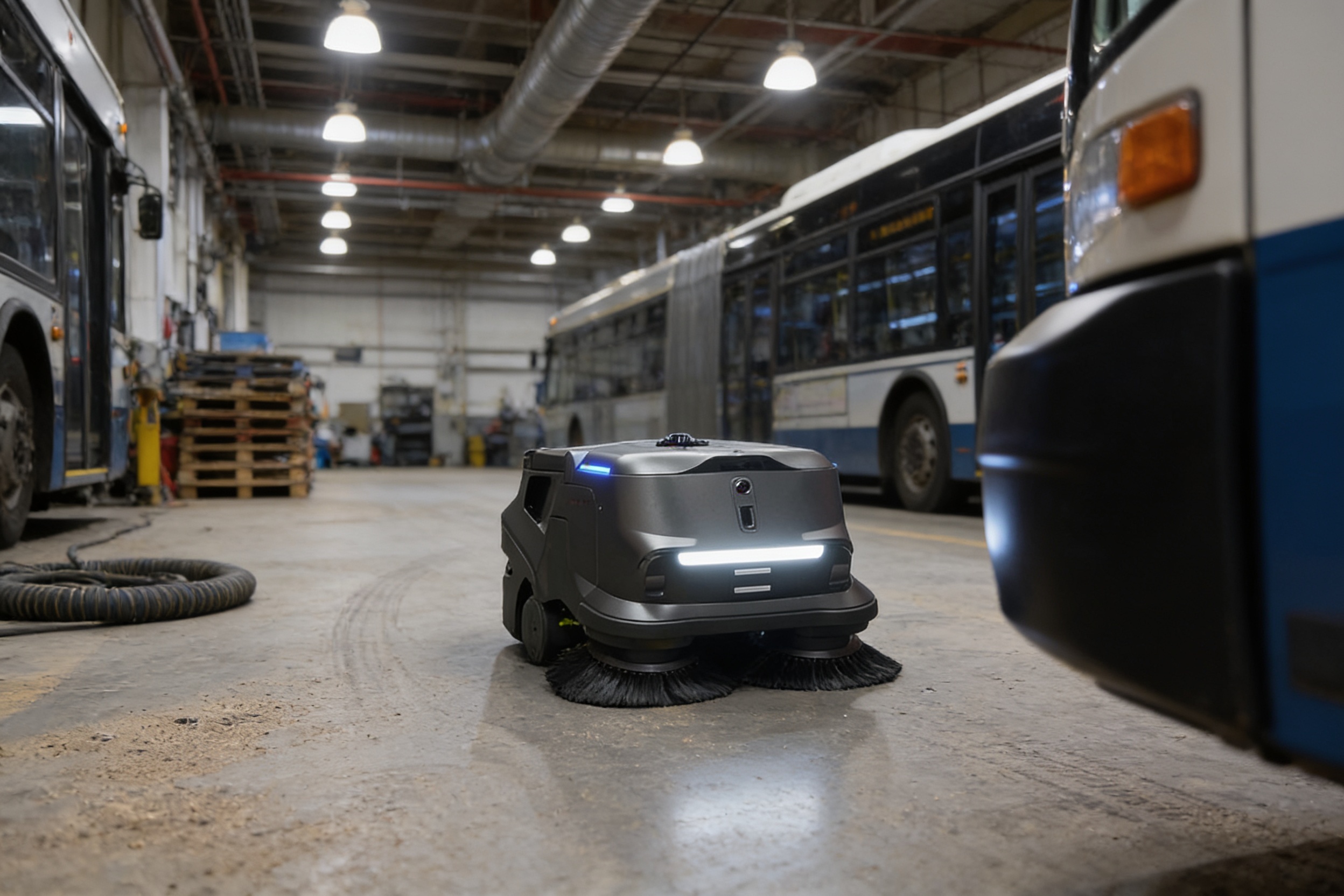
Those hours are then valued at the local wage for this job and set against the lease payment. Share matters most. A robot that covers most of a clear route is worth far more than one that reaches only a small part of it, and that share comes from mapping the site, not from a default assumption.
What changes the number up or down?
Several inputs move the savings range. The floor area in use matters more than the building total, because high office vacancy can leave whole floors unused overnight. Floor type and obstacles come next. Long, clear hard-floor routes give more robot hours than many small rooms with furniture, and carpet with cords lowers the share a robot can take.
Schedule also matters. An overnight or pre-opening window with no people present lets the robot run without supervision, which raises the share it can take. Before you rely on the offset, check it against the floor hours you schedule today, not the hours in a job description. An offset that is not on the roster is not a saving.
What are the risks to the return and how do I avoid them?
The biggest risk is overestimating coverage. A plan that assumes the robot does every floor hour usually fails at restrooms, lobbies with furniture, stairs and spill response. Map the site, count only the routes the robot can clear, and keep people on the rest.
The second risk is idle time. A unit leased for a route that is only partly used carries the lease cost without the offset. A safer start is one leased unit on the best route, measured over a set period, before adding units. Service Robot Co. handles deployment, integration and staff training, so the first weeks do not fall to the building team alone.
Injury exposure is part of the case. The BLS injury snapshot for 2016 to 2020 counted 21,100 private industry cases with days away from work for janitors and cleaners in 2020, along with 42 fatal work injuries. The BLS snapshot for 2015 to 2019 put the occupation's incidence rate at 157.4 per 10,000 full-time workers, against 86.9 for all occupations. Moving repetitive floor passes to a robot reduces that exposure for the hours it covers, but people still lift, handle spills and use stairs.
Downtime is the third risk. A unit that stops mid-shift leaves a route uncleaned, so the service plan matters as much as the lease terms. We service leased units nationwide, with on-site dispatch and remote triage, and we discuss spare unit coverage during the assessment.
How much floor work does a robot realistically take?
Robots suit open floors and repeatable routes. They do less well with restrooms, spills, detailing, stairs and cluttered rooms, and those tasks stay with staff. Plan the share as a range, then confirm it on the map.
Adoption is still early for most operators. An AACEM and ISSA autonomous cleaning survey from 2019 found that 69 percent of facility or property managers had not used autonomous cleaning equipment, and 26 percent said they had. That survey is several years old, so treat it as a baseline. A 2026 review published by a vendor and carried on Webull news says about 32 percent of building service contractors plan to adopt robotic floor equipment within 12 months, about double the 2025 share. Vendor sources can overstate interest, so weigh that figure lightly.
What is a realistic timeline from assessment to payback?
The sequence runs from assessment to quote, then mapping, deployment, training and go-live support. The assessment collects floor plans, floor types, the route list, the schedule and the existing roster of floor work. The quote then sets the fixed lease payment and a savings range based on mapped hours.
Payback timing is set by how fast the measured offset covers the lease payment. Measure the first operating period against the hours in the assessment, then adjust scope. We do not give a payback date on this page, because it depends on the measured share of work and the lease term in the quote. The comparison below shows where the robot and staff each carry the work.
- Overnight floor passes
Cleaning Robot
Runs unattended on mapped, clear routes without a shift to schedule
Staff
Needs a shift, supervision and breaks
- Restrooms and spills
Cleaning Robot
Not its job, staff still handle these
Staff
Handles them and judges what needs attention
- Stairs and cluttered rooms
Cleaning Robot
Limited to the routes it was mapped for
Staff
Flexible across any route
- Consistency on a route
Cleaning Robot
Makes the same pass on the same route each run
Staff
Varies with the person, the day and fatigue
- Covering absences
Cleaning Robot
Does not call in sick, though a stopped unit leaves a gap
Staff
Can cover unexpected gaps and adapt to the day
- Hiring and turnover
Cleaning Robot
Fewer open shifts on the routes it covers
Staff
Subject to hiring, turnover and absence
Which Houston sites tend to show the clearest return?
Sites with large open hard floors, long overnight routes and predictable schedules tend to show the clearest return. Those sites give the robot long, repeatable passes, and they let it run when no people are in the way. Houston office buildings with high vacancy can still qualify if the occupied floors are scoped correctly and the unused floors are left out.
Sites with many small rooms, frequent interruptions or floor types that change often tend to show a weaker return. That does not rule them out. It usually means a smaller robot scope and a lower share in the calculator. The honest answer comes from the mapped site, not from the building type.

How do I get a precise figure from a free site assessment?
Service Robot Co. is a US commercial robot integrator. We pick the robot that fits the site, lease it through financing, deploy and integrate it, train staff and service it nationwide. The lease is quoted after a free site assessment, and the quote is where the payment appears, not this page.
To get a precise figure, bring the floor plan, floor types, the route list, the floor hours done today, the shift times and the people doing that work. We map the site, count the routes the robot can clear, and set the share as a range. The quote then shows the fixed lease payment and a savings range for your building. That range is a planning estimate, and measured hours after go-live are what confirm it.
Frequently asked questions
Put a robot to work in Houston.
We walk your site, learn the job, and recommend the unit that fits. Then we quote the lease, deploy it, and keep it serviced.
Sources
- US Bureau of Labor Statistics, Occupational Employment and Wage Statistics (OEWS May 2024)
- BLS OEWS May 2023, Houston-The Woodlands-Sugar Land metro
- BLS Occupational Outlook Handbook, janitors and building cleaners
- BLS injury snapshot, janitors and cleaners, 2015 to 2019
- BLS injury snapshot, janitors and cleaners, 2016 to 2020
- FMLink, AACEM and ISSA autonomous cleaning survey
- Webull news, vendor-published review of building service contractors
- Janitorial Manager, ISSA cleaning times
- Transwestern Houston office market report, Q4 2025