
The short answer
Cleaning robot ROI in Kansas City, MO comes from janitorial labor hours the robot takes over, so the return depends on how much floor work it realistically covers, not on the machine itself. The savings range is built from the local wage for this job, the share of the floor the robot can clean without staff, and a fixed robot lease payment quoted after a free site assessment. Use the calculator on this page as a starting range, then confirm it with measured floor area and measured hours.
Key takeaways
- The return comes from janitorial hours the robot takes over, valued on the local wage for this job shown on this page.
- The savings figure is a range that moves with floor type, clutter, opening hours and how much work stays with staff.
- The lease is a fixed robot lease payment quoted after a free site assessment, with maintenance included.
- Janitorial work carries a real injury burden, so less repetitive floor work has safety value alongside the labor math.
- Start with one floor or one building, measure the hours, then decide on the wider rollout.
Run the numbers for your site
Auto-detected from your location - we use the real BLS wage here. Not right? Pick your city or state above.
What do you want to automate?
The robot runs the open floor overnight; your crew keeps detail and edges.
What is the cleaning robot ROI in Kansas City, MO?
Cleaning robot ROI in Kansas City, MO is the value of the janitorial hours a robot takes over, set against the lease payment for the machine. The robot earns nothing by standing in a corridor. It earns when the scrubbing or sweeping it does would otherwise take staff time on a shift, and when that time is either reassigned or no longer needed.
The labor side is priced on the wage for janitors and building cleaners, because that is the kind of work the robot takes off the floor. The government wage data for this occupation in Kansas City, MO sits in the panel next to this text. Where the people in a building mainly do other jobs, such as nursing or guest service, the robot takes the janitor and building cleaner tasks off their plate, and their own time is not priced here.
Your return is a range, not a promise. Floor type, clutter, opening hours and how much work stays with people all move the result. The calculator on this page is pre-filled for this city and shows that range.
How large is the janitorial labor market?
According to the Bureau of Labor Statistics Occupational Outlook Handbook, about 2.4 million people worked as janitors and building cleaners in 2024. The same source projects 2% growth from 2024 to 2034, which is slower than average, and about 351,300 openings a year, mostly from replacement hiring.
Replacement hiring is the part that matters for this decision. Each departure brings recruiting, onboarding and a learning period that the wage line does not show. We did not find a BLS turnover rate for this occupation, so this page does not put a turnover percentage on it. Treat turnover as a cost to measure in your own records.
For Missouri, a salary aggregator that cites government wage data reports about 41,010 jobs in this occupation for May 2024. We have not checked that count against the federal table, so use it only as a rough pointer. The Kansas City metro figures could not be confirmed against the federal table either, so the wage panel on this page is the place to read the local wage.
Median hourly wage, Janitors and Building Cleaners
$3,966
Monthly cost of one full-time worker in Kansas City, MO, at the median wage plus payroll costs (an estimate, not a quote).
How is the labor offset calculated?
The basic math is hours taken over, multiplied by the local wage for this job, less the lease payment, plus any other savings you can confirm. The hard part is the hours. A robot can cover open floor on a set route, but it cannot take every task in a building, so the share you can realistically offload is what sets the result.
Janitorial services is a field of many small firms. Census County Business Patterns figures for 2023, as relayed by a third-party analysis, show 67,799 janitorial services establishments employing 1,088,193 people. That works out to about 16 employees per establishment on average, which is our own arithmetic and not a published count. We use 16 as the typical headcount on this page, though a single building may have a smaller or larger crew.
The same analysis puts 61% of janitorial establishments below five employees, and it shows the count rising from 62,592 establishments in 2019 to 67,799 in 2023, about 8.3%. Small crews mean that even a modest route change can alter the whole schedule for the people on it.
The lease side is a fixed robot lease payment, quoted after a free site assessment. The payment is set for the term, and maintenance is included, so the cost you plan around is known in advance. The return is the gap between the hours offset and that payment, plus any overtime or vacancy savings you can measure.
How many hours does a cleaning robot take off a shift?
This is the number that decides the return, and it is the least well documented. Vendor material reports machine runtime and rated coverage, but we did not find an independent study that measured staff hours before and after a robot was deployed. Rated coverage speeds are set under controlled conditions, so they are a ceiling, not a shift result.
An industry survey by AACEM and ISSA from 2019 described autonomous cleaning adoption as being at an early stage. That is dated and predates most modern equipment, so use it as background on the market, not as a productivity figure.
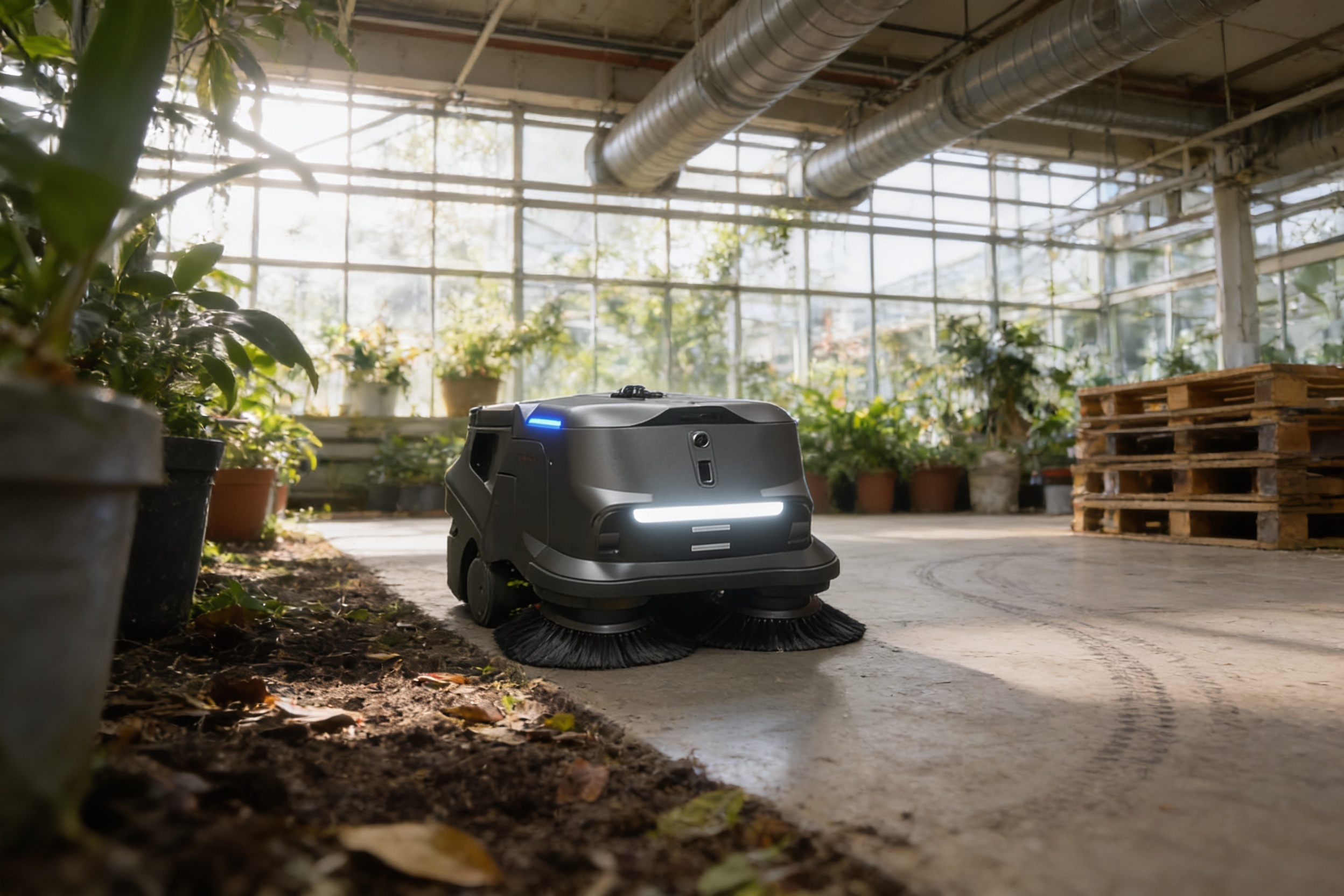
Time the work yourself before deciding. Walk the route, log the minutes for each task, and note which parts a robot can run alone. Open floor, aisles and corridors usually fit, while restrooms, stairs, glass and detailed spot work usually stay with people. The table below shows the structure of that split.
Where does the return come from, and where does it stop?
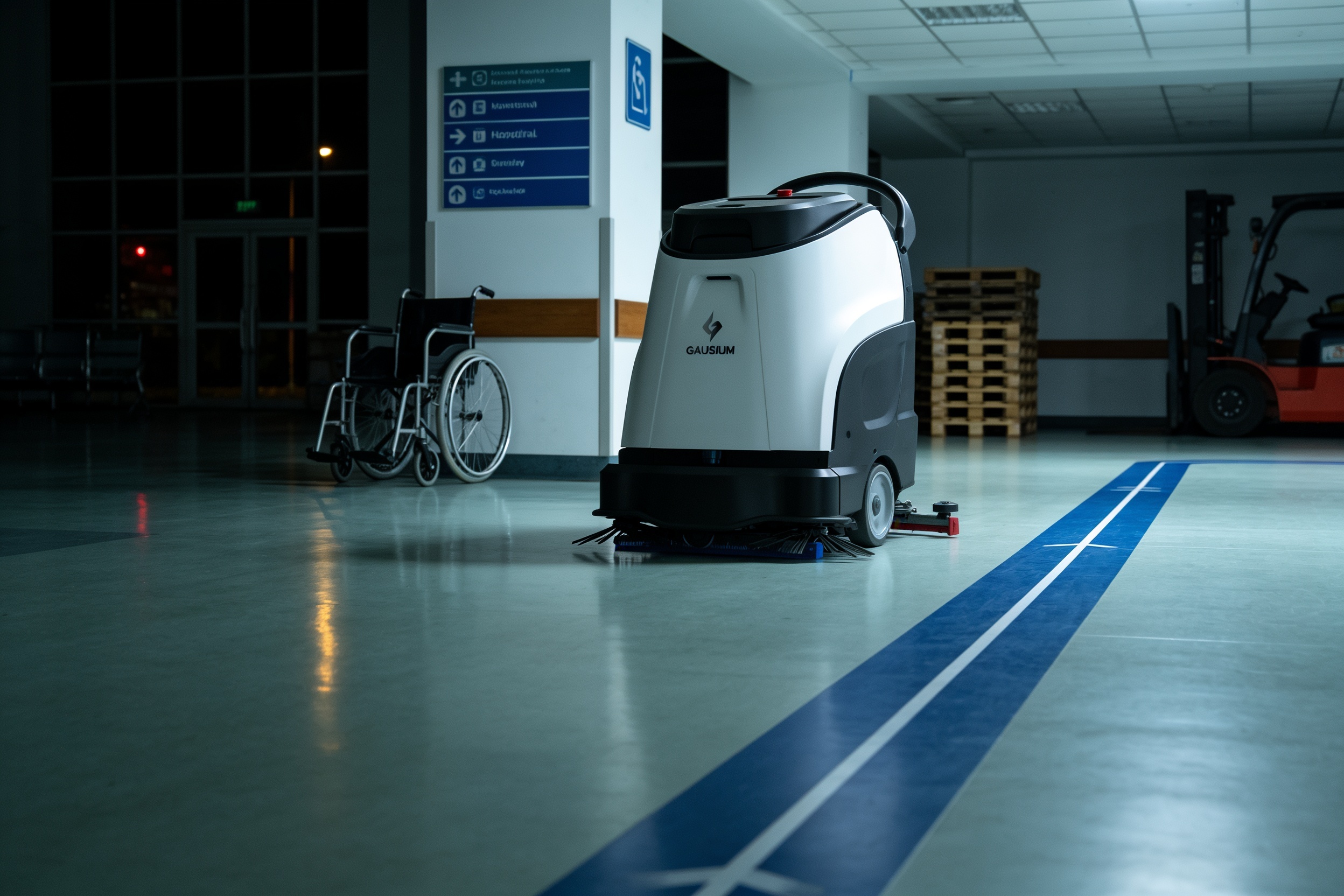
The return usually comes from work that repeats on a fixed route and can run during closed or quiet hours. Night floor care in offices, retail, warehouses and schools is the typical fit, because the robot covers open floor while the building is empty and staff focus on the tasks that need hands and judgment.
It stops where the job is detailed, varied or unpredictable. A robot does not clean a restroom, clear a jammed aisle, wipe glass or decide that a spill needs a special response. The comparison below sets out where the person still wins.
- Overnight or closed-hours floor care
Cleaning Robot
Runs a set route with no staff on the floor
Staff
Can run the same route, but off-hours shifts add labor cost and supervision
- Consistency of passes
Cleaning Robot
Same route and same pressure on every run
Staff
Varies with the worker, the day and the workload
- Open floor and aisles
Cleaning Robot
Strong fit when the route is clear
Staff
Adapts when the route is blocked
- Restrooms and sanitizing
Cleaning Robot
Not the main job, so it usually stays with staff
Staff
Handles it fully, including detail work and supplies
- Stairs, glass and spot cleaning
Cleaning Robot
Generally outside the route
Staff
Wins here: reaches, adjusts and inspects as it goes
- Obstacles and judgment calls
Cleaning Robot
Stops, or needs a staff member to clear the path
Staff
Moves items, reports the problem and decides what to do
- Coverage when a worker is out
Cleaning Robot
Runs the route regardless of attendance
Staff
Coverage depends on staffing and replacement hiring
- Cost structure
Cleaning Robot
Fixed lease payment with maintenance included
Staff
Wages, benefits and turnover costs that move with staffing
What changes the savings range up or down?
Four things move the range most: how much of the schedule is open floor on a clear route, whether staff are reassigned or still doing the same tasks, when the building is open, and how the lease term and service level are set. Each one can push the result up or down, so the range you see before a site visit is a starting point.
Check each item below before you trust any range, and make sure the assessment measures it rather than assuming it.
What are the risks to the return, and how do you avoid them?
The first risk is under-use. A route that is poorly matched to the floor, or a unit that sits idle because nobody schedules it, shrinks the hours offset while the lease payment stays fixed. Avoid it by piloting one zone, measuring the run log, and expanding only after the route works.
The second is staff handling. If supervisors and crew are not trained to clear the route, reset stops and report faults, the robot's hours do not turn into real savings. Build that training into go live, not after it.
The third is injury exposure. Janitorial services recorded a total recordable rate of 2.5 per 100 full-time equivalent workers in 2024, a days-away rate of 1.2 and a DART rate of 1.7, according to a state business resource site citing federal injury data. Less repetitive pushing can reduce some exposure, but a moving machine in a busy space is a new hazard that needs its own rules.
The fourth is adoption noise. Planned adoption of robotic floor equipment roughly doubled from 2025 to 2026, according to a vendor-sponsored press release. Rising interest is a signal, not evidence of return, so judge the machine on your own measured hours.
Downtime is the risk we handle directly. We pick the unit for the floor, train the staff, deploy and integrate it, and service it nationwide, with on-site dispatch and remote triage, so a unit that stops is our job to fix rather than yours to manage.

What is the realistic timeline from assessment to payback?
The timeline runs in stages. The free site assessment maps the floor and times the work. A lease quote follows with the fixed payment and terms. Then comes installation, integration and staff training, a pilot on one zone, and measurement of the run log against the hours you timed. Only after that does the full rollout start.
Payback is the point where the measured hours offset has covered the lease payment and any setup you agreed to. It depends on how quickly the schedule actually changes. Expect the pilot to show the true figures, because staff need time to learn the new routine and the first runs often need adjustment.
The timing is set during the assessment, not guessed in advance. Ask for a written schedule that lists each stage, who owns it, and what is measured before you move to the next one.
How do you get a precise figure from a free site assessment?
Prepare the inputs that drive the math: floor plans, floor types and any known problem areas, the existing cleaning schedule with the hours spent on each task, opening hours, and the lease term you would consider. Staff timing sheets help a great deal, and so does a list of obstacles that appear on the route.
We are a US commercial robot integrator. We pick the robot for the site, lease it through financing, deploy and integrate it, train the staff, and service it nationwide. The assessment turns the calculator range into a site-specific estimate and a fixed robot lease payment quote, with maintenance included and the terms in writing.
Use the calculator on this page to see the range for Kansas City, then request the assessment to narrow it. The narrower figure is the one to take to the people who sign off on the decision.
Frequently asked questions
Put a robot to work in Kansas City.
We walk your site, learn the job, and recommend the unit that fits. Then we quote the lease, deploy it, and keep it serviced.
Sources
- US Bureau of Labor Statistics, Occupational Employment and Wage Statistics (OEWS May 2024)
- Bureau of Labor Statistics, Occupational Outlook Handbook: Janitors and Building Cleaners
- Salary aggregator citing government wage data: Missouri janitors and cleaners, May 2024
- Census County Business Patterns figures relayed by a third-party analysis: janitorial services (NAICS 561720)
- Third-party analysis of janitorial establishment size and growth (NAICS 561720)
- State business resource site citing federal injury data: janitorial services, 2024
- AACEM and ISSA autonomous cleaning survey report (2019)
- Vendor-sponsored press release on robotic floor equipment adoption, carried by a financial news site