
The short answer
Drone ROI for water treatment plants comes mainly from inspecting tanks, clarifiers and overhead structures from the air, so crews spend less time on confined-space and fall-risk entries. The return is a range built from the hours of inspection work the drone takes over, the share of that work it realistically handles, and the lease cost quoted after a free site assessment. Interiors that cannot be drained still need entry or another method, so the savings range is a range, not a promise.
Key takeaways
- Most of the return comes from fewer confined-space and fall-risk entries, not from cutting operator headcount.
- The labor side is priced on the security guard wage in the government wage data on this page.
- Drones inspect exteriors, roofs and open tops well, but undrained tank interiors still need another method.
- The lease cost is quoted after a free site assessment, and the savings range moves with that quote.
- Minimum staffing per shift makes every avoided entry more valuable, because it keeps operators on process work.
Run the numbers for your site
Pick your city or state for a real regional number - we use the real BLS wage there. (On the live site this auto-detects from your location.)
What do you want to automate?
The unit runs the repetitive patrol and watch; guards handle the judgment calls.
Drone ROI for water treatment plants: where the return comes from
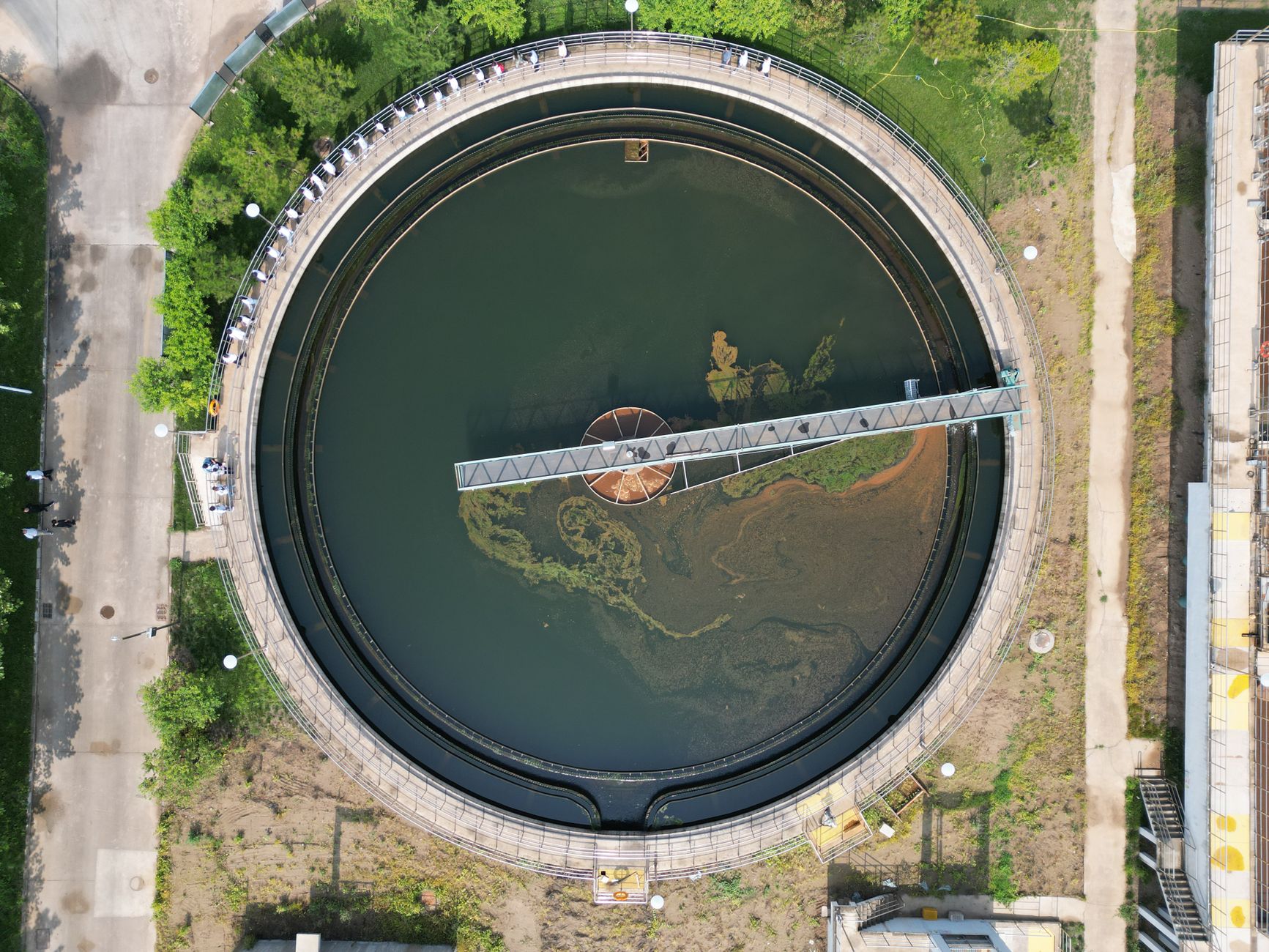
A water treatment plant has many structures that someone must look at on a schedule: clarifiers and sedimentation basins, storage tank roofs, filter gallery roofs, chemical containment, and exterior piping and walkways. Much of that looking has meant a person climbing a ladder, walking a catwalk with fall protection, or going inside a space that needs gas testing and an attendant. A drone can cover much of the exterior and open-top work from the air, and the operator reviews the images at a desk afterward.
The return on drone ROI for water treatment plants comes from three places. The first is fewer confined-space and fall-risk entries. The second is fewer hours spent on the paperwork, testing and standby that each entry requires. The third is faster first looks after weather events or a process upset, when crews want to know what changed before anyone goes in. The return does not come from removing operators. Plants run around the clock and need trained people on every shift, so the drone takes over a slice of inspection hours.
Why do confined-space entries drive the return?
Confined-space work is where most of the risk and cost sits. The BLS fact sheet on fatal injuries involving confined spaces, as reported in a secondary summary, lists 1,030 deaths from 2011 to 2018, and its tables show tank, bin and vat interiors leading the breakdown by space type. The fact sheet is titled for 2011 to 2019, but its tables cover 2011 to 2018, so check the period before quoting it internally.
Chemical exposure is part of the same picture. According to the Bureau of Labor Statistics, 37% (110) of single-episode chemical inhalation deaths from 2011 to 2017 occurred in confined spaces. An entry into a tank or vessel usually brings testing, ventilation, an attendant and a rescue plan, and any one of those can fail.
Rescue is a hazard of its own. According to NIOSH as reported by Compliance Training Online, rescuers make up about 60% of confined-space fatalities. A secondary summary also reports that about 30% of incidents occurred in spaces that had tested safe, so a clean test does not end the risk. At wastewater sites, a Canadian survey summarized in a PubMed Central article names hydrogen sulfide as the main cause of confined-space deaths.
For the ROI, the relevant cost is not the inspection flight. It is the testing, attendant, permit paperwork and standby that a person entry needs, plus the risk you carry while those steps run. Each entry you can answer from the air removes those steps from the schedule.
Median hourly wage, Security Guards
$4,317
Monthly cost of one full-time worker, at the median wage plus payroll costs (an estimate, not a quote).
How does the labor math work for a drone?

The math has three parts. Start with the hours of inspection and entry-support work the drone could take over each month. Price those hours at the local wage for this job, which here is security guard type work. Use the government wage data on this page, because a drone flight does what a security guard does on a route: it follows a set path, looks for problems, and records what needs attention.
Plant operators are a another job, so their time is not priced in this calculator. The robot takes security guard type work off their plate, such as route checks, perimeter looks and surface inspections, so operators can stay on process control and on the entries that still need them.
The second part is the share of work the drone realistically takes. A drone will not inspect every tank, every interior or every corner of a clarifier. The realistic share is the hours the drone can complete without an entry, measured on your site during a trial. Expect that share to be smaller than total inspection time, because some tasks will still need a person.
The third part is lease cost. Robots are leased through financing, and the payment is a fixed robot lease payment quoted after a free site assessment. The calculator's savings range nets that lease cost against the labor hours offset, so the range shows what remains after the cost.
Which tanks and structures can a drone inspect, and which still need entry?
Drones do best on what can be seen from outside or from above: roofs, open-top clarifiers, the surface of basins, exterior walls and piping, and the tops of storage tanks. Flights go faster when the operator can plan a route in advance and fly the same path on a schedule, which also makes images comparable from one visit to the next.
The limits are practical. Tanks that cannot be drained, or where draining threatens supply continuity, still need an interior check by another method. That method may be a person entering under permit, or a remotely operated underwater vehicle for some vessels. Plan these structures as entries that remain, not as drone work.
Ask the assessor to mark each structure with three things: whether it can be drained, how often it is inspected today, and what the inspection requires in people and time right now. That list shows which structures move to the air and which keep their entries.
What do the staffing numbers say about the return?
Staffing is the reason each avoided entry matters. A WaterWorld summary of job outlook for plant operators cites a projected 6.5% decline in employment from 2024 to 2034, with about 10,700 openings a year. That figure comes from a secondary report and was not checked against the government's own tables, so confirm it before using it in a board paper.
Minimum staffing is set by plant design and local policy. A Paris, Texas staffing study recommends at least two operators per shift for backup, and a city council document from 2003 states that fewer than two per shift cannot reliably ensure a safe supply. Those are local figures, so check your own permit and minimum before assuming the same number applies.
For the ROI, the point is not that a drone reduces headcount. When a shift is already at its minimum, every entry pulls a person off process work. A drone that handles inspection flights and surface checks keeps operators on the plant, which is a value that rarely shows up on a timesheet.
What changes the number up or down?
Three factors move the range most: how much of the inspection work is exterior or open-top, how often the structures are inspected, and how many entries you can actually avoid. Plants with many open clarifiers and easy roof access tend to move more hours to the air than plants with many undrained, enclosed vessels. Frequency multiplies everything, since a weekly flight and a monthly flight produce very different annual totals.
Site conditions change the quote. A site assessment checks airspace and flight rules near the plant, the number of tall structures in the flight area, power and route needs, and whether your data rules allow images to be stored and shared. Those answers change both the realistic share and the lease cost, so an early number from a web calculator is only a starting point.
Staffing minimums push the number up when shifts are tight, because an avoided entry frees a person who would otherwise be pulled off process work. Weather and seasonal access push it down when flights are often grounded, because the planned work does not get done on those days.
What risks can cut the return, and how do you avoid them?
The most common risk is overestimating the share of work the drone can do. Teams that assume every inspection moves to the air keep the same entries and find the savings range shrinks. Avoid this by running a trial on a set of structures and measuring which hours actually move.
A second risk is an image pipeline nobody owns. Flights that produce images stored in a folder save nothing. Name the reviewer, set a review frequency, and decide how findings reach the work order system. Without that loop the labor offset never appears in the numbers.
A third risk is downtime. A drone waiting on a battery, a part or a software fix does not inspect anything, and a missed flight can mean an entry you were trying to avoid. Plan for spare capacity in the lease, and ask how fast a failed unit is replaced and how remote triage works before a fault reaches the field.
Be skeptical of vendor numbers. A vendor-written UK case study describes one drone pilot replacing a larger crew, and other vendor material claims large cost cuts per tank or per meter of pipe. The research behind this page did not verify those claims against government data, so treat them as tests to run on your own site.
How common are drones at utilities right now?
Adoption is still early. According to Electric Energy Online, in an April 2025 survey covering utilities in general, about 11% of respondents said their companies use drones.
That share is low, so a plant that adopts now is not behind most peers, but it is also not following a settled industry standard. For the return, adoption matters less than whether your inspection hours and entries match the pattern described here. Compare your own numbers, not the industry average.
What is a realistic timeline from assessment to payback?
The sequence usually starts with a site assessment. That step maps the structures, counts the entries, checks airspace and sets the scope. A lease quote follows once the scope is clear. Deployment and integration come next, then staff training and go live support.
Payback depends on the hours the trial moves and on how quickly the drone runs on a regular schedule. We do not give a fixed timeline here because it depends on your site, permitting and the inspection frequency you choose. Ask for the timeline in the quote, broken into assessment, setup, a trial period and the full schedule.
A trial on a small group of structures shows whether the savings range holds on your plant before the full schedule starts. Measure the entries avoided, the hours moved and the number of images that get reviewed and acted on. Those three numbers tell you more than any early estimate.
How do you get a precise figure from a free site assessment?
Ask for a free site assessment. We are a US commercial robot integrator. We pick the right robot for the site, lease it through financing, deploy and integrate it, train the staff and service it nationwide. The assessment produces the lease quote, the scope and the hours that realistically move.
Bring the inputs the calculator needs. List the tanks and structures with drain status, the inspection frequency, the entries per year today and the steps each entry takes, including permit, testing and standby. Add the staffing minimum per shift from your permit. With those inputs the savings range narrows to your plant, not to a typical one.
Read the result as a range. Ask the assessor which assumptions drive the top and the bottom, and which ones you can test in the trial before you commit. A range that holds up under those questions is worth more than a single figure.
Frequently asked questions
Want a drone at your water treatment plant?
Tell us about your site. We will recommend the robot, quote the lease, and keep it serviced.
Sources
- US Bureau of Labor Statistics, Occupational Employment and Wage Statistics (OEWS May 2024)
- U.S. Bureau of Labor Statistics, fatal injuries involving confined spaces fact sheet
- U.S. Bureau of Labor Statistics, TED: fatal chemical inhalations in the workplace
- Compliance Training Online, confined space incidents and statistics
- PubMed Central, Canadian confined-space survey article
- WaterWorld, job outlook for plant operators
- City of Paris, Texas, staffing document
- Electric Energy Online, drones article (April 2025 survey)
- Vendor-written case study of a UK Environment Agency culvert survey