
The short answer
Cleaning robot ROI for convention centers comes from taking the hard floor scrubbing and aisle passes that must be finished between events off the night crew, so halls are ready for the next move in without pulling staff from other work. The return is a savings range, not a promise, and it depends on the floor area, the share of janitorial hours the robot can realistically take, and the lease payment quoted for your site. A free site assessment turns that range into a figure built from your own floor plans and event calendar.
Key takeaways
- Overnight scrubbing between events is where a convention center's return is easiest to see.
- The savings range depends on the share of janitorial hours the robot realistically takes, not on the floor area alone.
- Convention halls are large, so the number of overnight passes per week matters as much as the speed of the machine.
- Injury data for janitors and cleaners points to manual scrubbing as a real risk worth reducing.
- The lease payment is quoted only after a free site assessment of your halls.
Run the numbers for your site
Pick your city or state for a real regional number - we use the real BLS wage there. (On the live site this auto-detects from your location.)
What do you want to automate?
The robot runs the open floor overnight; your crew keeps detail and edges.
What return can a convention center expect from a cleaning robot?
A cleaning robot ROI for convention centers rests on one thing: floor work that has to be finished between events gets done overnight, on a fixed schedule, without a crew working the hall. Most of the return shows up as janitorial hours moved off the night shift, plus halls that open on time after teardown. It does not come from cutting event staff who handle guest services, rigging and setup.
The return is a range. Its size depends on the floor area, how much of the scrubbing and sweeping the robot can cover on each run, how many hours the existing cleaning process takes, and the fixed lease payment quoted for your site. The sections below explain each part so you can test the math against your own building rather than a generic benchmark.
Why do convention halls suit overnight floor scrubbing?
Scale is the first reason. According to WorldAtlas, nine US convention centers have at least 1 million square feet of exhibit space, and the largest of them is in Chicago. WorldAtlas gives that largest venue 2.6 million square feet in total, while Trade Show Executive counts 1.1 million square feet of prime exhibit space for it, so the definition you use changes the number. WorldAtlas also lists one Las Vegas venue at five halls totaling 1,035,600 square feet, and a California venue at 813,607 square feet of event space across five halls.
Trade Show Executive's directory covers the 298 largest convention centers in North America by prime exhibit space, and it defines midsized venues as 125,000 to 349,999 square feet. Even the smaller end of that band gives a crew a long night of hard floor work after each show. Building Design + Construction, in an opinion piece, reports that US convention space grew 50 percent over 20 years and that 44 new convention spaces have been planned or built since 2005. More floor means more overnight passes to schedule, and the same floor has to be ready for the next move in on a fixed date.
Median hourly wage, Janitors and Building Cleaners
$4,041
Monthly cost of one full-time worker, at the median wage plus payroll costs (an estimate, not a quote).
Where does the return actually come from?
There are three sources. The first is janitorial hours that now fall on the night shift. The labor side is priced on the work of janitors and building cleaners, which means scrubbing, sweeping and aisle passes. The government wage data on this page gives the local wage for that job, and the calculation multiplies it by the hours the robot takes over, not by headcount.
The second source is timing. A hall that is ready in the early morning rather than at midday spares the exhibitor build crew from waiting on a dirty floor, and that schedule value is real even though it is hard to place in a table. The third is consistency. Scrubbing on the same route every night gives the same passes every time, which matters on heavily trafficked floors and on the carpet and hard floor areas that convention center bids often price per square foot, according to CMM Online, which notes that local labor rates, equipment and chemicals also move the price.

How does the savings math work?
The calculation is simple to state. Start with the hours per night that the janitorial work takes across the halls you want covered. Multiply that by the share of those hours the robot can realistically take, which is always less than the whole, because edges, corners, stairs and any area a person must stage or check still need hands. Convert those hours into cost using the local wage for the job from the government wage data on this page, add the value of schedule gains, then subtract the fixed lease payment and any staff time still needed for setup and checks.
The result is a savings range rather than one number, and the low end matters most when someone signs off. The lower bound assumes a modest share of hours taken and a fair amount of supervision. The upper bound assumes more of the floor is open and routine. The site assessment narrows that range using the actual floor plan, the event calendar and the existing cleaning schedule, so the number you review is built from your records rather than an average.
| Task | Today | With a robot |
|---|---|---|
| Scrub open hard floors in the main hall | Measured on the night shift at site assessment | Run on a fixed route, checked at start and end |
| Sweep and scrub concourse corridors | Staff time on passes between event turns | Scheduled passes between event turns |
| Edge, corner and stair work | Handled by staff with hand tools | Still handled by staff, not the robot |
| Route setup after a layout change | Usually not tracked separately | A short planning step, timed at site assessment |
| Overnight checks and reporting | Walkthroughs by a supervisor | Run logs reviewed, walkthroughs kept for edges |
No hour figures on this table come from a published source. Each today value is measured on your floor at site assessment, and the share the robot takes is set from that measurement.
What changes the number up or down?
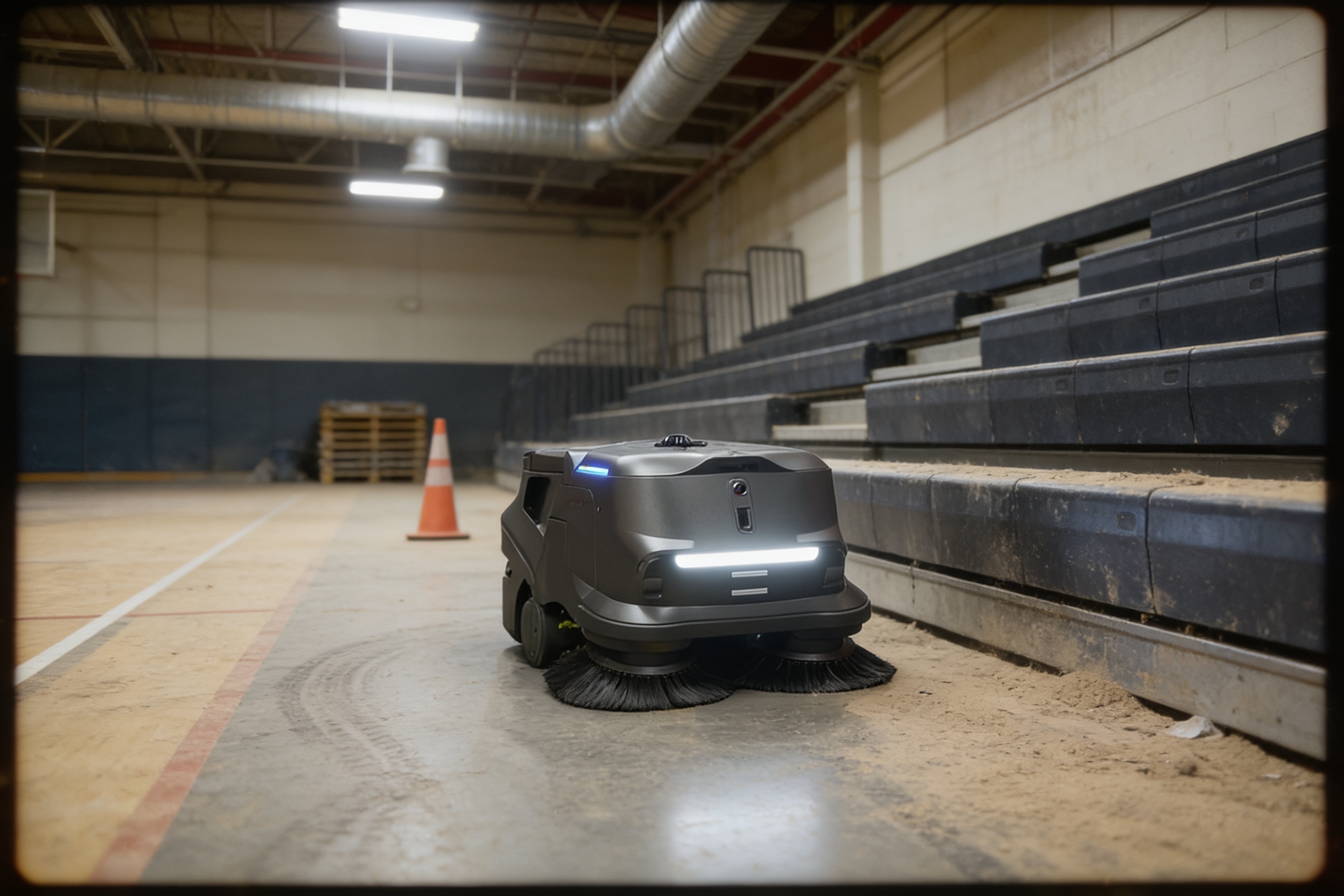
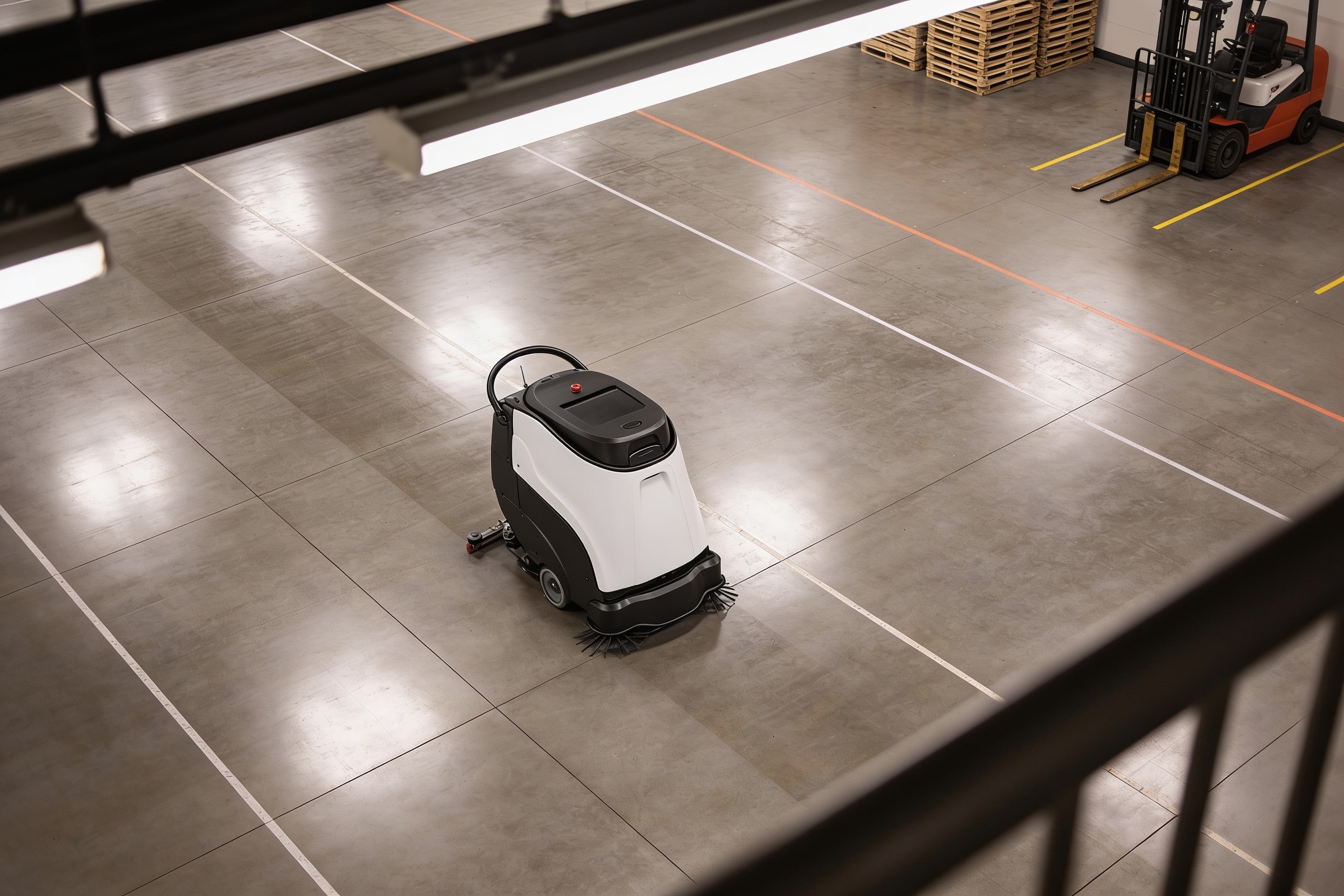
Floor layout moves the number first. Open halls with few obstacles let the robot run long, uninterrupted passes. Heavy carpet, many columns and frequent temporary staging reduce the share the robot can take. Event turnover matters too. A venue with many turns each week gets more overnight passes, while one with long gaps between shows gets fewer, so utilization follows the calendar.
Staffing levels set what the labor offset is worth. The Bureau of Labor Statistics projects a 2 percent change in employment for janitors and building cleaners from 2024 to 2034, which is slower than average, so the hours you carry today are the ones that matter for your decision, not a national trend. Use the checklist below before you commit to a range.
What are the risks to the return, and how do you avoid them?
The biggest risk is overestimating the share of hours taken. If layouts change every week, route planning takes time, and a robot that stops at every temporary stand returns less than a simple calculation suggests. Plan routes around a stable floor base and keep temporary staging on a defined path. The second risk is an idle unit. A robot that sits between shows does not earn its keep, so schedule runs for every overnight block the venue actually uses, not only the large shows.
The third risk is injury exposure. According to BLS injury data for janitors and cleaners, except maids and housekeeping cleaners, the category recorded 21,100 nonfatal injury and illness cases with days away from work in 2020, a rate of 191.6 per 10,000 full-time equivalent workers in private industry. The same category recorded 42 fatal work injuries in 2020, down from 45 in 2019. Reducing heavy, repetitive scrubbing is a legitimate safety argument, but it should be verified on your own floors rather than assumed. The most recent rate in this review is from 2020, so check newer BLS releases before you present the figure internally.
What is a realistic timeline from assessment to payback?
Expect the process to run in stages. Assessment and mapping come first, covering the floor plan, obstacles, the event calendar and the existing cleaning schedule. Next comes a route build and a short supervised trial across several overnight blocks, so you see real results before committing to the full run. Training for the crew that remains happens during this window as well, so the people who check routes and handle edges know the system before the first full schedule runs.
After go live, the first few weeks reveal the true share of hours taken, and that is when the payback estimate firms up. Payback depends on the lease term, the share of hours taken and the number of halls covered, so it is best read as a window rather than a fixed date. A venue that plans for a trial period and reviews its run logs at the end of each month is in a much better position to judge the number, and to decide whether to add a second unit for the largest halls.
How do I get a precise figure from a free site assessment?
We are a US commercial robot integrator. We select the right robot for the site, lease it through financing, deploy and integrate it, train staff and service it nationwide. The free site assessment is where a precise figure comes from. We map the halls, record the overnight window, measure the janitorial hours your team spends and confirm the share the robot can take. The lease is quoted after that assessment, so the payment reflects your building rather than a template.
To prepare, gather floor plans for each hall, the event calendar for the coming season, the scrubbing and sweeping schedule you run today, and notes on which areas are carpet and which are hard floor. Those four items let the assessment give a range you can test against your own records. Ask for the route plan, the trial terms and the service plan in writing, including what happens when a unit needs repair the night before a show.
How many people do this work at a convention center?
Convention centers rarely keep large permanent cleaning crews, and their staffing shifts with event load. No published count of cleaning staff at one convention center was found for this page, so the typical headcount field is set to the minimum of one until your own roster is entered at assessment.
The Bureau of Labor Statistics counts about 2.45 million people in the janitors and building cleaners occupation in 2024 and projects about 351,300 openings a year on average, mostly from replacement. A janitorial trade blog says janitorial turnover runs above construction, education and retail, but it does not source that claim, so treat it as directional. High turnover means the night crew is often new, and a schedule that depends on experienced hands carries real risk. The robot takes the janitors and building cleaners type of work off the crew, while event and guest services staff keep their own duties.
Frequently asked questions
Want a cleaning robot at your convention center?
Tell us about your site. We will recommend the robot, quote the lease, and keep it serviced.
Sources
- US Bureau of Labor Statistics, Occupational Employment and Wage Statistics (OEWS May 2024)
- WorldAtlas, the largest convention centers in the United States
- Trade Show Executive, World's Top Convention Centers directory preview
- Building Design + Construction, It is time to stop building convention centers
- BLS Occupational Outlook Handbook, Janitors and Building Cleaners
- BLS injury and illness snapshot, janitors and cleaners, 2020
- BLS injury and illness snapshot, janitors 2015 to 2019
- CMM Online, bidding and estimating convention centers
- Janitorial Manager, ways the janitorial industry turnover rate has changed